In November 2025, Google did something it had been signaling for over a year: it officially retired the Product Reviews Update as a standalone update system. The criteria didn't go away. The Google documentation that outlined what good product reviews look like — original photos, specific product details, disclosed testing methodology, genuine alternatives consideration — that all stayed. What changed is the mechanism. Product review quality is now evaluated continuously as part of core ranking, not periodically through dedicated update cycles.
For affiliate publishers, this is a bigger operational shift than it sounds. Here's what I've been observing across the dozen or so affiliate-heavy sites I work with, eight months into the new regime.
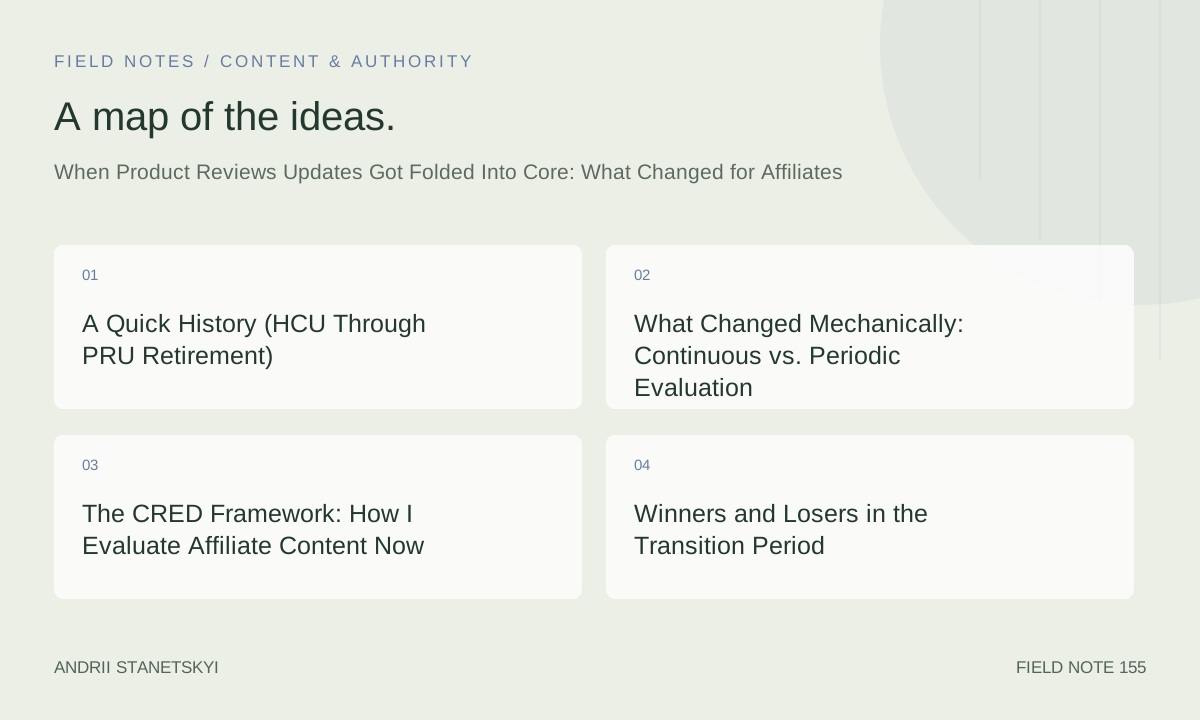
A Quick History (HCU Through PRU Retirement)
The 2024 Helpful Content Update hit a wide swath of affiliate sites — thin reviews, comparison-without-testing pages, "best of" lists assembled from manufacturer specs. Sites that had coasted on decent domain authority and low-competition affiliate niches got reset. That context matters for understanding where affiliate publishers were when the PRU retirement happened.
Between the HCU era and November 2025, there were three standalone Product Reviews Updates. Each one refined Google's ability to identify reviews that contained genuine testing evidence versus reviews that summarized publicly available product information while cosplaying as hands-on testing. Each one moved the floor up — what had been passable in 2022 was penalized by 2024.
By the time Google announced the retirement, the criteria were mature enough, and Google's ability to apply them continuous enough, that a separate update cycle had become largely redundant. The work that periodic PRUs had been doing was now baked into the ongoing quality evaluation.
What Changed Mechanically: Continuous vs. Periodic Evaluation
This is the part most coverage of the retirement got wrong or glossed over.
Under the periodic PRU system, your site's product review quality was meaningfully reassessed at the update cycle — roughly every few months. Between cycles, rankings were relatively stable from a review-quality standpoint (other things affecting rankings notwithstanding). This created a predictable cadence: sites would make improvements, then wait for the next PRU to see if those improvements translated to ranking changes.
Continuous evaluation doesn't work that way. Google's quality signals are applied to pages on a more rolling basis, tied to crawl frequency and processing schedules rather than a defined update cycle. This means improvements can show up faster — but it also means deterioration can show up faster.
In practice, I've seen both. A client who substantially improved their review methodology in January 2026 — adding a standardized testing protocol, original lab photos, and quantitative comparison tables — saw ranking improvements begin appearing in GSC data within six weeks, without waiting for a named update. Before the PRU system retired, I'd have told them to expect three to five months minimum before a PRU cycle would surface those improvements.
On the downside: a client who let several review pages go stale — their "best air purifiers" guide still referenced two discontinued models with no update note as of early 2026 — started losing rankings on those pages incrementally, without a named update event to point to. The quality signal was being assessed more frequently, and the stale content was being caught more frequently.
The CRED Framework: How I Evaluate Affiliate Content Now
I needed a way to audit affiliate pages against the integrated product review criteria that could be applied consistently across different content types — electronics, home goods, software, physical consumables. This is what I use now.
CRED:
- C — Criteria specificity: Does the review evaluate the product against specific, measurable criteria? Not just "build quality feels good" but "the hinge mechanism resisted 2,000 open-close cycles in our test without loosening." The more specific the evaluation criteria, the higher the score.
- R — Reproducibility signals: Could another person replicate the testing described? Does the review explain what conditions were used, how long the test ran, what comparison baseline was used?
- E — Evidence of hands-on contact: Original photographs, video, specific observations that couldn't come from a spec sheet. Noticing that a product's fan noise increases under sustained load, or that a cutting board develops knife marks faster than a competitor's — these are the details that only come from actual use.
- D — Drawbacks disclosed: Does the review mention real product weaknesses, not just generic "it's expensive" or "the app could be better"? Genuine drawbacks — specific, product-specific, sometimes deal-breaking — are one of the strongest signals that the reviewer actually used the product.
A CRED score of 4 (one point per category, genuinely satisfied) correlates strongly with what Google's current systems appear to reward. A score of 2 or below is a page I recommend restructuring before the next quality signal assessment catches it.
Winners and Losers in the Transition Period
Sites That Benefited From Consolidation
The clearest winners are sites that were doing genuine review work but had been undervalued by the PRU system's timing. If a site published an excellent, well-evidenced review in November 2024 and the next PRU wasn't until March 2025, that site was essentially waiting four months to be rewarded. Under continuous evaluation, the same improvements now surface faster.
I have a client — a pet supply affiliate — who completely rebuilt their testing methodology in Q4 2025 specifically because I told them the PRU consolidation was coming and that improvements would register faster afterward. They built a standardized 30-day product trial protocol, started photographing products against a calibrated background, and added a dedicated "Testing Methodology" section to their review template. By March 2026, their top 20 review pages had gained an average of 3.7 positions. Timing was part of it — but the improvement registered faster than it would have under the old system.
A second category of winners: sites that had been borderline strong enough to avoid PRU penalties but were competing against sites that were skating by. When continuous evaluation replaced periodic assessment, the consistency advantage shifted toward sites with uniformly strong review quality. Competitors who had managed to dodge specific PRU cycles — not by being good but by flying under the radar at the right moment — found the rolling assessment less forgiving.
Sites That Lost the Update Cycle Buffer
The periodic PRU cycle created a natural buffer. If your review quality was decent but not excellent, you might survive several update cycles in a row — particularly if your strongest competitors were also imperfect. The update would move the worst offenders and leave the borderline-fine sites alone.
Continuous evaluation erodes that buffer. Sites that were "good enough for now, we'll improve before the next PRU" no longer have that clearly defined deadline. The rolling nature of the assessment means the competitive gap between your content and better content is visible to Google's systems more consistently, not just at defined moments.
Two specific client situations illustrate this. First: an outdoor gear affiliate that had survived every PRU since 2022 without major damage. Their reviews were competent — they mentioned real product details, occasionally had original photos, disclosed Amazon affiliate relationships properly. Not excellent, but not penalized. Between November 2025 and March 2026, without any named update hitting them specifically, they lost 23% of organic traffic incrementally. No single drop. Just slow erosion, week over week. The continuous quality signal had found the gap between their content and better-optimized competitors.
Second: a kitchen appliance affiliate that had been putting off a major content audit for "after the next PRU." They were waiting to see what the update would hit before deciding where to invest. That strategy no longer makes sense. There is no discrete next PRU. The assessment is ongoing.
| Date | Event | Key Focus |
|---|---|---|
| April 2021 | First Product Reviews Update | Thin reviews rewarding own products; affiliate-only coverage without testing |
| 2022–2023 | Multiple PRU iterations | Increasing specificity requirements; original assets; alternatives consideration |
| Late 2024 | PRU signals increasingly integrated with HCU-era quality assessment | Product review quality evaluated more continuously between named updates |
| August 2025 | Last standalone Product Reviews Update | Final discrete PRU cycle |
| November 2025 | Google announces PRU consolidation into core | PRU criteria now part of continuous core ranking evaluation |
| Q1 2026 | First full quarter under continuous review evaluation | Sites see rolling quality signal changes; January spam update intersects |
| March 2026 | March 2026 Core Update | Product review quality signals apply as part of broader quality reassessment |
| May 2026 (current) | Six months into continuous evaluation regime | Pattern of faster improvement and faster deterioration now visible |
What Product Review Signals Actually Still Work in 2026
The criteria haven't changed. What changed is how consistently they're applied. So the question of "what works" is the same as it was under the PRU system — but the urgency of applying it is higher.
Original visual assets remain one of the strongest signals. Not stock photography from the manufacturer's press kit. Photographs and video that could only have been taken by someone who had the product in their possession. The specific lighting condition of a real kitchen. The worn pattern on a shoe after 200 miles. The battery percentage at hour 8 of a laptop test.
Specific quantitative data from real testing. If you review a coffee grinder, "the grind is consistent" is a claim. "At setting 20 for espresso, our particle size distribution measured between 200–280 microns with a standard deviation of 31 microns across five pulls" is evidence. Most affiliate sites aren't doing testing at this level, and don't need to — but the principle scales down. Specific observations at any level of precision are better than vague positive assessments.
Genuine drawbacks with specificity. The disclosure of product weaknesses is so strongly correlated with actual testing that Google's quality systems appear to treat it as a quality signal. A review that says "the handle feels plasticky" is marginally better than nothing. A review that says "the handle's friction fit loosened after about three months of daily use, and by month four required firm lateral pressure to prevent rotation during cutting" is demonstrably first-hand.
Alternatives considered. Not "see also our review of X" but genuine comparison logic: "if you primarily care about Y, this product is better; if Z matters more to you, consider W instead." Routing users toward a different product when it's the right call for their needs is something a genuine reviewer does and a commission-maximizing affiliate avoids. Google appears to understand this.
See also: Google's product reviews documentation, which remained in place after the PRU consolidation and reflects the criteria now applied continuously.
Two Things the Affiliate SEO Community Is Wrong About
Contrarian take 1: The PRU consolidation is bad news for all affiliates. It isn't.
The framing that dominated affiliate SEO forums in late 2025 was that consolidation meant Google was "coming for" affiliate content more aggressively. The fear was that without the defined update cycle structure, affiliates would be under constant attack.
That's not the right frame. If your content is genuinely good — actually tested, specifically observed, honestly assessed — the continuous evaluation system is better for you than the periodic one. Your improvements show up faster. Your quality advantage over competitors with worse content is captured more consistently. The periodic system meant your excellent content could be undervalued for months between cycles. The continuous system rewards it more reliably.
The consolidation is bad for mediocre affiliate content that was surviving on the timing luck of periodic cycles. It's neutral-to-good for excellent affiliate content. If you're treating the consolidation as a threat, it might be worth asking whether your content is as good as you think it is.
Contrarian take 2: "Testing methodology" pages are not sufficient.
The advice that circulated heavily after the PRU consolidation announcement was "add a testing methodology page to your site." The idea: document how you test products, link to it from reviews, signal to Google that you have a process.
The problem: a testing methodology page that describes a rigorous process, followed by reviews that don't contain specific evidence of that process having been applied, is worse than no methodology page at all. It's a quality signal that's contradicted by the content it's supposed to support.
Methodology pages work when the reviews themselves contain specific observations that could only come from following that methodology. The page is context, not a substitute. I've seen three affiliate sites add methodology pages in early 2026 without improving the reviews themselves, and two of them saw no ranking improvement. One saw a small positive movement that I'd attribute to a coinciding content refresh rather than the methodology page specifically.
Write the methodology page if you have a real methodology to document. Fix the reviews first.
The Strategic Shift This Requires
The most important operational change for affiliate publishers post-consolidation: stop managing review quality as a pre-update sprint and start managing it as an ongoing operational standard.
Under the PRU system, the rational strategy was to batch improvements before anticipated update cycles. Maintain a watchlist of underperforming reviews, improve them in the two to three months before the next expected PRU, see if they recover. If not, repeat for the following cycle. This was genuinely the sensible approach given how the system worked.
That approach doesn't fit the continuous evaluation model. Batching improvements to pre-update windows no longer makes sense when there are no defined windows. What replaces it is a rolling quality monitoring process — regular audits of your top review pages against your CRED criteria (or whatever framework you use), with improvements made on a continuous basis rather than in periodic sprints.
The other strategic shift: content maintenance is now as important as content creation. A well-researched review published in 2024 that hasn't been updated when the product has had significant revisions — or when a better alternative has entered the market — is a depreciating asset. Under the periodic PRU system, you might get away with stale content for one or two cycles before it cost you rankings. Under continuous evaluation, the staleness is caught more consistently.
Related reading: The March 2026 Core Update forensics for how quality signals applied across the board in March — product review quality was evaluated as part of that broader reassessment. And if your affiliate site runs significant volume of review content and you're concerned about AI Overviews eating your traffic, the CTR impact data across 47 sites is directly relevant to setting realistic traffic targets for review query categories.
Also relevant: the January 2026 Spam Update analysis — several affiliate sites that use hub-and-spoke structures or scaled content production got hit in January, setting up compounding damage when March arrived.
Eight months into continuous product review evaluation, the data I have suggests the change has been net positive for sites doing genuine work and net negative for sites that were timing the old periodic system. The criteria are the same. The stakes feel different because there's no longer a defined window where the score resets. That's probably the point.