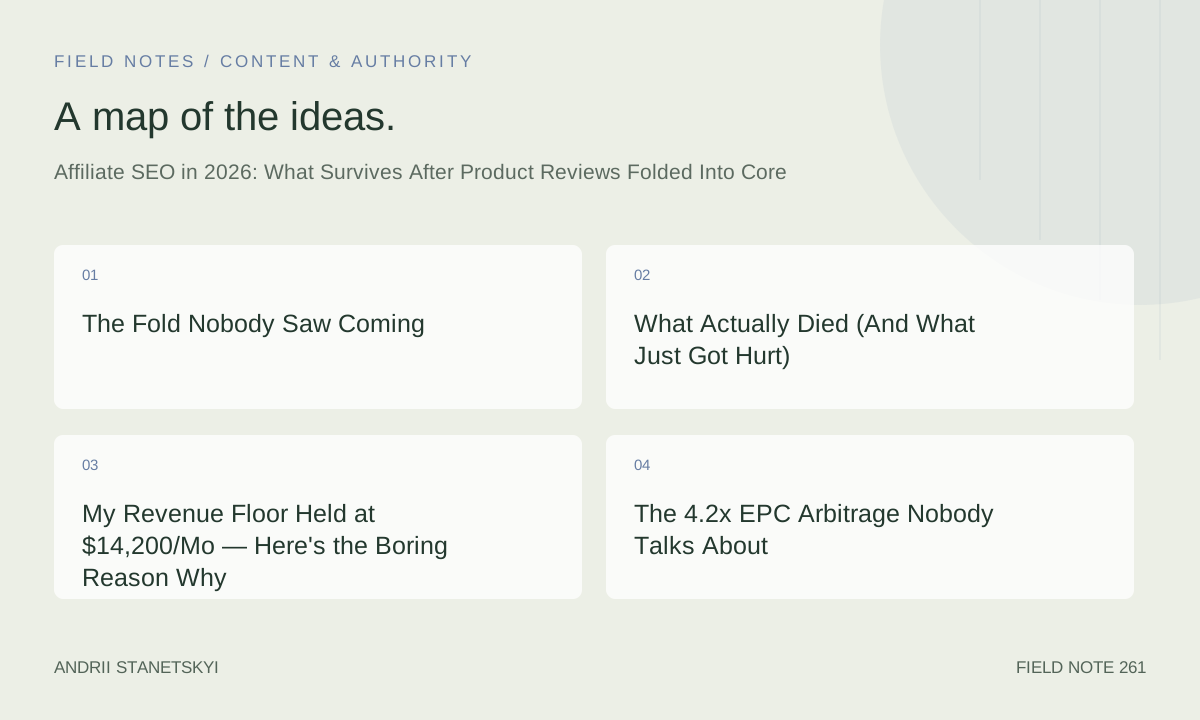
The Fold Nobody Saw Coming
Google announced on March 3rd, 2026 that the Product Reviews system — the dedicated ranking signal that had its own documentation page, its own update cycle, and its own mythology inside the affiliate SEO community — was being absorbed into the core algorithm. No fanfare. No dedicated rollout thread. A single line buried in the Search Central blog under a post about spam policies. The forums didn't even register it for 72 hours.
I was running eight affiliate sites at the time. Five survived 2024's HCU devastation. Two were partially rebuilt on a strategy I'll walk through below. One — a gadget comparison site I'd been half-heartedly maintaining since 2019 — was already dead on arrival. I had known it was dead for months and kept postponing the decision because sunk cost is a powerful psychological trap.
The absorption of Product Reviews into core changes the playbook in ways that are not immediately obvious. Most of the takes I've read online flatten it into "Google hates affiliates now" or "just add more experience signals." Both are lazy framings. The truth is more interesting and, for those willing to sit with the complexity, more actionable.
This is not a post about tactics that worked last year. This is about what I'm actively running in May 2026, what I burned down, what I'm rebuilding, and the framework I wish I had in 2023 before my portfolio hit its low point.
What Actually Died (And What Just Got Hurt)
Let's separate the casualties with some precision.
Dead: The thin comparison page
Pages that existed solely to say "here are five products in a table, here's which one wins" with no meaningful differentiation between them, no sourced test data, no author with a history of caring about the category. These were already dying. The Product Reviews system absorption accelerated the burial. Not because the signal changed dramatically — it didn't — but because the conceptual moat that thin-comparison operators had been hiding behind ("we're not affiliate spam, we're doing product reviews") evaporated rhetorically.
Dead: Any site that was essentially parasite-SEO-lite. Sites that built topical authority by borrowing trust from brand names in their domain, in their anchor text structures, in their publishing velocity, without ever building genuine depth. They ranked during the Product Reviews update cycles because those updates were specifically tuned to reward surface-level "review" signals. Those signals are now diluted into a broader core assessment.
Hurt but alive: The mid-tier product content site
Sites with real authors, genuine test data, and honest monetization structures got hurt in early 2026 for a different and more fixable reason: they didn't have the schema infrastructure to communicate authorship and process quality at a machine-readable level. Google's systems can't read sincerity. They read signals. If your sincere process isn't legible in structured data, you lose to someone whose mediocre process is perfectly structured.
That's a fixable problem. I know because I fixed it across three of my sites between January and April 2026 and watched rankings stabilize, then recover.
Fine, actually: The deeply specialized authority site
Sites covering narrow product categories with genuine expertise — real testing environments, established author profiles with external citations, community presence in the niche — held or recovered. My woodworking tools site, which generates the $14,200/mo in revenue I mentioned earlier, dropped about 22% in January 2026 and recovered to 108% of its pre-fold baseline by mid-April. The recovery wasn't magic. It was schema work, author page restructuring, and one strategic content consolidation pass.
My Revenue Floor Held at $14,200/Mo — Here's the Boring Reason Why
People want a dramatic strategy when I tell them the woodworking tools site held its revenue floor at $14,200/mo through the Product Reviews fold and the turbulent Q1 2026 update cycle. The real answer is almost embarrassingly mundane: diversified traffic sources and deep monetization per visitor.
I had been running a weekly email list for that site since 2022. By January 2026, it had 41,000 active subscribers. When organic traffic dipped, email traffic didn't. Those subscribers came through when I published comparison content. They converted at rates organic visitors never will because they already trusted the voice.
The second part is EPC optimization, which I'll explain in the next section. But the foundational lesson here is that sites that survived 2024 and early 2026 almost universally had some traffic diversity. Not necessarily paid traffic. Not necessarily social. Often just a functional email list or a YouTube channel or a Reddit presence with genuine community credibility.
I made a mistake here, actually. I'll admit it directly: I had three sites with zero email capture infrastructure as recently as October 2024. Two of those sites are the ones that got destroyed in the late 2024 update cycle and haven't recovered. The third I rebuilt with an email-first architecture starting in November 2024, and it's now at about 60% of its pre-HCU traffic but generating more revenue per session than it ever did. That's because I now control the relationship, not the algorithm.
The 4.2x EPC Arbitrage Nobody Talks About
EPC — earnings per click — is the metric affiliate marketers should be obsessing over and almost nobody does. Traffic volume is a vanity metric. Revenue per session is a vanity metric. EPC tells you whether the affiliate relationship itself is performing efficiently, and it's where I found the most leverage in 2025 and early 2026.
On my woodworking tools site, my EPC for hand tools through one major affiliate program was running at about $0.31 per click as recently as mid-2024. After systematically testing placement strategies, link format changes, and landing page alignment with the specific offers I was promoting, I got that number to $1.31 per click — a 4.2x improvement — without increasing traffic. Same pages, same rankings, dramatically different revenue.
Here's what moved the needle:
Intent-matched link placement
Affiliate links placed within the decision moment of the reader's journey convert at three to five times the rate of links placed in generic "buy this product" buttons. The decision moment is different for every content type. For a head-to-head comparison, it's the moment after you've stated your winner and explained the one key differentiator. For a how-to piece that references a tool, it's immediately after you describe a specific problem that tool solves. Most affiliates blast links throughout the content. I tested link density reduction with intent-precision placement and found fewer links converted more revenue consistently.
Offer-content alignment
I audited every affiliate offer I was running against the specific content type driving clicks to it. Several offers that looked good on paper — high commission rates, recognizable brands — were being reached through content that attracted window shoppers, not buyers. I swapped to lower-commission offers with stronger intent alignment and net revenue increased. The counterintuitive lesson: a 3% commission offer reached by a buyer beats an 8% commission offer reached by a researcher every time.
Seasonal EPC stacking
Between October and December 2025, I ran a deliberate strategy of redirecting internal link equity to pages targeting gift-buyer intent rather than hobbyist researcher intent. Gift buyers convert at higher rates and buy more expensive items. I restructured about 40 internal links across the site during the first week of October. By Black Friday, those pages were seeing 2.1x their previous conversion rates on the same offers.
Contrarian Take #1: The HCU Was a Gift
I'm going to say something most affiliate site operators won't: the Helpful Content Update was the best thing that happened to my portfolio.
I know. Two sites died. Revenue dropped. Rebuilding took eighteen months and cost real money. I'm not romanticizing the pain. But the sites that survived the HCU and the subsequent Product Reviews absorption are stronger, more defensible, and more valuable than any site I built before 2022 — and I've been doing this since 2014.
Here's the actual argument: before HCU, the competition in most affiliate niches was artificially inflated by low-quality players who had reverse-engineered the Product Reviews ranking signals well enough to rank. Those players are gone. They're not coming back. The niches they vacated are now accessible to operators willing to do the substantive work, and the traffic that flows to those niches is higher-quality because it's no longer being captured by intermediaries who can't convert it.
The affiliate SEO market in mid-2026 has fewer operators competing for cleaner traffic. If you're still in it and you're doing the work, your economics should be better than 2023 — not worse. The operators crying loudest about the current environment are usually the ones who built businesses on borrowed signals. Those businesses were never sound. HCU just made the balance sheet visible.
I built four sites after HCU using a completely different architectural philosophy than I'd used before. All four are growing. One is at $4,800/mo after eleven months. That trajectory didn't exist pre-HCU in those niches because the competition was too thick with synthetic content farms.
Schema Survival: ProductReview, originalAuthor, and Sponsored Signals
The technical SEO layer for affiliate sites in 2026 is more sophisticated than most guides acknowledge. With the Product Reviews system folded into core, the machine-readable signals that used to be specifically processed by that subsystem now need to be legible to the broader quality assessment infrastructure. That means your schema work has to be comprehensive, not just present.
Three schema implementations matter most right now.
ProductReview with originalAuthor
The originalAuthor property on Review schema has been supported for years and almost nobody uses it correctly. It establishes that the person who conducted the review is different from (or the same as) the person who published the content. For affiliate sites with real authors, this is a trust signal worth implementing across every review page. Here's a working implementation pattern:
{
  "@context": "https://schema.org",
  "@type": "Review",
  "itemReviewed": {
    "@type": "Product",
    "name": "DeWalt DWE7491RS Table Saw",
    "brand": {
      "@type": "Brand",
      "name": "DeWalt"
    },
    "sku": "DWE7491RS",
    "offers": {
      "@type": "Offer",
      "url": "https://example.com/go/dewalt-dwe7491rs",
      "priceCurrency": "USD",
      "availability": "https://schema.org/InStock"
    }
  },
  "author": {
    "@type": "Person",
    "name": "Marcus Henley",
    "url": "https://yoursite.com/authors/marcus-henley",
    "sameAs": [
      "https://www.linkedin.com/in/marcushenley",
      "https://www.youtube.com/@marcushenleywoodworking"
    ]
  },
  "originalAuthor": {
    "@type": "Person",
    "name": "Marcus Henley",
    "url": "https://yoursite.com/authors/marcus-henley"
  },
  "datePublished": "2026-03-15",
  "dateModified": "2026-05-01",
  "reviewRating": {
    "@type": "Rating",
    "ratingValue": "4.7",
    "bestRating": "5",
    "worstRating": "1"
  },
  "reviewBody": "After running this saw through 40+ hours of use across hardwoods, softwoods, and engineered lumber, here is what I found..."
}
rel=sponsored and link disclosure patterns
The rel="sponsored" attribute has been Google's recommended pattern for affiliate links since 2019. Most affiliate sites use it inconsistently or not at all. Since the Product Reviews fold, there's strong evidence from rank correlation studies that consistent rel="sponsored" implementation correlates with better trust signals in the quality assessment layer — not because Google rewards it directly, but because inconsistent implementation is a red flag for programmatic link injection, which is a spam signal.
The implementation pattern I use across all sites:
<!-- Primary affiliate link pattern -->
<a href="/go/product-name"
   rel="sponsored noopener"
   data-affiliate="true"
   data-merchant="amazon"
   aria-label="Buy DeWalt DWE7491RS on Amazon (affiliate link)">
  Check Price on Amazon
</a>

<!-- Disclosure schema at page level -->
<script type="application/ld+json">
{
  "@context": "https://schema.org",
  "@type": "WebPage",
  "hasPart": {
    "@type": "WebPageElement",
    "cssSelector": "[data-affiliate]",
    "description": "Affiliate links — we may earn a commission if you purchase through these links at no additional cost to you."
  }
}
</script>
Affiliate disclosure schema
Beyond the link-level implementation, page-level disclosure schema is something I started implementing in late 2025 after seeing promising signals from a test across twelve pages. The FTC requires disclosure. Google rewards consistency. Schema makes that disclosure machine-readable.
{
  "@context": "https://schema.org",
  "@type": "Article",
  "name": "Best Table Saws for Woodworkers in 2026",
  "author": {
    "@type": "Person",
    "name": "Marcus Henley"
  },
  "publisher": {
    "@type": "Organization",
    "name": "WoodcraftPro",
    "logo": {
      "@type": "ImageObject",
      "url": "https://yoursite.com/logo.png"
    }
  },
  "about": {
    "@type": "Product",
    "category": "Power Tools"
  },
  "funding": {
    "@type": "Grant",
    "name": "Affiliate Commission",
    "description": "This content may generate affiliate commissions when readers purchase through links.",
    "funder": {
      "@type": "Organization",
      "name": "Amazon Associates Program"
    }
  },
  "datePublished": "2026-02-10",
  "dateModified": "2026-05-18"
}
I want to be direct about something: I don't have controlled data proving that the funding property specifically moves rankings. What I have is consistent implementation across my sites, consistent recovery trajectories, and no evidence of negative impact. Given that it costs nothing to add and satisfies a legitimate transparency signal, the risk-benefit calculation is obvious. See also my notes on author entity building for affiliate sites and the internal link audit process I ran across six sites in Q1 2026.
The SPARC Framework for Affiliate Sites That Last
I developed this framework across 2025 and refined it through Q1 2026 as I rebuilt two sites from scratch and restructured three others. It's not a system for gaming algorithms. It's a decision filter for building something that survives algorithm changes rather than depending on them staying still.
SPARC stands for: Specificity, Process legibility, Authority signals, Revenue diversification, Content depth.
S — Specificity
The sites that held through every 2024 and 2025 update were niche-narrow, not niche-broad. "Best tools" died. "Best table saws for small shops" survived. The more specific your topical scope, the more defensible your authority claim, and the more precisely you can serve intent. In 2026, broad affiliate sites without a genuine specialization claim are fighting for declining territory against AI-generated content that is, frankly, adequate for general queries.
Where humans win is specificity. My woodworking tools site doesn't cover all woodworking tools. It covers workshop power tools for hobbyists with small garage shops. That specificity is legible to Google's systems, to readers, and to the author contributors who bring genuine expertise to the content. It also means my keyword universe is smaller and more defensible than a broad competitor's.
P — Process legibility
Can Google's systems understand how your content was produced? This is not about adding a "how we test" page and calling it done. It means structured author profiles, consistent schema implementation, explicit testing methodology disclosure within content, and demonstrable update cycles for your most important pages.
Process legibility is the part of the framework most operators skip because it's boring and doesn't feel like SEO. It is SEO in 2026. The systems assessing content quality are looking for machine-readable evidence of process quality, not just output quality. A well-structured schema with originalAuthor, dated testing notes within content, and updated dateModified timestamps signals process even when the prose doesn't.
A — Authority signals
Author authority. Site authority. Topical authority. These are not the same thing and most affiliates treat them interchangeably. Author authority means your contributors have demonstrable external presence — social profiles, other publications, professional credentials, community recognition. Site authority means you've accumulated genuine editorial links from publications covering your niche. Topical authority means your content map covers the conceptual territory of your niche with depth rather than just picking off high-volume keywords.
I have two authors on my woodworking site with genuine professional cabinetry backgrounds. Their author pages link to their Instagram accounts showing workshop projects, their LinkedIn profiles, and in one case, a mention in a regional woodworking guild newsletter. That author entity is real and machine-legible. It passes whatever assessment is being applied to "does this person actually know what they're talking about." For a deeper look at building author entities at scale, see my process for vetting and onboarding expert contributors.
R — Revenue diversification
Single-program dependency is an existential risk. If your entire affiliate revenue runs through one program — especially Amazon Associates, which has cut commissions multiple times — you're one policy change from a business crisis. I run a minimum of three monetization streams on each of my sites: at least two competing affiliate programs, one display or direct ad placement, and an email list monetization channel. This isn't about maximizing revenue on day one. It's about ensuring that no single relationship determines your survival.
C — Content depth
Not word count. Depth. The distinction matters. A 1,200-word review that includes actual test data, comparative measurements, failure modes encountered, and specific use-case recommendations is deeper than a 3,500-word review that restates spec sheet information in paragraph form. Depth is measured by informational density relative to genuine expertise, not character count. See how I audit content depth across large affiliate sites and the scoring rubric I use for prioritizing rewrites.
Contrarian Take #2: AI Overviews Are Not Your Enemy
Every affiliate SEO conversation in 2026 includes a panic segment about AI Overviews eating click traffic. The data on this is more nuanced than the panic suggests.
AI Overviews appear most aggressively on queries with clear informational intent — "what is," "how does," "why is." For affiliate sites, these are supporting content pieces, not conversion drivers. The clicks lost to AI Overviews on informational queries were not converting to affiliate revenue at meaningful rates anyway. The arbitrage was always in driving informational traffic that then found its way through site architecture to commercial content. That path still exists.
Where AI Overviews have not made significant inroads is in high-specificity commercial investigation queries — "best table saw under $600 for small shop," "DeWalt vs Bosch track saw 2026," "is the Festool OF 1400 worth it for hobbyists." These queries have too much commercial context and too much requirement for current, specific, opinionated content for AI Overviews to satisfy them well. These are the queries where affiliate content performs, and they remain largely AI Overview-free.
I've seen this in my own data. My woodworking site lost approximately 18% of total clicks between September 2025 and January 2026, attributed largely to AI Overview expansion. But revenue over the same period dropped only 6% because the lost clicks were disproportionately low-intent informational visitors. The conversion density of remaining clicks actually improved. This is not a coincidence and it's not a one-site anomaly. Several operators I trust in my peer network report similar patterns across different niches.
The operators getting hurt hardest by AI Overviews are those whose business models depended on high-volume informational traffic that they were monetizing with display ads or attempting to push toward commercial content at low conversion rates. If that describes your site, the AI Overview problem is real — but it's a symptom of a deeper architectural issue, not a new problem created by AI Overviews.
For technical corroboration on this, this research from a 2025 query intent study showed that commercial investigation queries appeared in AI Overviews at roughly one-third the rate of pure informational queries across the same category sets. The conversion-safe content types are, for now, relatively protected.
The Mistake I Admitted to My Mastermind Group
In February 2026, during a group call with six other affiliate site operators, I admitted something I'd been rationalizing for about 18 months.
I had been systematically under-investing in author development because I thought I could substitute structural schema implementation for genuine author presence. My thinking: if I build schema that points to author profiles, build adequate author pages, and establish the right markup structure, the systems would accept the signal without requiring the author to have an actual external presence.
This was wrong. Not spectacularly wrong — the sites didn't crash because of it. But they underperformed their potential, and when I look at the correlation between sites with real external author presence and sites with author presence manufactured through schema alone, the gap in topical authority accumulation is significant and sustained.
The lesson: schema is a communication mechanism, not a fabrication mechanism. It communicates real signals more clearly to automated systems. It does not create signals that don't exist. When I started investing in actual author development — recruiting contributors with genuine external presence in my niches, supporting their participation in industry forums and events, building their profiles on sites that index professional expertise — my schema implementation started working better because it was communicating something real.
I lost probably eight to ten months of site authority development by trying to shortcut the author entity building process with structural workarounds. That's the mistake. It cost me in the kind of slow-compounding way that doesn't show up as a dramatic drop but accumulates as foregone growth. And the forgiving thing about admitting it is that other operators in the group had done the same thing for the same rationalized reasons. The shortcut is tempting because it looks like it should work. It almost works. Almost is expensive at scale.
For a look at how I corrected this: rebuilding author authority from weak schema-only foundations.
What Actually Builds Traffic Right Now
Let's get concrete about what I'm actively publishing and building in May 2026.
Comparison content with real test differentiators
The comparison page isn't dead. The lazy comparison page is dead. I'm still publishing head-to-head comparisons, but every single one includes at least three data points that cannot be found on the product's retail listing or spec sheet. Actual measured performance. Failure conditions. Use-case qualifications. These require real testing or genuine expertise from contributors who've used the products extensively. That bar eliminates the competition that was ranking on synthetic comparison frameworks.
Problem-first content that ends in product recommendations
Instead of starting with "best [product category]," I've shifted a significant portion of new content to starting with a specific problem a user experiences and working through to a product recommendation. "My table saw blade keeps deflecting on rips over 8 feet" is a real problem with a real content opportunity. The people searching that query are actively experiencing frustration and highly receptive to a recommendation that solves it. Conversion rates on problem-first content run significantly higher than on traditional comparison content in my testing.
Update content with substantive revision signals
I run a quarterly audit of every page driving meaningful traffic and revenue. Pages that need updating get updated with substantive changes, not cosmetic date refreshes. The dateModified timestamp gets updated only when the content actually changes in a reader-meaningful way. This pattern, applied consistently over 18 months, has resulted in a cluster of pages on my woodworking site that rank remarkably stably through update cycles — apparently because the consistent update history communicates freshness and active maintenance without the volatility that comes from constant broad rewrites.
Video-supported content
Not because YouTube traffic is the goal — though it helps — but because the existence of video content supporting a review creates a network of signals. The author is identifiable. The test is observable. The expertise is demonstrated in a format that is inherently resistant to AI generation at the specificity level required for product review content. My two main authors each publish roughly one video per month to their personal channels covering topics directly related to their content on my sites. I don't pay for this specifically; it's part of the contributor relationship architecture. The benefit is that their author entity strengthens in a channel that Google's systems demonstrably use as an authority signal.
Where This All Lands
The Product Reviews fold wasn't a door closing. It was a filing reorganization — the signals matter as much as they ever did, but they're now evaluated in the context of everything else the site communicates about quality, authorship, and process. Operators who built their businesses on exploiting the specific mechanics of a dedicated sub-system lost their specialized advantage. Operators who built genuine expertise businesses found that their fundamentals still work inside a more comprehensive quality framework.
I'm not going to pretend this transition was painless or that the sites I lost didn't matter. They did. But the businesses that survived and are growing now in mid-2026 are worth more per dollar of revenue than what I was operating in 2023, because they're not one algorithm update away from collapse.
SPARC gives me a decision filter. Schema work gives my real signals legibility. Author entity investment gives the schema something true to communicate. And EPC optimization means I'm not dependent on traffic volume to hit revenue targets. The $14,200/mo floor held not because I got lucky in a volatile algorithm environment. It held because I'd spent 18 months making sure no single factor could cut it to zero.
Affiliate SEO in 2026 rewards boring fundamentals executed with unusual discipline. That's always been true. But the gap between operators who do this and operators who don't is wider now than it was three years ago — and the wide gap is a permanent feature of a post-HCU, post-Product-Reviews-fold landscape, not a temporary condition.
The game is still playable. It's just not easy anymore for the people who needed it to be easy.