Search intent is the operating instruction embedded in every query. Get it right and your content ranks, converts, and earns links. Get it wrong and you publish a technically perfect article that sits at position 22 because Google has already decided the format, depth, and purpose of the content it will surface for that query. In 2026, with AI Overviews rewriting the top of the SERP for a third of informational queries and Google's ranking systems leaning harder than ever on behavioral signals, intent alignment is not an SEO best practice—it is the prerequisite for organic visibility.
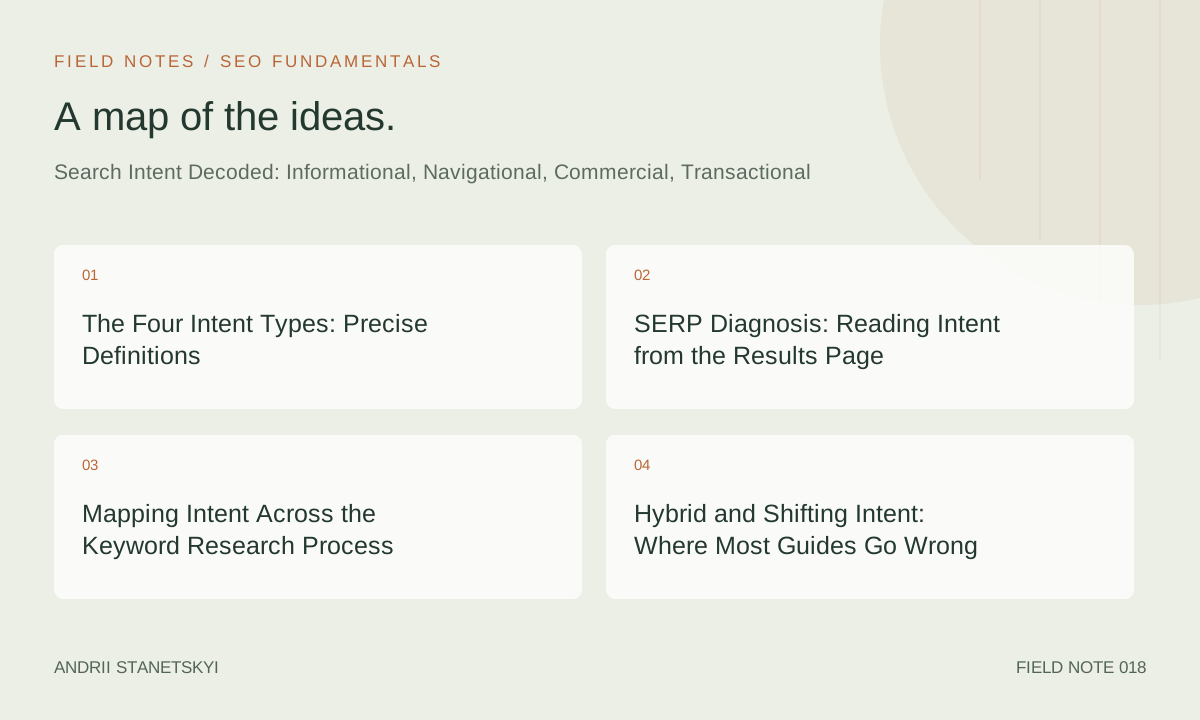
The Four Intent Types: Precise Definitions
The four-bucket framework (informational, navigational, commercial, transactional) comes from Andrei Broder's 2002 taxonomy of web search. It has lasted twenty-four years because it maps cleanly to the actual cognitive states of searchers. Here is how each plays out in 2026:
Informational Intent
The user wants to learn something. They do not know who should answer—or do not care. They are not ready to buy, not navigating to a specific site. "How does compound interest work," "what is keyword cannibalization," "why is my React app slow"—all informational. These queries dominate AI Overview appearances because they are exactly the scenario Google's generative layer was built to answer. Ranking #1 organically for high-volume informational queries has become demonstrably less valuable in 2025–2026 as AI Overviews suppress click-through on informational queries by 35–55% for the keywords they cover. This does not mean abandon informational content—it means be selective and prioritize informational queries where an AI Overview is unlikely (niche, technical, data-heavy, rapidly changing topics).
Navigational Intent
The user knows the destination and is using search as a shortcut. "Ahrefs login," "Semrush keyword magic tool," "GSC performance report." Your job here is to own your own navigational queries—make sure your login page, feature pages, and documentation rank #1 for your branded navigational terms. There is almost no opportunity for a third-party site to rank well for navigational queries targeting a different brand. If you're competing, you're doing it through comparison pages, not direct navigation content.
Commercial Investigation Intent
The user is evaluating options before a decision. They know they need something; they are comparing, vetting, researching. "Best SEO tools 2026," "Ahrefs vs Semrush," "keyword research tool reviews," "is Screaming Frog worth it." These are high-value keywords—they attract users in late-decision stages who convert at 3–6x the rate of informational traffic. CPC for commercial investigation keywords is correspondingly high: "best project management software" runs $8–$22 CPC on Google Ads. This is your primary content battleground if you sell anything.
Transactional Intent
The user is ready to act. Buy, sign up, download, book, call. "Buy Ahrefs plan," "Semrush free trial," "keyword research tool pricing." Transactional keywords have the highest CPC ($15–$80 in SaaS, $20–$150 in legal/finance), highest conversion rate, and lowest search volume relative to informational. The content format here is almost always a landing page or product/category page—not a blog post.
SERP Diagnosis: Reading Intent from the Results Page
Google has already done your intent classification work. The SERP layout for any keyword tells you—precisely—what Google has concluded about user intent. Train yourself to read these signals:
SERP Features as Intent Indicators
| SERP Feature | Primary Intent Signal | Content Implication |
|---|---|---|
| AI Overview (top of page) | Informational | Write for featured snippets AND depth; AIO pulls from ranking content |
| People Also Ask box | Informational / multi-intent | Answer PAA questions explicitly in H3 format within content |
| Shopping ads + product listings | Transactional | Page must have price, schema, clear CTA—no long-form content |
| Local pack (3-pack) | Local transactional or navigational | GBP optimization matters more than on-page content |
| Knowledge Panel (entity) | Navigational / branded | Control your entity data via structured data + Wikipedia/Wikidata |
| Sitelinks | Navigational (brand) | Ensure key pages are internally linked from homepage |
| Image pack | Informational or commercial (visual) | Invest in image SEO, alt text, and image sitemaps |
| Video carousel | Informational / how-to | Publish YouTube content with matching keyword targeting |
| Comparison/review blocks | Commercial investigation | Publish comparative content with structured review schema |
The 3-Scroll Rule
Look at the top 5 organic results for your target keyword. If 4 of 5 are blog posts, you need a blog post. If 4 of 5 are product pages, you need a product page. This is not a creative writing exercise—it is pattern matching against Google's demonstrated preference. Scroll through the actual content of the top results: are they 800 words or 3,000? Do they have tables? Videos? Tool embeds? This tells you not just intent but format and depth requirements.
Mapping Intent Across the Keyword Research Process
Intent classification should happen before you assign keywords to content, not as an afterthought. Here is a practical workflow:
Step 1: Pull Keyword List with SERP Data
In Ahrefs Keyword Explorer, export your target keyword list with SERP feature columns enabled. Semrush Keyword Magic Tool shows "Intent" as a column (it uses its own classification system—useful but not perfect). Filter for keywords where Semrush's intent matches your hypothesis; manually verify the 20% where they conflict.
Step 2: SERP Scrape and Feature Tagging
# Python: Classify intent from SERP features using SerpAPI
import serpapi
import json

def classify_intent_from_serp(keyword, api_key):
    client = serpapi.Client(api_key=api_key)
    results = client.search({
        "engine": "google",
        "q": keyword,
        "num": 10
    })

    features = {
        "has_shopping": "shopping_results" in results,
        "has_local_pack": "local_results" in results,
        "has_ai_overview": "ai_overview" in results,
        "has_paa": "related_questions" in results,
        "has_knowledge_panel": "knowledge_graph" in results,
        "top_results_type": []
    }

    for result in results.get("organic_results", [])[:5]:
        # Heuristic: check for /blog/, /article/, vs /product/, /category/
        url = result.get("link", "")
        if any(x in url for x in ["/blog/", "/article/", "/guide/", "/learn/"]):
            features["top_results_type"].append("editorial")
        elif any(x in url for x in ["/product/", "/shop/", "/buy/"]):
            features["top_results_type"].append("product")
        else:
            features["top_results_type"].append("other")

    # Intent inference
    if features["has_shopping"] or features["top_results_type"].count("product") >= 3:
        return "transactional"
    elif features["has_local_pack"]:
        return "local_transactional"
    elif features["has_ai_overview"] or features["has_paa"]:
        return "informational"
    else:
        return "commercial_investigation"

    return features
Step 3: Validate with AlsoAsked
AlsoAsked.com maps the People Also Asked tree for any keyword. This is invaluable for informational intent mapping—it shows you the sub-questions that users have at the same stage of research. A keyword with 40+ PAA questions is deeply informational; one with 3–5 more specific PAA questions is typically commercial investigation. AlsoAsked's research on PAA patterns across intent types is a useful supplement to this analysis.
Hybrid and Shifting Intent: Where Most Guides Go Wrong
Real user intent is not always a clean match to one of the four buckets. The practical problems:
Hybrid Intent Keywords
"Best CRM for small business" is simultaneously commercial investigation (comparing options) and informational (learning what to look for). The SERP reflects this: you'll see listicles, review aggregators, and some deep-dive explainer content all ranking together. The content that ranks #1 for hybrid intent keywords typically serves both needs: it has a clear recommendation (commercial) AND substantial explanation of why (informational). The mistake is writing a pure buying guide that skips the educational layer, or a pure educational piece that never makes a recommendation.
Intent Shifts During a Session
A user searching "keyword research" is informational. The same user, after reading two articles, searches "keyword research tool"—now commercial investigation. Then "Ahrefs pricing"—transactional. This progression is predictable, and your internal linking should map to it: informational content should link to commercial investigation content, which should link to pricing or demo pages. See our buyer journey keyword mapping guide for the full internal linking strategy.
Seasonally Shifting Intent
"Tax software" in January is commercial investigation (people choosing a product for filing season). In April it becomes transactional (people buying now). In July it becomes informational (people learning about next year's options). The SERP shifts to match, and your ranking may fluctuate not because your content changed but because intent shifted and your content format no longer matches what Google is surfacing. Track SERP composition changes seasonally for your top keywords.
Intent-to-Format Matrix: What to Build for Each Type
Intent dictates format as rigidly as it dictates topic. Here is the production decision matrix:
| Intent Type | Preferred Formats | Avoid | Word Count Range | CTA |
|---|---|---|---|---|
| Informational | Long-form guides, tutorials, explainers, FAQs | Product landing pages, heavy CTAs | 1,500–4,000 | Newsletter, free resource download |
| Navigational | Dedicated landing/feature pages, login pages | Blog posts trying to redirect | 400–800 | Login, app launch, direct action |
| Commercial Investigation | Comparison pages, review roundups, "best of" lists | Pure blog posts with no recommendations | 2,000–5,000 | Free trial, demo, comparison CTA |
| Transactional | Product pages, category pages, pricing pages | Long-form articles, educational content | 300–700 | Buy now, add to cart, sign up |
Tools and Workflow for Intent Classification at Scale
Manual classification is viable up to ~200 keywords. Beyond that, you need a systematized approach.
Semrush Keyword Magic Tool
Filter by "Intent" column. Semrush uses a four-category system (Informational, Navigational, Commercial, Transactional) with multi-intent labeling. Accuracy is roughly 80–85% for English-language keywords with 500+ monthly volume. It degrades for niche technical terms and non-English markets. Use it as a first-pass filter, not a final decision.
Keyword Insights
Keyword Insights clusters keywords by intent and SERP similarity simultaneously. This is more sophisticated than single-keyword intent tagging—it identifies that "keyword research tool" and "best keyword research tool" should be covered by the same page (commercial investigation, same SERP), not two separate articles. For large keyword sets (5,000+), Keyword Insights saves 15–20 hours of manual SERP analysis. Our keyword clustering guide covers Keyword Insights workflows in detail.
Manual SERP Sampling
# SQL: Query to flag keywords that need manual intent review
-- Assuming a keywords table with intent_auto_classified and search_volume
SELECT
    keyword,
    monthly_volume,
    intent_auto_classified,
    cpc_usd,
    keyword_difficulty
FROM keywords_research
WHERE
    monthly_volume > 1000
    AND intent_auto_classified IS NULL
    OR (
        monthly_volume > 500
        AND cpc_usd > 5.00  -- High commercial value = higher cost of intent mistake
        AND intent_auto_classified NOT IN ('transactional', 'commercial')
    )
ORDER BY
    (monthly_volume * cpc_usd) DESC  -- Prioritize by revenue opportunity
LIMIT 100;
This query surfaces the 100 keywords where an intent misclassification would be most expensive—high volume, high CPC keywords where auto-classification disagrees with commercial signal. These warrant manual SERP review.
Case Study: Intent Misalignment Audit on 800 Keywords
A B2B software company had 800 published articles targeting keywords across all intent types. They were ranking but not converting—organic traffic was high (210K/month) but organic MQL contribution was under 8%. An intent audit revealed the problem.
Audit methodology: Exported all published URLs with their target keywords from the CMS. Ran each keyword through Semrush for auto-intent classification. Manually reviewed the top 150 by traffic volume. Cross-referenced against actual page format (blog post vs landing page).
Findings:
- 48 pages targeting transactional keywords (pricing, buy, get started variants) were formatted as long-form blog posts—intent mismatch
- 31 pages targeting commercial investigation keywords ("best X," "top X tools") were product landing pages with no comparison content—intent mismatch
- 112 pages targeting informational keywords were correctly formatted—intent matched
- 22 pages had no clear intent alignment—they targeted multiple conflicting intents simultaneously
Fixes implemented over 90 days:
- Converted 48 transactional blog posts to dedicated landing pages with pricing tables, CTAs, and schema markup
- Rewrote 31 commercial investigation landing pages as comparison guides with genuine competitive analysis
- Consolidated 22 multi-intent pages by splitting into separate URLs per intent
Result at 90 days: Organic MQL contribution rose from 8% to 19%. Traffic held at 198K/month (slight dip expected during restructure). Average position for transactional keywords improved from 18.3 to 7.1.
FAQ
How does Google determine search intent?
Google uses behavioral signals (click patterns, dwell time, pogo-sticking), natural language understanding of the query, historical SERP data showing which result types users engage with, and contextual signals including location, device, and time of day. The intent classification is not based on a keyword database—it is dynamically inferred from aggregated user behavior and refined continuously. This is why intent can shift seasonally and why new queries get classified quickly based on behavior patterns from similar queries.
Can the same keyword have different intent for different users?
Yes, and this is Google's hardest classification problem. "Python" could be a programming language query or a snake query. Google disambiguates using contextual signals: a user who has been searching programming topics all session gets a programming SERP; a user who has been searching reptiles gets a different one. Personalization means that the "true" intent for a keyword is actually a distribution across user segments. For SEO purposes, target the majority intent that the SERP reflects for a cold, unpersonalized search.
What is micro-intent and do I need to worry about it?
Micro-intent refers to the specific sub-task or format preference within a broader intent category. Within informational intent for "how to do keyword research," micro-intent splits into: tutorial (step-by-step), conceptual (what/why), tool-specific (how to do it in Ahrefs). The SERP shows which micro-intent dominates. If the top results are all video tutorials, a text-only guide will underperform even if it targets the same keyword and primary intent. Pay attention to format and depth as micro-intent signals.
Should I create separate pages for informational and commercial intent for the same topic?
Usually yes. "Keyword research" (informational) and "keyword research tool" (commercial investigation) are different enough in intent that Google surfaces very different SERPs. Building one page to serve both intent types results in a compromised page that ranks weakly for both. Build the informational page, link it to the commercial page, and let the internal link equity flow in the right direction. The informational page attracts links; the commercial page converts.
How do I handle intent for international or multilingual keyword research?
Intent patterns vary significantly by market. "Cheap flights" in the US is almost purely transactional. In markets where search behavior leans toward price comparison before buying (common in Southeast Asia), the same concept may surface more commercial investigation SERPs. Always do SERP diagnosis per locale—do not assume intent classifications from one market transfer to another. Semrush and Ahrefs allow country-specific SERP analysis, which is the right starting point.
Are AI Overviews changing intent classification?
They are changing the value of rankings by intent type more than the classification itself. Informational intent keywords with AI Overviews see 35–55% CTR reduction on organic results. Transactional and commercial investigation keywords currently show AI Overviews rarely—Google has learned these need product/pricing information that it cannot generate reliably. The practical implication: de-prioritize low-specificity informational keywords where AIO coverage is high, and invest more in commercial investigation and transactional content that AIO does not typically displace.
What's the fastest way to audit intent alignment for an existing site?
Pull a Semrush Position Tracking report or Ahrefs Organic Keywords report for your site. Export with intent classification. Filter for pages that get significant impressions but poor clicks (CTR under 2% in GSC for non-branded). These are your misalignment candidates—either the page does not match what Google wants to rank for the query, or the meta title/description does not match the intent well enough to earn clicks. Prioritize by traffic opportunity (volume × position).
Key Takeaways
- Read intent from the SERP, not from the keyword itself—SERP composition is Google's explicit signal of what it has decided users want
- AI Overviews are changing the value of informational rankings; be selective about which informational keywords justify content investment in 2026
- Hybrid intent keywords require content that serves both needs—avoid the trap of building for one dimension only
- Intent shifts seasonally and across search sessions—build internal linking that mirrors the progression from informational to transactional
- At scale, use Semrush or Keyword Insights for first-pass intent classification, then manually validate high-value keywords where classification errors are most costly
- Intent misalignment is a more common cause of poor conversion from organic traffic than content quality or link profile weakness
Conclusion
Search intent is not a checkbox in a content brief—it is the fundamental question that determines whether your content can rank at all. The four-type framework gives you a usable mental model, but the real skill is in reading the nuance: hybrid intent, shifting intent, micro-intent, and how AI Overviews are selectively eroding the value of certain intent categories. Practitioners who treat intent classification as a quick Semrush filter pass will produce content that occasionally works. Practitioners who run rigorous SERP diagnosis per keyword and build their content architecture around intent progression will compound their traffic gains quarter over quarter.