Topic authority is not granted — it is architected. A single well-written article does not establish expertise in a subject; a strategically organized cluster of interconnected content does. Content hubs are the structural implementation of that principle. When built correctly, they concentrate link equity, clarify topical relevance for Googlebot, and give users a navigable knowledge resource that keeps them on your domain. When built poorly, they are navigation menus dressed up as strategy. This guide is about building them correctly.
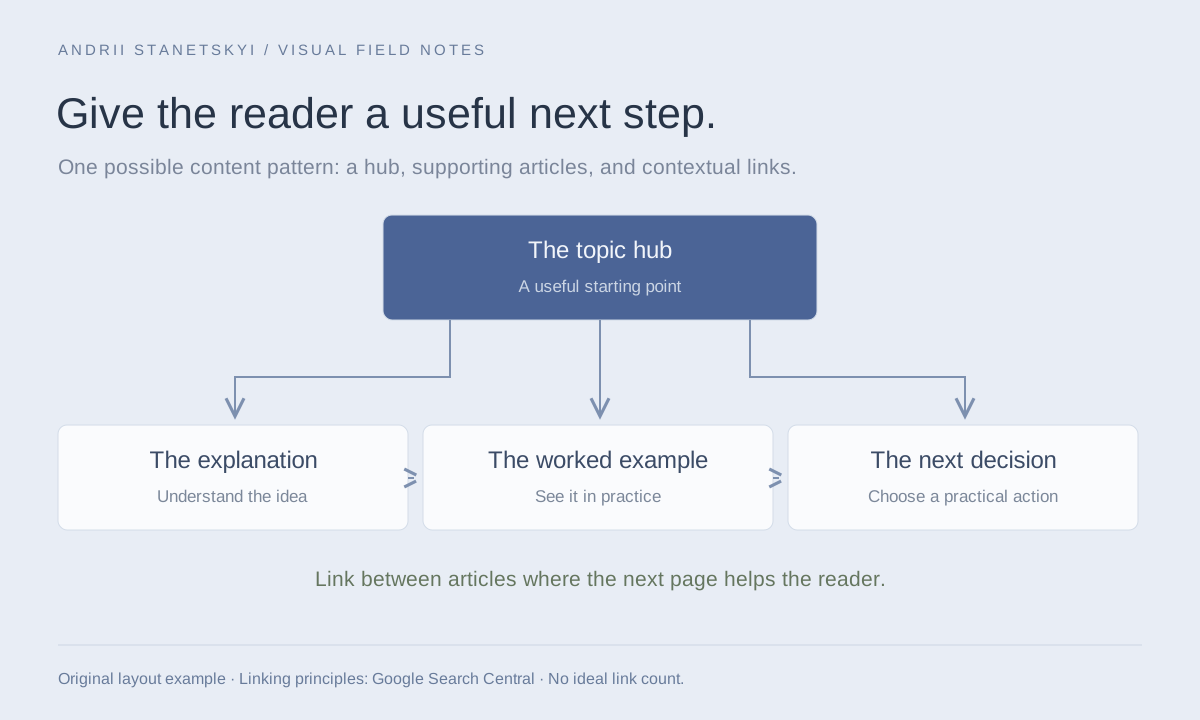
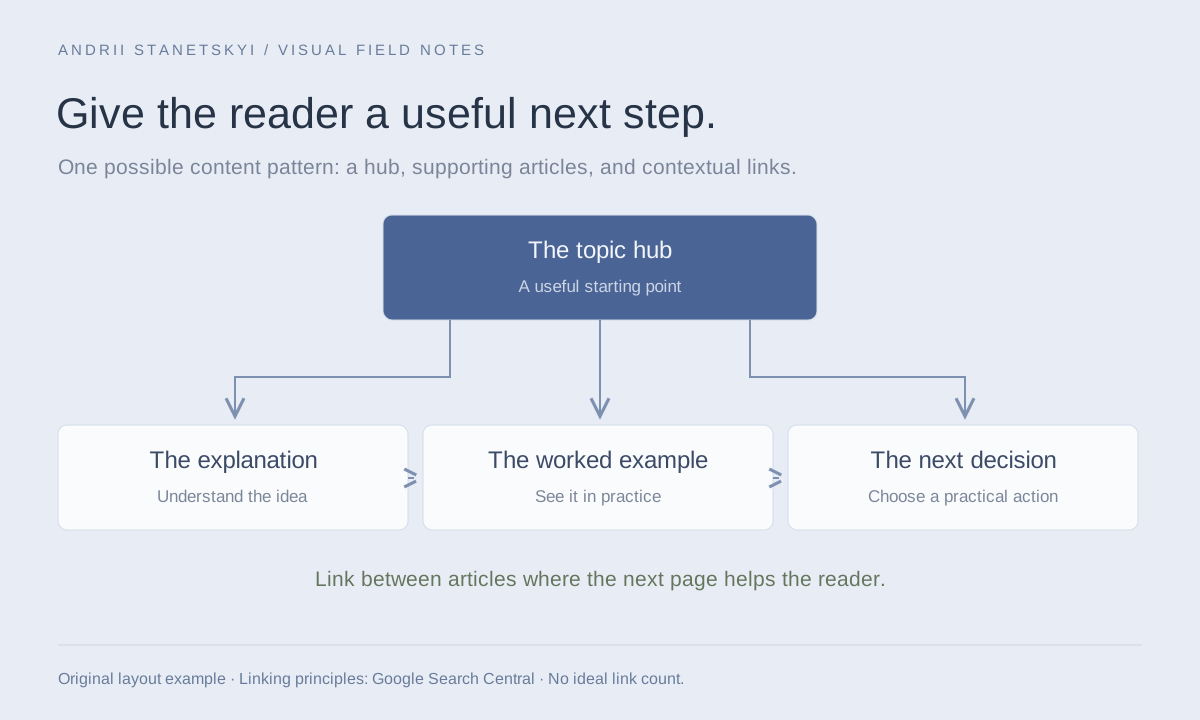
A topic hub connects an explanation, a worked example, and a next decision. Supporting articles link to each other where relevant.
Why Content Hubs Outperform Isolated Articles
Google's ranking systems increasingly evaluate topical coverage, not just individual document quality. A site that has published 15 deeply interconnected articles on "content marketing" — covering strategy, tools, measurement, team structure, and channel-specific tactics — signals broader expertise than a site with one exceptional article on the same topic. This is not a new observation; it reflects how Google has described its "expertise" and "authoritativeness" evaluation: the context of a page within its site matters as much as the page itself.
The mechanical advantage is equally real. A hub concentrates PageRank within a topical cluster. The pillar page receives links from every spoke article; those internal links pass equity back to the pillar; the pillar's authority elevates all spoke pages. Contrast this with isolated articles, where each page accumulates its own small equity pool with no systematic sharing. The hub model systematically advantages all pages within the cluster.
There is also a behavioral dimension. Users who arrive at a well-structured hub and find navigation to related sub-topics spend more time on the domain, visit more pages, and are more likely to convert. These behavioral signals — time on site, pages per session, return visits — are at minimum correlated with rankings even if their direct weight in ranking algorithms is contested.
Anatomy of a Content Hub
The Pillar Page
The pillar is the hub's spine. It covers a broad head keyword comprehensively but not exhaustively — its job is to introduce every major subtopic and link to the spoke articles where each subtopic gets deep treatment. Pillar pages typically target head terms with high monthly search volume (5,000–100,000+). They are long (2,500–5,000 words), but their depth is deliberately limited: they create demand for spoke content, not replace it.
Spoke Articles (Cluster Content)
Spokes are specialized articles targeting long-tail and mid-tail keywords within the topic cluster. Each spoke treats one subtopic exhaustively — the depth the pillar intentionally avoids. A pillar on "email marketing" links to spokes on "email deliverability," "email list segmentation," "email A/B testing," "transactional email setup," and so forth. Each spoke links back to the pillar and cross-links to directly related spokes.
Supporting Content (Optional Third Tier)
Large hubs benefit from a third tier: highly specific, often lower-volume pages that serve tail queries and user-generated content (glossary terms, tool comparison pages, FAQ pages). These create a long-tail capture layer and reinforce topical coverage breadth without demanding significant editorial investment per page.
| Tier | Page Type | Target Keyword Type | Typical Word Count | Internal Links Out |
|---|---|---|---|---|
| 1 | Pillar Page | Head term (broad) | 2,500–5,000 | All spoke articles (8–20) |
| 2 | Spoke Article | Mid-tail / subtopic | 1,500–3,500 | Pillar + 2–4 related spokes |
| 3 | Supporting Content | Long-tail / glossary | 500–1,200 | Pillar + most relevant spoke |
Keyword Mapping to Hub Architecture
The keyword research phase determines the hub's topology before you write a single word. The goal is to map your topic space exhaustively enough to identify every hub tier and understand which subtopics are large enough to warrant their own spoke article vs. being covered within the pillar.
Step 1: Seed Expansion
Enter your head term into Ahrefs Keyword Explorer. Export all phrase-match and "questions" results. Do the same in Semrush Topic Research. You should have 500–2,000 raw keywords for a substantial topic cluster.
Step 2: Cluster by Subtopic
Group keywords by shared semantic intent — not just shared words. Use Ahrefs' "Parent Topic" field as a first-pass grouping. Keywords with the same parent topic likely compete for the same ranking slot and should roll into one spoke article, not multiple. Keywords with different parent topics warrant separate spokes.
Step 3: Prioritize by Volume and Difficulty
Apply thresholds: spoke articles for subtopics with 500+ combined monthly searches; supporting tier for 50–499 searches. Below 50, consider whether a FAQ section within a spoke article covers the intent adequately without requiring a standalone URL.
# Sheets formula: Assign hub tier by keyword volume
=IF(B2>=5000, "Pillar Candidate",
  IF(B2>=500, "Spoke Article",
    IF(B2>=50, "Supporting / FAQ",
      "Skip or FAQ within Spoke")))
Internal Linking Logic for Hub Pages
Internal linking is not a nice-to-have in a content hub — it is the mechanism that makes the architecture function. Without systematic internal links, you have a collection of articles, not a hub. PageRank does not flow through unlinked pages.
The Rule of Reciprocal Connection
Every spoke must link to the pillar. Every pillar must link to every spoke. This is non-negotiable. The pillar-to-spoke link establishes the hub's topical tree for Googlebot. The spoke-to-pillar link concentrates equity on the pillar, elevating its authority for the head term. Sites that link pillar→spoke without the reciprocal spoke→pillar link build a one-way equity drain; the pillar's rankings improve but spoke rankings plateau.
Cross-Linking Between Spokes
Spokes should link to semantically adjacent spokes where the user journey naturally continues. After reading about "email list segmentation," a user's next logical question is often about "email deliverability" or "A/B testing." These cross-links model the user journey, increase pages-per-session, and distribute equity across the cluster. Limit spoke-to-spoke links to 2–4 per article — link because it serves the user, not to maximize link density.
Anchor Text Strategy
Use descriptive, keyword-rich anchor text for pillar links ("email marketing guide" not "click here"). For spoke cross-links, use the spoke's primary keyword as anchor text. Vary anchor text across the site to avoid over-optimization patterns — no two links to the same spoke should use identical anchor text.
See: Content Repurposing — how hub content extends to other channels
Technical Implementation: URLs, Schema, and Crawl Paths
URL Structure
Hub architecture should be reflected in URL hierarchy. A flat structure (/email-marketing/, /email-deliverability/) works but wastes the opportunity to signal hierarchy. A subfolder structure (/email-marketing/ as pillar, /email-marketing/deliverability/ as spoke) makes the parent-child relationship explicit to Googlebot and surfaced to users via breadcrumbs. Choose one approach and apply it consistently — mixing flat and hierarchical URLs within the same hub creates conflicting signals.
Breadcrumb Schema
Implement BreadcrumbList schema on all spoke and supporting pages. This markup signals the hub hierarchy to Google and enables breadcrumb display in SERPs — a subtle but real CTR improvement for navigational queries.
{
  "@context": "https://schema.org",
  "@type": "BreadcrumbList",
  "itemListElement": [
    {
      "@type": "ListItem",
      "position": 1,
      "name": "Email Marketing",
      "item": "https://example.com/email-marketing/"
    },
    {
      "@type": "ListItem",
      "position": 2,
      "name": "Email Deliverability",
      "item": "https://example.com/email-marketing/deliverability/"
    }
  ]
}
Sitemaps and Crawl Prioritization
Create a dedicated XML sitemap for each major hub. Reference it in your robots.txt sitemap declaration. This gives GSC a clean view of hub-level crawl and indexing health. Pillar pages should be crawled and indexed first; if your site is large, list pillar pages with higher priority values in the sitemap (though Google has stated it treats priority as a hint, not a directive, it remains useful for monitoring).
Step-by-Step Hub Build Process
- Define the hub topic and pillar keyword. Confirm the head keyword has sufficient volume (>2,000 monthly searches) and is within your domain's current authority range. Use Ahrefs Keyword Difficulty as a rough guide — targeting a KD of 70+ with a DR 30 domain is a losing battle regardless of hub quality.
- Map the full subtopic space. Run keyword research as described above. Group into pillar candidate, spoke articles, and supporting tier. Document the target keyword, estimated volume, and current SERP difficulty for each.
- Audit existing content. Before creating new content, identify which subtopics you already have articles for. These become spoke candidates that need optimization and internal link updates, not net-new creation.
- Write spokes before the pillar. This is counterintuitive but effective: write the spoke articles first, then write the pillar to reference them. The pillar's summaries of subtopics will be sharper when you have already written the full treatments.
- Build the internal link architecture systematically. After all content is published, conduct a link audit: every spoke must link to the pillar; the pillar must link to every spoke; 2–4 cross-links between adjacent spokes. Use a spreadsheet to track the link matrix.
- Update existing content to link into the hub. Your highest-authority pages outside the hub should link to the pillar page. Identify these via Ahrefs (filter by URL Rating) and add contextual internal links where relevant.
- Monitor hub performance in GSC. Filter Performance by URL path (your hub's subfolder). Track impressions, clicks, and average position for the hub as a whole and for individual URLs. Expect 3–6 months before hub-level authority gains become visible in rankings.
Case Study: Fintech Hub Dominating BOFU and TOFU
A fintech comparison platform built a hub on "small business loans." The pillar targeted the head term (22,000 monthly searches, KD 65). Twelve spoke articles covered subtopics: SBA loan requirements, equipment financing, invoice factoring, merchant cash advances, business line of credit, and more. Four supporting pages covered glossary terms (amortization, APR for business loans, collateral definition, underwriting process).
The build took four months with a team of three writers and one SEO strategist. At publication, the domain had a DR of 58 — below the typical threshold for ranking head terms with KD 65. Within nine months: the pillar ranked #4 for "small business loans," eight spoke articles ranked in positions 1–5 for their respective keywords, and the hub collectively drove 47,000 monthly organic sessions. The decisive factor was not link building — external links to the hub were minimal — but the systematic internal link architecture that concentrated equity on the pillar and cross-distributed it across spokes.
Related: Topic Authority — The New Currency of Search
Measuring Hub Performance
Measure hubs as units, not as individual pages. Create a custom segment in GA4 for each hub's URL path. Track:
- Total organic sessions to the hub (monthly, trended)
- Average pages per session for hub visitors (hub engagement indicator)
- Hub-attributed conversions (define at least one conversion event reachable from the hub)
- Average GSC position for all hub URLs combined
- Number of hub URLs in top 10 positions (breadth of hub penetration)
A hub is succeeding when organic sessions grow month-over-month, spoke pages gain positions, and the pillar remains stable at a top-5 ranking for the head term. A hub is stagnating when spoke pages rank but the pillar does not — this typically indicates the pillar needs a stronger backlink investment or the spoke-to-pillar internal linking is broken.
FAQ
How many spoke articles does a hub need to be effective?
A minimum of six to eight spoke articles is generally needed to signal meaningful topical depth to Google. Hubs with fewer than five spokes often fail to differentiate the domain from a single comprehensive article. There is no hard upper limit — large hubs with 30+ spokes are common in competitive verticals — but quality matters more than count. Eight excellent spoke articles outperform twenty thin ones every time.
Should a pillar page target a transactional or informational keyword?
Match the intent of the SERP for the head term. Check the current top 10 results: if they are primarily guides and resources, your pillar should be informational. If they are primarily comparison pages or product pages, your pillar should be transactional. Misaligning content format with SERP intent is the most common reason well-built hubs fail to rank competitively for their head terms.
Can I retrofit an existing blog into a hub architecture?
Yes, and this is often more efficient than building from scratch. Conduct a content audit to identify existing articles that belong to the same topic cluster. Redesignate the most comprehensive article as the pillar and update it to formally link to all relevant existing articles (which become spokes). Update each spoke to link back to the pillar. This hub retrofit process typically takes 2–4 weeks of editorial work and frequently produces ranking improvements within 60–90 days.
How does E-E-A-T factor into hub architecture?
Hub architecture supports E-E-A-T signals by creating a coherent body of work on a topic rather than isolated claims of expertise. Google evaluates expertise at the site level: a domain with 15 deeply linked articles on a topic demonstrates more consistent expertise than a domain with one article making the same claims. Author bylines, credentials, and expert quotes should be consistent across hub content to reinforce the authoritativeness signal.
What is the difference between a content hub and a resource page?
A resource page is a curated list of external links on a topic — primarily useful for link acquisition. A content hub is an internally-linked network of original content that owns the topic on your domain. Resource pages depend on external content for value; hubs create the value internally. They serve different strategic purposes and should not be confused.
How do I handle outdated spoke articles within a hub?
Apply the content decay framework to spokes individually. A spoke with significant traffic decline needs a refresh before it drags down hub-level authority signals. Do not remove outdated spokes without first redirecting them to the most relevant current page — removing URLs breaks the internal link architecture and loses accumulated equity.
Key Takeaways
- Content hubs are not a content strategy — they are an architectural strategy that makes content strategy compound over time.
- Three tiers: pillar (head term, broad coverage), spokes (subtopic, deep coverage), supporting content (tail terms, narrow answers).
- Every spoke must link to the pillar; every pillar must link to every spoke. Non-negotiable. The reciprocal link is the mechanism that concentrates equity.
- Write spokes before the pillar — the pillar will be sharper for having the full treatments already written.
- URL hierarchy, breadcrumb schema, and dedicated XML sitemaps reinforce the hub architecture at the technical level.
- Measure hubs as units: total hub sessions, pages per session, hub-attributed conversions, and number of hub URLs in top 10.
- A hub with 8 excellent spoke articles outperforms a hub with 20 thin ones — topical depth per spoke matters as much as total spoke count.
Conclusion
Content hubs are how domain authority is built intentionally rather than accidentally. They give Google a coherent signal of topical expertise, give users a reason to stay on your domain longer, and give your link equity a systematic distribution mechanism. The investment is front-loaded — keyword mapping, coordinated production, link auditing — but the compounding returns make it the highest-ROI content architecture available to most B2B and B2C publishers. Build one hub well before you attempt to build five mediocre ones.
Next: AI-Generated Content and SEO — Where Google Actually Stands in 2026