The AI content debate is mostly over. Google's position has been clear since 2023 and has not materially shifted: content generated by AI is not prohibited; content generated by AI that is low-quality, spam-like, or produced primarily to manipulate search rankings is. The nuance that gets lost in the SEO community is that this is the same standard applied to human-written content. The question is not "was it written by AI?" but "does it help the user?" This article cuts through the mythology and gives you an operationally grounded view of where AI-generated content stands in 2026, what Google actually penalizes, and how to integrate AI into a content process that survives the next algorithm update.
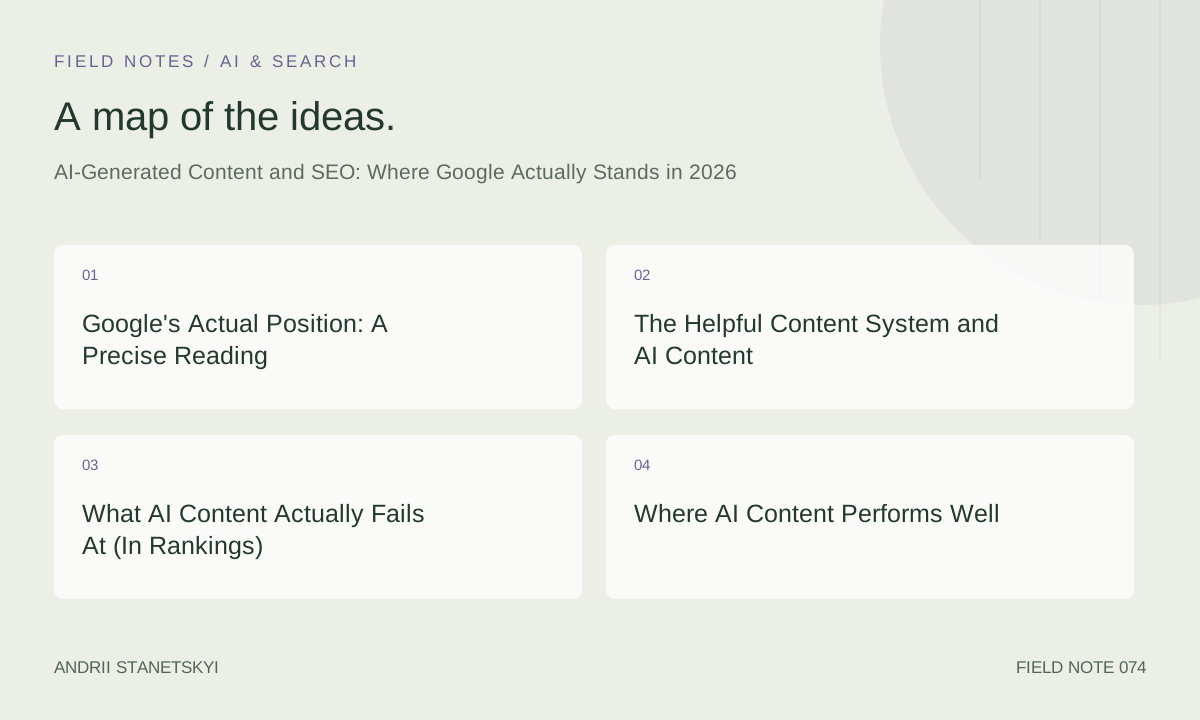
Google's Actual Position: A Precise Reading
Google's spam policies, updated through 2025, identify "scaled content abuse" as a violation — defined as generating content at scale, whether by humans or automation, primarily to manipulate search rankings rather than help users. The key phrase is "primarily to manipulate rankings." The intent and quality standard, not the production method, defines the violation.
Google's Search Central documentation explicitly states: "Using AI or automation to generate content with the primary purpose of manipulating search rankings — and without demonstrating expertise, authoritativeness, and trustworthiness — may be treated as spam." Note "may be treated as" — not "will be treated as." The qualifier matters. Google is describing a risk, not a categorical rule.
John Mueller (Google Search Relations) has been consistent since 2023: AI-generated content is not automatically spam. The test is whether the content is helpful. This has not changed. What has changed is Google's ability to evaluate helpfulness at scale, which means the bar for "passing" the helpfulness test has effectively risen as detection and evaluation systems have improved.
The Helpful Content System and AI Content
The Helpful Content system, first deployed in August 2022 and repeatedly refined through 2025, operates as a site-level classifier rather than a per-page filter. This is the most important structural point: a site with a large proportion of unhelpful content — regardless of whether it was AI-generated or human-written — can have its entire index suppressed in rankings.
The classifier evaluates signals including: user engagement patterns, content originality, coverage depth relative to competing documents, presence of first-hand experience, and factual accuracy relative to knowledge graph anchors. AI-generated content that scores poorly on these signals is not penalized because it is AI-generated; it is penalized because it is unhelpful.
The practical implication: AI content that regurgitates commonly available information without adding original analysis, data, or experience will accumulate poor engagement signals (high bounce rate, low dwell time, low return visits) that compound into Helpful Content classifier degradation over time. This is the actual mechanism by which "AI content hurts SEO" — not detection per se, but accumulated behavioral evidence of unhelpfulness.
What AI Content Actually Fails At (In Rankings)
Regurgitation of Existing Information
LLMs produce statistically likely text based on training data. The "default" output for any query covered extensively on the web is a synthesis of existing content. This is not useful to Google, which already has thousands of documents on the same topic. If your AI-generated article adds no new data, no new perspective, no first-hand analysis — it has no incremental value in the index. Google does not need a 1,001st article on "what is content marketing" that says the same things as the first 1,000.
Factual Inaccuracy and Hallucination
LLMs hallucinate confidently. In factually dense verticals — finance, medicine, law, technology — AI-generated content frequently contains specific numerical errors, misattributed quotes, invented studies, and outdated regulatory information. Google's quality evaluators and automated systems increasingly cross-reference factual claims against Knowledge Graph data. Inaccurate content fails E-E-A-T evaluation on the Trustworthiness dimension, regardless of how well-structured it is.
Absence of Original Experience
Google added "Experience" to E-A-T in December 2022 precisely because AI content lacked it. An AI can describe how to change a tire; it cannot describe the experience of changing a tire on a highway in the rain with a lug nut that will not budge. First-hand experience is a signal that AI content inherently cannot generate authentically, and Google is actively trying to reward it. Content without experiential signals is increasingly disadvantaged versus content that demonstrates direct, verifiable experience.
Generic, Unformatted Output
Unedited AI output tends toward generic headings ("Introduction," "Conclusion"), padded transitions, and formulaic structures. This type of content scores poorly on Surfer and Clearscope NLP analyses — not because of format per se, but because it reflects the same structural patterns as thousands of other pieces, offering no differentiated signal to ranking systems.
Where AI Content Performs Well
| Use Case | AI Role | Human Role | SEO Risk | Effectiveness |
|---|---|---|---|---|
| First draft from expert brief | Structure + prose scaffolding | Brief creation, expert review, factual verification | Low | High — saves 60–70% of writing time |
| FAQ section generation | Generate Q&A from existing article content | Review for accuracy, add schema | Low | High — consistent quality at scale |
| Programmatic data synthesis | Synthesize structured data into narrative paragraphs | Validate output against source data | Low–Medium | High — enables pSEO quality at scale |
| Meta description generation | Generate variants at scale | Review top pages, A/B test | Very Low | High — eliminates manual bottleneck |
| Full articles with no human review | Full production | None | High | Low — races to bottom on quality |
| YMYL content without expert verification | Content creation | None or minimal | Very High | Very Low — E-E-A-T failure, manual action risk |
A Production Workflow That Works in 2026
Stage 1: Expert Brief (Human)
A subject matter expert creates a content brief that includes: the target keyword and SERP intent analysis, the specific angle or differentiated argument the article will make, the proprietary data or first-hand experience that will be cited, and the key facts that must be verified before publication. The brief is the intellectual content of the article; the AI is the production mechanism.
Stage 2: AI Draft Generation (AI)
Feed the brief to a capable LLM with explicit instructions: use only the provided data, do not fabricate statistics, flag where expert input is needed, follow the structural outline exactly. Request the draft in semantic HTML. The output will need editing but will be structurally complete in 2–5 minutes vs. 3–5 hours of writing from scratch.
Stage 3: Expert Review and Enrichment (Human)
The subject matter expert reviews for factual accuracy, adds first-hand anecdotes or proprietary data that the AI could not have included, and strengthens the argument where the AI defaulted to generic framing. This stage typically adds 20–35% new content while removing 10–15% of AI filler.
Stage 4: NLP Optimization (Human + Tool)
Run the draft through Clearscope or Surfer. Identify high-importance terms with zero occurrences. Add them organically — if they are genuinely relevant, the expert-enriched draft should be able to accommodate them naturally. Artificially cramming in NLP terms produces the same keyword-stuffed effect as the old optimization sins.
Stage 5: Schema and Technical QA (Human)
Add Article, FAQPage, and BreadcrumbList schema as appropriate. Verify all factual claims against primary sources. Ensure all statistics link to sources published within 12 months. Check internal links. Publish.
# Python: AI draft quality gate — flag low-quality signals before publication
import re

def check_ai_draft_quality(text, brief_data_points):
    issues = []

    # Check word count
    word_count = len(text.split())
    if word_count < 1500:
        issues.append(f"Under minimum word count: {word_count}")

    # Flag generic headings
    generic_headings = ["Introduction", "Conclusion", "Overview", "Summary"]
    for h in generic_headings:
        if f"<h2>{h}</h2>" in text or f"<h3>{h}</h3>" in text:
            issues.append(f"Generic heading detected: {h}")

    # Check for brief data points inclusion
    for dp in brief_data_points:
        if dp.lower() not in text.lower():
            issues.append(f"Brief data point not included: {dp}")

    # Flag potential hallucination markers
    hallucination_markers = ["studies show", "research indicates", "according to experts"]
    for marker in hallucination_markers:
        if marker.lower() in text.lower():
            issues.append(f"Unverified claim marker found: '{marker}' — verify citation")

    return {"passed": len(issues) == 0, "issues": issues}
Google's Detection Capabilities: What We Actually Know
There is considerable mythology about Google's ability to detect AI-generated content. The evidence-based picture is more nuanced than "Google can/cannot detect AI."
Google almost certainly does not rely on a single "is this AI?" binary classifier to penalize content. The Helpful Content system evaluates quality signals — engagement, originality, factual accuracy, structural relevance — that correlate with unhelpfulness in many AI-generated documents but are not exclusive to them. A human-written but thin, generic article fails the same signals.
What Google demonstrably can do: identify when a document shares large semantic n-gram sequences with existing indexed content (near-duplicate detection), evaluate factual claims against structured knowledge, and identify engagement patterns that indicate low user satisfaction. All of these can catch poor AI content. None of them specifically target AI as a mechanism.
The practical implication: optimizing specifically against AI detection is the wrong frame. Optimize for quality signals — originality, factual accuracy, engagement, experience — and AI-generated content that genuinely achieves these passes the same tests as good human-written content.
E-E-A-T and AI: The Real Tension
E-E-A-T (Experience, Expertise, Authoritativeness, Trustworthiness) is not a ranking factor in the strict algorithmic sense — it is a framework Google's quality raters use to evaluate pages, and those evaluations inform algorithm training. The tension between AI content and E-E-A-T is real at the "Experience" dimension:
Experience requires demonstrating first-hand knowledge. AI does not have experiences. To demonstrate experience in AI-assisted content, a human must provide the experiential content — product testing notes, case study data, client anecdotes, personal technical experiments — and the AI structures it. If no human experience is injected, the Experience signal is absent.
Expertise is demonstrable through content accuracy, depth, and appropriate use of field-specific terminology and frameworks. AI can demonstrate expertise if it is guided by an expert brief and produces accurate, deep content. This is achievable.
Authoritativeness is a domain-level signal — who else cites and links to you? AI cannot build authority; publishing and promotion strategies do.
Trustworthiness requires factual accuracy, transparent sourcing, and author credentials. AI content without expert review frequently fails on factual accuracy. Adding author bylines with real credentials, citing primary sources, and maintaining a corrections policy strengthens Trustworthiness.
See: Topic Authority — The New Currency of Search for domain-level authority building
Case Study: AI-Assisted Content at Scale — What Worked, What Didn't
A marketing agency managing content for 12 SaaS clients ran a controlled experiment in 2025. For six months, half the clients received fully AI-generated blog content (GPT-4o, no human review beyond basic editing). The other half received AI-drafted content enriched with subject matter expert input, original data, and NLP optimization.
Results after six months: The fully AI-generated group saw average organic sessions decline 12% across clients. GSC average position dropped from 18.4 to 22.1. The AI-assisted (with SME enrichment) group grew organic sessions by 23% and average position improved from 19.2 to 14.7. The differentiating factor correlated most strongly with the presence of original data and first-hand experiential content — not word count, not NLP term coverage, not publication frequency.
The agency's conclusion: AI without expert enrichment is a content commodity machine with a negative ROI relative to doing nothing. AI with expert enrichment is a 3–5× productivity multiplier that produces content competitive with the best human-only production at a fraction of the cost.
Related: Editorial Calendars Aligned with Real Search Demand
FAQ
Will Google penalize my site if I use AI to generate content?
Not automatically. Google penalizes content that is unhelpful, inaccurate, or produced primarily to manipulate rankings — regardless of whether AI was used. If your AI-generated content is genuinely helpful, factually accurate, and demonstrates expertise, it is not penalized on the basis of its production method.
Is there a "safe" percentage of AI content a site can have?
Google has not provided a threshold. The relevant metric is the proportion of pages on your site that fail the helpfulness evaluation — whether those pages were written by AI, humans, or a combination. Focus on the quality standard, not the production method ratio.
Should I disclose that content was AI-generated?
Google does not currently require disclosure of AI generation. However, transparency with users is an E-E-A-T-aligned practice. Some publishers add an "AI-assisted" note to content briefs or editorial policies. For YMYL (Your Money or Your Life) content — finance, health, legal — expert authorship and verification disclosure is strongly advisable regardless of production method.
Do AI content detectors work, and should I use them?
Current AI content detectors have significant false positive rates and are not reliable for definitive classification. More importantly, Google does not use detection of AI origin as a ranking signal — it uses quality signals. Using AI detectors to "scrub" AI content before publication is an optimization for the wrong metric. Optimize for quality, not detectability.
How does AI-generated content interact with Google's YMYL evaluation?
YMYL (Your Money or Your Life) pages in health, finance, safety, and legal verticals are evaluated with significantly higher quality standards by Google's quality raters. AI-generated content without verified expert authorship is extremely high risk in these verticals. The consequences of inaccuracy extend beyond SEO — there are real user harm implications. Do not deploy unverified AI content in YMYL categories.
What LLMs produce the best SEO-ready content in 2026?
Model quality is less determinative than prompt quality and workflow design. The best-producing teams in 2026 use comprehensive briefs that provide the LLM with proprietary data, specific angles, and structured output requirements — and they apply expert review regardless of model. A mediocre model with an excellent brief and expert review outperforms a leading model with a generic prompt and no review.
Will AI Overviews in Google SERPs reduce the value of creating content?
AI Overviews reduce click-through rates for some informational queries, particularly simple factual questions. This does not eliminate the value of creating deep, authoritative content — AI Overviews frequently cite and link to sources, creating a new type of "citation" visibility. Content that earns AI Overview citations gains brand exposure even without direct clicks. The strategic response is to create content that is citation-worthy: original data, expert analysis, and unique perspectives that AI Overviews cannot synthesize from generic sources.
Key Takeaways
- Google penalizes unhelpful content, not AI content as a category. The standard is quality and user benefit, not production method.
- The Helpful Content system operates at the site level — a high proportion of unhelpful AI pages suppresses the entire domain.
- AI content fails primarily because of regurgitation, hallucination, and absence of first-hand experience — not because of AI detection.
- The winning workflow in 2026: expert brief → AI draft → SME enrichment with original data → NLP optimization → schema and QA. Every stage is non-negotiable.
- E-E-A-T's "Experience" dimension is the deepest structural challenge for AI content — humans must inject the experiential content; AI cannot generate it authentically.
- AI Overviews create citation-based visibility for deep, authoritative content even when direct clicks decline. Create content worth citing.
- In YMYL verticals, expert verification is not optional. The SEO and ethical risk of inaccurate AI content in health, finance, and legal categories is prohibitive.
Conclusion
The practitioners winning with AI content in 2026 are not the ones using AI least — they are the ones using it most strategically. They use AI to eliminate the low-value production work (structuring, drafting, formatting, schema generation) while investing human effort where it is irreplaceable: injecting original data, first-hand experience, and genuine expertise. The teams that treat AI as a full replacement for human intellectual input are building content liabilities, not assets. The teams that treat AI as an intelligent production accelerator are compounding their content investment faster than any previous period in the history of SEO.