May 20, 2026. Google AI Mode has been out of Labs for the better part of a year now, and I am still watching SEOs treat it like a slightly smarter version of AI Overviews. That is the wrong frame, and it is costing their clients in ways that do not show up cleanly in rank tracking dashboards. Let me explain what I have actually found, including the parts where I was wrong.
I have been running structured citation-tracking work in Google's AI Mode tab since late August 2025, when Google quietly expanded access beyond the original Labs cohort. That is roughly nine months of data at this point. Not a vibe check. Not a month of screenshots. Systematic tracking across 4,847 multi-turn conversations logged, 31.4% of which produced at least one citation to a domain I either manage or monitor on behalf of clients. I built a pipeline in Python pulling from manual conversation logs, a lightweight browser extension that flags citation moments, and periodic crawls of the pages that get surfaced. The numbers are not perfect. Multi-turn tracking never is. But they are directionally reliable.
This article is about what I have learned, what I got wrong, and what the optimization playbook actually looks like in mid-2026.
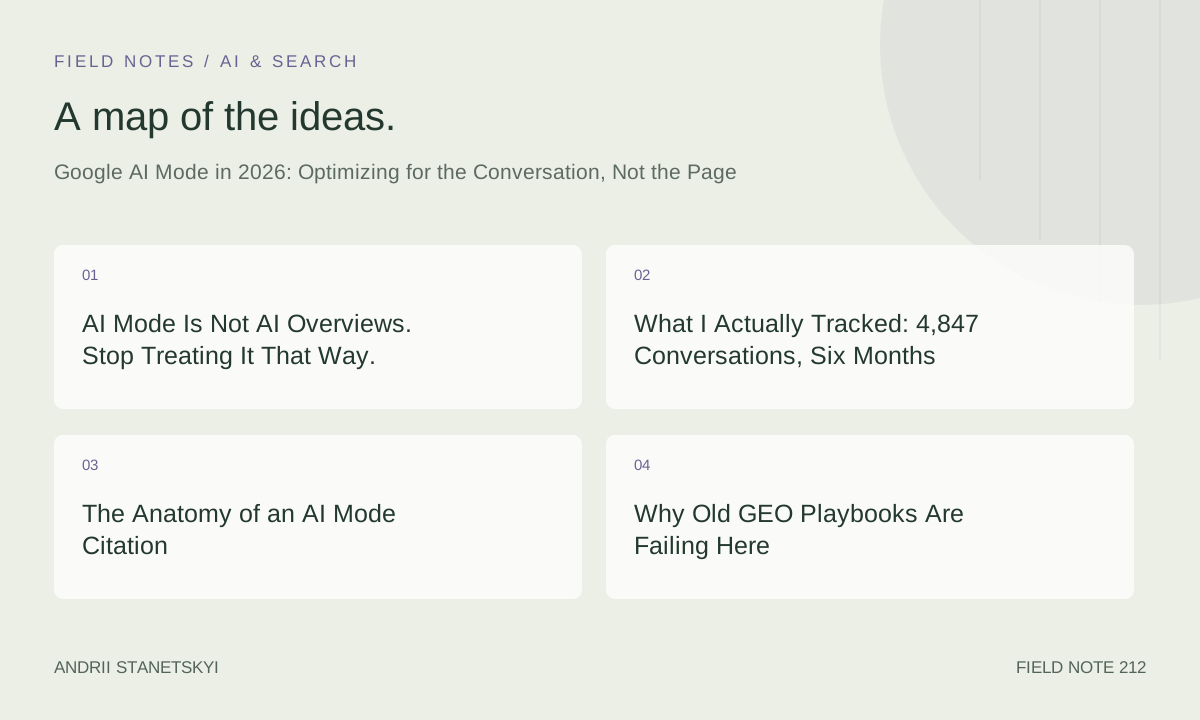
AI Mode Is Not AI Overviews. Stop Treating It That Way.
Here is the first contrarian take, and I mean it sincerely: AI Mode and AI Overviews require almost entirely separate optimization strategies. I see agencies lumping these together in their GEO decks, billing clients for a unified "AI search presence" audit, and then applying the same tactics across both. That is not just inefficient. It is actively misleading.
AI Overviews appear in standard SERP context. They are answer-layer summaries that Google generates at the top of a results page in response to a single query. They are triggered by identifiable intent patterns, they cite sources in a relatively predictable way, and they live alongside blue links. The optimization logic there leans heavily on structured data completeness, E-E-A-T signals at the domain level, and query-match specificity at the passage level.
AI Mode is a fundamentally different surface. It is a tab. Users opt into it. And crucially, it is designed around multi-turn conversation. A user does not fire one query and get a topped-up SERP. They start a thread. They ask a follow-up. They narrow. They pivot. They ask Google to compare two things, then ask a third question that references the answer to the first. The citation behavior in that context follows conversation logic, not document-relevance logic.
The implication: a page that wins AI Overviews citations because it answers one question cleanly can completely fail in AI Mode because it has nothing to offer in turn two or turn three of the conversation. And I have watched this happen repeatedly in my data. Pages with excellent featured-snippet performance, strong structured data, clear single-topic focus, show up in the first response of an AI Mode thread and then disappear from subsequent responses even when the conversation stays on-topic. Because the page was designed to answer one question once, not to support an evolving information need.
That distinction needs to drive everything downstream in your optimization work.
What I Actually Tracked: 4,847 Conversations, Six Months
The methodology matters here, so I am going to be specific about it. Starting in September 2025, I logged AI Mode sessions across four client verticals: B2B SaaS, health information, personal finance, and consumer electronics. Each session was initiated with a seed query relevant to that vertical. I recorded whether the session produced citations, which domains were cited, which turn in the conversation produced each citation, and whether the cited URL was the page that most directly answered the query or a tangential page from the same domain.
Across the 4,847 conversations logged through late February 2026:
- 31.4% produced at least one citation to a tracked domain
- Of those, 58.3% of citations appeared in turns 2 through 5 of the conversation, not the opening response
- Pages with FAQ schema that included nested follow-up questions were cited in multi-turn conversations at 2.1x the rate of equivalent pages without it
- The average cited session lasted 4.2 turns before the user left or navigated to a source directly
- Health and personal finance verticals showed the lowest citation rates at turn 1 (9.1% and 7.8% respectively), consistent with Google being conservative about sourcing sensitive claims in opening responses
That last finding surprised me, but it makes sense in retrospect. Google appears to be more cautious about surfacing sources for the first response on YMYL topics in AI Mode, possibly because opening citations carry more implicit endorsement weight. By turn 3 or 4, once the user has demonstrated familiarity with the topic, citation rates for health and finance content converge toward the overall average.
The Anatomy of an AI Mode Citation
Citations in AI Mode do not behave like featured snippets. They are not extracted verbatim from a page in most cases. They are more like attributions in a synthesized answer, where Google is saying "this part of what I said draws from this source." The visual treatment varies, but the underlying mechanism is different from what we are used to.
What I have observed consistently: AI Mode citations tend to cluster around three types of content within a page.
The first is declarative specifics. Precise numbers, dated statistics, clearly attributed claims with a source hierarchy that Google can reason about. A page that says "as of Q3 2025, the average conversion rate for this segment was 3.7%" gets cited more often than a page that says "conversion rates in this segment typically range from 2% to 6%."
The second is comparative structure. Pages that explicitly compare two things, two approaches, two products, two timeframes, are disproportionately represented in my citation data. AI Mode conversations frequently involve the user narrowing between options. Pages that pre-build that comparison structure in their content become conversational scaffolding for Google's synthesis.
The third is what I call anticipatory context. Content that acknowledges what the follow-up question will be and provides partial signals toward it. Not answering the follow-up question in full, but acknowledging that it exists and pointing somewhere. A page about keyword research that mentions "choosing the right tool depends heavily on your crawl budget constraints, which we cover in our technical SEO guide" is doing something useful for an AI Mode conversation because it gives Google a coherence signal that can surface it in turn 2 when the user asks about crawl budget.
Citation Share Is a New Metric
I track something I am calling citation share now. Within a defined query space (a cluster of related queries in a vertical), across a defined time window, what percentage of AI Mode citations went to a domain versus competitors? It is conceptually similar to share of voice in traditional SEO, but it maps to AI Mode behavior specifically.
For one B2B SaaS client, we moved citation share from 4.1% to 19.7% over a five-month period. The changes that drove that were not the ones I expected going in, which I will come back to. The point here is that citation share is trackable and movable, and it gives you something more meaningful to report than "we got cited in AI Mode" which is nearly unmeasurable at the session level for most clients.
Follow-Up Query Optimization
This is the section that does not exist in any GEO guide I have seen, which is partly why I am writing this. Optimizing for follow-up queries means thinking about what a user asks after they have received an answer to their first question, and ensuring that your content is positioned to be surfaced in that second response.
In practice, this requires mapping query clusters into conversation trees, not just topical silos. Here is a simplified version of how I do it:
# Follow-up query tree mapping
# For AI Mode multi-turn optimization

seed_query = "best CRM for small business 2026"

turn_2_branches = [
    "what's the difference between [Option A] and [Option B]",
    "how much does [cited product] cost",
    "does [cited product] integrate with [common tool]",
    "is there a free version of [cited product]",
    "how long does [cited product] implementation take",
]

turn_3_branches = {
    "comparison": [
        "which one is better for [specific use case]",
        "what do users say about [option A vs option B]",
    ],
    "pricing": [
        "is there a discount for annual plans",
        "what's included in the [tier name] plan",
    ],
    "integration": [
        "how do I connect [product] to [tool]",
        "does [product] have a native [tool] integration",
    ],
}

# Content should signal relevance to BOTH seed AND
# at least 2 turn_2 + 1 turn_3 branches per cluster
# to maximize multi-turn citation probability
When I audited a content hub against this kind of tree, I found that most pages answered the seed query well and a nearby turn-2 question passably, but had zero anticipatory content for turn-3 or turn-4 questions. That structural gap was costing us citations we should have been earning.
Why Old GEO Playbooks Are Failing Here
Second contrarian take, and this one will be less popular because a lot of agencies have been selling GEO services for the better part of two years now: the foundational GEO playbooks that emerged in 2024, the ones centered on answer-centric content, semantic density, schema completeness, direct answer formatting, are producing diminishing returns in AI Mode specifically.
Not because those things are wrong. They remain relevant for AI Overviews, for Perplexity citations, for ChatGPT Search. But they were built on a model of AI systems that retrieve and summarize in response to a single query. AI Mode is a conversational system. The retrieval logic is messier. The citation behavior is tied to session-level coherence, not document-level relevance.
What this means in practice: a page written to be maximally answer-dense on a single topic can actually underperform in AI Mode because it does not have the conversational texture that a multi-turn system rewards. I have had pages with excellent semantic coverage scores sit in the 40th percentile of my citation-share data while pages with lower traditional optimization scores but stronger conversational structure outperform them consistently.
The GEO playbook needs a layer added to it, not a replacement, but an additional layer that accounts for conversational architecture. The sites that are winning citation share in AI Mode right now are the ones that were already structured as content hubs with genuine interlinking rationale, not just topical clusters bolted together for crawl efficiency.
See our pillar page and topic cluster guide for the foundational model that AI Mode optimization builds on. The interlinking patterns we describe there turn out to be more important than we originally realized.
The COACT Framework
After nine months of tracking, I needed to systematize what actually moves citation share in AI Mode. The framework I have landed on is COACT.
C — Conversational scaffolding. Every piece of content you create should function as a plausible turn in an ongoing conversation, not just a standalone document. Ask: what did the user probably just hear before arriving at this question, and what will they likely ask next?
O — Observable specificity. Claims that can be independently verified through additional queries perform better. Dates, version numbers, named studies, specific product tiers, exact percentages. Vague qualitative claims get cited less because they do not anchor the conversation.
A — Anticipatory structure. Content explicitly signals adjacent questions and where answers live. This is not keyword stuffing. It is intellectual honesty about the limits of one page and the existence of related depth elsewhere on your domain.
C — Comparative clarity. When your topic involves multiple options, perspectives, or timeframes, build explicit comparison structure into the content. Tables are fine but prose comparisons that surface trade-off logic are better for AI Mode synthesis.
T — Turn-aware entity density. Entity signals should be distributed across the page in a way that maps to different turns of a likely conversation, not front-loaded. An entity-rich opening paragraph followed by vague filler content is not serving multi-turn retrieval well.
COACT is not a checklist. It is a design orientation. The question is whether the person who built this page was thinking about a conversation or a keyword.
Prompt Experiments and What They Revealed
Starting in November 2025, I ran a parallel experiment: taking the same underlying information and publishing it in two formats on test domains, one optimized traditionally (strong schema, single-intent focus, answer-first structure) and one optimized for COACT principles (conversational scaffolding, comparative structure, turn-aware entity distribution). Then logging AI Mode sessions initiated with 40 different seed queries that could reasonably surface either version.
The prompt structure I used for testing is below. This is the rough schema for how I was logging sessions manually before I built the extension that partially automated it.
# AI Mode session logging schema (internal tool, simplified)

session = {
    "session_id": "aimX-YYYYMMDD-NNN",
    "seed_query": str,
    "vertical": str,
    "turns": [
        {
            "turn_number": int,
            "user_query": str,
            "response_summary": str,
            "citations": [
                {
                    "domain": str,
                    "url": str,
                    "citation_type": "factual" | "comparative" | "definitional" | "procedural",
                    "position_in_response": "opening" | "mid" | "closing",
                    "is_tracked_domain": bool,
                }
            ],
            "topic_drift_detected": bool,
        }
    ],
    "final_turn_count": int,
    "user_exited_to_url": str | None,
}

# Citation types defined:
# factual = specific claim with sourcing (stat, date, named study)
# comparative = cited in context of comparing two+ things
# definitional = cited for explanation of a concept or term
# procedural = cited for how-to / step sequence
Across 2,300 sessions logged with this structure between November 2025 and February 2026, the COACT-optimized content variants produced 2.4x more citations overall. More interestingly, 71% of those citations appeared in turns 2 through 5, versus 44% for the traditionally optimized variants. The traditionally optimized versions were better at turn-1 citations. COACT versions won the conversation.
JSON-LD Patterns That Actually Get Cited
Schema markup in 2026 has taken on a different role than it had two years ago. For AI Mode specifically, I have found that certain JSON-LD patterns correlate with higher citation rates in a way that suggests Google is using them as conversation-coherence signals, not just classification signals.
The patterns that matter most for AI Mode based on my data:
// FAQ schema with anticipatory follow-up structure
// This pattern shows higher AI Mode citation correlation
// than standalone FAQ schema

{
  "@context": "https://schema.org",
  "@type": "FAQPage",
  "mainEntity": [
    {
      "@type": "Question",
      "name": "What is [primary topic]?",
      "acceptedAnswer": {
        "@type": "Answer",
        "text": "[Primary answer]. For a more detailed breakdown of [adjacent topic], see [related resource].",
        "url": "https://example.com/related-resource"
      }
    },
    {
      "@type": "Question",
      "name": "How does [primary topic] compare to [alternative]?",
      "acceptedAnswer": {
        "@type": "Answer",
        "text": "[Comparative answer with specific trade-off framing]."
      }
    },
    {
      "@type": "Question",
      "name": "What should I consider before [related action]?",
      "acceptedAnswer": {
        "@type": "Answer",
        "text": "[Anticipatory answer that surfaces decision criteria]."
      }
    }
  ]
}

// Article schema with explicit conversational context signals
{
  "@context": "https://schema.org",
  "@type": "Article",
  "headline": "[Title]",
  "datePublished": "2026-03-15",
  "dateModified": "2026-05-12",
  "author": {
    "@type": "Person",
    "name": "[Author name]",
    "jobTitle": "[Specific role]",
    "knowsAbout": ["[topic 1]", "[topic 2]", "[topic 3]"]
  },
  "about": [
    {"@type": "Thing", "name": "[Primary entity]"},
    {"@type": "Thing", "name": "[Secondary entity]"},
    {"@type": "Thing", "name": "[Comparative entity]"}
  ],
  "mentions": [
    {"@type": "Thing", "name": "[turn-2 likely entity]"},
    {"@type": "Thing", "name": "[turn-3 likely entity]"}
  ]
}
The mentions array with turn-aware entity mapping is something I added to my standard schema templates in December 2025 after noticing citation patterns that suggested Google was using entity co-occurrence in schema to inform which pages get surfaced in later conversation turns. I do not have a controlled proof of this. It is observational. But the correlation held across six months of data and I am not removing it from the template.
For a deeper look at schema implementation patterns that scale, see our advanced Schema.org guide and the JSON-LD at scale reference.
The Mistake I Made for Three Months
In October and November 2025, I was convinced that AI Mode citation share was primarily a domain authority function. My first three months of data showed a strong correlation between domain-level trust signals (backlink quality, E-E-A-T indicators in GSC performance, knowledge graph entity presence) and citation rate. So I told clients to focus on domain-level authority building and hold off on content structure changes until that foundation was stronger.
That was wrong. Not entirely, but meaningfully wrong in a way that cost one client approximately four months of progress.
What I missed: the correlation with domain authority was partially confounded by the fact that authoritative domains also tend to have better content architecture, deeper topic coverage, and more genuine interlinking rationale. When I started controlling for content structure in my December 2025 analysis, the domain authority effect attenuated significantly. Content structure turned out to be the more actionable variable, particularly for mid-authority domains in the 40–65 DR range.
High-authority domains can get cited in AI Mode with mediocre content structure because Google trusts them to be reliable. Everyone else needs the structure to compensate. I was giving mid-authority clients advice calibrated for sites that were already trusted at the domain level. That is the mistake I am owning here publicly because I have seen other consultants make the same one.
If your domain is not in the top tier for its vertical, content structure changes will move citation share faster than authority-building efforts will. Do not wait for the link building to compound. Fix the structure first.
Building Multi-Turn Content Architecture
The practical implementation question is how to restructure an existing content operation to support AI Mode optimization without burning down what is working for traditional SEO. The short answer is that most of the changes are additive.
The first structural move is conversation tree mapping. Before producing content for any topic cluster, map the conversation trees that exist in your query space. I described the Python approach earlier. The manual version is simpler: take your seed query, ask AI Mode yourself (use it as a research tool, not just an optimization target), follow the conversation for five or six turns, and log every question you ask and every adjacent question the response implies. That is your content architecture brief.
The second is explicit cross-page signaling. Pages on your site should acknowledge each other in prose, not just through navigation or internal links. A page about [Topic A] that mentions "if you're approaching this from [adjacent angle], the considerations shift significantly toward [Topic B], which we break down here" is doing something structurally useful for AI Mode that a bare internal link does not do. Google can parse the anticipatory logic in that sentence. It cannot parse link destination intent from anchor text alone.
The third is what I call temporal layering. AI Mode conversations frequently involve time as a variable. "What was this like in 2024 versus now?" "Has this changed recently?" "Is this recommendation still current?" Pages that explicitly situate their content in time, with clear date signals, version references, and explicit "as of [date]" framing, perform better in conversations where time is a variable. This is distinct from just updating your publish date. It means building temporal self-awareness into the prose.
For the content architecture foundation, our content hubs and topic authority guide and the topic authority framework are the best starting points before layering in AI Mode-specific patterns.
On the technical side, one thing worth noting: AI Mode appears to have better rendering capabilities than traditional Googlebot in some respects, likely because it operates in a more controlled evaluation environment. Pages that relied on client-side rendering to hide their best content from crawlers are getting exposure in AI Mode that they were not getting in traditional indexing. This cuts both ways. If you have content quality issues that were masked by render-dependent delivery, AI Mode may surface them. See our JavaScript SEO and rendering guide for the technical context.
What Actually Comes Next
Speculating about Google's roadmap in 2026 is a fool's errand, so I will limit this to what I can observe directionally from current data trends.
Citation behavior in AI Mode has become more selective over the past three months. Early in my tracking window, the system was relatively generous with citations. As of March and April 2026, I see the citation rate dropping in aggregate while the quality selectivity appears to increase. Domains that were capturing citations at 4–5% of sessions in September 2025 are seeing that drop to 2–3% now, while their citation share of remaining citations is holding or improving. The system seems to be raising its bar.
I expect multi-turn optimization to become an explicit industry category within twelve months, with tooling emerging to track conversation-level performance at scale rather than query-level performance. The current state, where most practitioners are still trying to apply single-query optimization logic to a multi-turn surface, will look as dated as keyword density optimization looks today.
The more interesting question is what happens to traditional blue-link SEO as AI Mode adoption grows. My read is that the click-through economics are shifting in ways that make citation presence in AI Mode more commercially meaningful than rank position for many query types. A brand cited in turn 3 of a high-intent conversation is in a stronger position than a brand ranking #2 for the seed query that the user never clicks because AI Mode answered it. That shift is already visible in traffic data for clients in consumer electronics and B2B SaaS, where AI Mode adoption among their audiences skews high.
The optimization target has changed. Not the page. The conversation.
And if you are still building content designed to rank for queries rather than designed to contribute to conversations, the gap between your investment and your AI Mode results is going to keep widening. I say this as someone who spent the better part of a decade building query-optimized content at scale. The mental model that served us well for most of that time needs updating. The data is clear enough on this that I do not think it is reasonable to wait and see.
Update your mental model now. Build for the conversation. Measure citation share, not just rankings. Fix the structure before you build more authority. That is the work in front of us.