The "just focus on Google" advice made sense when Google held 92%+ of global search market share and the cost of maintaining separate optimization programs for alternative engines exceeded the return. That calculation has changed. Bing now powers ChatGPT's SearchGPT. Brave Search underpins a growing privacy-first audience. DuckDuckGo serves over 100 million queries per day. And collectively, these engines are responsible for a disproportionate share of the audience most valuable to technology, privacy-conscious, and enterprise B2B brands.
More importantly: with Google AI Overviews compressing organic CTR for informational queries, the marginal value of diversifying to engines where AI interference is lower has increased sharply. This is not about abandoning Google—it is about building resilience while the Google SERP changes beneath you.
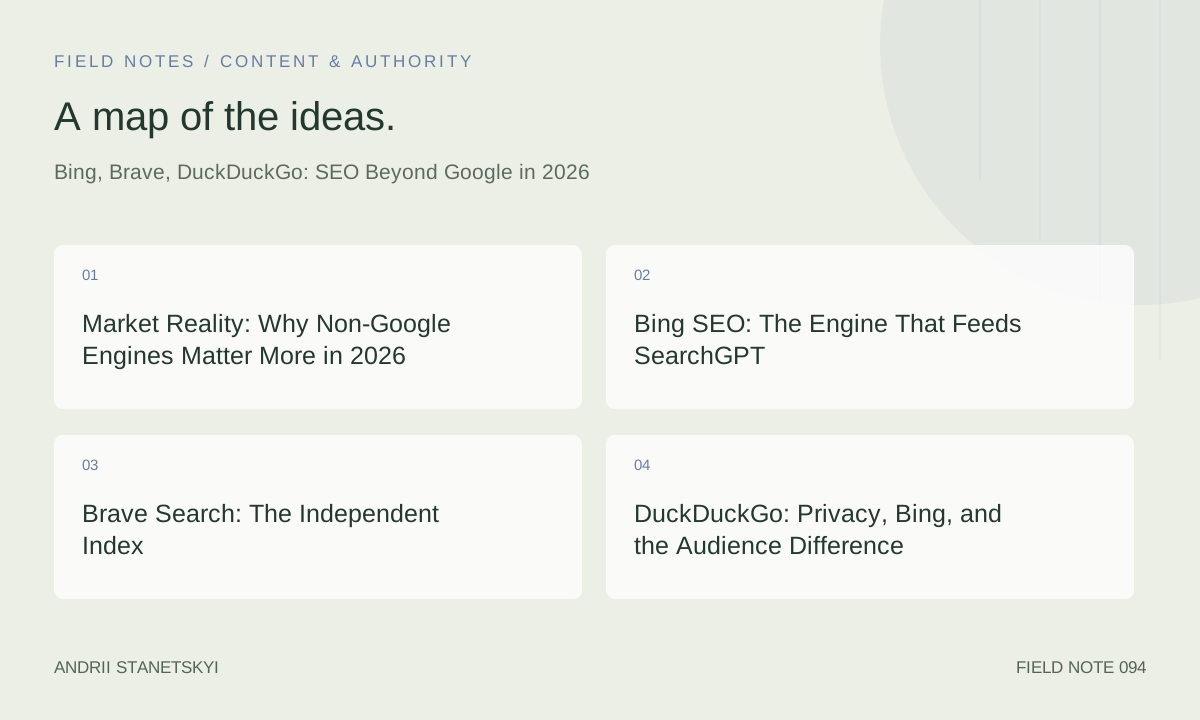
Market Reality: Why Non-Google Engines Matter More in 2026
The strategic case for non-Google SEO in 2026 rests on three concurrent trends:
Trend 1: Bing's role in the AI search ecosystem. ChatGPT's SearchGPT product uses Bing's index as its primary retrieval source. This means your Bing ranking has become a proxy for your ChatGPT SearchGPT visibility. Microsoft's investment in OpenAI has made Bing the backend of the most-used AI assistant in the world. If you are invisible in Bing, you are invisible to SearchGPT.
Trend 2: Google's CTR compression. AI Overviews have reduced organic CTR for informational queries by 30–40% on Google. Alternative engines have not deployed equivalent AI answer features at the same scale. Bing's AI features are aggressive but trigger less frequently on long-tail queries. Brave has no AI Overview equivalent. DuckDuckGo's AI features are opt-in. The alternative engines are currently better at sending traffic for the informational query types that Google is absorbing.
Trend 3: Audience quality differentiation. The audience using Brave Search skews heavily toward developers, privacy-conscious professionals, and technology early adopters—often the exact B2B ICP that enterprise technology companies are targeting. A Brave referral frequently has higher session quality metrics than a Google referral for these verticals.
| Engine | Est. Global Query Share | AI Search Feature | Index Type | Crawler |
|---|---|---|---|---|
| ~88% | AI Overviews (Gemini) | Own | Googlebot | |
| Bing | ~4% | Copilot / SearchGPT backend | Own | Bingbot |
| DuckDuckGo | ~2% | AI Answers (opt-in) | Bing + own sources | DuckDuckBot |
| Brave Search | ~0.7% | Summarizer (own index) | Own (independent) | Brave-Bot |
| Ecosia | ~0.3% | Bing AI features | Bing | Via Bing |
| Perplexity | ~0.5% (AI-first) | Core product | Own + Bing | PerplexityBot |
Bing SEO: The Engine That Feeds SearchGPT
Bing's ranking algorithm shares conceptual foundations with Google's but differs in several measurable ways. Practitioners who treat Bing as "Google-lite" leave significant performance on the table.
Bing's Key Ranking Differences
Social signals: Bing has consistently stated that social signals (shares, engagement on social platforms that Bing indexes) influence rankings. Google has explicitly denied this. For content that generates social sharing, Bing's social signal weighting can accelerate ranking timelines significantly.
Exact-match domain and keyword in domain: Bing shows a stronger correlation between keyword-containing domains and ranking positions than Google does for the same query set. The signal has weakened over the years but remains more prominent than in Google's algorithm.
Page age and domain age: Bing gives more weight to established domains and pages. New content on established domains ranks faster; entirely new domains face a steeper authority ramp than on Google.
On-page keyword signals: Bing's relevance model weights keyword presence in title, H1, and first paragraph more heavily than Google's neural ranking (which interprets semantic intent more flexibly). Traditional on-page optimization (exact keyword in title and H1) is more reliably rewarded by Bing.
HTTPS: Bing confirmed HTTPS as a ranking factor. Non-HTTPS sites rank significantly lower on Bing than they do on Google (where HTTPS is a tiebreaker, not a strong signal).
Bing Webmaster Tools: Your First Step
A remarkable number of sites have never submitted their sitemap to Bing Webmaster Tools or claimed their property. This is the lowest-hanging fruit in non-Google SEO. Bing Webmaster Tools provides:
- Index coverage reporting (equivalent to GSC Coverage)
- Keyword performance data (impressions, clicks, CTR)
- Crawl diagnostics and crawl budget controls
- URL inspection equivalent
- Backlink data (often more revealing than Bing's link profile data in third-party tools)
- Site scan tool for basic technical issues
Setup takes 30 minutes. For a site with non-trivial Bing organic presence, the data return is immediate. Bing Webmaster Tools also provides early signals for SearchGPT visibility, since Bing's understanding of your site structure directly influences how SearchGPT retrieves your content.
ContentBot and IndexNow
IndexNow is a Bing-backed protocol (also supported by Yandex, Seznam, and other participating engines) that allows instant URL submission when content is published or updated. Rather than waiting for Bingbot to discover a new page through crawl, IndexNow pushes the URL directly to participating engines within minutes. Implementation is a single API call or a plugin in most CMS platforms:
# IndexNow API call (simplified)
GET https://www.bing.com/indexnow
  ?url=https://example.com/new-page
  &key=your-indexnow-key

# Or via your sitemap ping (Bing supports both)
# Key file at: https://example.com/[your-key].txt
Google does not support IndexNow. For Bing, Brave, and other participating engines, it is the fastest path to fresh content appearing in results.
Brave Search: The Independent Index
Brave Search is the only major search engine (outside Google and Bing) running a fully independent web index—no Bing API, no Google dependency. This matters because content that ranks well in Brave's independent index is genuinely highly regarded by a system that has not been influenced by Bing or Google's ranking models.
Brave's crawler, Brave-Bot (user agent: Mozilla/5.0 (compatible; BraveBot/1.0)), is rate-limited and resource-constrained relative to Googlebot or Bingbot. Crawl budget management is more important on Brave than on Google for large sites. Prioritize your most important pages via sitemap and robots.txt.
Brave Search Ranking Signals
Brave has published limited documentation on its ranking approach, but observable patterns from the SEO community:
- Backlink authority from non-Google/Bing sources (independent web directories, niche communities) appears to carry more weight than it does in Google
- Technical performance (Core Web Vitals equivalent) appears to influence ranking more directly—pages with poor LCP and CLS are noticeably down-ranked
- Brave's Summarizer (its AI answer feature) sources from pages with strong structured data and direct-answer sentence structure—same as other generative features
- Privacy policy and data collection practices may influence content trust scores (consistent with Brave's privacy-first brand positioning)
Brave Goggles: The Differentiation Opportunity
Brave's "Goggles" feature allows users to apply custom ranking rulesets created by the community. Niche publishers can create Goggles that prioritize content from specific domains or topic clusters. For communities that are active Brave users (developers, privacy advocates), creating a Goggle that centers your content is a low-effort differentiation strategy not available on any other engine.
DuckDuckGo: Privacy, Bing, and the Audience Difference
DuckDuckGo's organic results are primarily sourced from Bing's index (with additional sources including its own crawl for certain content types). This means Bing SEO is DuckDuckGo SEO for the majority of result pages. However, DuckDuckGo's ranking layer applies its own adjustments, particularly around content quality and privacy.
DuckDuckGo's audience is worth understanding specifically: it over-indexes for:
- US and European users with above-average technical literacy
- Users who have actively opted out of personalization (privacy-conscious)
- Younger demographics who adopted privacy tools early
For B2B technology, developer tools, and privacy/security product verticals, DuckDuckGo's audience quality (measured by session depth and conversion rate) often matches or exceeds Google's for the same queries. This is an audience worth optimizing for on its own merits.
DuckDuckBot is the primary crawler. It respects robots.txt and follows standard technical SEO signals. There is no DuckDuckGo equivalent of Google Search Console or Bing Webmaster Tools—you cannot submit sitemaps directly. Your Bing sitemap submission effectively covers DuckDuckGo.
Ecosia, Qwant, and Other EU/Ethical Engines
Ecosia (Germany) and Qwant (France) are relevant primarily for EU-focused content strategies. Both use Bing as a major index source, making Bing optimization the primary lever. Qwant maintains a partial independent index with strong French-language coverage.
For brands with ESG commitments or sustainability messaging, Ecosia's audience (environmentally motivated users who choose Ecosia because searches plant trees) represents a niche but high-affinity segment. Content that explicitly aligns with environmental values may see above-average engagement metrics from Ecosia referrals.
Cross-Engine Technical SEO: What Differs
Most technical SEO fundamentals apply equally across all engines: HTTPS, proper canonicalization, XML sitemaps, structured data, mobile usability, and page speed. The areas where engines diverge:
| Signal | Bing | Brave | DuckDuckGo | |
|---|---|---|---|---|
| JavaScript rendering | Full (WRS) | Limited | Limited | Via Bing |
| Exact-match keyword signals | Low (semantic) | Medium | Medium | Via Bing |
| Social signals | Not confirmed | Confirmed | Unknown | Via Bing |
| IndexNow support | No | Yes | Yes | No (via Bing) |
| Domain/page age | Low signal | High signal | Medium | Via Bing |
| Core Web Vitals | Ranking factor | Partial | Apparent yes | Via Bing |
The JavaScript rendering point deserves emphasis. Google's Webmaster Rendering Service (WRS) executes JavaScript during indexing, meaning client-side rendered content is indexed correctly. Bing, Brave, and DuckDuckGo have far more limited JavaScript execution during crawl. For SPA (single-page application) sites or heavy JavaScript-dependent content, server-side rendering or pre-rendering is not optional for non-Google visibility—it is a prerequisite.
Bing Webmaster Tools: The Underused Advantage
Bing Webmaster Tools is the most underused tool in SEO given its importance. Beyond the basic indexing and keyword reports, advanced features include:
- SEO Analyzer: On-demand page-level analysis for common technical issues. Runs independently of Bing's crawl schedule.
- Backlink Explorer: Bing's link data often surfaces referring domains not visible in Ahrefs or Semrush, particularly from Microsoft properties and Bing-indexed directories.
- Copilot Insights (2025 addition): Shows how your pages are being used as sources in Copilot / SearchGPT responses—the closest thing to a generative engine visibility report for the Bing ecosystem.
For clients generating significant Bing traffic (typically >10% of organic), I recommend a monthly Bing Webmaster Tools review as a standard reporting cadence, not just an annual check.
Multi-Engine Strategy for 2026
The practical strategy for most sites:
- Fix Bing indexing first. Submit sitemap to Bing Webmaster Tools. Verify all major pages are indexed. Fix any crawl errors. This is 90% of the Bing/SearchGPT/DuckDuckGo optimization work.
- Implement IndexNow. For sites that publish content frequently, IndexNow is a 2-hour implementation that improves freshness ranking across Bing, Brave, and participating engines.
- Ensure SSR or pre-rendering. If any of your content is client-side rendered, add server-side rendering or dynamic pre-rendering for AI crawlers and non-Google engines that lack full JS execution.
- Allow all AI and non-Google crawlers explicitly. Review your robots.txt. Make sure Bingbot, DuckDuckBot, Brave-Bot, PerplexityBot, GPTBot, and ClaudeBot are all allowed where you want visibility.
- Track alternative engine traffic separately in GA4. Create custom channel groupings for Bing, DuckDuckGo, Brave, and Perplexity. You cannot optimize what you cannot see.
See also our enterprise site audit framework for incorporating multi-engine checks into regular technical SEO audits, and our guide to optimizing for generative engines for the AI layer on top of this multi-engine foundation.
FAQ
Does Bing SEO actually matter if Bing has only 4% market share?
For most sites, Bing organic traffic is 7–12% of total organic—higher than market share implies because Bing's results appear in Microsoft Edge (default), Cortana, and now SearchGPT. More importantly, Bing is the index that powers ChatGPT SearchGPT. Bing ranking has disproportionate influence on generative AI visibility relative to its raw query share.
How do I check my Bing indexing status without GSC?
Use site:yourdomain.com in Bing to see indexed pages, or use Bing Webmaster Tools' URL inspection tool for individual pages. Bing Webmaster Tools requires property verification (same as GSC) but provides detailed crawl and index data once verified.
Is there a Bing equivalent of Google's Core Web Vitals ranking system?
Bing has not published a named page experience system equivalent to Google's Core Web Vitals, but page speed and usability signals are confirmed as ranking factors. Fast, usable pages rank better on Bing. The thresholds are not publicly documented, but optimizing for Google's CWV standards is a sufficient proxy.
Does DuckDuckGo have any unique ranking factors I should optimize for?
DuckDuckGo's organic results are primarily Bing-sourced. The main DuckDuckGo-specific content type worth optimizing for is its Instant Answers feature, which sources from Wikipedia, OpenStreetMap, and DuckDuckGo's own curated sources. Getting your content into Wikipedia's coverage of relevant topics is the most reliable path to DuckDuckGo Instant Answer inclusion.
Should I create separate sitemaps for different engines?
No. A single well-structured XML sitemap that follows the sitemap protocol (including lastmod, changefreq, and priority attributes) is sufficient for all engines. Submit it to Google Search Console and Bing Webmaster Tools. IndexNow handles real-time update signaling for participating engines beyond that.
How do I track SearchGPT referrals in GA4?
SearchGPT citations do not always pass referrer data cleanly, but openai.com and chatgpt.com appear as referral sources in GA4 when users click citations. Create a custom channel in GA4 that captures these domains under a "ChatGPT / SearchGPT" label. Track bing.com organic separately as your Bing SEO proxy metric.
Key Takeaways
- Bing's index is the backend of ChatGPT SearchGPT. Bing SEO is now directly linked to SearchGPT citation visibility.
- Bing ranks differently from Google: social signals confirmed, exact-match keyword signals stronger, domain age more prominent, JavaScript rendering more limited.
- Bing Webmaster Tools is critically underused. It provides index coverage, keyword data, and (since 2025) Copilot Insights showing generative citation data.
- IndexNow is a 2-hour implementation that accelerates indexing across Bing, Brave, and other participating engines.
- Brave Search has an independent index and an audience that over-indexes for developers and privacy-conscious professionals—high-value segments for B2B tech brands.
- JavaScript rendering is the most common technical blocker for non-Google visibility. SSR or pre-rendering is required for SPA sites.
- Alternative engines currently send more referral traffic for informational queries than Google does (per click), because AI Overview CTR compression is less severe on Bing and nonexistent on Brave.
Conclusion
The argument for multi-engine SEO has never been stronger. Google's AI Overviews compress CTR. Bing powers the AI assistant with 100 million daily active users. Brave serves the audience most likely to convert for technology products. The cost of adding Bing and Brave to your optimization program is marginal compared to the risk of concentrating all your organic equity in a single engine undergoing its most significant interface change in two decades.
Start with Bing Webmaster Tools and IndexNow. They cost nothing and take an afternoon. Then build the measurement infrastructure to track the returns. The diversification case will make itself.