Link velocity — the rate at which a site acquires new backlinks over time — is one of the most discussed and least precisely understood concepts in link building. The popular framing is simple: build links too fast and Google penalizes you, build them too slowly and you don't rank. Neither of those statements is quite accurate, and building a real mental model of how velocity patterns actually work matters if you're going to run link campaigns at scale without burning your clients' sites.
This guide covers what the data shows about natural link velocity patterns, how Google's systems detect manipulation, what specific patterns trigger scrutiny, and how to structure link acquisition campaigns to remain within safe parameters — while still moving aggressively enough to actually compete.
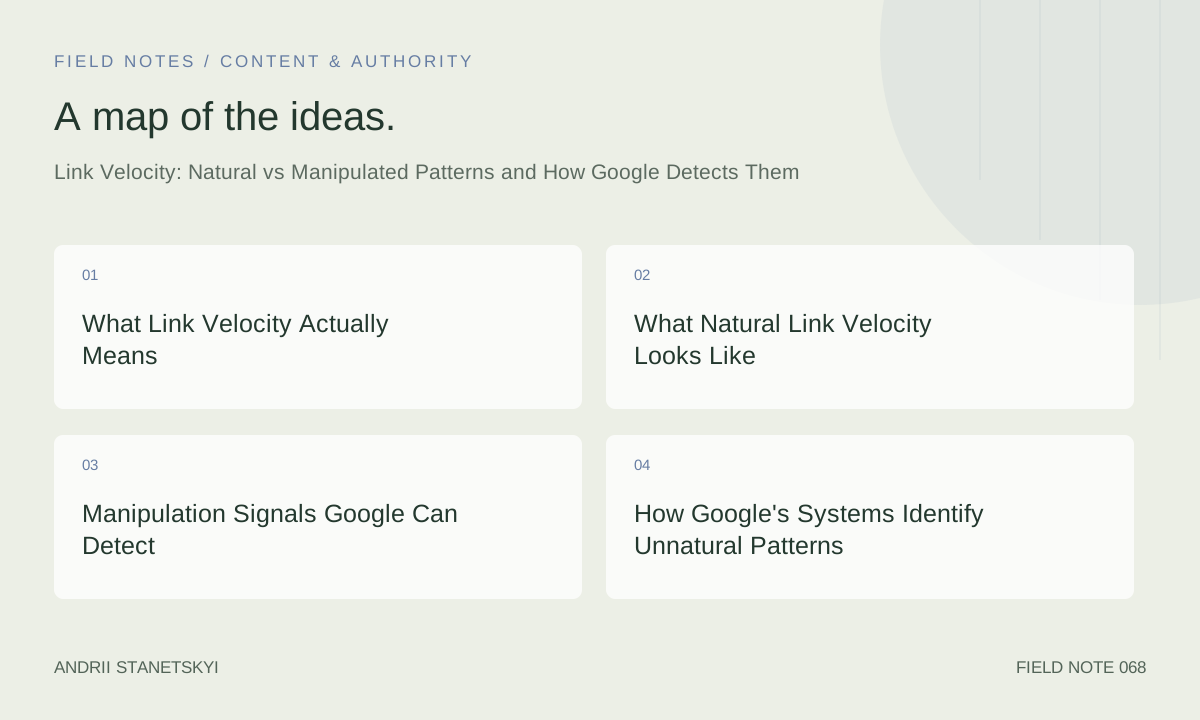
What Link Velocity Actually Means
Link velocity is typically measured as referring domains per time unit — usually per week or per month. It's distinct from total backlink count (which includes multiple links from the same domain) and from raw link count. Referring domain velocity is what matters most, because Google treats multiple links from the same domain as a single editorial signal from one source.
The concept matters for two related but distinct reasons. First, an unnatural velocity pattern is itself a manipulative signal — it suggests coordinated link placement rather than organic editorial discovery. Second, velocity relative to a site's historical baseline is what triggers scrutiny, not absolute numbers.
A major news site gaining 5,000 referring domains in a week after publishing a viral article is unremarkable. A three-year-old B2B SaaS site gaining 500 referring domains in a week with no corresponding content publication or PR event is a red flag. The context is everything.
What Natural Link Velocity Looks Like
Organic link acquisition follows recognizable patterns that differ fundamentally from manipulated profiles. Understanding these patterns is the foundation for both avoiding detection and for identifying when a competitor's link profile is manipulated.
The Baseline Drift Pattern
Established sites in mature niches tend to acquire links at a slow, consistent rate with occasional spikes tied to content events or PR activity. A typical DR 50–60 site in a competitive vertical might gain 20–80 referring domains per month organically. That rate grows gradually over years as the site's authority and content output increases.
The Content-Correlated Spike
When sites publish genuinely link-worthy content — original research, controversial positions, major product launches, tools — they see velocity spikes that correlate precisely with publication date and then decay back to baseline. The spike shape is recognizable: sharp rise within 2–4 weeks of publication, followed by exponential decay over 6–12 weeks, then a new, slightly higher baseline as the content ages.
The PR Event Pattern
Press coverage, product launches, and media mentions create link spikes that are extremely concentrated in time (72–96 hours) and extremely diverse in linking domain types (news sites, blogs, industry publications, social platforms). The topical diversity of these linking domains is much higher than what link building campaigns produce.
The Long Tail Accumulation
For most sites, the majority of new referring domains come in ones and twos — individual bloggers, resource pages, citations in industry forums. This long tail pattern creates a smooth velocity curve with high variance month-to-month but a consistent upward trend over quarters.
Manipulation Signals Google Can Detect
Google has been explicit — through patents, algorithm updates, and Search Quality Rater guidelines — about what it's looking for. The signals that indicate manipulation go well beyond simple velocity:
Velocity Without Contextual Trigger
Link spikes that don't correlate with any discoverable content publication, news event, or product launch are the primary red flag. Google can cross-reference linking patterns with its own freshness index. A spike of 200 referring domains in 10 days with no corresponding new content or indexed page update is algorithmically suspicious.
Anchor Text Concentration
Natural link profiles show high anchor text diversity: brand name, URL variants, generic terms ("click here," "source," "via"), partial match, and a minority of exact-match commercial terms. Manipulated profiles often show commercial anchor text rates above 20–30% — a rate that's essentially impossible to achieve organically at scale. If your exact-match anchor text rate spikes alongside a velocity increase, that's doubly flagged.
Linking Domain Homogeneity
PBN links, guest post farms, and link exchange networks tend to produce links from sites with similar characteristics: same hosting providers, same CMS, similar domain registration patterns, similar content templates. Google's systems can identify these clusters. A velocity spike entirely from this type of homogeneous domain set is a strong manipulation signal.
Link Placement Patterns
Sitewide links, footer links, and links placed in low-engagement page locations (privacy pages, terms of service) create suspicious patterns when they appear in volume. Natural editorial links appear overwhelmingly in body content, mid-paragraph or in concluding resource sections.
Geographic and Language Inconsistency
A UK-focused B2B site that suddenly receives 150 links from domains with predominantly Russian, Chinese, or Hindi content (with no corresponding international strategy) raises flags. Google assesses the geographic and linguistic coherence of a link profile relative to the site's stated focus and audience.
| Signal | Natural Profile | Manipulated Profile |
|---|---|---|
| Velocity trigger | Correlates with content/PR event | Uncorrelated spikes |
| Anchor text (exact-match commercial) | 2–8% of total anchors | 20–60%+ of total anchors |
| Linking domain diversity | High — varied hosting, CMS, geography | Low — clustered footprints |
| Link placement | Primarily body content | High sitewide/footer/widget ratio |
| Domain DR distribution | Follows power law (many low, few high) | Clustered in 20–50 range (PBN sweet spot) |
| TF/CF ratio (Majestic) | TF generally tracks CF, ratio 0.3–0.8 | CF >> TF, ratio often below 0.15 |
| Time between link placement | Random distribution, business hours bias | Regular intervals, off-hours placement |
How Google's Systems Identify Unnatural Patterns
Google doesn't rely on any single signal. Its spam detection system applies multiple overlapping analytical lenses to identify manipulated link patterns:
Graph Analysis at Scale
Google's link graph is one of the largest graph databases ever assembled. Graph analysis algorithms can identify community structures within that graph — clusters of sites that link to each other or to a common set of targets with unusual density. PBNs and link farms appear as tight subgraphs within the broader web graph, and their links to your site create detectable edges between your site and those subgraphs.
Temporal Pattern Analysis
The timing of link placement is a strong signal. Links placed through legitimate editorial processes tend to follow workday patterns — published during business hours, concentrated in the days after content publication. Bulk-placed links (through automated tools or manual link farm posting) often show off-hours patterns, weekend spikes, or suspiciously regular intervals (every N hours or days).
Machine Learning on Content Context
Google's systems assess whether the content surrounding a link is genuinely relevant to the linked page. A link to a personal injury law firm embedded in a paragraph about cryptocurrency, on a site whose primary topic is tech news, is a context mismatch that ML models can identify. At scale, a backlink profile full of context mismatches is a strong signal.
Historical Pattern Memory
Google maintains historical link data. A site that had 500 referring domains, dropped a disavow file and a reconsideration request, and then immediately began acquiring 50 new domains per month is under heightened scrutiny. The history of a domain's link pattern is part of its risk profile.
Practical Velocity Thresholds by Site Type
There are no universally safe velocity numbers — anyone claiming specific thresholds is fabricating certainty that doesn't exist. What we can say is that velocity thresholds scale with site authority, niche, and content output. Here are practitioner benchmarks:
| Site Type / Ahrefs DR | Conservative Monthly RD Growth | Aggressive (With Content) | Risky Territory |
|---|---|---|---|
| New site (DR 0–20) | 5–20 RDs/month | 20–50 RDs/month | 50+ RDs/month |
| Growing site (DR 20–40) | 20–60 RDs/month | 60–150 RDs/month | 150+ with no content trigger |
| Established site (DR 40–60) | 50–150 RDs/month | 150–400 RDs/month | Context-dependent |
| Authority site (DR 60+) | 100–500 RDs/month | 500–2000+ with PR event | Sustained unexplained spikes |
These ranges are directional, not rules. A DR 25 site that publishes original research that gets picked up by industry publications legitimately acquiring 200 RDs in a month is fine. The same DR 25 site buying 200 guest posts simultaneously is not. The delta between "aggressive with content" and "risky territory" is the presence of a credible contextual trigger for the velocity.
Structuring Link Campaigns to Avoid Velocity Flags
Practical link building at scale requires deliberate campaign structuring. Here's how experienced practitioners manage this:
Stagger Outreach Campaigns
If you're running outreach through Pitchbox or BuzzStream with a pipeline of 200 prospects, don't launch the entire campaign simultaneously. Stagger send dates and expect that placements will land across 4–8 weeks naturally. This creates a velocity profile that looks like steady outreach activity rather than bulk placement.
# BuzzStream campaign timing structure (example)
Week 1: Initial outreach — 50 prospects
Week 2: Follow-up batch 1 + 30 new prospects
Week 3: Follow-up batch 2 + 30 new prospects
Week 4: Final follow-up + 30 new prospects

Expected link placements: distributed over 6–10 weeks
Target: 15–25 placements per campaign at DR 30–60
Diversify Link Types Simultaneously
Running only one link type at a time creates pattern recognition risk. If you're building guest posts, run them simultaneously with digital PR campaigns and resource page outreach. The resulting diversity of link types, anchor texts, and linking domain characteristics looks much more like organic acquisition.
Match Anchor Text to Natural Distributions
Before running any campaign, audit your existing anchor text distribution. Calculate the current percentages of brand, naked URL, generic, partial-match, and exact-match anchors. Your new links should not significantly shift these ratios. If you're at 5% exact-match commercial anchor text, adding 50 links that are all exact-match is a red flag even if the velocity itself is acceptable.
# Ahrefs API query — anchor text distribution check
# Site Explorer → Anchors → Export
# Target distribution for healthy profile:
# Brand variants: 30–45%
# Naked URL / URL variations: 10–20%
# Generic (click here, source, more): 5–15%
# Partial match: 15–25%
# Exact match commercial: under 10%
# Image/alt text: 2–8%
Prioritize Real Sites Over Metrics-Optimized Ones
A guest post on a DR 35 site with real traffic, real social engagement, and real comments is categorically different from a DR 35 PBN. Google's systems can distinguish these. Prioritize sites that pass a basic traffic verification (Semrush or Ahrefs organic traffic estimate above zero) and have genuine content history.
Monitoring Your Own Velocity in Real Time
Set up ongoing velocity monitoring so you can catch anomalies — both your own campaigns and competitor negative SEO — early:
Ahrefs Alerts
Configure Ahrefs alerts for new backlinks. Review the weekly digest to track referring domain velocity. Export monthly to track trends. Look for the following in your monthly review:
- Referring domain growth rate vs. prior month (calculate month-over-month percentage change)
- Anchor text distribution shift (flag if exact-match commercial jumps more than 2 percentage points)
- New linking domains by DR distribution (flag if DR 0–10 spikes disproportionately)
- Geographic distribution of new domains
Google Search Console Link Report
GSC's link report updates slowly but is the most authoritative source for what Google actually counts. Compare GSC referring domain counts to Ahrefs monthly to spot discrepancies. Large gaps (Ahrefs showing many more domains than GSC acknowledges) often indicate links that Google is actively ignoring — which is useful data for your own disavow decisions.
Mini Case Study: New Site Link Ramp-Up
A fintech content site launched in Q1 2024 with zero referring domains. The founders wanted aggressive growth and asked for 100 referring domains within 90 days.
The plan we executed:
- Month 1: HARO/Connectively responses to finance journalists (secured 8 links from DR 50–85 publications). No other link building. Published 12 pieces of content.
- Month 2: Resource page outreach to fintech and personal finance resource hubs (secured 14 links). Published a data study that earned 6 organic links from niche blogs.
- Month 3: Targeted guest post campaign via BuzzStream — 4 placements at DR 40–55. Additional 11 organic links from the data study continuing to circulate.
Outcome: 43 referring domains at 90 days. Short of the 100 target, but the profile was bulletproof — genuine editorial placements, diverse anchor text (67% brand/URL, 22% partial, 11% generic, 0% exact-match commercial), high DR average (52), and velocity that correlated exactly with content publication events.
The client wanted to supplement with a guest post package to hit 100 RDs faster. We declined. A sudden jump to 20 guest posts per month in month 4 with the existing pattern would have been the kind of discontinuity that creates risk. Slow and defensible outperforms fast and exposed, especially for sites with no penalty buffer.
See the full link building outreach methodology for how we structure HARO and resource page campaigns.
FAQ
Does Google actually penalize for link velocity, or does it just ignore unnatural links?
Both, depending on the severity and pattern. Mild velocity anomalies are often handled algorithmically — Google simply discounts or ignores the suspicious links rather than penalizing. Sustained, large-scale manipulative velocity patterns — particularly combined with other signals like concentrated anchor text and homogeneous linking domains — can result in algorithmic suppression or manual actions. The distinction matters for remediation: ignored links don't require disavowing, but suppression-causing patterns do.
How quickly can I safely scale link building for a new site?
For sites with zero or minimal link history (DR under 10), the first 90 days are highest-risk. Focus on earning genuine editorial links through PR and content rather than outreach-heavy campaigns. After establishing a legitimate baseline of 20–30 referring domains from real sites, you can gradually increase outreach velocity. The "ramp" should never be steeper than doubling your monthly acquisition rate in a single month without a corresponding content trigger.
My competitor is clearly using a PBN and outranking me. Should I do the same?
Almost certainly not. Competitors using PBNs in 2026 are operating on borrowed time — Google's link graph analysis has become significantly better at identifying PBN clusters. More importantly, competing by matching their tactics means you're also exposed when their strategy collapses. The better play is to document their manipulative patterns and consider whether to submit a spam report to Google, while continuing to build legitimate authority that compounds over time.
Can a high-velocity link campaign from legitimate sources (e.g., a PR campaign going viral) trigger a manual review?
It can trigger algorithmic scrutiny, but genuine viral PR events are extremely unlikely to result in a manual action. Google's systems are calibrated to recognize event-correlated spikes. The key differentiator is that viral content links come from topically diverse, high-authority real publications — the domain homogeneity signal that characterizes manipulated profiles is absent. Log all major content publications and PR events with dates so you have a paper trail if questions arise.
How do I check my current link velocity without Ahrefs?
Google Search Console's link report shows total referring domains but doesn't provide granular temporal data. Semrush's Backlink Analytics provides referring domain graphs over time and is a reasonable Ahrefs alternative. Majestic's Historic Index allows comparison of link counts across time snapshots. For free monitoring, the GSC link report export compared month-over-month in a spreadsheet provides basic velocity tracking.
Is there a safe "burst" strategy for building links quickly after launching a new page?
Yes, with caveats. A concentrated burst of outreach immediately after publishing a genuinely link-worthy piece of content (original research, comprehensive tool, controversial data study) is completely natural behavior. The links you secure through that outreach, even if acquired through deliberate effort, look editorially natural if the content merits them. The "burst" window where velocity spikes are defensible is approximately 4–8 weeks post-publication. Sustained high velocity after that window without new content triggers is the pattern to avoid.
Do disavowed links count against my velocity pattern?
No. Disavowed links are excluded from Google's evaluation of your link profile. However, the velocity of incoming spam — before you disavow it — may briefly affect how your profile looks. This is another argument for keeping your disavow file current rather than doing large periodic batch disavows, which create their own pattern discontinuities.
Key Takeaways
- Link velocity risk is relative to a site's baseline, niche, and authority — absolute velocity numbers are less important than pattern anomalies.
- Natural velocity spikes always correlate with discoverable content or PR events. Uncorrelated spikes are the primary manipulation signal.
- Google's detection systems analyze velocity alongside anchor text concentration, domain homogeneity, link placement patterns, and temporal regularity — not velocity in isolation.
- For new sites, the first 90 days are highest-risk. Prioritize genuine PR and content-earned links before scaling outreach campaigns.
- Stagger outreach campaigns using tools like Pitchbox or BuzzStream to distribute placements across 6–10 weeks rather than creating a single concentrated spike.
- Monitor your own anchor text distribution monthly — a distribution shift is often more dangerous than velocity alone.
- Legitimate high-velocity periods (viral content, PR events) are safe if the linking domain diversity is high and anchor text distribution remains natural.
Conclusion
Link velocity management is ultimately about plausibility. Every link acquisition pattern tells a story — and Google's systems are reading that story with increasingly sophisticated tools. The question to ask about any link campaign is: "If a smart Google engineer looked at this velocity chart, would they believe a real human editorial process produced this?" If the answer is no, the risk is real.
The good news is that sustainable link building programs — diverse outreach, content-led spikes, PR-driven authority building — naturally produce velocity patterns that pass scrutiny. The shortcuts that create velocity risks (PBNs, link farms, bulk guest post packages) are also the ones that produce the worst long-term ROI. Natural velocity isn't just safer; it's the strategy that compounds.
For an in-depth look at how to audit an existing backlink profile for velocity anomalies and other risk signals, see our guide on comprehensive backlink profile auditing. And if you're building velocity from scratch on a new domain, the unlinked brand mention strategy is one of the lowest-risk ways to accelerate early link acquisition.
Reference: Google's Search Quality Evaluator Guidelines provide context on how evaluators assess link profile quality signals.