The best backlink is one you never had to pitch. Digital PR — the discipline of creating content assets so newsworthy, data-rich, or genuinely useful that journalists and bloggers link to them without prompting — is the closest thing to a scalable, penalty-proof link acquisition strategy that exists in 2026. It is also the hardest to execute well, which is why most SEO teams get it wrong. This guide shows you the exact workflow used by teams earning 50–200+ links per campaign from publications with DR 60 and above.
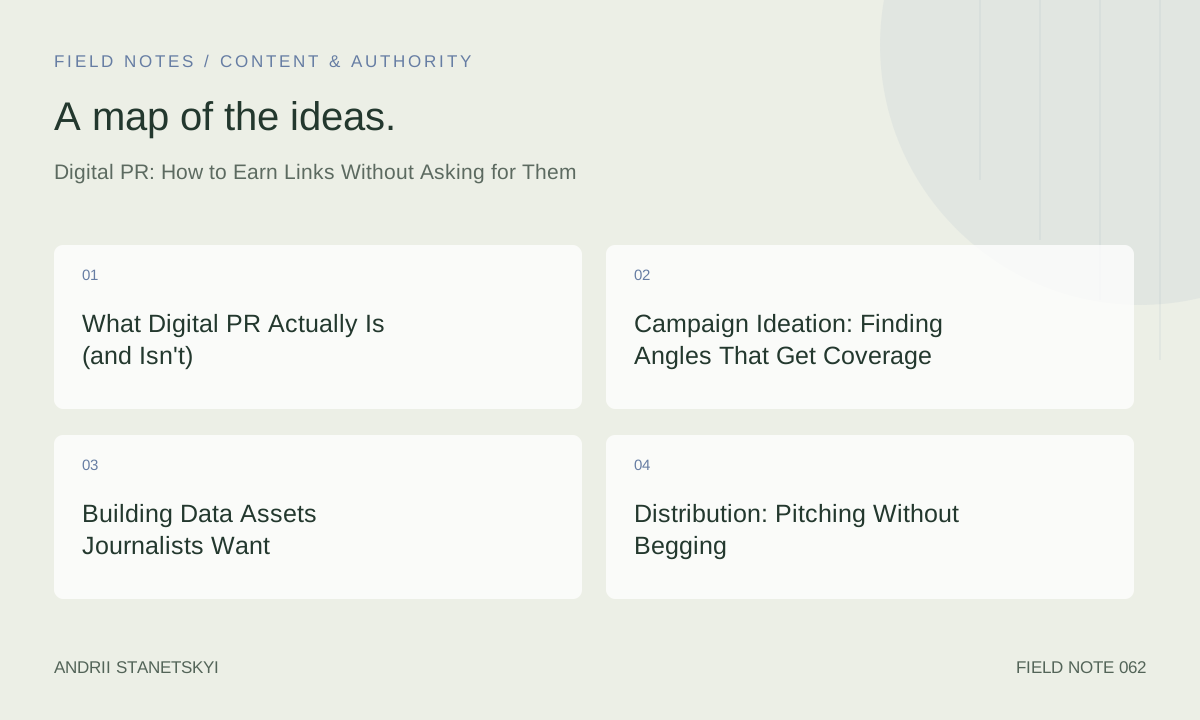
What Digital PR Actually Is (and Isn't)
Digital PR is not "content marketing with a distribution layer." It is not guest posting. It is not sponsored content. It is the practice of creating newsworthy assets — data studies, interactive tools, original research, expert commentary — and placing them in front of journalists and editors who will cover them because they have genuine editorial value.
The distinction matters because it changes your quality standard. A guest post needs to be useful to a readership. A digital PR asset needs to be newsworthy enough that a journalist at a DR 80 publication will stake their editorial reputation on covering it. That is a fundamentally higher bar.
What makes something newsworthy in the context of SEO link building:
- Original data no one else has published
- A finding that surprises or contradicts conventional wisdom
- A timely angle tied to a current news cycle
- A human-interest story with quantitative backing
- A genuinely useful tool or calculator that solves a real problem
Campaign Ideation: Finding Angles That Get Coverage
Most digital PR campaigns fail at ideation. The team produces an asset that is interesting to themselves but irrelevant to the journalists they're pitching. Rigorous ideation starts with the journalist, not the brand.
The "Journalist-First" Ideation Framework
- Identify your target publications first. Use Ahrefs' Content Explorer to find which publications have recently linked to your competitors. Filter by DR 50+ and organic traffic 10k+/month. These are your tier-1 targets.
- Study what those outlets actually cover. Look at their 20 most-shared articles in the last 90 days. What topics, what angles, what data formats perform best?
- Find the data gap. Is there a question in your industry that everyone talks about but no one has hard numbers on? That gap is your campaign angle.
- Stress-test with the "so what" filter. For every angle candidate, ask: if a journalist published this story, what would their readers get out of it? If the answer is "not much," kill the idea.
Proven Angle Categories
| Angle Type | Typical Link Yield | Avg. DR of Linking Sites | Production Difficulty | Shelf Life |
|---|---|---|---|---|
| Original survey / research report | 50–200+ | 45–70 | High (4–8 weeks) | 12–24 months |
| Index / ranking (cities, companies) | 30–100 | 40–65 | Medium (2–4 weeks) | Annual refresh |
| Interactive tool / calculator | 20–80 | 35–60 | High (development required) | Evergreen |
| Reactive / newsjacking | 5–30 | 50–85 | Low (24–48h turnaround) | Days to weeks |
| Expert roundup / prediction report | 15–50 | 35–55 | Medium | 6–12 months |
Building Data Assets Journalists Want
The research report is the workhorse of digital PR link building. A well-executed study can generate links across three distinct distribution phases: pre-launch (embargo coverage), launch, and evergreen long-tail.
Survey Design That Produces Citable Data
Your survey needs at least 300 respondents for credibility; 500+ is preferred for segmentation. Use tools like SurveyMonkey Audience, Pollfish, or Lucid for paid panels. Key design principles:
- Keep surveys under 10 questions — completion rates drop sharply beyond that
- Include at least one counterintuitive question designed to produce a surprising finding
- Segment by demographics that journalists care about: age, geography, company size, industry
- Design for a headline: "67% of marketers say X" is a headline; "many marketers do X" is not
Packaging the Asset
A data study lives on a purpose-built landing page with these elements:
- Clear headline with the most striking stat
- Methodology section (journalists will ask about this)
- Embeddable charts and infographics (removes friction for coverage)
- Full data download option (CSV/PDF) — increases perceived credibility
- Author bio establishing expertise
Distribution: Pitching Without Begging
The pitch is not a link request. It is a story tip. The framing difference is everything. You are not asking a journalist to do you a favour — you are giving them a story they will thank you for.
Building Your Media List
In Ahrefs, run a Link Intersect report: sites that link to two or more of your top competitors but not to you. Filter for DR 50–85 and organic traffic 20k+/month. Export this list and cross-reference with recent articles on your topic using BuzzSumo or Ahrefs Content Explorer to identify the specific writers covering your beat.
Timing Your Launch
Tuesday and Wednesday mornings (8–10am recipient's local time) consistently outperform other send windows. Avoid Mondays (inbox overload), Fridays (journalists checking out), and news-heavy news cycles that will bury your story. Monitor Google Trends and Twitter/X for competing narratives before launch.
Outreach Templates and Scripts
The following templates are designed for journalists, not SEO editors. Adapt them to each specific reporter's beat.
Initial Pitch Email — Data Study
Subject: Exclusive: [Striking stat from your study] — [Publication]-first data

Hi [First name],

I noticed your recent piece on [specific article they wrote] — this data might be a natural follow-up for your readers.

We surveyed [N] [audience] and found [most surprising finding]. A few headlines from the data:

• [Stat 1 — most counterintuitive]
• [Stat 2 — most actionable]
• [Stat 3 — most relevant to their beat]

The full study is embargoed until [date], but I'd be happy to share it with you exclusively before then. Includes methodology, raw data file, and pre-built charts.

Worth a look?

[Name]
[Title, Company]
Follow-Up Email (Day 5, if no response)
Subject: Re: [Original subject line]

Hi [First name],

Bumping this in case it got buried. The embargo lifts [date] — happy to extend an exclusive window to [publication] if you're interested in covering this before the public release.

Full dataset and expert commentary available on request.

[Name]
Reactive Pitch — Newsjacking
Subject: Data angle for your [news topic] coverage

Hi [First name],

Saw your coverage of [recent news event]. We actually have relevant data on this that might add depth:

[One-sentence stat directly relevant to the news story]

This is from our [dataset/research], which we'd be happy to share in full. I can also connect you with [expert name] for a quote if useful.

Happy to send details — 2-minute response if interested.

[Name]
Measuring Campaign Performance
Track these metrics at 30, 60, and 90 days post-launch:
- Total referring domains acquired (Ahrefs, filter for new links to campaign URL)
- DR distribution of linking sites (breakdown by tier: 70+, 50–69, 30–49, <30)
- Average UR of linking pages
- Organic traffic to campaign page (GSC)
- Anchor text distribution (check for unnatural patterns)
- Share of voice in coverage (were you the primary source or buried in a list?)
A successful tier-1 digital PR campaign benchmark: 40+ referring domains, 30%+ from DR 50+ sites, within 90 days of launch.
Mini Case Study: FinTech Startup, 140 Links in 6 Weeks
Client: Personal finance app, DR 31 at start, in the competitive "budgeting app" space.
Campaign angle: "The Savings Gap Index" — original survey of 600 Americans on savings habits vs. self-reported financial goals, segmented by age, income, and state.
Key finding used as hook: "73% of Americans aged 25–34 have less than one month of expenses saved, despite 89% saying they plan to save more this year."
Outreach:
- 130 journalists contacted via Pitchbox (personal finance, business, lifestyle beats)
- 18 embargoed exclusives offered to tier-1 outlets
- 3 exclusive pieces placed (Business Insider, Forbes Advisor, NerdWallet)
Results:
- 140 referring domains within 6 weeks
- DR range of linking sites: 25–91
- 38 links from DR 50+ sites
- Domain rating increased from 31 to 44
- Primary keyword cluster rankings improved by average 8.3 positions
What worked: The state-level segmentation allowed regional publications (local news, city business journals) to write "local angle" stories — "Here's how [State] residents compare." This multiplied coverage without additional outreach effort. See our guide on link velocity for how to manage sudden link spikes safely.
FAQ
How is digital PR different from traditional link building outreach?
Traditional outreach asks for a link. Digital PR offers a story. The mindset shift changes everything — your pitch success rate, the quality of sites that respond, and the editorial permanence of the links you earn. Links earned through genuine editorial coverage are far more durable than links earned through reciprocal arrangements.
What budget do I need for a digital PR campaign?
A basic survey campaign (300 respondents via Pollfish, one landing page, 8 weeks of outreach) costs $3,000–$8,000 in execution costs. A premium campaign with 600+ respondents, professional design, and dedicated PR outreach support runs $15,000–$40,000. The cost-per-link from digital PR is almost always lower than equivalent-quality links from other methods.
How do I protect the link if a journalist covers the story but doesn't link?
Follow up politely within 48 hours of publication: "Great piece — would you mind adding a link to the original data source so readers can verify the methodology?" Cite it as a journalistic transparency standard, not an SEO request. Success rate on this ask is approximately 40–60%.
Can small sites execute digital PR, or is it only for established brands?
Any site can execute digital PR with the right data angle. Credibility comes from the research methodology and the data quality, not the brand name. A startup with genuinely original survey data will outperform a legacy brand with recycled statistics. See our guide on building link-worthy assets for small sites.
How often should I run digital PR campaigns?
For most sites: one major campaign (50+ target links) per quarter, supplemented by reactive/newsjacking campaigns as opportunities arise. Running campaigns more frequently without sufficient ideation time leads to diminishing returns and journalist fatigue with your brand as a source.
What tools do I need for digital PR outreach at scale?
Minimum viable stack: Ahrefs (prospecting and competitor research), BuzzSumo or Sparktoro (journalist identification), Pitchbox or BuzzStream (outreach CRM), Hunter.io (email discovery). For enterprise campaigns, add Cision or Muck Rack for media database access and coverage monitoring.
Key Takeaways
- Digital PR earns links by being newsworthy — build the asset first, pitch second. Never reverse this order.
- Original survey data with a surprising finding is the most reliably scalable digital PR format in 2026.
- Pitch journalists, not editors. Write subject lines like story tips, not link requests.
- State/regional segmentation of national data multiplies coverage without additional outreach effort.
- Measure campaigns at 30/60/90 days. The long tail of coverage often matches the initial spike.
- A DR 80 link from Business Insider on a digital PR campaign is worth more than a month of standard outreach. Invest in the asset quality accordingly.
Conclusion
Digital PR is the most defensible link building strategy available in 2026, precisely because it is the hardest to replicate at scale. It requires real research, real relationships, and real editorial judgment. But the payoff — dozens of high-DR editorial links from a single campaign, earned without a single direct link request — is a compounding advantage that generic outreach tactics cannot match. Build assets worth linking to, and the links will follow. See the PRSA's framework for ethical digital PR practices.