Google Business Profile (GBP) remains the single most leveraged piece of real estate in local search. One well-optimized profile can drive more qualified foot traffic than a six-month link-building campaign. Yet most businesses treat it as a set-and-forget listing. This guide is for practitioners who want to extract every ranking and conversion signal GBP offers in 2026.
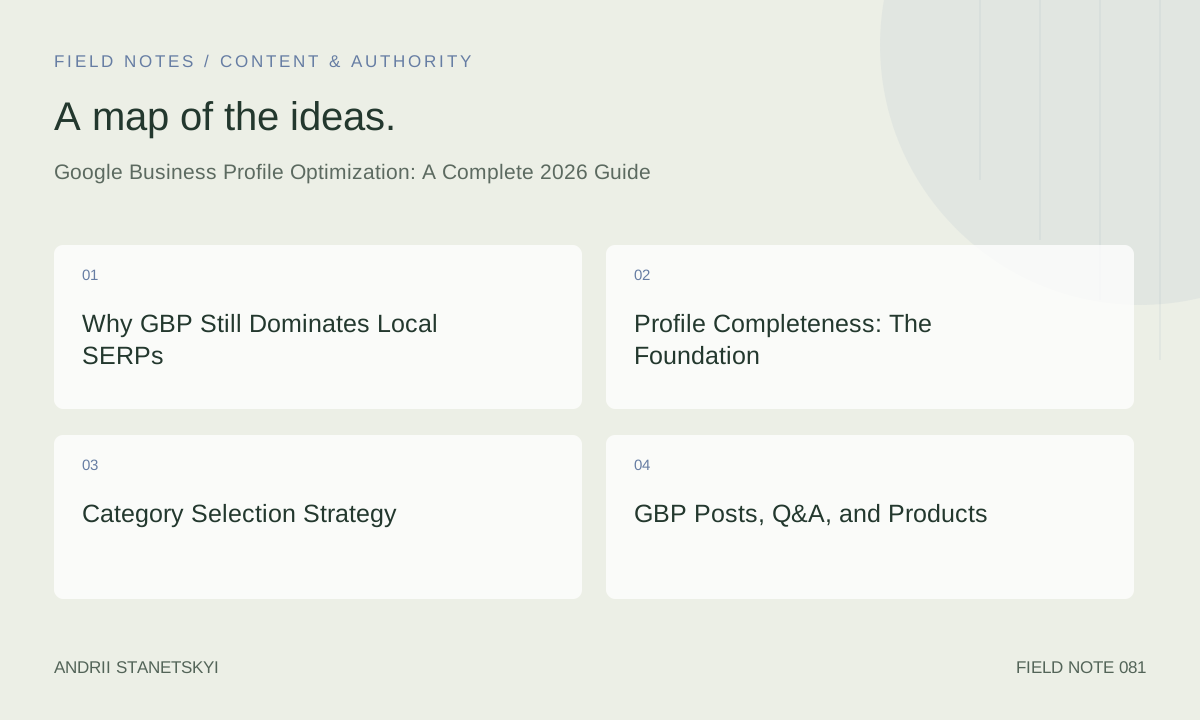
Why GBP Still Dominates Local SERPs
In 2026, the local pack appears in roughly 29% of all Google searches according to aggregated SERP studies — and for high-intent commercial queries, that figure climbs above 60%. The three-pack is the first thing users see on mobile, often above the fold with zero organic results visible. Clicks on map listings convert at 2–4x the rate of organic blue links for local intent queries.
Google's continued investment in AI Overviews has not displaced GBP — if anything, the AI summaries pull from GBP attributes (hours, price range, services) to populate local answer cards. A poorly maintained profile now feeds inaccurate data directly into AI-generated responses, compounding visibility damage.
The three core ranking factors for local pack have not changed in substance: Relevance, Distance, and Prominence. But the signals feeding each factor have evolved. In 2026, behavioral signals (clicks, direction requests, calls from GBP) carry more weight than in previous years, and GBP completeness now directly influences how Google interprets relevance.
Profile Completeness: The Foundation
Google's own documentation acknowledges that complete profiles are more likely to be shown to searchers. Empirically, profiles with every available field populated outperform sparse profiles in local pack rankings, especially in competitive verticals. Treat this like technical on-page: every missing field is a gap a competitor can exploit.
Essential Fields Checklist
- Business Name: Legal name only — no keyword stuffing. GBP's spam detection will suppress or suspend profiles with keyword-injected names.
- Primary Category: The single highest-impact field. More on this in the next section.
- Secondary Categories: Add up to 9 additional categories relevant to your service mix.
- Address: Consistent with your website and all citation sources (exact NAP match).
- Service Area: For SABs (service-area businesses), hide the address and define your coverage zones at city/zip level.
- Phone: Local number preferred over 800 numbers — local area codes remain a proximity trust signal.
- Website URL: Use a UTM-tagged URL or a tracking landing page to isolate GBP traffic in GA4.
- Hours: Keep regular and special hours current — outdated hours trigger "Permanently closed" crowdsourced suggestions from users.
- Attributes: Category-specific attributes (wheelchair access, outdoor seating, LGBTQ-friendly) influence filter-based searches and knowledge panel display.
- Description: 750 characters, naturally incorporating your primary and secondary keywords. Not a ranking field per Google's documentation, but it feeds AI summaries.
- Services/Menu: Add individual services with descriptions and pricing where applicable. These feed Google's service-based search features.
- Products: Brick-and-mortar and online retailers can link product listings directly — these appear in the "Products" carousel on the knowledge panel.
Category Selection Strategy
Category selection is the most critical and most under-strategized element of GBP optimization. The primary category determines which search queries your profile is eligible to appear for. Get this wrong and no amount of reviews or posts will save your rankings.
How to Select the Right Primary Category
The correct process: search your target keyword in Google Maps in incognito mode, identify the top 3 ranking competitors, and audit their primary categories using a tool like GMB Everywhere or Pleper. The category used by the majority of top-ranked competitors for your target query is your primary category candidate.
Do not default to the broadest available category. A "Law Firm" category is less specific than "Personal Injury Attorney" — specificity wins when your exact service matches a more granular category.
| Category Type | Example | Query Eligibility | Competition Level | Best For |
|---|---|---|---|---|
| Broad | Restaurant | Very high | Extreme | Multi-cuisine establishments |
| Mid-tier | Italian Restaurant | High | High | Most single-concept restaurants |
| Specific | Pizza Restaurant | Moderate | Moderate | Pizza-focused operators |
| Hyper-specific | Neapolitan Pizza Restaurant | Low | Low | Niche premium operators |
GBP Posts, Q&A, and Products
Posts
GBP Posts are underutilized by most businesses. While Google has not confirmed a direct ranking impact, posts drive engagement signals — clicks, calls, and direction requests — that correlate with local pack position improvements in controlled tests. More practically, posts occupy additional real estate in the knowledge panel and keep your profile looking actively managed, which influences user trust and click-through rate.
Effective post cadence: at minimum, 1 post per week for competitive markets. Use Event posts for time-bounded promotions (these display a countdown timer), Offer posts for discount codes, and Update posts for general news. Each post should include a high-quality image and a clear call to action.
Q&A
The Q&A section is crowd-sourced and moderated poorly by Google. Left unmanaged, competitors or bad actors can seed inaccurate questions and answers. Best practice: seed your own Q&A section with the 10 most common questions your staff answers on the phone. Answer them from your Google account as the business owner. This gives you authoritative answers indexed in Google and reduces friction to conversion.
Monitor Q&A weekly using BrightLocal's GBP audit tools or manually. Flag and report inaccurate answers immediately.
Products
For retail businesses, the Products feature enables direct browsing from the knowledge panel. Each product entry should include a high-resolution image, accurate price, and a deep link to the exact product page on your website. This creates an additional conversion path that bypasses organic listings entirely.
Review Acquisition and Response Strategy
Review quantity, velocity, and average rating are confirmed local ranking signals. But the quality signals embedded within reviews — specifically, keyword mentions and reviewer authority — are increasingly important in 2026 as Google uses NLP to extract sentiment and service-topic relevance from review text.
Review Acquisition at Scale
The most effective review acquisition channels, ranked by conversion rate: SMS (highest), email follow-up sequences, QR codes at point of sale, and staff verbal requests. Use a short, branded GBP link (available in the GBP dashboard under "Get more reviews") in all touchpoints. Tools like BrightLocal's review management suite automate request sequences and track response rates by channel.
Avoid incentivized review solicitation — Google's policies prohibit it, and review gating (only sending requests to happy customers) violates guidelines that can trigger listing suspension.
Response Protocol
Respond to every review within 48 hours. Positive review responses should naturally incorporate your service category and location to reinforce keyword relevance. Negative review responses should be professional, brief, and move the conversation offline. Do not include promotional language in negative review responses — it reads as defensive and can escalate.
Photo and Video Optimization
Profiles with photos receive 42% more direction requests than those without (Google internal data, cited in GBP Help documentation). In competitive verticals, photo count and recency are visible differentiation signals for users comparing multiple listings.
Photo Categories to Populate
- Logo: Square, high-resolution, consistent with brand guidelines.
- Cover photo: 1080x608px, the most prominent image in map search results.
- Exterior photos: Multiple angles, different times of day, help users identify the location.
- Interior photos: Set customer expectations, reduce no-shows for service businesses.
- Team photos: Build trust, especially for professional services (legal, medical, financial).
- Product/service photos: Category-specific, directly tied to what you sell.
Strip EXIF geolocation data from photos before upload unless it's accurate — incorrect embedded GPS coordinates can confuse Google's location verification systems. Filename optimization (e.g., chicago-deep-dish-pizza-giordanos.jpg) provides marginal but real semantic signals.
LocalBusiness Schema Alignment
Your GBP profile and your website's LocalBusiness schema must be consistent. Discrepancies in NAP data between the two sources create conflicting signals that suppress local pack performance. Here is a production-ready LocalBusiness schema template:
{
  "@context": "https://schema.org",
  "@type": "LocalBusiness",
  "name": "Greenway Plumbing Services",
  "@id": "https://www.greenwayplumbing.com/#business",
  "url": "https://www.greenwayplumbing.com",
  "telephone": "+1-312-555-0182",
  "priceRange": "$$",
  "address": {
    "@type": "PostalAddress",
    "streetAddress": "1420 N Milwaukee Ave",
    "addressLocality": "Chicago",
    "addressRegion": "IL",
    "postalCode": "60622",
    "addressCountry": "US"
  },
  "geo": {
    "@type": "GeoCoordinates",
    "latitude": 41.9086,
    "longitude": -87.6773
  },
  "openingHoursSpecification": [
    {
      "@type": "OpeningHoursSpecification",
      "dayOfWeek": ["Monday","Tuesday","Wednesday","Thursday","Friday"],
      "opens": "08:00",
      "closes": "18:00"
    },
    {
      "@type": "OpeningHoursSpecification",
      "dayOfWeek": "Saturday",
      "opens": "09:00",
      "closes": "14:00"
    }
  ],
  "image": "https://www.greenwayplumbing.com/images/storefront.jpg",
  "sameAs": [
    "https://www.facebook.com/greenwayplumbing",
    "https://www.yelp.com/biz/greenway-plumbing-chicago"
  ]
}
The sameAs array should include your GBP URL, Yelp, Facebook, and any other authoritative directory profiles. This explicitly tells Google's Knowledge Graph that these entities are the same business, strengthening entity consolidation.
GBP API and Tool Stack
At scale — multi-location brands, agencies managing hundreds of profiles — manual GBP management is impractical. The Google Business Profile API enables programmatic management of locations, posts, reviews, and Q&A at scale.
Recommended Tool Stack
| Tool | Best For | Strengths | Weaknesses | Pricing Tier |
|---|---|---|---|---|
| BrightLocal | Agencies, SMBs | Citation audit, rank tracking, review management | No bulk GBP editing | Mid |
| Yext | Enterprise, multi-location | Bulk listing management, structured data sync | Expensive, lock-in risk | Enterprise |
| Whitespark | Citation building, local rank tracking | Best citation finder in market | Limited GBP management | Mid |
| GBP Native Dashboard | Single-location businesses | Free, direct Google integration | No bulk operations, poor analytics | Free |
| Semrush Local | SEOs already on Semrush | Integrated with keyword and rank data | Less deep than dedicated local tools | Add-on |
Tracking GBP Performance
GBP's native Insights dashboard provides directional data but is notoriously imprecise. For serious measurement, combine GBP Insights with GA4 and call tracking.
Key Metrics to Track
- Search impressions (discovery vs. direct vs. branded): Discovery impressions indicate ranking for non-branded queries — the most valuable signal.
- Direction requests: Correlate with foot traffic. Track month-over-month trend.
- Phone calls from GBP: Use a unique call tracking number in GBP (different from your website number) to isolate GBP-driven calls in a call analytics platform.
- Website clicks from GBP: Use UTM parameters (
utm_source=google&utm_medium=organic&utm_campaign=gbp) on your GBP website URL and track in GA4. - Photo views vs. competitor photo views: GBP Insights shows how your photo engagement compares to category averages.
For local rank tracking, use BrightLocal's grid rank tracker or Local Falcon to measure pack position across a geographic grid — this is more accurate than single-point rank checks because pack results are heavily personalized by searcher proximity.
See also: our guide to multi-location SEO tracking and local pack ranking factors in 2026.
FAQ
How often should I update my Google Business Profile?
At minimum, verify all fields monthly for accuracy. Post updates weekly if you're in a competitive market. Update special hours for every holiday — outdated holiday hours are one of the most common triggers for user-submitted "permanently closed" reports, which can cause temporary suppression.
Does keyword stuffing in the business name help rankings?
Short-term, yes — it's a known ranking exploit. Long-term, no — GBP's spam detection has improved significantly in 2025-2026, and a suspension resulting from a competitor report will cost you weeks of recovery time. The risk-reward ratio is unfavorable. Compete on legitimate signals.
Can I have multiple GBP listings for one location?
Only if you have distinct businesses operating from the same address (e.g., a law firm and an accountancy sharing a building). Duplicate listings for the same business at the same address violate GBP guidelines and will be merged or removed.
How do I recover from a GBP suspension?
Distinguish between a "soft" suspension (listing not showing) and a "hard" suspension (access revoked). For soft suspensions: clean up any guideline violations, re-verify the listing if possible, and submit a reinstatement request through GBP support. For hard suspensions, prepare documentation proving your business legitimacy (utility bill, business license, storefront photos) before contacting support. Recovery timelines range from 2 days to 8 weeks.
Is a Google Business Profile website (the free Google-hosted site) worth using?
No. Google deprecated the free GBP website feature in March 2024. Any businesses still relying on it should have already migrated to a self-hosted website. Without a dedicated website, local pack performance is severely limited because Google cannot crawl your site to verify NAP consistency and service relevance.
Does GBP affect organic (non-local) rankings?
Not directly. GBP data influences local pack and Knowledge Panel results. Your website's organic rankings are determined by traditional ranking factors. However, GBP-driven engagement signals (branded searches, website visits from GBP) contribute indirectly to your site's authority.
How important are review responses for local pack rankings?
Google has stated that responding to reviews demonstrates that you value customer feedback, and this is reflected in how prominently your listing appears. Empirical testing confirms that consistent review response correlates with ranking improvements, particularly for businesses in the 3.8–4.2 star range where recency and engagement matter most.
Key Takeaways
- Primary category selection is the highest-leverage GBP optimization action — audit competitors before committing.
- Every unverified or incomplete GBP field is a ranking gap. Treat profile completeness as technical SEO hygiene.
- Review velocity and NLP keyword signals within review text are increasingly important ranking factors in 2026.
- LocalBusiness schema on your website must be NAP-consistent with your GBP to avoid conflicting entity signals.
- Use UTM parameters and call tracking numbers to isolate GBP's true revenue contribution — native Insights data is insufficient for ROI measurement.
- At scale, use Yext or the GBP API for bulk management; Whitespark and BrightLocal for citation audits and rank tracking.
- Behavioral signals (clicks, calls, direction requests) are confirmed ranking inputs — every UX improvement that increases these metrics is an indirect ranking strategy.
Conclusion
Google Business Profile optimization in 2026 rewards practitioners who combine technical rigor with consistent operational discipline. The basics — complete profile, accurate NAP, active review management — remain the foundation. The edge comes from behavioral signal optimization, category strategy, and schema alignment. Businesses that treat GBP as a living marketing channel rather than a static directory listing consistently outperform competitors who set it and forget it.