People Also Ask boxes appear in approximately 48% of all Google SERPs in 2026 — more frequently than featured snippets, more frequently than knowledge panels for most queries, and now integrated within AI Overviews for complex informational searches. Yet most SEO teams treat PAA as a passive byproduct of content quality. It's not. PAA is an engineerable visibility layer with a clear content structure, researchable question clusters, and measurable tracking. This playbook covers the complete PAA optimization workflow from research to measurement.
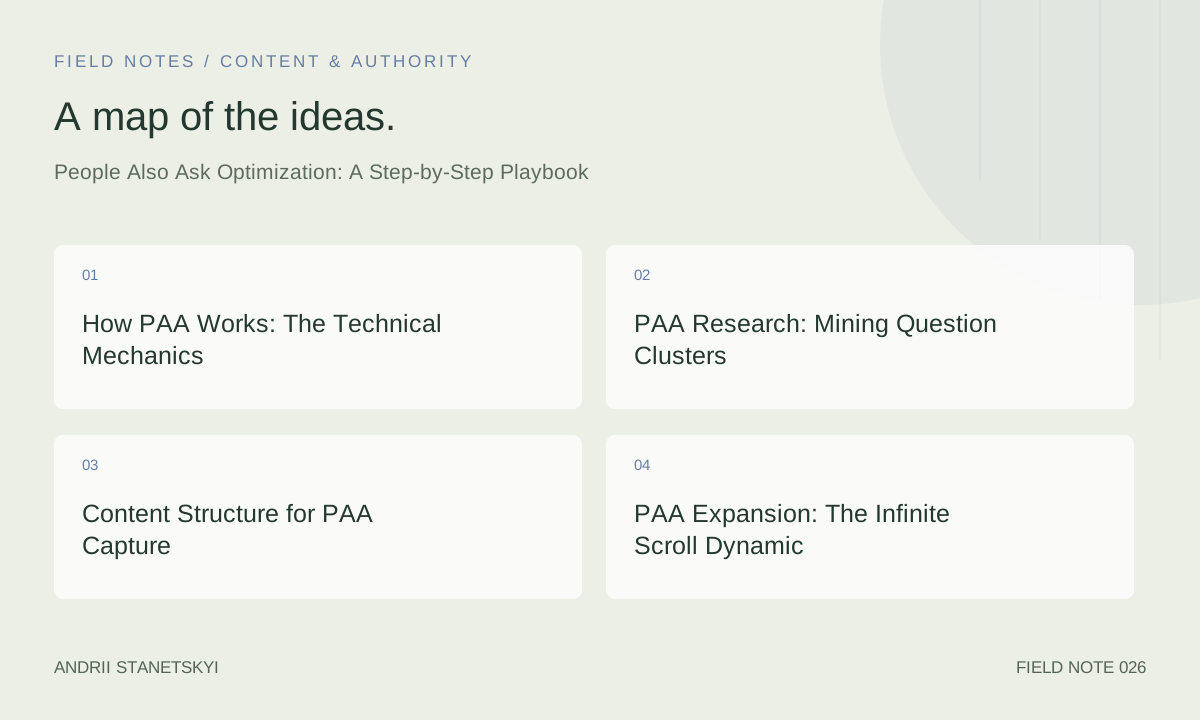
How PAA Works: The Technical Mechanics
People Also Ask is a dynamic SERP feature that surfaces questions semantically related to the user's query. When a user expands a PAA question, Google extracts an answer from a web page — similar to a featured snippet — and displays it with a link to the source page. The feature then dynamically generates new related questions, meaning the PAA box is effectively infinite for a curious user who keeps expanding.
The extraction mechanism mirrors featured snippets: Google identifies a relevant question on a web page (usually an H2 or H3 heading formatted as a question), finds the best answer in the immediately following content, and displays approximately 40–60 words of that answer. The page providing the answer earns a clickable link in the PAA box — an additional visibility surface beyond the organic blue link.
Key distinction from featured snippets: a page can hold multiple PAA answers for a single SERP simultaneously. If your page has five well-structured Q&A sections, all five questions could appear in the PAA box for a related query. Featured snippets are zero-sum (one per SERP); PAA is a pool with multiple slots.
PAA Research: Mining Question Clusters
Method 1: Live SERP Scraping with AlsoAsked
AlsoAsked.com maps the PAA tree for any query — showing the initial 4 questions, then the expansion questions triggered by each. Export the tree as a CSV and you have a question cluster map for your topic. For a seed query like "technical SEO audit," you might surface 40–60 related questions spanning beginner to advanced. This is your content brief for a comprehensive FAQ or H3-structured article.
Method 2: Semrush's Keyword Magic Tool — Questions Filter
In Semrush's Keyword Magic Tool, apply the "Questions" filter to any seed keyword. The tool surfaces questions phrased as keywords with their search volume, keyword difficulty, and SERP features. Sort by "Featured Snippet" and "People Also Ask" SERP features to identify which questions already trigger PAA boxes — these are confirmed PAA opportunities, not speculative ones.
Method 3: GSC Query Mining for PAA-Style Questions
In Google Search Console, export 12 months of query data. Filter for queries beginning with "what," "how," "why," "when," "can," "does," "should," "is," "are." These question-format queries are PAA candidates. Cross-reference impressions with your current position — if you're receiving impressions for a question query but ranking at position 8–15, your page is in consideration for PAA but not yet winning the extraction. Targeted content restructuring can shift this.
Method 4: Ahrefs' "Also Rank For" Report
In Ahrefs Site Explorer, run the "Organic Keywords" report for a top-ranking competitor and filter for question keywords where they rank in the top 5. These represent the question cluster your competitor has already validated — and where their PAA answer content has been optimized. Cross-reference against your own keyword rankings to identify gaps.
| Method | Tool | Output | Best For |
|---|---|---|---|
| PAA tree scraping | AlsoAsked.com | Question tree map | Deep question cluster discovery |
| Keyword + question filter | Semrush Keyword Magic | Questions with volume + KD | Prioritizing by search demand |
| GSC query mining | Google Search Console | Questions you already rank for | Quick wins from existing rankings |
| Competitor question gap | Ahrefs | Validated questions by top-rankers | Confirming demand before creating content |
Content Structure for PAA Capture
The Gold Standard: FAQ Schema + H3 Q&A Sections
The most reliable PAA capture pattern combines semantic HTML structure with FAQ schema markup. The page structure should look like:
<h3>What is the difference between crawl budget and crawl rate?</h3>
<p>Crawl budget is the total number of URLs Googlebot crawls
within a given period, determined by crawl rate limit and
crawl demand. Crawl rate is the speed at which Googlebot
requests pages from your server. Managing crawl budget focuses
on which pages get crawled; managing crawl rate focuses on
server load during crawling.</p>
Then the corresponding JSON-LD FAQ schema markup at page bottom:
<script type="application/ld+json">
{
  "@context": "https://schema.org",
  "@type": "FAQPage",
  "mainEntity": [{
    "@type": "Question",
    "name": "What is the difference between crawl budget and crawl rate?",
    "acceptedAnswer": {
      "@type": "Answer",
      "text": "Crawl budget is the total number of URLs Googlebot crawls
      within a given period... Crawl rate is the speed at which
      Googlebot requests pages from your server."
    }
  }]
}
</script>
The HTML structure enables extraction from the page content. The schema markup reinforces the Q&A structure for Google's understanding. Together they create a strong PAA capture signal.
Answer Length and Formatting
PAA answers display approximately 40–55 words in the collapsed SERP view. Longer answers are truncated with a "More" expansion. The optimal strategy: write a 40–55 word direct answer as the first paragraph under the question heading, then expand with additional detail in subsequent paragraphs. Google extracts the first complete paragraph as the PAA answer; users who want more detail can click through to the full page.
Question Phrasing Best Practices
- Match the exact question phrasing from PAA research (AlsoAsked, Semrush Questions) — Google's extraction models use exact and near-exact question matching
- Use natural conversational phrasing, not SEO-keyword-constructed questions
- Include the target entity in the question: "What is [specific term]?" not "What is this?"
- Format questions as full interrogative sentences with question marks
- Group related questions under their corresponding H2 section, nested as H3s
PAA Expansion: The Infinite Scroll Dynamic
When a user expands a PAA answer, Google replaces that question with 3–4 new related questions. This means the PAA pool for any query is effectively unbounded. For SEO strategy, this creates two implications:
Long-tail PAA opportunities: Questions that only appear after 2–3 expansions have lower competition because fewer SEOs are explicitly targeting them. However, they're still displayed to curious users who engage with the PAA box — a high-intent, high-engagement audience. Creating content that answers these deeper expansion questions can generate visibility with very low competition.
Topic cluster validation: The questions that appear in PAA expansion for your primary keyword define the comprehensive topic cluster for that keyword. If you're writing a pillar page on "email deliverability," expanding the PAA box 2–3 levels deep gives you a comprehensive map of sub-topics your pillar must address to be considered authoritative by Google's content understanding models.
Integration with Existing Content
Retrofitting Existing Articles
Most PAA optimization work happens on existing content, not new articles. The workflow for retrofitting:
- Identify the page's primary ranking keyword
- Research the PAA question cluster for that keyword (AlsoAsked, GSC questions)
- Audit the page for existing Q&A sections — many articles have FAQ sections that are already close to PAA-ready
- Restructure existing FAQ Q&As to match the question phrasing from research
- Add missing high-priority questions from the research as new H3 + answer paragraph pairs
- Ensure FAQ schema is present and matches the on-page Q&A content exactly
- Request re-indexing via GSC URL Inspection
New Content: Building for PAA from the Start
For new content creation, run PAA research before writing. Build the Q&A sections into the content brief with pre-specified question text and target answer word counts. Clearscope and Frase's SERP analysis features show which questions appear in the PAA box for your target keyword — use this data to brief the writer rather than leaving question discovery to post-production editing.
See our content brief template for PAA-optimized articles.
Tracking PAA Ownership
What GSC Shows (and What It Doesn't)
GSC doesn't explicitly label PAA clicks. However, there's a reliable proxy: queries that return question-format impressions with very high impression volume but moderate position (average position 8–12 range) are frequently PAA-source queries — the impression comes from the PAA box, not from ranking position 8–12 in the organic results. The CTR on PAA positions is typically lower than featured snippet CTR (0.5–2% range) but the incremental visibility is additive to existing organic rankings.
Semrush and Ahrefs Tracking
Semrush's Position Tracking shows the "PAA" SERP feature presence for tracked keywords and flags when you hold a PAA answer. Set this as a weekly review in your SEO reporting. Ahrefs' SERP feature filter in rank tracking similarly flags PAA ownership. Track your PAA portfolio alongside featured snippets — they often move together, since the content optimizations that win one tend to win the other.
Manual Validation
For priority pages, manually search your target queries in an incognito browser weekly. Expand PAA questions and note which pages are providing answers. Screenshot the PAA box and track changes over time. This manual verification catches PAA ownership that automated tools may lag in detecting by 1–2 weeks.
Case Study: 67 PAA Captures in 90 Days
A B2B software company with a 200-article content library had zero tracked PAA captures despite ranking in the top 5 for 80+ informational keywords. Audit findings:
- No FAQ schema on any page
- FAQ sections existed but used generic question phrasing that didn't match actual PAA question text
- Answer paragraphs were 100–150 words (too long for clean extraction)
- Questions were H4 or bold paragraph text, not H3 semantic headings
The intervention, executed over 6 weeks:
- AlsoAsked research for all 80 target keywords — generated 340 specific question-text variants
- Mapped research questions against existing FAQ sections — 60% overlap, 40% new content needed
- Restructured FAQ sections: upgraded question formatting to H3, trimmed answers to 40–55 words, added missing questions
- Implemented FAQ schema across all 80 pages via CMS template update
- Requested re-indexing for all 80 pages in GSC
Results at 90 days: 67 confirmed PAA captures (tracked via Semrush), 14 new featured snippet wins (bonus from the same structural changes), and an average CTR increase of 4.2 percentage points across the restructured pages.
Read our full on-page SEO case studies collection.
FAQ
Does PAA optimization require FAQ schema markup?
Schema markup is not required for PAA extraction — Google extracts PAA answers from properly structured HTML content without schema. However, FAQ schema provides a reinforcing signal that consistently improves extraction reliability and speed. The combination of semantic H3 question headings + direct answer paragraphs + FAQ schema is the highest-reliability PAA capture structure and adds only 20–30 minutes of implementation work per page.
Can one page hold multiple PAA answers for the same SERP?
Yes. Multiple Q&A sections on a single page can each independently provide PAA answers within the same SERP's PAA box. This is distinct from featured snippets where only one source can hold position zero. For comprehensive pillar pages with 10+ Q&A sections, it's not uncommon to hold 3–5 PAA answers within a single SERP's PAA pool.
How long does it take to win a PAA after content restructuring?
Typically 2–8 weeks, depending on crawl frequency for your domain. Pages that are crawled daily (high-traffic, frequently updated) see PAA captures within days of content changes. Lower-priority pages may take 6–8 weeks to recrawl and have the PAA extraction updated. Request re-indexing via GSC URL Inspection immediately after making PAA-optimization changes to expedite the process.
Do PAA answers drive meaningful traffic?
Individual PAA answers drive less traffic than featured snippets — estimated 0.5–2% CTR per PAA box impression versus 5–15% for featured snippets. However, a page holding 3–5 PAA answers in a high-volume SERP can accumulate meaningful incremental traffic. The strategic value of PAA is visibility diversification: your page appears in the SERP in three places simultaneously (organic listing, featured snippet if held, PAA answers), which increases total impressions and brand exposure even when individual PAA CTR is modest.
Can PAA answers help with AI Overview citation?
Yes — significantly. Google's AI Overviews frequently cite the same sources that hold PAA answers for related queries. The content signals are nearly identical: clear question-answer format, concise direct answers, strong topical authority. Optimizing for PAA in 2026 is one of the most reliable paths to AI Overview citation frequency.
What's the best way to prioritize which questions to target?
Prioritize by: (1) search volume of the parent query where the PAA appears — high-volume parent queries mean more PAA impressions; (2) your current ranking position for the parent query — pages already in the top 5 have higher PAA eligibility; (3) question competition — check if the current PAA answer source has a high-authority domain or if it's beatable with better content structure.
Key Takeaways
- PAA appears in ~48% of SERPs in 2026 and is an engineerable visibility layer, not a passive byproduct.
- Use AlsoAsked for question tree maps, Semrush Questions filter for volume-prioritized question lists, and GSC for quick-win existing ranking questions.
- The capture pattern: H3 question heading → 40–55 word direct answer paragraph → FAQ schema markup.
- One page can hold multiple PAA answers in the same SERP — unlike featured snippets, PAA is not zero-sum.
- PAA optimization overlaps heavily with featured snippet and AI Overview citation optimization — it's the same structural work.
- Retrofit existing content first (highest ROI) before creating net-new PAA-focused content.
- Track with Semrush Position Tracking and validate manually with weekly incognito SERP checks.
Conclusion
People Also Ask is an underutilized visibility multiplier. The research is systematic, the content structure is precise, and the implementation is repeatable at scale. For a content-heavy site with 200+ articles, a six-week PAA optimization sprint targeting the top-traffic pages can generate 50–100 new SERP visibility placements with zero new content creation — purely from restructuring what already exists. That return on structural editing time is exceptional by any SEO efficiency measure. Run the AlsoAsked research, restructure the Q&A sections, implement the schema, and track the results. The playbook works when you work it.