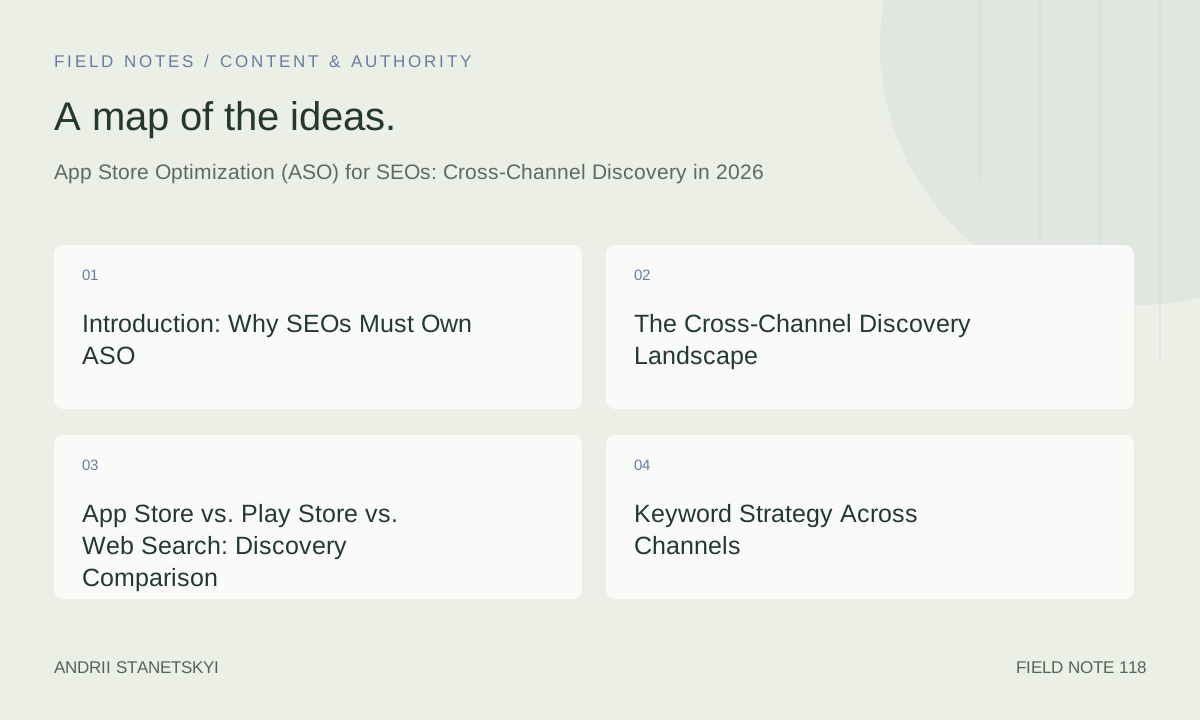
Introduction: Why SEOs Must Own ASO
For most of the past decade, App Store Optimization and Search Engine Optimization lived in parallel silos. The SEO team worried about rankings in Google and Bing; the mobile team tinkered with screenshots and keyword fields in App Store Connect. That division no longer makes strategic sense. As of 2026, roughly 65 percent of app discoveries on Android begin with a Google Search query, and Apple's own data confirms that Spotlight, Siri Suggestions, and Google-indexed app content collectively drive more first-open sessions than featured editorial placements do. The channels have converged.
This guide is written for senior SEO practitioners who already understand keyword intent, technical markup, and link authority — and who now need to extend that knowledge into the app store ecosystem. We will cover the full cross-channel discovery stack: from MobileApplication JSON-LD and smart app banners to the Universal Links infrastructure that replaced Firebase Dynamic Links after Google's 2025 sunset, and the commercial intelligence tools — AppFollow, AppTweak, Sensor Tower — that give your ASO programme the same data rigour you expect from an enterprise SEO platform.
You will leave this article with a replicable process, real schema snippets, and an honest assessment of where the two disciplines align and where they still require separate workflows. See our foundational SEO strategy guide if you need a refresher on core organic search principles before proceeding.
The Cross-Channel Discovery Landscape
How Users Actually Find Apps in 2026
The old mental model — user opens app store, searches, downloads — accounts for less than half of app acquisition in mature markets. The realistic funnel looks more like a web of touchpoints:
- Google organic search: Queries like "best budgeting app for freelancers" surface Google Play store listings directly in the SERP, often above traditional web results. Google indexes Play store descriptions and user reviews.
- Apple Spotlight & Siri: On-device search on iOS 17 and later surfaces apps based on metadata in App Store Connect, usage signals, and on-page web content associated with your domain. Apple's private relay infrastructure means you receive zero first-party attribution data — but the traffic is real.
- Universal Search in the App Store: Apple's algorithm weights localised keyword fields, ratings velocity, download velocity in a geographic cohort, and in-app event content — the last of which began contributing meaningfully to ranking in late 2024.
- Google Play Explore & Editorial: Play's "For You" feed increasingly uses signals from a signed-in user's Chrome browsing history. A site that ranks well for a topic will have its associated app surfaced more readily to users who browse that site.
- Web-to-app transitions: A web user landing on your site via organic search who then taps a smart app banner or a Universal Link deep into the app represents a full cross-channel journey — and the one where SEO work most directly converts to app installs.
The Attribution Problem
One reason SEOs historically avoided ASO is that attribution is fragmented. Apple's SKAdNetwork caps install attribution at a campaign level with a 24-to-48-hour postback delay and no user-level data. Google's Android privacy sandbox, fully enforced since early 2025, imposes similar constraints. This does not mean measurement is impossible — it means you must build a probabilistic attribution model that triangulates App Store Connect analytics, Play Console install reports, and server-side conversion data. Our mobile attribution guide covers that modelling in depth.
App Store vs. Play Store vs. Web Search: Discovery Comparison
| Factor | Apple App Store | Google Play Store | Web Search (Google/Bing) |
|---|---|---|---|
| Primary ranking signals | Keyword field, title, subtitle, ratings velocity, download velocity, in-app events, reviews | Title, short description, long description (full-text indexed), ratings, installs, engagement | Content relevance, E-E-A-T, backlinks, Core Web Vitals, structured data, user signals |
| Keyword character limits | 30 (title) + 30 (subtitle) + 100 (keyword field) = 160 effective chars | 50 (title) + 80 (short description) + 4,000 (long description, indexed) | No hard limit on page content; title tag ~60 chars, meta description ~160 chars |
| External link authority | Not a ranking signal (indirect via brand search volume) | Not a direct signal (backlinks to Play listing do not pass PageRank) | Core ranking signal |
| Indexation by Google | Partial — App Store pages indexed but ranking capped | Full — Play listings rank in Google SERP for branded and category queries | Full |
| Localisation granularity | 40 storefronts, separate metadata per locale | 72 languages, machine-translated if not provided | hreflang + ccTLD/subdirectory |
| Review signals | Rating displayed prominently; reviews indexed by Apple only | Reviews indexed by Google; appear in rich results via aggregate rating schema | Reviews via third-party schema on web page |
| Primary analytics tool | App Store Connect, AppFollow, AppTweak, Sensor Tower | Play Console, AppFollow, AppTweak, Sensor Tower | Google Search Console, SEO platforms |
| A/B testing capability | Product Page Optimisation (up to 3 variants, 90-day limit) | Store Listing Experiments (up to 5 variants, unlimited duration) | Server-side or CMS-based experiments |
| Deep linking support | Universal Links (AASA file) | Android App Links (Digital Asset Links JSON) | N/A (web URLs) |
Keyword Strategy Across Channels
Mapping Search Intent to Store Intent
Web search intent taxonomy (informational, navigational, commercial, transactional) maps imperfectly but usefully onto app store search behaviour. In the App Store and Play Store, queries cluster into three intent categories: discovery ("best habit tracker"), brand ("Notion app"), and feature ("app that reads PDFs aloud"). Feature-intent queries are systematically underserved by most ASO programmes and systematically overserved by web SEO — which creates a gap you can close by mirroring your best-performing web feature pages in your app store long description (Play) or in Custom Product Pages (iOS).
Step-by-Step: Building a Unified Keyword List
- Export your top-performing organic web keywords from Google Search Console filtered to queries that mention your core product category. Strip navigational branded queries.
- Run those keywords through AppTweak or Sensor Tower's keyword tool. Both platforms will score each keyword on search volume, difficulty, and relevance within the store. Sensor Tower's "Keyword Spy" feature lets you reverse-engineer competitor keyword fields on iOS — something Apple does not expose natively in App Store Connect.
- Identify the overlap. Keywords that perform well on web AND have meaningful store search volume are your highest-priority targets. These terms already have demonstrated consumer demand; you are simply extending your coverage into a new channel.
- Identify store-unique high-volume terms. App stores have their own vocabulary. "Offline mode," "widget support," "no subscription" are feature qualifiers that drive significant store search volume but rarely appear in web SEO keyword research. These belong in your subtitle and keyword field on iOS, and woven naturally into the first 80 characters of your Play short description.
- Localise with tool support. AppFollow's localisation module and AppTweak's market-level keyword volumes let you replicate this process per storefront without relying on machine translation of keyword intent.
Metadata Architecture for iOS
Apple's 100-character keyword field is comma-delimited with no spaces after commas, and Apple's algorithm does tokenise phrases across the field, title, and subtitle. Avoid repeating words across fields — each character is scarce real estate. The title carries the highest weight; your primary category keyword belongs there. The subtitle carries secondary weight and is the right home for a secondary use-case keyword plus your strongest differentiator. The keyword field is for long-tail and complementary terms that do not fit naturally in human-readable fields.
Technical Implementation: Schema, App Indexing & Smart Banners
MobileApplication JSON-LD Schema
Adding MobileApplication structured data to your web pages that describe your app is the single highest-leverage technical action an SEO can take for app cross-channel discovery. It signals to Google which app corresponds to your web presence, enables rich results in Search, and can trigger app install prompts in Chrome on Android.
{
  "@context": "https://schema.org",
  "@type": "MobileApplication",
  "name": "YourApp — Category Keyword",
  "operatingSystem": ["ANDROID", "IOS"],
  "applicationCategory": "FinanceApplication",
  "offers": {
    "@type": "Offer",
    "price": "0",
    "priceCurrency": "USD"
  },
  "aggregateRating": {
    "@type": "AggregateRating",
    "ratingValue": "4.7",
    "ratingCount": "28400",
    "bestRating": "5",
    "worstRating": "1"
  },
  "author": {
    "@type": "Organization",
    "name": "Your Company Name",
    "url": "https://www.yourcompany.com"
  },
  "description": "A concise, keyword-rich description matching your Play Store short description. Under 160 characters for SERP truncation safety.",
  "url": "https://www.yourcompany.com/app/",
  "downloadUrl": "https://play.google.com/store/apps/details?id=com.yourcompany.yourapp",
  "installUrl": "https://apps.apple.com/app/yourapp/id123456789",
  "screenshot": [
    "https://www.yourcompany.com/images/app-screenshot-1.png",
    "https://www.yourcompany.com/images/app-screenshot-2.png"
  ],
  "softwareVersion": "6.2.1",
  "datePublished": "2022-03-15",
  "dateModified": "2026-04-01"
}
Apple Smart App Banners
Smart App Banners render a native iOS banner at the top of a Safari page inviting users to open or download your app. The implementation is a single meta tag. The app-argument parameter accepts a URL or deep link value that routes the user to the correct in-app screen rather than the app home screen — critical for conversion.
<!-- Place in <head> on all pages that have an app-equivalent screen -->
<meta name="apple-itunes-app"
      content="app-id=123456789,
               affiliate-data=ct=smart-banner&pt=yourpartnertoken,
               app-argument=yourapp://screen/product/456">
For Android, Chrome displays an ambient banner based on the intent URL in your Digital Asset Links configuration rather than a meta tag. The smart banner meta tag is Apple-only; do not omit the app-argument value for pages where context matters — a product page should deep link to that product, not to the app home screen.
Google App Indexing Setup (Android)
App Indexing allows Google to index in-app content and serve it in mobile Search results with an "Open in app" button. After Firebase Dynamic Links sunset in August 2025, the recommended implementation path uses native Android App Links combined with a verified sitemap of app-indexed URIs submitted through Play Console.
<!-- AndroidManifest.xml — intent filter for App Links -->
<activity android:name=".ProductActivity">
  <intent-filter android:autoVerify="true">
    <action android:name="android.intent.action.VIEW" />
    <category android:name="android.intent.category.DEFAULT" />
    <category android:name="android.intent.category.BROWSABLE" />
    <data
      android:scheme="https"
      android:host="www.yourcompany.com"
      android:pathPrefix="/product/" />
  </intent-filter>
</activity>
The android:autoVerify="true" attribute triggers the Android OS to verify your Digital Asset Links JSON file at https://www.yourcompany.com/.well-known/assetlinks.json. Without verification passing, users see a disambiguation dialog rather than a direct app open — a conversion killer.
Universal Links, App Links & the Post-Firebase World
Universal Links on iOS
Universal Links are Apple's mechanism for routing a web URL directly into your app without a redirect or a custom URI scheme. The routing decision is made by iOS at the OS level based on your Apple App Site Association (AASA) file, which must be served at https://yourdomain.com/.well-known/apple-app-site-association with Content-Type: application/json and no redirect.
{
  "applinks": {
    "details": [
      {
        "appIDs": ["TEAMID.com.yourcompany.yourapp"],
        "components": [
          {
            "/": "/product/*",
            "comment": "Matches all product pages"
          },
          {
            "/": "/blog/*",
            "comment": "Matches all blog pages — open in-app browser"
          },
          {
            "/": "/checkout",
            "exclude": true,
            "comment": "Excluded — route to web for payment processing"
          }
        ]
      }
    ]
  },
  "webcredentials": {
    "apps": ["TEAMID.com.yourcompany.yourapp"]
  }
}
The Firebase Dynamic Links Sunset: What Replaced It
Google retired Firebase Dynamic Links on August 25, 2025. Any SEO or growth team still relying on FDL short links for deferred deep linking — the mechanism that routes a new user who installed the app from a web link to the correct in-app screen on first open — must have already migrated. The replacement landscape is fragmented:
- Branch.io and Adjust: The two most-adopted enterprise replacements for deferred deep linking. Both maintain a link graph that survives the app install gap and support SKAdNetwork attribution out of the box.
- AppsFlyer OneLink: Favoured in performance marketing contexts where MMP (mobile measurement partner) consolidation is a priority.
- Native Universal Links + Play Install Referrer API: The no-third-party path. Works well for teams with strong Android engineering capacity. The Install Referrer API on Android passes the referring URL through the install event, giving you a deterministic deep link target without requiring a third-party SDK. iOS has no equivalent — deferred deep linking on iOS without a third-party service requires a fingerprinting approach that Apple increasingly restricts.
For SEO-driven web-to-app flows specifically, the most important thing is that your smart app banner app-argument and your Universal Link AASA file stay synchronised with your web URL structure. A site migration that changes URL patterns without updating the AASA file will silently break Universal Links for all affected paths — something your SEO team's redirect auditing process should explicitly check for. See our site migration checklist for the full mobile verification step.
The 2026 ASO Tool Stack
AppFollow
AppFollow is primarily a review management and competitive intelligence platform. Its most useful capability for cross-channel SEO work is its keyword rank tracking with locale segmentation — you can monitor rank movement in 40 App Store storefronts and correlate spikes with metadata updates or web PR campaigns. AppFollow's review analysis uses NLP to surface feature-request themes across thousands of reviews, which is a legitimate qualitative keyword research method: users describe the features they want in the vocabulary they actually search for.
AppTweak
AppTweak is the closest ASO equivalent to a full-suite SEO platform like Semrush or Ahrefs. Its keyword difficulty scores are built on panel data for iOS and on a combination of Google Play API signals and panel data for Android. For an SEO audience, the most immediately familiar feature is the organic keyword discovery report — it shows which keywords each app ranks for in the store, analogous to an organic keyword rank report in a web SEO tool. AppTweak also provides a Store Listing Quality Score that audits your metadata against best-practice character counts, keyword placement, and localisation completeness. Use AppTweak's official documentation for API integration details.
Sensor Tower
Sensor Tower is the enterprise-tier platform, widely used for market-level competitive analysis. Its Usage Intelligence module provides monthly active user estimates and session data for competitor apps — information with no web SEO equivalent short of SimilarWeb. For SEO strategists making the case for cross-channel investment, Sensor Tower's TAM (total addressable market) and category trend data provide the executive-level context that justifies ASO budget alongside organic search budget. Sensor Tower's Category Rankings data shows seasonal patterns in app store category competition that often mirror (and sometimes lead) web search trend seasonality in the same vertical.
App Store Connect & Play Console
Native platform analytics are mandatory baselines, not optional supplements. App Store Connect's Analytics tab shows Impressions, Product Page Views, and Conversion Rate by Traffic Source — the distinction between "App Store Search" and "App Store Browse" is your organic vs. editorial split. Play Console's Acquisition reports show "Store listing visitors" segmented by Search vs. Explore vs. Third-party — map "Third-party" to your web referral traffic when correlating with Google Search Console data.
Mini Case Studies
Case Study 1: Finance App — Closing the Feature-Keyword Gap
A UK-based personal finance app had strong organic web rankings for "budgeting app" and "expense tracker" but negligible App Store visibility for the same terms. An AppTweak audit revealed that their subtitle read "Manage your money" — a brand tagline, not a keyword — and their 100-character keyword field contained generic terms already covered in the title. The SEO team mapped their top 15 web-converting queries against AppTweak keyword volumes, rewrote the subtitle to "Budget Tracker & Expense Log," and rebuilt the keyword field to prioritise long-tail feature queries ("daily spending limits," "bill reminders," "CSV export"). Within two metadata update cycles (Apple processes metadata updates within 24–48 hours), the app's App Store Search impression share for target keywords increased by 34 percent in the UK storefront. The change cost zero media spend.
Case Study 2: SaaS Productivity Tool — Web-to-App Smart Banner Conversion
A project management SaaS tool was generating roughly 40,000 mobile web sessions per month from organic search. Their smart app banner used the generic app-argument pointing to the app home screen. The engineering team, prompted by the SEO manager, updated the banner implementation to pass the current page URL as the deep link target, routing blog readers to the in-app knowledge base and pricing-page visitors to the in-app trial flow. App installs attributed to organic web sessions (measured via the Play Install Referrer API on Android and probabilistic matching on iOS) increased by 61 percent in the first 30 days. No changes were made to app store metadata in this experiment — the entire lift came from improving the web-to-app routing.
Case Study 3: E-Commerce App — Universal Links After FDL Migration
A mid-market fashion retailer migrated from Firebase Dynamic Links to Branch.io in Q1 2025, ahead of the August sunset. The migration team correctly updated Branch link configurations but failed to update the AASA file when the SEO team ran a URL restructuring project three months later. The result was a silent failure: iOS users tapping web links were routed to Safari rather than the app for all URLs matching the new /collections/ path pattern. AppFollow's session tracking (comparing app opens by traffic source) flagged the anomaly two weeks later. The fix was a one-line AASA update and a CDN cache purge — but the two-week gap represented meaningful lost conversion. The post-mortem led the team to add AASA validation to their CI/CD pipeline, running Apple's swcutil verification tool on every deployment that touches URL structure.
FAQ
Does Google use App Store ratings in web search rankings?
Not directly. Google's web ranking algorithm does not consume App Store or Play Store rating signals as a ranking factor for web pages. However, aggregate app ratings can appear in web search results via AggregateRating schema markup on your website, which can improve click-through rate on branded queries. Additionally, a high app rating contributes to brand trust signals that correlate with higher branded search volume — an indirect influence on organic search performance.
What happened to Firebase Dynamic Links, and what should I use instead?
Google formally retired Firebase Dynamic Links on August 25, 2025. All FDL short links stopped resolving. Teams that had not migrated lost deferred deep linking and cross-platform link routing. The recommended replacements in 2026 are Branch.io or Adjust for full deferred deep linking with attribution, or a native implementation using Android App Links with the Play Install Referrer API for Android deferred linking (iOS still requires a third-party service for true deferred deep linking post-install).
How do I get my app to appear in Google web search results?
Three mechanisms contribute: (1) Google indexes Play Store listing pages directly — a well-optimised Play Store listing can rank for branded and category queries. (2) Adding MobileApplication JSON-LD to your app landing page allows Google to associate your web presence with your app and surface install prompts. (3) Android App Indexing, configured via verified App Links and a URI sitemap submitted through Play Console, allows Google to index in-app content and serve it in mobile search results. Apple App Store pages receive partial indexing but do not rank competitively in Google web search for non-branded queries.
Is ASO keyword research the same as web SEO keyword research?
Methodologically similar, but with significant differences. Both involve identifying high-volume, achievable-difficulty terms that match user intent. ASO-specific differences: (1) iOS keyword fields have hard character limits (100 characters), forcing extreme prioritisation. (2) App store search volume data is estimated from panel data, not from the first-party click data Google provides in Search Console — confidence intervals are wider. (3) App store ranking algorithms weight download velocity and rating recency much more heavily than web SEO does, meaning a great keyword alone cannot overcome poor product metrics. Tools like AppTweak and Sensor Tower provide the store-specific volume and difficulty data that Google Keyword Planner cannot.
How do in-app events affect App Store discoverability?
Apple introduced In-App Events in 2021 and has progressively weighted them more heavily in the App Store algorithm since iOS 17. In-App Events are time-limited events (challenges, live sports, sales, new content releases) that appear on your product page and in App Store editorial surfaces. They do not directly affect your keyword rank position, but they influence browse-channel discovery (the "For You" tab, category pages) and can drive a downloads-velocity spike that indirectly boosts keyword rankings. For an SEO team, the content strategy angle is significant: In-App Events function like structured content that Apple indexes and surfaces, analogous to how Google surfaces structured news or event schema in rich results.
Should the SEO team or the mobile team own ASO?
In 2026, the most effective model is shared ownership with a defined RACI. The SEO team owns keyword strategy, metadata copywriting, structured data implementation, and the web-to-app technical layer (smart banners, Universal Links, schema markup). The mobile/product team owns store creative assets (screenshots, preview videos), rating and review management, in-app events, and product page experimentation in App Store Connect and Play Console. Both teams share reporting, with a unified cross-channel dashboard that surfaces App Store Search impressions alongside Google Search Console click data. Organisations that assign ASO entirely to either team consistently underperform on cross-channel metrics compared to those that build a collaborative workflow. Our guide on modern SEO team structures addresses this org design question in detail.
How do I verify that my Universal Links are working correctly?
Apple provides the swcutil command-line tool on macOS for verifying your AASA file. Run swcutil dl --domain yourdomain.com to see what Apple's CDN has cached for your domain. Additionally, Apple's App Search API validation endpoint at https://search.developer.apple.com/appsearch-validation-tool/ provides a browser-based check. For ongoing monitoring, integrate AASA file validation into your CI/CD pipeline and set up a synthetic monitor that requests the /.well-known/apple-app-site-association URL and validates the JSON structure and Content-Type header. Silent failures — wrong content type, redirect on the AASA path, missing team ID — are common and undetectable without active monitoring.
Key Takeaways
- The majority of app discovery on Android now begins in Google web search. SEOs cannot treat ASO as a separate team's problem.
- A unified keyword strategy — mapping web SEO terms to store search volumes via AppTweak or Sensor Tower — is the highest-ROI starting point for most teams.
- Add
MobileApplicationJSON-LD to every page that describes your app. It is a 15-minute implementation with measurable impact on rich result appearance and cross-channel signal coherence. - Smart app banners with context-aware
app-argumentdeep links consistently outperform generic home-screen routing by 40–60 percent in web-to-app conversion. Always pass the relevant in-app destination, not the default app open. - Firebase Dynamic Links are gone. If you have not migrated to Branch, Adjust, AppsFlyer OneLink, or a native App Links implementation, that migration is overdue.
- Universal Links fail silently. Add AASA validation to your deployment pipeline and monitor the endpoint as you would any critical web asset.
- App Store Connect and Play Console native analytics are mandatory baselines. Layer AppFollow for competitive review intelligence, AppTweak for keyword and store listing analysis, and Sensor Tower for market-level strategic context.
- In-App Events are App Store content that Apple indexes and surfaces. Brief your content team on this placement as you would any structured content format.
- Cross-channel ownership works best with a shared RACI: SEO team owns technical implementation and keyword strategy; mobile team owns creative assets and experimentation; both share reporting.
Conclusion
The convergence of web search and app store discovery is not a future trend — it is the present reality of how consumers navigate between information and software. An SEO programme that ignores the app store channel is leaving a measurable portion of its addressable organic audience unserved. Conversely, an ASO programme that does not leverage web SEO infrastructure — schema markup, link equity, content strategy, technical URL architecture — is competing in the store with one hand tied behind its back.
The good news for senior SEO practitioners is that the skills transfer more cleanly than the tool names suggest. Keyword research is keyword research. Technical markup is technical markup. The discipline of measuring what you can, modelling what you cannot, and iterating on the basis of evidence applies equally in Google Search Console and App Store Connect. The channel is new; the rigour is familiar.
Start with the quick wins: add your MobileApplication schema today, audit your smart app banner app-argument values this week, and run a keyword overlap analysis between your top web queries and your AppTweak keyword data before your next quarterly planning cycle. Each of those actions is executable within your existing team's capacity. The more complex work — deferred deep linking architecture, unified attribution modelling, AASA pipeline integration — can follow on a roadmap. Build the cross-channel discovery programme incrementally, measure it honestly, and the compounding returns will justify the investment. Request a cross-channel SEO audit to benchmark your current state before building your roadmap.