Voice search has been the SEO topic promised as transformative for a decade. In 2016, Comscore predicted that 50% of all searches would be voice by 2020. That did not happen. What did happen is more interesting and more strategically tractable: voice search bifurcated into two distinct categories that require completely different optimization approaches, and the rise of LLM-powered assistants has made one of those categories far more commercially significant than the other.
The two categories are: (1) traditional voice search through devices like Google Assistant, Siri, and Alexa—largely superseded in complexity by their AI upgrades—and (2) conversational AI assistant interactions through ChatGPT, Perplexity, Claude, and Gemini, which often begin with spoken queries. Understanding this bifurcation is the prerequisite for any serious voice search strategy in 2026.
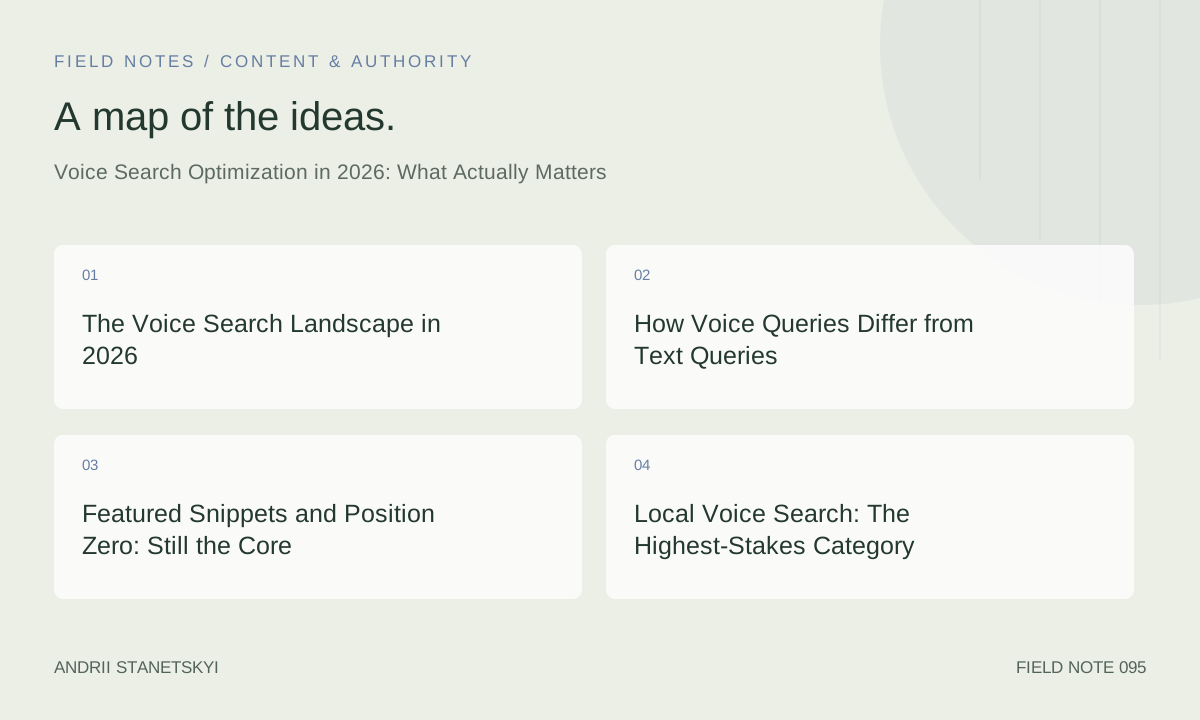
The Voice Search Landscape in 2026
The voice search ecosystem has consolidated and evolved significantly since the early "Alexa, what's the weather" era. The current landscape:
| Platform | Underlying Engine | Primary Use Case | SEO Relevance | Optimization Focus |
|---|---|---|---|---|
| Google Assistant | Google / Gemini | Mobile, smart home | High | Featured snippets, local, schema |
| Siri | Google (web search), Apple (some) | iOS ecosystem | Medium | Google optimization + Apple Maps |
| Alexa | Bing (web) + proprietary | Smart home, shopping | Medium | Bing + structured data |
| ChatGPT (voice) | OpenAI + Bing | Conversational AI | High (growing) | GEO / conversational content |
| Gemini (voice) | Android, Google ecosystem | High | Schema, AI Overviews optimization | |
| Perplexity (voice) | Multiple LLMs | Research, mobile | Medium-High | GEO, freshness, citations |
The critical observation: Google Assistant, Siri, and Alexa draw their web knowledge from Google and Bing respectively. Optimizing for Google search—particularly for featured snippets, local packs, and structured data—remains the primary lever for traditional voice assistant results. The new complexity is the LLM-powered voice category, where ChatGPT's voice mode, Gemini's voice, and similar interfaces are handling increasingly complex queries that the traditional assistant systems could not answer.
How Voice Queries Differ from Text Queries
The empirical data on voice query characteristics is now robust enough to build optimization strategy from. Key differences from text queries:
Average Query Length
Voice queries average 29 words; text queries average 3–5 words. This sounds dramatic but the more important implication is syntactic: voice queries are full sentences with natural language structure. "What's a good Italian restaurant near downtown Seattle that's open late on Sundays" is a typical voice query. No text searcher types that. The natural language query contains multiple intent signals (restaurant type, location, hours, day) that traditional keyword-based content rarely addresses simultaneously.
Question Format Dominance
Over 70% of voice queries begin with a question word: who, what, where, when, why, how. This maps directly to the FAQ content format—questions and direct answers. Content structured as Q&A is inherently voice-optimized in a way that narrative prose is not.
Local Intent Concentration
Voice search has 3× the local intent rate of text search (Brightlocal, 2024). "Near me" queries are almost entirely a voice search phenomenon. The combination of location context (mobile devices) and natural language query structure makes voice the dominant interface for local commercial discovery.
Conversational Follow-ups
LLM-based voice assistants handle multi-turn conversations. A user might ask "what are the symptoms of appendicitis" followed by "how is it treated" followed by "what should I do if I think I have it." Each follow-up inherits context from the previous. Content that comprehensively covers a topic cluster (not just a single query) performs better in multi-turn conversational retrieval.
Featured Snippets and Position Zero: Still the Core
For Google Assistant and Siri, the answer to a voice query is typically the featured snippet text, read aloud. This makes featured snippet optimization the single highest-leverage SEO activity for traditional voice search—and it remains so in 2026.
Featured snippets are earned (not purchased) for informational queries where Google identifies a single page as the best answer. The factors that correlate most strongly with featured snippet capture:
- Ranking in positions 1–5 for the query — Google almost never pulls featured snippets from below position 5 organically
- Direct question-answer format — A heading that poses the question and an immediately following paragraph (40–60 words) that answers it completely
- List and table formats — Numbered lists (HowTo style) and comparison tables are featured at higher rates than prose for procedural and comparison queries
- Schema markup — FAQPage and HowTo schema increase featured snippet eligibility for the marked-up questions and steps
The relationship between AI Overviews and featured snippets is currently in flux. On queries where an AI Overview appears, the featured snippet often disappears—replaced by the AI Overview. This means featured snippet volume is declining as AI Overview trigger rate increases. However, for voice queries where a spoken answer is needed, Google currently reads either the featured snippet or the AI Overview text. Optimization for one serves the other.
For details on AI Overview optimization, see our complete guide to AI Overview CTR impact.
Local Voice Search: The Highest-Stakes Category
Local voice search is the category with the clearest, most measurable conversion path. A user asks "best pizza near me open now" via voice and expects an immediate, accurate answer. The businesses that appear are competing for foot traffic, reservations, or immediate orders—not brand awareness.
The optimization stack for local voice search:
Google Business Profile (Mandatory)
Google Assistant reads NAP (Name, Address, Phone), hours, and ratings directly from Google Business Profile. An incomplete or inaccurate GBP means your business either does not appear or appears with wrong information. Review your GBP against these voice-critical fields:
- Business name (consistent with in-store signage and website)
- Primary and secondary categories (accurate to your actual business type)
- Hours (including holiday hours and special hours—"open now" queries check real-time hours)
- Phone number (click-to-call from voice results)
- Service area (for service-area businesses)
- Attributes ("women-owned," "outdoor seating," "LGBTQ-friendly"—voice queries for these exist)
Local Schema Markup
LocalBusiness schema on your website provides structured data that both Google and Alexa/Bing use for local voice answers. A minimal but complete LocalBusiness schema:
{
  "@context": "https://schema.org",
  "@type": "LocalBusiness",
  "name": "Example Business",
  "address": {
    "@type": "PostalAddress",
    "streetAddress": "123 Main Street",
    "addressLocality": "Seattle",
    "addressRegion": "WA",
    "postalCode": "98101",
    "addressCountry": "US"
  },
  "telephone": "+12065551234",
  "openingHoursSpecification": [
    {
      "@type": "OpeningHoursSpecification",
      "dayOfWeek": ["Monday", "Tuesday", "Wednesday", "Thursday", "Friday"],
      "opens": "09:00",
      "closes": "18:00"
    },
    {
      "@type": "OpeningHoursSpecification",
      "dayOfWeek": "Saturday",
      "opens": "10:00",
      "closes": "16:00"
    }
  ],
  "url": "https://example.com",
  "image": "https://example.com/storefront.jpg",
  "priceRange": "$$",
  "aggregateRating": {
    "@type": "AggregateRating",
    "ratingValue": "4.7",
    "reviewCount": "143"
  }
}
NAP Consistency Across the Web
Alexa (Bing) and Siri use multiple sources to validate business information. Inconsistent NAP across Yelp, TripAdvisor, Apple Maps, Bing Places, and your website creates confidence failures that reduce your likelihood of appearing in voice results. Audit your NAP consistency across the top 20 local citations annually.
Schema Markup for Voice Retrieval
Schema markup is the clearest technical signal for voice optimization because it provides machine-readable answers that voice assistants can read directly. Priority schema types for voice:
FAQPage Schema
Questions and answers in FAQPage schema are directly readable by voice assistants. Structure each Q&A pair as a complete, self-contained unit:
{
  "@context": "https://schema.org",
  "@type": "FAQPage",
  "mainEntity": [
    {
      "@type": "Question",
      "name": "What are your business hours?",
      "acceptedAnswer": {
        "@type": "Answer",
        "text": "We are open Monday through Friday from 9 AM to 6 PM, and Saturday from 10 AM to 4 PM. We are closed on Sundays and major holidays."
      }
    },
    {
      "@type": "Question",
      "name": "Do you offer free shipping?",
      "acceptedAnswer": {
        "@type": "Answer",
        "text": "Yes. We offer free standard shipping on all orders over $50 within the continental United States."
      }
    }
  ]
}
HowTo Schema
Voice queries for procedural content ("how do I change a tire," "how do I set up two-factor authentication") map to HowTo schema. Step-by-step structured content with HowTo markup is featured in Google Assistant responses for these query types at rates significantly higher than unstructured how-to prose.
Speakable Schema
Google's Speakable schema (@type: SpeakableSpecification) allows publishers to mark specific sections of their content as "optimized for audio playback." As of 2026, Google is still testing this feature, primarily with news publishers. For non-news sites, it is worth implementing as a forward-looking signal but should not take priority over FAQPage and HowTo markup.
LLM Voice Assistants: The New Frontier
ChatGPT's voice mode, launched broadly in 2024, is fundamentally different from traditional voice assistants. It conducts multi-turn conversations, reasons about complex queries, and retrieves live web information (via SearchGPT) when needed. Gemini's voice interface, integrated into Android in 2025, has similar capabilities.
Optimizing for LLM voice assistants requires GEO (Generative Engine Optimization) principles rather than traditional voice SEO:
- Content depth over breadth: LLM voice users ask follow-up questions. Content that covers a topic comprehensively (not just the head query but the likely follow-ups) is more likely to be surfaced across a multi-turn conversation.
- Natural language phrasing in headings: Headings written as natural language questions ("What should I eat if I have type 2 diabetes?") rather than keyword phrases ("Type 2 Diabetes Diet") align better with voice query syntax.
- Authoritative sourcing within content: LLM voice assistants prefer to cite content that itself cites authoritative sources. Citing peer-reviewed studies, government data, or recognized industry organizations within your content improves citation likelihood.
The distinction between voice query optimization for traditional assistants (Google, Siri, Alexa) and LLM voice assistants (ChatGPT voice, Gemini) will blur over the next 2–3 years as traditional assistants are upgraded with LLM backends. Optimizing for both—which means GEO-aligned content structure that also captures featured snippets—is the durable strategy.
Content Format for Voice Optimization
Specific formatting choices that improve voice search performance:
Answer Length
Google Assistant typically reads 20–40 words when answering a factual voice query. Perplexity and ChatGPT voice responses average 50–150 words. Structure your "direct answer" paragraphs to be complete in under 50 words, then expand with detail. This way, both short-form traditional voice assistants and long-form LLM assistants can use your content effectively.
Conversational Tone
Voice results are read aloud. Jargon, complex sentence structures with multiple subordinate clauses, and bullet points that lose meaning when linearized all degrade voice answer quality. Write your direct-answer paragraphs as you would speak them to someone asking a question verbally.
Numbers and Specifics
Voice queries seeking facts respond to specific, concrete answers. "Approximately" or "around" in a direct answer reduces its suitability for voice response. "Paris is approximately 2,100 miles from New York" is less voice-appropriate than "Paris is 2,100 miles from New York by air." Use specific numbers where accuracy permits.
Avoid Visual-Only Content in Critical Answer Positions
Infographics, charts, and images are invisible to voice interfaces. If your primary answer to a likely voice query is embedded in an image, add equivalent text content. Tables should have prose summaries of their key data points for voice accessibility.
Measuring Voice Search Performance
Voice search traffic is notoriously difficult to isolate in standard analytics because:
- Google does not label voice queries separately in Search Console
- Most voice results that trigger featured snippets are zero-click—no referral data reaches GA4
- LLM voice interactions often do not produce clickthrough to your site
Practical measurement proxies:
- Featured snippet tracking: Monitor which queries you hold featured snippets for using Semrush or Ahrefs. Featured snippet count is the closest proxy for traditional voice search visibility.
- Long-tail question query tracking in GSC: Filter GSC by queries containing question words (who, what, where, when, why, how). Impressions and clicks for these queries reflect your voice-intent query coverage.
- Local pack appearance tracking: Local voice results draw from the local pack. Track your local pack appearances for your primary local queries.
- GBP call tracking: Google Business Profile shows call click volume. An increase in calls without an increase in website traffic often signals voice search activity (user calls directly from the voice result).
For integrating voice metrics into a broader forecasting model, see our SEO traffic forecasting framework.
FAQ
Is voice search actually growing in 2026 or has it plateaued?
Traditional smart speaker voice search has plateaued or slightly declined in developed markets as novelty wore off. However, voice interaction with LLM assistants (ChatGPT voice, Gemini voice) is growing rapidly—these are not traditional voice queries but represent a new and expanding category. Net voice search volume is growing, but the composition has shifted significantly toward LLM-powered interactions.
Does page speed affect voice search ranking differently than text search?
For traditional voice search through Google Assistant, page speed affects the underlying Google ranking, which determines featured snippet eligibility. For LLM voice assistants, page speed matters less because the LLM caches or processes content during training rather than fetching it in real-time. Google's Core Web Vitals remain important for the Google-powered traditional voice assistant path.
Should I create separate pages for voice search queries?
No. Create pages that cover topics comprehensively and include natural-language FAQ sections. Separate "voice search pages" fragment your authority and create content management overhead. Integrated FAQ sections with FAQPage schema serve both traditional voice and LLM retrieval needs without site structure compromise.
How important is page reading level for voice search?
Readability matters for traditional voice search because the answer text is read aloud directly. Google's featured snippet preference for direct answers correlates with content that scores at a Flesch-Kincaid grade level of 8–10. More complex content is less likely to be chosen as a featured snippet. For LLM voice assistants, readability is less critical since the LLM reformulates the content in its own words before speaking.
What is the best schema type for a voice-optimized FAQ section?
FAQPage schema is the direct answer. Each Question should contain the complete text of the question as it would be asked verbally, and each Answer should be a complete, self-contained response of 30–60 words for traditional voice, or more comprehensive for LLM retrieval. Do not abbreviate answers in schema relative to visible page content—Google's guidelines require they match.
Does voice search affect B2B SEO as much as B2C?
Traditional consumer voice search (smart speakers, mobile assistant) is predominantly B2C—local, entertainment, shopping. B2B voice search is concentrated in the LLM assistant category: professionals using ChatGPT voice or Gemini voice for research, competitive analysis, and technical questions. B2B GEO optimization (authoritative content, statistical density, expert sourcing) is the primary lever for B2B voice visibility.
Key Takeaways
- Voice search has bifurcated into traditional assistant voice (Google, Siri, Alexa) and LLM voice (ChatGPT, Gemini). Each requires different but complementary optimization approaches.
- Featured snippets remain the core mechanism for traditional voice search answers. Position zero capture is the primary SEO activity for this category.
- Local voice search has a 3× higher local intent rate than text search. Google Business Profile completeness and NAP consistency are mandatory.
- FAQPage and HowTo schema are the most direct technical signals for voice result eligibility.
- LLM voice assistants require GEO optimization: conversational content structure, topic cluster depth, authoritative sourcing, and natural language headings.
- Voice search traffic is largely unmeasurable directly. Featured snippet tracking, long-tail question query GSC analysis, and GBP call volume are the best proxies.
- Answer length targeting should serve both short-form (40 words) and long-form (150 words) consumption to serve both traditional and LLM voice interfaces.
Conclusion
Voice search optimization in 2026 is not the single tactical exercise that "optimize for featured snippets" would suggest, nor the abandoned discipline that the failed 2020 predictions left many practitioners assuming it was. It is two distinct practices: maintaining featured snippet coverage for the traditional voice path, and implementing GEO principles for the LLM voice path that is growing fastest.
The practitioners who treat these as integrated but distinct work streams—and who build the measurement infrastructure to track both—will be positioned for the continued migration of user behavior toward spoken AI interactions. The underlying discipline is the same: understand how the retrieval system works, structure your content to match, and measure the results. Voice is the interface; the optimization principles are universal. See our guide to generative engine optimization for the full framework that underlies LLM voice optimization.