I watched twelve people read SEO case studies out loud. Not mine—a mix of formats I'd collected from people I respect in the industry. I screenshared the documents and asked each person to narrate their attention: where they slowed down, what they skipped, where they lost confidence in the author.
The exercise was humbling. Several sections I'd considered essential—the executive summary, the "about the agency" preamble, the tools-used list—got skimmed or ignored entirely. Five things got read carefully every time. This article is about those five things.
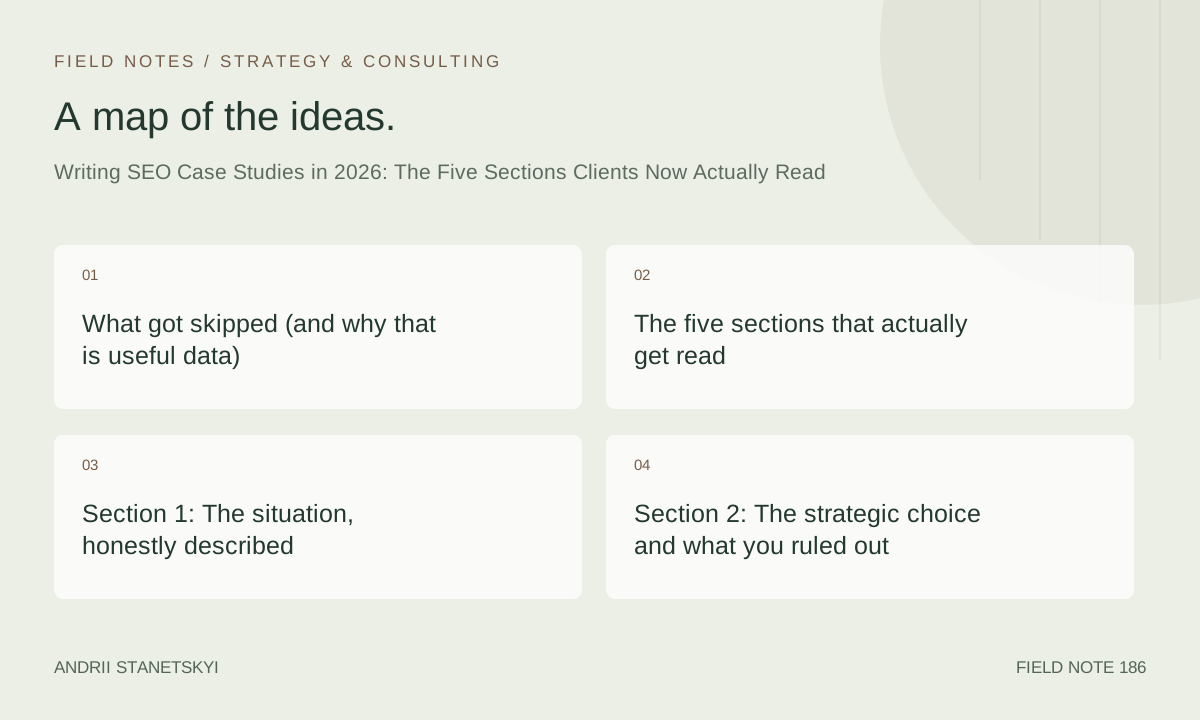
What got skipped (and why that is useful data)
The intro paragraph. Almost always. Readers jumped straight to the first bolded subheading or, if there wasn't one, to wherever numbers appeared in the text. This is consistent with how people read most professional content online, but case study writers still bury the most interesting information three paragraphs in after a windup about how the client "faced increasing competition in a crowded market."
The tools section. "We used SEMrush, Screaming Frog, Ahrefs, and Google Search Console." Nobody cared. Every SEO uses these tools. Listing them doesn't differentiate you; it just takes up space where better information could live.
The agency bio at the end. All twelve participants said some version of "I already know who this is from, I don't need to read their bio again at the bottom." Put your credentials in your site nav and your byline. Not appended to each case study.
The timeline graphic. Five out of twelve scrolled past these entirely. The visual variety was appealing but the content wasn't more useful than a paragraph of prose. Timeline graphics take significant production time for minimal reader payoff.
The five sections that actually get read
Here is what stopped the scroll every time—either because it built trust or because it raised a red flag the reader needed to resolve before continuing.
Section 1: The situation, honestly described
Not a marketing description of the client's business. An honest description of the problem state they were in when they hired you.
The case studies that held attention opened with something uncomfortable. "Their organic traffic had been declining for 11 months when they contacted us. The previous agency had built a significant PBN that was starting to show manual action signals." Or: "They'd launched a new site migration six weeks before reaching out and had lost 62% of their indexed pages." Or: "The founder had been doing their own SEO for three years and had created 340 pages targeting essentially the same 15 keywords."
These openings work because they're specific and they imply expertise. Only someone who actually worked on the problem writes like this. AI-generated case studies and pattern-following writers produce vague situations: "the client wanted to improve their search visibility and generate more qualified leads." That's a goal, not a situation.
Target length: 120-180 words. No more. Set the scene, establish the problem, move on.
Section 2: The strategic choice and what you ruled out
This is the section that best-performing case studies have and average ones don't. What did you decide to do, what did you decide not to do, and why?
Every situation has multiple plausible approaches. Readers—especially experienced buyers—know this. When a case study presents only one approach as if it were obvious, it signals that the author either doesn't know the alternatives or doesn't think the reader can handle the nuance. Both are confidence-killers.
A strong version: "We considered prioritizing link acquisition immediately given the competitor gap, but the crawl showed 34% of the site's key pages weren't being indexed. Getting Googlebot to read what already existed would have faster impact than earning links to pages it wasn't visiting. We deferred link strategy by eight weeks."
This kind of reasoning shows a decision process, not just a decision. It tells the reader: this person has a model. That model will be applied to my problem too.
Target length: 200-250 words. Enough to feel genuinely deliberate. Not so long it becomes a lecture.
Section 3: The one thing that almost broke it
Every project has one. A technical discovery that changed the scope. A content team that couldn't deliver at the promised cadence. A Google update that hit mid-project and required recalibration. A client who overruled a recommendation and created a problem you then had to solve around.
Writing this section takes courage because it surfaces imperfection. But readers trust imperfect narratives more than seamless ones, because seamless ones aren't true. When I added a "what almost went wrong" section to my case studies in late 2025, average time on page for those case study pages went up by 40 seconds. People lean in when the story gets complicated.
The format: name the problem, describe the moment you recognized it, explain what you did. Keep the agency's role clear without shifting all blame to the client. If you made a mistake, say so. "I underestimated how long the dev team's ticket queue was. I should have asked for dev capacity data in week one rather than assuming we had deployment access. We lost six weeks."
Target length: 120-160 words. Crisp and honest.
Section 4: Results with anchored numbers
Numbers need three things to be credible in 2026: an anchor (starting point), a timeframe, and business context.
Unanchored: "Organic traffic increased 218%."
Anchored: "Organic sessions went from 8,400/month to 26,700/month over nine months. Non-branded queries drove 71% of the growth. The traffic increase corresponded to a 34% lift in demo request form submissions from organic channels."
The second version tells me the scale (not a huge site, not a tiny one), the timeline (nine months, realistic), the quality signal (non-branded, not just branded awareness traffic), and the business outcome (demos, not just sessions). That's four dimensions of information in two sentences.
In 2026, I'd also add one of these where relevant: AI Overview impression share change (if the client has significant informational content), branded vs. non-branded split change, and crawl efficiency metrics if you did significant technical work. These are newer and signal that your measurement framework is current.
| Metric | Why it builds trust | What to pair it with |
|---|---|---|
| Organic sessions (with start/end figures) | Shows scale and trajectory | Non-branded split or conversion rate |
| GSC click data | First-party, hard to fake | Impression-to-click ratio change |
| Revenue from organic | Business-level impact | Attribution model used |
| Crawl coverage change | Technical depth signal | Indexed page count before/after |
| AI Overview appearances | Current, differentiating | Query category that triggered it |
| Ranking positions only | Weak—rankings fluctuate | Must be paired with traffic and conversion data |
| Domain Authority score | Avoid—third-party metric, widely gamed | Replace with referring domain growth figures |
Section 5: What you would do differently
This is the section almost no SEO case study includes. It's also the section that, when present, generates the most direct inquiry responses in my experience.
One or two sentences. Not self-flagellation. A specific, considered reflection on a choice that in retrospect you'd make differently. "If I were starting this engagement over, I'd have pushed harder for the content brief approval process to be internal to their team rather than requiring my sign-off. The dependency on me created a bottleneck in months four and five that slowed publishing velocity."
This works for three reasons. It's human. It signals that you've genuinely processed the project and extracted learning from it. And it demonstrates that you're not selling—you're documenting. Sellers don't tell you what went wrong. Trusted advisors do.
Two things case study advice gets wrong
Testimonials do not belong inside case studies
Pull quotes from clients embedded in the case study body break the narrative flow and signal insecurity. You're writing the story—you don't need a character witness mid-chapter. If you have a strong client quote, put it on your homepage or in a dedicated testimonials section. Inside the case study, it reads as a hedge. "Trust me, but also here's someone else saying trust me."
The exception: a brief, specific quote that adds information the case study itself doesn't contain. "We were skeptical about deprioritizing content production in month one, but looking back it was the right call—the technical work unlocked pages that had been invisible for two years." That quote adds context. "Working with [name] was transformative for our business" adds nothing.
Visual-heavy case studies do not outperform text-heavy ones
I've tested both. Infographic-rich case studies with process diagrams and custom graphics look impressive. They don't convert better than dense, honest prose with one or two GSC screenshots. Senior buyers aren't persuaded by production value—they're persuaded by specificity. Design is a surrogate for substance only when substance is absent. When substance is present, design becomes invisible.
Format, length, and where to publish
700-1,100 words per case study, published as individual pages on your own domain. Each one should have a descriptive URL slug that includes the industry and the primary challenge type: /shopify-migration-case-study, /saas-content-audit-case-study, /healthcare-technical-seo-case-study.
Those URLs attract low-volume, high-intent organic searches. "Healthcare technical SEO case study" gets maybe 30 searches a month. Everyone searching it is considering hiring an SEO. Three or four of those visitors per month arriving at a strong case study page is worth more than a thousand impressions from a generic industry roundup.
A Google Doc or Notion page is an acceptable format for sharing async in a specific conversation. It is not a substitute for a published, indexed case study page. The domain matters. The crawlability matters. You are an SEO.
The SEAR template
I've packaged the five-section structure into an acronym I use with everyone I advise on portfolio work. SEAR: Situation, Edge (the strategic choice and what you ruled out), Adversity (the one thing that almost broke it), Results (anchored with anchor, timeframe, and business context), Reflection (what you'd do differently).
It's not a rigid template. Think of it as a checklist. Each letter is a question: did I answer this in the case study? If a section is genuinely not present in a project's story—if nothing almost went wrong, which I'd question—you skip it. SEAR is a prompt, not a form.
Print it out. Read every case study you've written against it. You'll immediately see which sections are missing and which ones you've been burying under the wrong label.
The goal isn't a beautiful document. It's a document that a skeptical, experienced buyer reads start to finish and then opens a new tab to look up your contact page. That's conversion. SEAR gets you there faster than any other structure I've tried.
See also: Building an SEO Portfolio That Converts in 2026 — Senior SEO Interview Prep in 2026 — Senior SEO Career Path — Moz Blog: SEO research and industry commentary