The SEO profession has matured considerably from its early positioning as a tactical execution role. In 2026, senior SEO practitioners operate at the intersection of data engineering, content strategy, AI system literacy, and organizational influence — disciplines that command genuine market premiums and increasingly resist automation. The field has also bifurcated: generalists who can orchestrate an entire SEO program versus deep specialists who master one technical domain with unusual depth. Both paths lead to senior roles; they lead to different organizations, different compensation structures, and different day-to-day work.
This article maps the 2026 SEO career landscape with specificity: what skills actually differentiate senior practitioners from mid-level ones, what the market pays for those skills, which specializations are growing versus commoditizing, and how the rise of AI search surfaces is reshaping what expertise is valuable over the next five years.
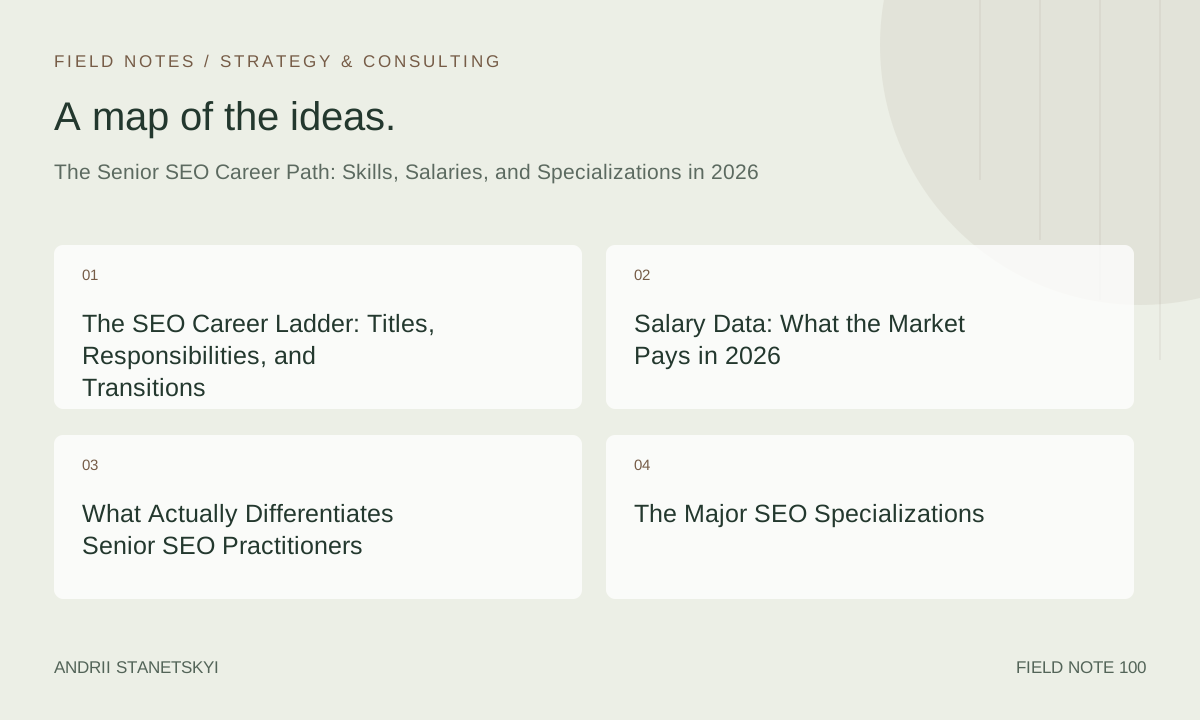
The SEO Career Ladder: Titles, Responsibilities, and Transitions
Title conventions vary significantly by organization type — agency titles do not map directly to in-house titles, and industry standards across companies are inconsistent. Nevertheless, functional responsibility levels are consistent enough to describe:
SEO Specialist / Analyst (0–3 years)
Executes defined tasks: keyword research, on-page optimization, technical audit support, reporting. Works within established frameworks defined by senior practitioners. Primary learning objective: understand the full system, not just the assigned tasks. The best junior practitioners are intensely curious about the "why" behind every instruction they receive.
SEO Manager / Senior SEO Specialist (3–6 years)
Owns workstreams: a content program, a technical audit, an agency relationship, a segment of a large site. Defines the approach within a broader strategy set by leadership. Can diagnose and explain algorithm changes, communicate recommendations to non-SEO stakeholders, and manage external vendors. The transition from junior to mid-level is primarily analytical; the transition from mid-level to senior is primarily strategic and communicational.
Senior SEO Manager / SEO Lead (5–9 years)
Sets strategy for a site, a business unit, or a product vertical. Manages other SEO practitioners. Owns the SEO roadmap and is accountable to business-level KPIs (organic revenue, lead volume) rather than channel-level metrics (rankings, traffic). Interfaces regularly with VP and C-suite stakeholders. The technical depth may narrow as breadth and influence widen.
Director of SEO / Head of SEO (8–15 years)
Owns the full SEO function. Manages team size and budget. Reports to VP Marketing, CMO, or equivalent. Strategic allocation of resources across technical, content, and authority-building workstreams. Responsible for forecasting, headcount planning, and cross-functional alignment with Engineering, Product, and Brand.
VP of SEO / Principal SEO / SEO Consultant (10+ years)
Either an organizational leader at large-scale businesses (VP) or an independent expert who works with multiple clients at the strategic advisory level (Principal/Consultant). At this level, the market is for judgment and track record, not execution. Compensation reflects outcomes delivered, not hours worked.
Salary Data: What the Market Pays in 2026
| Level | US (Tier 1 Market) | US (Remote/National) | UK (London) | Agency (US) |
|---|---|---|---|---|
| SEO Specialist / Analyst | $55,000–$80,000 | $45,000–$65,000 | £28,000–£40,000 | $42,000–$60,000 |
| SEO Manager / Senior Specialist | $85,000–$120,000 | $70,000–$100,000 | £45,000–£65,000 | $65,000–$90,000 |
| Senior SEO Manager / Lead | $120,000–$160,000 | $95,000–$135,000 | £65,000–£90,000 | $85,000–$115,000 |
| Director of SEO / Head of SEO | $155,000–$220,000 | $130,000–$185,000 | £90,000–£130,000 | $110,000–$155,000 |
| VP / Principal / Independent Consultant | $220,000–$400,000+ | $180,000–$320,000 | £130,000–£220,000 | N/A (retainer-based) |
Technical SEO specialists command premiums of 15–30% above the ranges shown for equivalent levels, primarily because the skill set is genuinely scarce. An enterprise technical SEO with Python fluency, log file analysis experience, and a track record of large-scale site migrations is in a seller's market in 2026. Content SEO at equivalent levels earns at the midpoint or below these ranges.
Independent consultants at senior level typically charge $200–$600/hour for advisory work, or $8,000–$25,000/month for retained engagements. Day rates for project work range from $1,500–$4,000 in the US market. These are guideline ranges — outliers in both directions exist, particularly for practitioners with notable case studies or media profiles.
What Actually Differentiates Senior SEO Practitioners
The observable skills that separate senior practitioners from mid-level ones are not always the ones taught in courses or listed in job descriptions. From hiring and mentorship experience:
Ability to Diagnose Without Complete Information
Senior practitioners develop strong diagnostic instincts — they can form a credible hypothesis about what is causing a traffic drop in 15 minutes from GSC, GA4, and a quick crawl, rather than requiring a week of analysis. This comes from having seen many sites, many issues, and many algorithm changes. It is not teachable directly; it accumulates through volume of exposure and deliberate retrospection on past diagnoses.
Communication that Produces Action
The most technically brilliant SEO recommendation that cannot be communicated in terms an engineering manager cares about does not get implemented. Senior practitioners translate: "We have 2.3 million crawlable URLs that are not indexed and never will be, which means Googlebot is spending 40% of its crawl budget on content that provides zero return" is more actionable than "we have crawl budget waste." The translation skill — from SEO metric to business language — is the primary separator at senior level.
Anticipatory Thinking
Mid-level practitioners respond to algorithm changes. Senior practitioners anticipate the direction of Google's and AI systems' evolution and build toward it before it becomes necessary. The practitioners who had strong E-E-A-T signals, first-party data strategies, and GEO-compatible content structures in 2023 were better positioned in 2025 than those who scrambled to adapt after the fact.
Knowing What Not to Do
A counterintuitive differentiator: senior practitioners are better at saying "that is not worth the investment" than junior ones. The judgment to deprioritize — to identify that a recommended tactic will consume 80 hours of engineering time for 3% traffic uplift — is as valuable as knowing which tactics work. This requires enough confidence in one's model of the world to resist pressure to act on everything.
The Major SEO Specializations
Technical SEO
The highest-compensation specialization in 2026. Covers crawlability, indexation, site architecture, JavaScript SEO, Core Web Vitals, server configuration, log file analysis, and now AI crawler management and structured data for AI systems. Practitioners with genuine engineering proximity (comfortable reading server configs, writing Python, understanding CDN behavior) command the top of the salary ranges. This specialization is growing in complexity as AI search surfaces add new crawl protocols, llms.txt considerations, and multimodal rendering requirements.
Content SEO / Topical Authority
Builds the informational architecture of a site: keyword clustering, content hub design, editorial calendar planning, content decay management, and E-E-A-T optimization. This specialization is increasingly affected by AI-generated content at scale — the practitioner who can evaluate content quality at scale, manage AI-human hybrid workflows, and maintain topical authority against AI-generated competitor content is valued differently from one who only manages traditional editorial production.
Local SEO
A persistent specialization with strong SMB and multi-location enterprise demand. Covers Google Business Profile optimization, citation management, local pack ranking factors, and review strategy. Not dramatically changed by AI search yet — local search retains higher click-through because the action (visiting a physical location) requires information that AI summaries do not fully substitute. Compensation is lower than technical or enterprise-scale roles.
E-commerce SEO
The intersection of technical SEO (faceted navigation, product schema, Core Web Vitals on product pages) and content SEO (category page optimization, buyer intent content). Strong commercial impact visibility makes this specialization attractive for practitioners who want clear attribution of their work to revenue. Requires understanding of Merchant Center, Google Shopping, and increasingly, AI Overview product panel optimization.
GEO / AI Search Optimization
The newest and fastest-growing specialization: optimizing for Generative Engine Optimization — being cited in ChatGPT, Perplexity, Claude, and Gemini AI Overviews. This is not yet a standalone career track; it is an emerging competency layered on top of traditional SEO skills. Practitioners with deep understanding of how LLMs select and cite sources, how to structure content for AI parsing, and how to manage brand presence across AI systems are commanding premiums. Within 2–3 years, GEO competency will likely be a standard expectation rather than a differentiator. See our detailed treatment in GEO: Generative Engine Optimization guide.
International SEO
Managing multi-language, multi-region SEO programs: hreflang implementation and auditing, geo-targeting via GSC, country-specific content strategy, and ccTLD vs. subdirectory decisions. Valued in global enterprises; less relevant for SMB or regional businesses. Requires genuine proficiency in navigating organizational complexity across multiple marketing teams and legal jurisdictions.
AI Literacy as a Career Requirement
In 2026, AI literacy is no longer a differentiator — it is a baseline requirement at senior level. What this means in practice:
- Understanding how LLMs select and cite sources — not the technical architecture, but the behavioral patterns that make a page more or less likely to be cited in an AI-generated answer. This informs content structure, entity markup, and authority-building strategy.
- Working with AI writing tools effectively — senior practitioners must be able to evaluate AI-generated content for quality, E-E-A-T signals, and factual accuracy at scale. "Prompt engineering" is less important than quality evaluation judgment.
- Using Python and AI APIs for SEO automation — content gap analysis at scale, automated schema validation, log file analysis, and forecast modeling all benefit from programmatic approaches. Practitioners who can write or adapt Python scripts have materially wider analytical capability than those who cannot.
- Understanding AI crawler behavior — robots.txt configuration for GPTBot, ClaudeBot, PerplexityBot, Google-Extended, and CCBot is now a standard technical SEO task. Understanding what these crawlers do with the content they retrieve (training data vs. real-time retrieval vs. both) informs policy decisions.
The practitioners who frame AI tools as a threat to their role are misidentifying the risk. The risk is not automation of SEO tasks — it is other practitioners who combine AI tools with SEO expertise to multiply their output and analytical capacity. The competitive moat is expertise-driven AI use, not AI avoidance.
Agency vs. In-House: Career Implications
The agency-versus-in-house debate is a persistent one in SEO careers, and the answer genuinely depends on career goals:
Agency Advantages
- Volume of exposure: In 3 years at an agency you may audit 40–60 different sites across multiple verticals. The pattern recognition that develops from this volume is genuinely difficult to replicate in-house.
- Specialization development: Agencies with focused practices (e-commerce, enterprise technical, SaaS) allow deep specialization faster than generalist in-house roles.
- Client-facing communication skills: Presenting to clients regularly develops stakeholder communication skills that in-house practitioners often lack until director level.
In-House Advantages
- Business context depth: In-house practitioners understand why decisions are made, not just what is decided. This context produces better-calibrated recommendations.
- Implementation proximity: Direct relationships with engineering and product teams mean faster implementation cycles and better technical collaboration.
- Equity and total compensation: At growth-stage companies, equity can represent the most significant component of total compensation — absent at agencies.
- Attribution clarity: In-house results are more directly attributable, which is valuable for portfolio building.
The conventional wisdom — agency first for breadth, then in-house for depth — remains sound for most practitioners. The exception is practitioners who join a high-growth company early in their career; the in-house experience at a company scaling from 50 to 500 can compress a decade of learning into three years.
Building a Portfolio That Earns Trust
At senior level, the portfolio matters differently than at junior level. Hiring managers and clients evaluating senior practitioners are not looking for proof that you can execute — they are evaluating judgment, communication, and scale of impact.
What to Include
- Case studies with business impact, not just traffic metrics. "Organic revenue increased 140% over 18 months, from $2.1M to $5.1M" is a portfolio item. "Organic traffic increased 200%" is incomplete — traffic without revenue context is less convincing and invites questions about traffic quality.
- Published writing that demonstrates expertise. Articles, conference presentations, and public audit methodologies that demonstrate how you think about problems. A well-written, technically rigorous article on a specific SEO challenge does more portfolio work than five generic "top 10 tips" posts.
- Evidence of organizational influence. Descriptions of how you got technical recommendations implemented in a complex organization, how you built a cross-functional SEO process, or how you trained a team. These demonstrate the communication and influence skills that differentiate senior from mid-level practitioners.
The Public Credibility Flywheel
Senior practitioners who write, speak, or build public tools accumulate credibility that compounds over time. This is not primarily about building a personal brand in a superficial sense — it is about creating verifiable evidence of expertise that exists outside the referral network. A practitioner known in their community for rigorous technical analysis has a different market position than one with equivalent skills but no public presence. See our guide on content strategy for professional authority building.
Five-Year Outlook: Which Skills Retain Value
Honest assessment of skill durability through 2031:
High Durability
- Diagnostic reasoning — the ability to identify root causes from ambiguous signals. This is not automatable in any meaningful sense.
- Stakeholder communication and organizational navigation — increasingly important as SEO's cross-functional dependencies expand.
- Technical architecture understanding — crawlability, indexation, and rendering are engineering problems with SEO implications. This intersection remains human-judgment-intensive.
- AI system literacy — understanding how LLMs select sources, how GEO differs from traditional SEO, and how to optimize for multimodal AI queries.
Moderate Durability
- Keyword research and content strategy — AI tools are already automating significant portions of this; the differentiator will be the strategic judgment applied to AI-generated inputs, not the execution of keyword research itself.
- Link building strategy — tactics will continue commoditizing; the strategic judgment about which links are worth pursuing and why retains value.
Low Durability (commoditizing)
- Mechanical on-page optimization — title tag writing, meta description optimization, header tag auditing. AI tools already do this adequately. Practitioners who specialize here exclusively will face market pressure.
- Basic reporting — automated dashboards and AI-generated performance summaries are commoditizing the descriptive reporting function.
- Generic content production — if AI tools can produce content at 20× the speed at equivalent quality for informational topics, the volume play in content production is not a defensible specialization.
The career strategy that survives this shift is specialization in the human-judgment-intensive dimensions: complex diagnosis, organizational influence, AI-system-literate strategy, and the ability to evaluate quality rather than just produce quantity. See also our overview of GEO and generative engine optimization and industry salary survey data for digital marketing roles.
FAQ
Is SEO a good career in 2026, given AI search?
Yes — with caveats. The SEO roles that are at risk are those focused on mechanical execution at low complexity: basic on-page optimization, generic content production, and routine reporting. Roles focused on technical architecture, strategic content planning, AI search optimization, and organizational influence are growing in demand and compensation. The profession is bifurcating: higher complexity and higher compensation at the top, commoditization pressure at the entry level. For practitioners willing to invest in technical depth and AI literacy, the career is strong through at least 2030.
Do I need to learn Python to advance in SEO?
You do not need to be a software engineer. But the ability to write or adapt Python scripts for SEO tasks — pulling GSC data via API, running log file queries, automating crawl analysis, building forecast models — meaningfully expands analytical capability and earns credibility with engineering teams. Budget 50–80 hours of structured learning (Python for SEO courses exist specifically for this) to reach a productive baseline. The ROI on that investment is among the highest available in SEO skill development.
Is agency or in-house better for reaching director level faster?
In-house at a growth-stage company is typically faster for reaching director level, because the organizational expansion creates headcount opportunities. At a stable large company, director promotions are slower. At an agency, the path to director-equivalent (usually Group Director or Practice Lead) is merit-based but constrained by company growth rate. The fastest paths to director level in the 2026 market are: in-house at a scale-up, or via independent consulting where the client base effectively defines your seniority level.
How important are SEO certifications in 2026?
At entry level, they signal baseline knowledge. At mid-level and above, they are essentially irrelevant to hiring decisions. What matters at senior level: verifiable results (case studies), technical depth demonstrated through public writing or interviews, and practitioner community reputation. No SEO certification confers the credibility that a well-documented enterprise audit case study delivers. Invest time in building verifiable expertise demonstrations, not accumulating credentials.
What should a senior SEO focus on learning in the next 12 months?
Three priorities: (1) GEO / AI search optimization — understanding citation mechanics in LLM-based search engines. (2) Python for SEO automation — specifically GSC API integration, log file analysis, and Prophet for forecasting. (3) Structured data and entity optimization for AI systems — including llms.txt, ImageObject schema, and entity disambiguation via sameAs properties. These are the areas with the largest skill gap relative to market demand as of Q1 2026.
How do I transition from agency SEO to in-house at a senior level?
The transition friction is real: in-house hiring managers sometimes perceive agency practitioners as lacking business context depth. Counter this by: (a) developing case studies that show business impact, not just SEO metrics — demonstrate you understand the revenue implications; (b) highlighting cross-functional project experience — any work you have done interfacing with engineering, product, or brand teams; (c) targeting companies in verticals where your agency experience is directly relevant. The transition is significantly easier when you can point to a specific domain expertise that the target company values.
What does a healthy senior SEO compensation negotiation look like?
Know the market range for the specific level, market, and company type before any negotiation. In-house senior roles at well-funded tech companies are negotiating in total compensation (base + equity + bonus), not base alone. Never anchor to your previous salary — anchor to the market rate for the role. The strongest negotiating positions are built on competing offers or clearly demonstrated impact: "I drove $3.2M in incremental organic revenue last year" is a negotiating position. "I have 8 years of experience" is not.
Key Takeaways
- The SEO career has bifurcated: high-complexity strategic and technical roles are growing in compensation; mechanical execution roles face commoditization pressure from AI tools.
- Technical SEO remains the highest-compensation specialization in 2026, commanding 15–30% premiums over equivalent-level content or local SEO roles.
- Senior-level differentiation is primarily about communication, diagnostic reasoning, and organizational influence — not technical knowledge depth alone.
- AI literacy — understanding LLM citation mechanics, Python automation, and GEO — is a baseline requirement at senior level, not a differentiator.
- Portfolio at senior level must demonstrate business impact and organizational influence, not just traffic growth or keyword ranking improvements.
- The agency-first-then-in-house path remains sound for most practitioners; high-growth in-house opportunities can compress the timeline significantly.
- Skills with the highest 5-year durability: diagnostic reasoning, stakeholder communication, technical architecture, and AI system literacy. Invest accordingly.
The practitioners who will define the senior SEO roles of 2030 are the ones investing now in the skills that AI tools cannot replicate: judgment under uncertainty, cross-functional influence, and the ability to synthesize technical complexity into organizational action. The execution skills commoditize; the judgment skills compound.