If your SEO program is still organized the way it was in 2019, you are leaving performance on the table. The discipline has matured beyond a single "SEO person" owning a keyword spreadsheet. Modern search requires coordinated technical execution, content operations, digital PR, and analytics infrastructure — all moving simultaneously, at speed, across business units that have their own roadmaps and their own opinions about priority.
The question senior marketing leaders and heads of growth face in 2026 is not whether to invest in SEO structure. It is which structure fits their stage, their org chart, and their competitive environment. This article gives you the frameworks, the tradeoffs, the RACI templates, and the honest assessments you need to make that call.
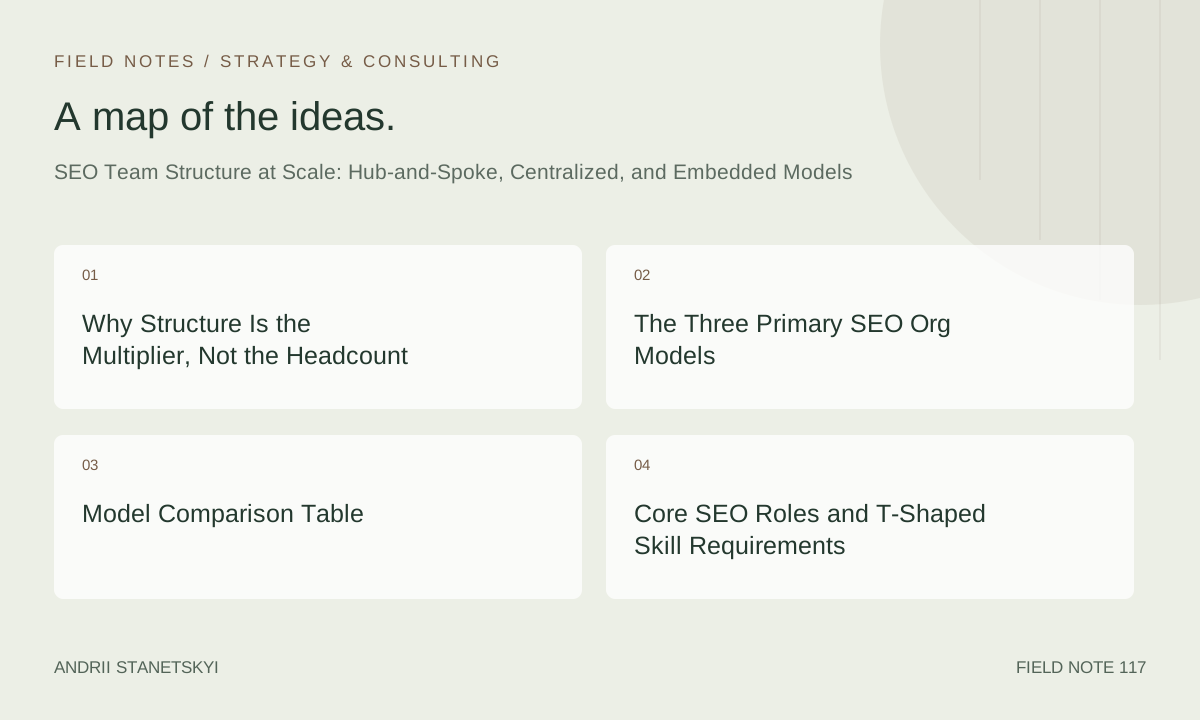
Why Structure Is the Multiplier, Not the Headcount
Adding headcount to a broken org structure produces proportionally broken results. Before you approve the next SEO hire, audit whether your current team has clear ownership, unambiguous reporting lines, and agreed escalation paths when priorities conflict. In most organizations I have advised, the SEO program suffers not from a skills gap but from a structural one: nobody owns the roadmap end-to-end, technical work is blocked on engineering sprints, and content operates independently from keyword strategy.
The compounding nature of organic search rewards consistency over bursts. A team that ships 20 solid optimizations per month for 18 months beats a team that spikes to 80 in Q1 and stalls for the rest of the year. Structure creates the consistency. Headcount alone does not.
This is especially true as AI-generated content floods the index. Search engines in 2026 weight expertise signals, link authority, and entity-level trust more aggressively than ever. Your org structure must enable your team to produce verifiably expert content, earn editorial links at scale, and instrument everything so you can prove causality. That requires cross-functional coordination — and that requires deliberate design. See also: [Internal: SEO Program Maturity Framework].
The Three Primary SEO Org Models
Centralized (Center of Excellence) Model
In a centralized model, all SEO practitioners report to a single SEO leader — typically a Director or VP of SEO — who sits within Marketing or Growth. The team owns strategy, execution, and reporting. Business units are "clients" of the central team and submit requests through a defined intake process.
Org Chart — Centralized Model
- VP / Head of SEO
- Technical SEO Lead
- Technical SEO Specialist (x1–2)
- Content SEO Lead
- SEO Content Strategist (x1–2)
- SEO Editor
- Outreach & Link Acquisition Lead
- Digital PR / Outreach Specialist (x1–2)
- SEO Analytics Lead
- SEO Data Analyst
- Technical SEO Lead
Best for: Single-product companies, early-stage growth companies scaling from zero, and organizations where consistency of execution outweighs speed of local iteration.
Common failure mode: The central team becomes a bottleneck. Business units circumvent the intake process and produce unoptimized content anyway. The SEO team spends more time in intake meetings than doing work.
Embedded / Federated Model
In the embedded model, SEO practitioners live within the business units they serve — sitting alongside product managers, content teams, and engineers. There is no central SEO function; strategy and execution are distributed. A dotted-line reporting relationship to a central SEO guild or community of practice provides loose alignment.
Org Chart — Embedded Model (example: e-commerce with three verticals)
- Vertical A (Apparel)
- Content Team → embedded SEO Specialist (Technical + Content focus)
- Vertical B (Home Goods)
- Product Team → embedded SEO Specialist (Technical focus)
- Vertical C (Beauty)
- Marketing Team → embedded SEO Strategist (Content + Outreach focus)
- SEO Guild (dotted-line, meets biweekly)
- Embedded specialists share learnings, review tooling, align on standards
Best for: Multi-product enterprises where business units have distinct audiences, distinct content calendars, and distinct technical stacks. Works well when each vertical has sufficient volume to justify a dedicated practitioner.
Common failure mode: SEO practitioners go native and optimize for local metrics at the expense of domain authority. Cross-linking strategy falls apart. Technical standards fragment across the site. Nobody owns a canonical sitemap for the enterprise.
Hub-and-Spoke Model
The hub-and-spoke model combines the consistency benefits of centralization with the speed benefits of embedding. A central hub team owns strategy, standards, tooling, and cross-cutting technical work. Spoke practitioners are embedded in business units but have a solid-line or strong dotted-line report to the hub lead. The hub sets the what and the why; the spokes own the how and the when within their domain.
Org Chart — Hub-and-Spoke Model
- SEO Hub (Central)
- Head of SEO (Hub Lead)
- Technical SEO Lead (enterprise-wide crawl health, Core Web Vitals, schema strategy)
- SEO Analytics Lead (unified measurement, attribution, executive reporting)
- Outreach Lead (domain-level link strategy, PR partnerships)
- Head of SEO (Hub Lead)
- Spoke A — Product Marketing
- SEO Specialist (solid-line: Product Marketing Manager; dotted-line: Hub Lead)
- Spoke B — Blog / Editorial
- SEO Content Strategist (solid-line: Editorial Director; dotted-line: Hub Lead)
- Spoke C — International / Localization
- International SEO Specialist (solid-line: Regional Marketing; dotted-line: Hub Lead)
Best for: Mid-market to enterprise companies with multiple content streams, a maturing technical foundation, and leadership willing to invest in hub coordination overhead. This is the model I recommend to most companies growing past 50 in marketing headcount.
Common failure mode: The dotted line becomes decorative. Spoke practitioners get pulled entirely into local priorities. The hub lead lacks the organizational authority to enforce standards without executive air cover.
Model Comparison Table
| Dimension | Centralized (CoE) | Embedded / Federated | Hub-and-Spoke |
|---|---|---|---|
| Speed of local execution | Low | High | Medium–High |
| Strategic consistency | High | Low | High |
| Technical standards enforcement | High | Low | High |
| Cross-team coordination overhead | Medium | Low (siloed) | High |
| Talent depth per discipline | High | Low (generalists) | Medium |
| Scalability past 10 SEO practitioners | Low | Medium | High |
| Ideal company size (marketing headcount) | 5–40 | 50–200 (multi-BU) | 40–500+ |
| Agency supplementation typical? | Yes (capacity) | Sometimes (specialty) | Yes (specialty + overflow) |
| Risk of "SEO island" syndrome | High | Low | Low–Medium |
| Executive reporting clarity | High | Low | High |
Core SEO Roles and T-Shaped Skill Requirements
Generalist SEO practitioners are a liability at scale. Every role on a mature SEO team should be T-shaped: deep expertise in one discipline with working fluency across adjacent ones. Here is how I define the four core disciplines and the skill signatures that distinguish senior from junior practitioners in 2026.
Technical SEO Lead / Specialist
Deep expertise: Crawl budget optimization, JavaScript rendering pipelines, structured data / schema at scale, log file analysis, Core Web Vitals instrumentation, international hreflang architecture.
Working fluency: Content gaps, keyword intent mapping, link equity flow, GA4 / BigQuery querying.
Reports to: Hub Lead or VP SEO. Partners with: Engineering, DevOps, CMS owners.
Red flag in a candidate: Cannot explain the difference between a crawl error and a render error, or has never opened a log file.
Content SEO Strategist / Lead
Deep expertise: Keyword clustering, topical authority architecture, content brief production, EEAT optimization, internal linking strategy, content decay auditing.
Working fluency: Schema markup for articles, basic page speed implications of content choices, outreach hooks for link-earning content.
Reports to: Editorial Director (spoke) with dotted-line to SEO Hub Lead. Partners with: Content writers, subject matter experts, product marketing.
Red flag: Treats keyword research as a one-time deliverable rather than a living system.
Outreach / Digital PR Lead
Deep expertise: Link prospecting, journalist and blogger relationship management, digital PR campaign strategy, anchor text profiling, competitor backlink gap analysis.
Working fluency: Content strategy (what makes link-worthy assets), technical redirects, brand mentions unlinked to linked conversion.
Reports to: SEO Hub Lead or Comms Director (depending on org). Partners with: PR, Brand, Content.
Red flag: Measures success by links acquired rather than by domain authority delta or referral traffic quality. See also: [Internal: Digital PR and Link Building at Scale].
SEO Analytics Lead / Analyst
Deep expertise: GA4 event schema design for SEO, Search Console API integration, rank tracking at keyword segment level, share-of-voice measurement, attribution modeling for organic.
Working fluency: Technical SEO (enough to understand what to instrument), content performance interpretation, executive-level dashboard design.
Reports to: SEO Hub Lead with dotted-line to Data / Analytics org. Partners with: Marketing Ops, BI, Finance.
Red flag: Reports on rankings without connecting to revenue or pipeline influence.
For more on hiring for these profiles, see [External: SEMrush SEO Career Path Guide].
RACI Matrix for SEO Operations
A RACI matrix eliminates the ambiguity that kills cross-functional SEO programs. Below is a simplified version for the hub-and-spoke model. Adapt it to your structure. R = Responsible, A = Accountable, C = Consulted, I = Informed.
| Activity | Hub Lead | Tech SEO | Content Strategist | Outreach Lead | Analytics Lead | Engineering | Editorial |
|---|---|---|---|---|---|---|---|
| Annual SEO strategy | A/R | C | C | C | C | I | I |
| Keyword & topical research | A | C | R | I | C | I | C |
| Technical audit execution | A | R | I | I | C | C | I |
| Technical fixes implementation | A | C/R | I | I | I | R | I |
| Content brief creation | I | C | R | C | I | I | A |
| Content publishing | I | I | C | I | I | I | A/R |
| Link acquisition campaigns | A | I | C | R | I | I | C |
| Monthly performance reporting | A | C | C | C | R | I | I |
| Schema / structured data rollout | A | R | C | I | I | R | I |
Download a full version of this RACI template at [Internal: SEO RACI Template Download].
Org Chart Examples by Company Stage
Stage 1: Startup / Seed (1–2 SEO practitioners)
- Head of Growth / Marketing (owns SEO accountability)
- SEO Generalist (technical + content; strong T-shape toward technical)
- Fractional SEO Advisor (2–4 hours/week for strategy review)
- Content freelancers (managed by SEO Generalist)
- SEO Generalist (technical + content; strong T-shape toward technical)
At this stage, the priority is laying technical foundations and building topical authority in one cluster before expanding. Do not hire an outreach specialist yet. Earn links through product PR and founder-driven content.
Stage 2: Series A / B (3–6 SEO practitioners)
- Director of SEO (owns program, reports to VP Marketing)
- Technical SEO Specialist
- Content SEO Strategist
- Outreach / Digital PR Specialist
- SEO Analyst (part-time or shared with Marketing Ops)
This is a centralized model. The Director must be a genuine player-coach — hands-on in the work, not just managing. Supplement with a specialist agency for outreach capacity if headcount is constrained.
Stage 3: Series C / Scale-up (7–15 SEO practitioners)
Transition to hub-and-spoke. Build the hub first, then assign spokes as business units demonstrate sufficient content volume to justify dedicated support. Avoid fragmenting before the hub infrastructure (tooling, dashboards, standards documentation) is solid.
Stage 4: Enterprise (15+ SEO practitioners)
Hub-and-spoke with formalized Communities of Practice. Quarterly SEO Summits across spokes. Dedicated SEO Program Manager role to manage tooling contracts, intake process, and cross-BU prioritization. See also: [Internal: Enterprise SEO Program Management].
Agency vs. In-House vs. Fractional SEO
This is the question every CFO asks and every CMO eventually has to answer with data. My position is that the binary framing — agency or in-house — is outdated. The optimal model for most companies at scale is a hybrid, with in-house ownership of strategy and measurement, and agency or fractional support for execution capacity and specialty work.
| Dimension | In-House | Agency | Fractional SEO |
|---|---|---|---|
| Strategic alignment | High | Medium (depends on account team stability) | High (if senior) |
| Institutional knowledge | High | Low (churn risk) | Medium |
| Speed to scale capacity | Low | High | Medium |
| Specialty depth (e.g., JS SEO, international) | Medium | High (if specialist agency) | High (if domain expert) |
| Cost structure | Fixed (salary + benefits) | Variable (retainer + project) | Variable (day rate or retainer) |
| Executive access & credibility | High | Medium | High |
| Best use case | Core strategy, analytics, content direction | Outreach at scale, technical audits, content production | Interim leadership, audit + roadmap, board-level credibility |
Fractional SEO deserves special attention. A senior fractional SEO leader — typically a former in-house director or VP engaging at 20–40% of their time — can give pre-Series B companies access to enterprise-grade strategic thinking without a full-time salary. The fractional model works best when there is at least one in-house SEO practitioner to own day-to-day execution. Without that, the fractional leader spends their limited hours managing freelancers rather than setting strategy.
For a deeper analysis, see [External: Moz — Building an In-House SEO Team].
Case Studies: Structuring for Scale
Case Study A: SaaS Company Transitioning from Centralized to Hub-and-Spoke
A mid-market SaaS company (B2B, ~$80M ARR) ran a centralized SEO team of five under a Director of SEO reporting to the CMO. In 2024, they launched three new product lines, each with distinct ICP segments and content needs. The centralized team became a bottleneck: average time from content brief request to published article hit 47 days.
Structural change: They kept the Technical SEO Lead and Analytics Lead in the hub. They embedded two SEO Content Strategists into the product marketing teams for each new product line, with a solid dotted-line to the Director. They hired a third embedded strategist for the core product line.
Outcome at 12 months: Average brief-to-publish time dropped to 19 days. Organic traffic grew 67% YoY. The Director regained bandwidth to lead a core web vitals overhaul that had been deprioritized for 18 months.
Key lesson: The hub-and-spoke transition requires explicit governance documentation — specifically, a one-page "SEO Ways of Working" document that every embedded practitioner and their local manager signs off on before the practitioner starts in their spoke role.
Case Study B: E-Commerce Enterprise Standardizing Embedded Chaos
A large e-commerce retailer had accumulated 12 embedded SEO practitioners across six business units over five years. There was no hub. Each business unit used a different rank tracking tool, a different content brief format, and a different schema strategy. The site had conflicting hreflang implementations across three international markets.
Structural change: They appointed an enterprise SEO Director (new hire) to build a hub function from scratch. Year one was dedicated entirely to tooling consolidation, schema standardization, and establishing the SEO guild. No embedded practitioner was moved or restructured in year one — the hub built credibility by solving problems the embedded teams could not solve alone.
Outcome: By month 18, all business units had adopted the unified measurement framework. The international hreflang conflict was resolved, recovering an estimated 340,000 impressions/month that had been split across duplicate indexation. See related: [Internal: International SEO and Hreflang at Enterprise Scale].
Key lesson: When retrofitting structure onto an embedded org, earn trust before enforcing standards. The hub that leads with service — tooling, training, audit support — earns the authority to set mandates later.
FAQ
How many SEO practitioners do I need per business unit in a hub-and-spoke model?
A practical rule of thumb: one embedded SEO practitioner per business unit that produces more than 15 pieces of net-new content per month and has a distinct technical surface area (separate subdomain, different CMS, or unique category architecture). Below that threshold, a shared spoke practitioner covering two smaller business units is more efficient. The hub should never have fewer than two practitioners — Technical SEO Lead and Analytics Lead are the minimum viable hub roles.
Should my Technical SEO Lead have engineering skills or SEO skills?
Both, but the primary orientation should be SEO with strong engineering literacy, not the reverse. An engineer who learns SEO typically over-indexes on implementation and under-indexes on prioritization — they will build perfect structured data for a section of the site that drives 0.3% of your traffic. A strong technical SEO practitioner knows which technical problems are revenue-limiting and advocates for engineering cycles accordingly. They should be comfortable reading JavaScript, writing Python for log file analysis, and operating in a staging environment — but they should not be your first-choice resource for building features.
When does it make sense to use a fractional SEO rather than a full-time hire?
Three scenarios justify fractional over full-time: (1) You are pre-Series A and cannot afford or retain a senior SEO leader, but you need strategic direction and investor-credible program oversight. (2) You have a specific 6–12 month problem — a site migration, an international expansion, a penalty recovery — that requires deep seniority for a defined period. (3) Your current SEO Director has left and you need interim leadership while recruiting, without regressing your program. In all three cases, the fractional engagement only works with at least one in-house practitioner handling execution continuity.
How do I handle SEO governance when my CMS is decentralized across product teams?
Establish an SEO Standards Document — not a policy, but a standards document — that defines the non-negotiables: title tag format, meta description character limits, canonical tag implementation rules, schema types by page category, and image alt text requirements. This document should live in your engineering wiki, be linked in every CMS onboarding guide, and be reviewed quarterly by the Technical SEO Lead. Pair it with automated SEO linting in your CI/CD pipeline using tools like Screaming Frog API, Sitebulb, or a custom Python script that checks pages before they go to production. Standards without automation are aspirations.
What reporting line gives the SEO Hub Lead the most organizational leverage?
Reporting to the CMO or VP of Growth — not the Director of Content and not the Director of Performance Marketing. SEO spans content, technical, and distribution; when it reports into one of those three silos, it becomes an advocate for that silo rather than a cross-functional program. If the CMO role does not exist or is occupied by someone who does not champion organic, the VP of Growth or Chief Marketing Technology Officer are acceptable alternatives. The worst outcome is reporting to the SEO Hub Lead's own most senior stakeholder — it creates inherent conflict of interest in program prioritization.
How do I measure the performance of individual SEO practitioners in a hub-and-spoke model?
Use a combination of program-level OKRs (which the whole team owns) and role-specific leading indicators. Technical SEO practitioners: crawl coverage rate, CWV pass rate by template type, structured data error count. Content SEO practitioners: topical authority score growth, content brief throughput, decay-rate-adjusted traffic per published piece. Outreach practitioners: referring domain growth, link-to-target ratio, digital PR campaign placement rate. Analytics practitioners: dashboard adoption rate, reporting cycle time, attribution model coverage. Never evaluate SEO practitioners solely on keyword rankings — it conflates individual contribution with algorithm variability.
Is it worth building an internal SEO team if AI is disrupting organic search?
Yes — and the disruption accelerates the case for structural maturity rather than undermining it. In a world where AI overviews and generative search surfaces are capturing informational queries, SEO programs that compound authority through EEAT signals, brand entity strength, and editorial link acquisition become more valuable, not less. These outcomes require sustained organizational investment. The companies that gut their SEO teams in response to AI-driven traffic volatility will find that they have also gutted their ability to earn the trust signals that AI systems use to decide which sources to cite. Structure your team to build durable authority, not to chase ranking volatility.
Key Takeaways
- Structure is the multiplier. Headcount without clear ownership, reporting lines, and governance produces fragmented results at scale.
- The hub-and-spoke model is the most scalable option for companies with 40+ marketing headcount and multiple content streams. It balances strategic consistency with local execution speed.
- Every SEO team needs four core disciplines: Technical SEO, Content SEO, Outreach / Digital PR, and SEO Analytics. All four must be T-shaped, with depth in one and literacy across the others.
- RACI matrices eliminate the ambiguity that kills cross-functional programs. Define accountabilities before you structure, not after.
- Fractional SEO is a legitimate and often underutilized option for pre-Series B companies and for specific high-stakes initiatives. It only works with in-house execution capacity.
- Agency relationships are most valuable for outreach at scale, specialty technical audits, and content production overflow — not for owning strategy or measurement.
- When retrofitting structure onto a distributed org, earn organizational trust first by solving problems the distributed teams cannot solve alone. Enforce standards second.
- In 2026, the teams with the strongest structural foundations — especially around EEAT and link authority — are best positioned to benefit from AI-driven search surface changes, not most threatened by them.
Conclusion
The organizations winning at SEO in 2026 are not the ones with the most budget or the largest teams. They are the ones with the clearest structure, the most explicit accountability, and the deepest integration between their technical, content, outreach, and analytics functions. The hub-and-spoke model, properly implemented with executive air cover and a genuinely empowered hub lead, gives most scaling organizations the best combination of consistency and speed.
Whatever model you choose, the operational fundamentals do not change: document your standards, instrument everything, define your RACI before you scale headcount, and build for durable authority rather than short-cycle ranking wins. The teams that treat structure as a strategic investment — not an administrative overhead — are the ones compounding authority while their competitors are still debating who owns the title tag.
If you are assessing your current SEO org structure, start with a structural audit before a skills audit. Most SEO programs underperform not because of who is on the team, but because of how the team is organized. Get the structure right, and the skills compound. Get it wrong, and no hiring plan will save you.