Published 19 May 2026 | By Andrii Benrey
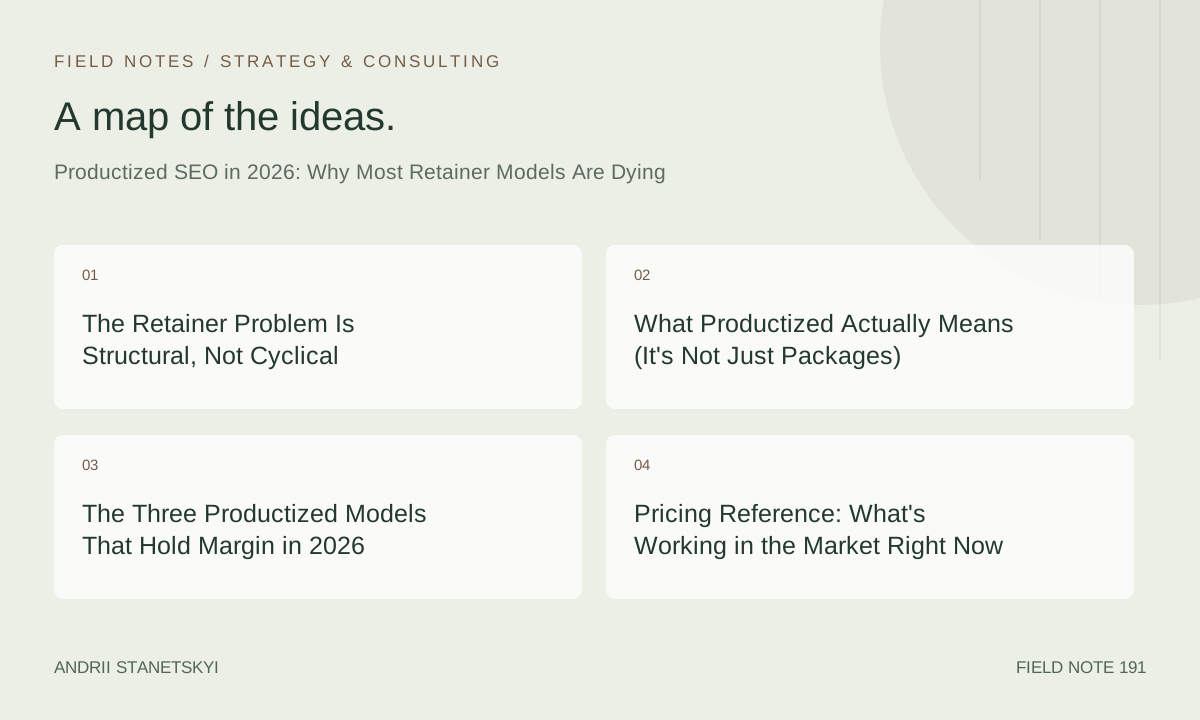
The Retainer Problem Is Structural, Not Cyclical
The traditional SEO retainer has a fundamental design flaw that predates AI — and AI just made it impossible to ignore.
Here's the flaw: a retainer trades time for money without specifying what the client receives. The client pays $5,000/month and gets "ongoing SEO services." What does that mean? It means whatever the account manager decides to work on this month, documented in a report that gets skimmed or ignored, justified in a quarterly call where everyone agrees things are going well even when they're not.
When all SEO deliverables were labor-intensive, the retainer model was defensible. Eight hours to write a content brief? Sure, that's 4% of a $5k retainer's implied time budget, feels reasonable. A technical audit taking 20+ hours? Classic retainer work. But now? A content brief takes 35 minutes with good AI tooling. A crawl analysis that used to take half a day runs in an hour. Technical audit templates that cover 80% of common issues can be parameterized and semi-automated.
Clients know this. Not all of them, not in technical detail — but they feel it. They see AI tools advertised everywhere. They ask why the brief looks like it was written in a template. They wonder what the retainer is actually paying for when turnaround times get faster without any explanation of what changed.
The retainer model survives when clients don't ask hard questions. It's dying because more clients are asking them.
What Productized Actually Means (It's Not Just Packages)
A lot of SEO shops hear "productized" and immediately think: "I'll bundle my services into packages and call it a product." That's not productization. That's repackaging. The distinction matters.
True productization requires three things:
1. A defined, specific deliverable. Not "monthly SEO management." A specific output — a 47-point technical audit in a standardized format. A 90-day content architecture for a B2B SaaS product. Twelve months of monthly link acquisition at a specified DA range and editorial quality standard. The client knows exactly what they're buying before they sign.
2. A repeatable delivery process. You've built the SOPs, the templates, the contractor workflow. The product doesn't require you to re-invent the approach for each client. You're running the same playbook with client-specific inputs. This is what creates margin as you scale — the product gets cheaper to produce as you refine the process, but the price stays stable because the output value is consistent.
3. Outcome orientation. The best productized SEO offers are tied to a measurable outcome, not just a deliverable. Not "we'll do a technical audit" but "we'll identify and prioritize every technical issue blocking your indexing and ranking, with implementation instructions your dev team can act on in the next sprint." The outcome is what the client actually wants. The audit is how you get there.
Without all three, you have a package. Packages are fine. They're just not as durable or scalable as true products.
The Three Productized Models That Hold Margin in 2026
Model 1: The Diagnostic Sprint
A time-boxed, fixed-price engagement that produces a specific analysis and action plan. Typically 2–4 weeks. Priced $1,800–$4,500 depending on site complexity and depth. No retainer commitment required upfront.
This works because it solves a specific buyer psychology problem: companies that want SEO help but are skeptical of long-term retainer commitments. The Diagnostic Sprint gives them a low-risk entry point. If it's good, they either convert to a longer engagement or come back for the next sprint. If it's not, at least they learned something for $2,400.
Margin on Diagnostic Sprints is high — typically 68–75% — because the process is fully templated. The trap is when you customize so heavily for each client that you're essentially doing a bespoke project every time. Resist that.
Model 2: The Content Engine
A monthly recurring service that produces a fixed quantity of strategic content — not commodity content, but publication-ready articles that are researched, structured for search intent, internally linked, and optimized. Priced $2,800–$6,500/month depending on volume and complexity.
This is the most competitive productized category because it's the one everyone thinks they can build. The differentiator is quality control and editorial consistency. Clients who've burned through cheap content mills are actively looking for a productized content service that doesn't embarrass them. If you can demonstrate that consistently, the price ceiling is higher than most providers realize.
Warning: Content Engines require a real editorial process and a stable writer pool. Agencies that try to run this on a revolving-door freelancer model produce inconsistent work and churn clients fast. It's a product that requires more operational infrastructure than it looks like.
Model 3: The Outcome Retainer
This is the evolution of the traditional retainer, and it's the hardest to execute well. The structure: a monthly fee (typically 30–50% lower than a comparable traditional retainer) plus performance bonuses tied to specific, measurable outcomes. Revenue from organic search above a baseline. Ranking improvements in a defined keyword set. Lead volume from organic traffic.
The Outcome Retainer aligns incentives and removes the "what am I paying for" question. It's also risky for the provider — you're partly subsidizing months where results are slow, which is common in SEO. To make it work, you need a clear baseline measurement methodology, an honest pre-engagement conversation about timeline expectations, and enough financial cushion to absorb 2–3 slow months at the reduced base rate.
This model is growing fast in 2026. Clients love it. Practitioners who try it without good financial modeling often regret it.
Pricing Reference: What's Working in the Market Right Now
| Product Type | Typical Price Range | Gross Margin | Avg Contract Length | Main Risk |
|---|---|---|---|---|
| Technical SEO Audit | $1,800–$4,500 | 65–75% | One-time | Scope creep into implementation |
| Content Architecture Sprint | $2,400–$5,800 | 60–70% | 4–6 weeks | Client expects execution included |
| Monthly Content Engine (4 articles) | $2,800–$4,200 | 45–55% | 3–6 months | Writer quality consistency |
| Monthly Content Engine (8–12 articles) | $5,500–$9,000 | 42–52% | 6–12 months | Editorial process overhead |
| Link Acquisition Package (monthly) | $2,200–$5,500 | 35–48% | 3–6 months | Quality vs. volume pressure |
| Outcome Retainer (base) | $3,000–$6,000/mo base | Variable | 6–12 months | Slow months gut-check revenue |
| Full-Program Productized Bundle | $8,000–$14,000/mo | 38–50% | 6–12 months | Complexity approaching retainer model |
The gross margin figures assume a functioning process with contractor labor for content and outreach. Solo operators doing everything themselves will see higher margins but lower capacity. The Full-Program Bundle starts to look like a retainer at the higher end — which is the danger zone where productization discipline tends to break down.
The VDOP Framework: How to Build a Productized SEO Offer
I use a four-step framework called VDOP — Value Definition, Delivery Design, Operational Systemization, Positioning — whenever I'm building or evaluating a productized SEO offer. Here's how each step works in practice.
Value Definition: Start with the client's desired outcome, not with what you know how to deliver. "More organic traffic" is not a value definition. "Reducing CAC by 30% through organic lead volume within 9 months for a B2B SaaS company with a 14-touch sales cycle" is. The more specific the value, the easier it is to price, deliver, and sell.
Delivery Design: Map out every step of how the product gets delivered. Who does what? In what sequence? With what tools? What are the quality checkpoints? How long does each step take? This mapping reveals where your margin is and where scope creep tends to enter. If you can't map the delivery process in detail, you don't have a product yet — you have an intention.
Operational Systemization: Build the infrastructure: templates, SOPs, contractor briefs, client-facing documentation, progress tracking. This is the unglamorous part that most SEO practitioners skip because they'd rather work on client projects. Don't skip it. The system is what lets you deliver the product at scale without reinventing it each time.
Positioning: Define who this product is for and who it's explicitly not for. A productized offer that tries to serve everyone serves nobody well. The Technical SEO Audit for Shopify Plus stores over $5M in GMV is a sharper, more valuable product than "Technical SEO Audit for E-Commerce." Specificity enables premium pricing.
Who Actually Buys Productized SEO and Why
Three buyer types consistently respond to productized offers:
The retainer-burned skeptic. They've paid $5k–$8k/month to an agency for 8–12 months, seen mediocre results, and are now gun-shy about any open-ended commitment. A fixed-price product with a defined deliverable feels lower-risk. They're often willing to pay a premium per unit if they know exactly what they're getting.
The self-directed operator. Founders and in-house marketers who understand what they need but don't want to manage a full-service agency relationship. They want a specific output — an audit, a keyword strategy, a content calendar — and they'll execute it themselves or with their team. Productized offers let them buy exactly what they need.
The budget-constrained growth company. $1M–$5M ARR companies that can't afford a full agency retainer but need serious strategic input at specific moments. A $2,400 content architecture sprint twice a year is a realistic budget item. A $6k/month retainer is not. Productized pricing opens up a market segment that traditional retainers can't serve.
How Productized SEO Fails (And Why Most Attempts Do)
Most productized SEO attempts fail for one of three reasons.
First: the product is productized on the outside but custom on the inside. The sales page says "Technical SEO Audit — $2,400, delivered in 10 business days." But every audit is built from scratch, takes 15–20 hours, uses whatever format the practitioner feels like using that week, and has no standardized delivery process. That's not a product. That's a recurring custom project with misleading marketing.
Second: the pricing doesn't hold. Clients ask for discounts. You give them. Clients ask for scope additions at no extra charge. You agree because you want to keep the relationship. Within three engagements, you're back to effectively billing time under the guise of a product price. Productization requires pricing discipline.
Third: no lead generation system supports the product. A productized offer needs a repeatable pipeline. If you're still getting all your clients from referrals that require personal outreach, the product doesn't behave like a product — it behaves like a consulting relationship with a standardized deliverable. That's not wrong, but it's not productization in the scalable sense.
Two Uncomfortable Truths About This Model
Uncomfortable truth 1: Productized SEO commoditizes faster than agencies admit. Once you've defined a product, you've also made it easier for competitors to copy it. A technical SEO audit at $2,400 is a defensible offer for 12–18 months. Then three other practitioners start offering the same thing. Your only protection is brand, quality reputation, and specialization. Those are real moats — but they require continuous investment to maintain. The product alone doesn't protect you.
Uncomfortable truth 2: The clients who most need productized SEO often can't follow through on the outputs. A content architecture sprint is useless if the client never publishes the content. A technical audit is expensive decoration if the dev team never implements the fixes. Productized services don't include the execution accountability that a good retainer relationship can provide. You hand over the product and walk away, which feels clean until you realize the client spent $3,500 on a document they'll never use.
This is why I include implementation briefing sessions in my productized audits — not as scope creep, but as a built-in handoff meeting that increases the probability the client actually acts. It's a small investment that dramatically improves the outcome they experience, and therefore the probability they buy again.
The Pricing Mistake I Made with My First Product
In early 2025, I launched my first formal productized offer: a B2B SaaS content architecture sprint at $1,600. I'd priced it based on time cost — roughly 10 hours at $160/hour — plus a small buffer. It sold immediately. I delivered it. The client loved it and went on to hire me for $7,800/month.
That sounds like a success. It was, mostly. But I priced the product wrong by a factor of almost two.
The content architecture I delivered that first client directly contributed to content that drove 340 MQL leads over the next 8 months. Their average MQL-to-close rate is roughly 22%, average deal size around $18k. The math is straightforward. I charged $1,600 for an output that helped generate multiple six figures in pipeline.
I should have charged $3,200–$3,800. Not because of the hours, but because of the value. I wasn't thinking in value terms yet — I was still thinking like an hourly consultant. That mental shift took me longer than it should have. I've since repriced the sprint to $3,400, and not one prospect has walked because of it.
Price by value. Test the ceiling. Most SEO practitioners price far below where the market would actually bear.
Before You Kill Your Retainer
Don't torch your retainer model because you read this article. The retainer model isn't dying because it's inherently flawed — it's dying because most practitioners use it without defining what the client actually receives. A well-defined retainer with explicit quarterly deliverables, measurable outcomes, and a clear scope of service is still a good business structure.
What you should kill: the shapeless retainer where "ongoing SEO services" is the deliverable and the client's main feedback mechanism is a monthly report they half-read.
What you should build: one or two productized entry points that let clients experience your work before committing to a longer engagement. A good Diagnostic Sprint sells a good retainer. A good retainer, redefined as an Outcome Retainer with clear deliverables, is basically a productized service anyway.
The goal isn't to abandon recurring revenue — it's to make the recurring revenue defensible when a client asks "what exactly am I paying for?"
Have a good answer to that question, and the model doesn't matter much.
Related reading: Running a Fractional SEO Business in 2026 — and Scaling a Solo SEO to Eight People for what happens when a productized practice starts growing faster than planned.
External reference: ProfitWell's research on pricing pages and value communication is worth reading even if you're in services, not SaaS — the psychology of value perception translates directly.
Andrii Benrey is a fractional SEO consultant and former agency partner. He advises B2B SaaS and e-commerce companies on organic growth strategy. May 2026.