I want to be direct about what this article is and isn't. It's not a playbook for starting a fractional SEO practice. It's a post-mortem and real-time report on what the business actually looks like after 18 months—the numbers, the things that worked, the things that didn't, and the specific mistakes I'd undo if I could.
Total revenue: $312,400 across 18 months ending April 2026. Net after tools, subcontractors, and professional costs: $241,800. That's not a flex. That's a data point. I'll explain what generated it and what it cost.
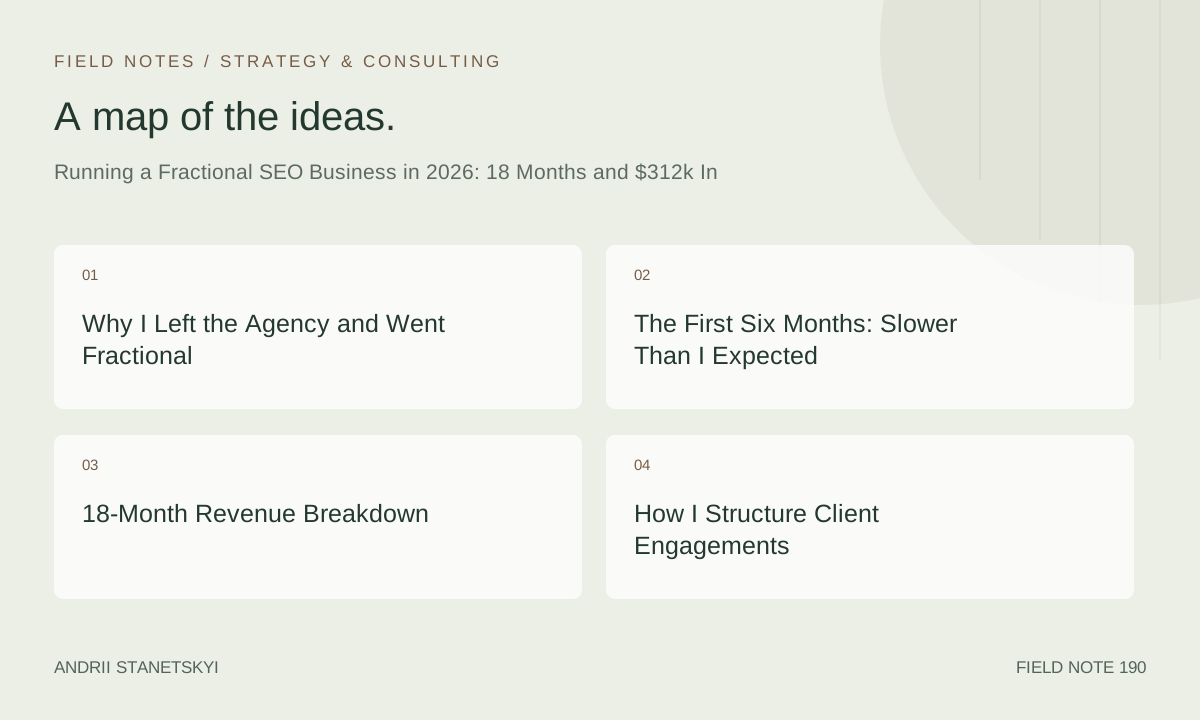
Why I Left the Agency and Went Fractional
I ran an SEO agency for six years. At peak we were 14 people, about $1.8M in annual revenue, and I was miserable. Not because the business wasn't working—it was working fine by most measures—but because I had spent three years solving management problems instead of SEO problems. Hiring, firing, performance reviews, payroll, client escalations that had nothing to do with rankings. I got into SEO because I liked the technical puzzle of it. The agency had turned into an HR company that also did SEO.
The decision to dissolve came in late 2023 when I did an honest audit of where I was spending my time: 60% on people management, 15% on business development, 10% on client strategy, 15% on everything else. That 10% was the only part I still enjoyed. So I spent most of 2024 transitioning clients—some to other agencies, some to a fractional arrangement with me directly—and winding down the team. By November 2024, I was fully fractional.
The financial case was also obvious once I ran the numbers. My fully-loaded cost to the agency had been about $280,000 annually (salary, employer taxes, benefits, overhead allocation). The agency billed my time at roughly $185/hour, generated $370,000 in billings attributable to my direct work, and kept about $200,000 in margin from my activity after my comp. If I billed direct at $175–$200/hour without the overhead structure, I'd keep most of that.
Reality check: it's not that clean. But the directional analysis was right.
The First Six Months: Slower Than I Expected
Month 1 (November 2024): Two clients, both former agency clients who followed me. $9,600 in revenue. I thought I'd have four clients by month two. I didn't.
Months 2–4 were the hard stretch. Referral conversations don't close fast. I'd reach out to someone, they'd express interest, we'd have a few calls, they'd say "let's start in Q1," and Q1 would arrive and they'd need another 30 days. Meanwhile I was doing $11,000–$14,000/month when I'd projected $22,000. I was drawing down savings and recalculating every week.
What I underestimated: the visibility gap. When you're at an agency, you have a brand behind you, case studies, a sales deck, a proposal process. Fractional, you're just a person. Until your name carries enough weight in your specific network to generate inbound, you're cold-starting every conversation. That takes longer than any projection model accounts for.
By month six I had four clients and was at $21,500/month. That felt like the inflection. From there the compounding of referrals and reputation started to work.
18-Month Revenue Breakdown
| Period | Monthly Revenue (Avg) | Active Clients | Notes |
|---|---|---|---|
| Months 1–3 (Nov 2024–Jan 2025) | $11,300 | 2–3 | Ramp, referral conversations slow |
| Months 4–6 (Feb–Apr 2025) | $17,400 | 3–4 | First non-agency-network referral |
| Months 7–9 (May–Jul 2025) | $21,800 | 4 | Stable four-client base |
| Months 10–12 (Aug–Oct 2025) | $19,200 | 3–4 | One client paused (internal restructure) |
| Months 13–15 (Nov 2025–Jan 2026) | $24,600 | 4–5 | New client (highest-value to date) |
| Months 16–18 (Feb–Apr 2026) | $26,300 | 5 | Introduced light productized add-on |
Total: $312,400. Net after Ahrefs ($2,200/yr), Screaming Frog + custom crawl tools ($800/yr), occasional subcontractor writing ($11,400 total), accountant ($3,600/yr), and misc professional costs ($2,200 total): approximately $241,800. That's about a 77.4% net margin, which sounds remarkable until you account for the fact that I'm the only person, there are no benefits, and I'm responsible for my own retirement contributions, health insurance, and self-employment tax—which knock that effective number down considerably.
How I Structure Client Engagements
Each client engagement is structured around one of three tiers. The naming is internal—clients don't see these labels.
Tier 1 — Strategic (15–20 hrs/week): Full SEO ownership. I sit in on weekly leadership calls, own the SEO roadmap, direct any in-house SEO coordinators or content teams, and produce the technical audits and strategy documents myself. Currently two clients at this tier. Rates: $9,500–$11,200/month.
Tier 2 — Advisory (8–12 hrs/week): I own strategy but not execution. Monthly or biweekly calls, written strategy briefs, review of what the in-house team produces. Two clients here. Rates: $5,400–$6,800/month.
Tier 3 — Consultative (4–6 hrs/week): Quarterly strategy sessions, one async review cycle per week, available for escalations. One client here at the moment. Rates: $2,800–$3,500/month.
The Tier 3 slot is deliberately kept as one client maximum. It's the highest-margin engagement type in terms of hourly rate, but it tends to expand in scope creep faster than the other tiers because boundaries are harder to enforce when the time commitment is so light.
Client Mix by Vertical (Current)
| Client | Vertical | Tier | Monthly Retainer | Months Active |
|---|---|---|---|---|
| Client A | B2B SaaS (fintech) | 1 | $11,200 | 14 |
| Client B | E-commerce (specialty retail) | 1 | $9,500 | 7 |
| Client C | B2B SaaS (HR tech) | 2 | $6,800 | 11 |
| Client D | Professional services | 2 | $5,400 | 5 |
| Client E | DTC consumer goods | 3 | $3,100 | 3 |
How My Pricing Evolved (And Why)
I launched with hourly pricing. $185/hour, tracked carefully, billed monthly. It made sense to me because I was pricing myself off my agency's effective blended rate and I wanted to be comparable.
It was the wrong model. Within three months I switched to monthly retainers scoped by hours, and here's why: hourly pricing made clients nervous. They'd ask how long everything would take before approving work. They'd see a big month and feel shocked. The relationship started to feel transactional in a way that undermined the strategic trust I needed to do the work well.
Monthly retainers fixed the dynamic. Clients stopped watching the clock and started trusting recommendations. I stopped feeling like I needed to inflate time entries to justify the value. The relationship became more collaborative because neither side was adversarial about billable time.
The second evolution was adding a performance bonus structure to the two Tier 1 clients in Q3 2025. Specifically: a quarterly bonus of $2,000–$4,000 tied to organic lead volume growth against a baseline. It's not outcome-based pricing in the pure sense—the base retainer pays regardless—but it creates alignment and gives the client a reason to prioritize my recommendations internally. That's worth more than the bonus amount.
Three Things That Actually Built the Business
1. Being specific about who I serve. Midway through month four I stopped saying "I do SEO for B2B companies" and started saying "I do SEO for B2B SaaS companies between Series A and Series C who've hit a plateau in organic growth and don't have the internal capacity to diagnose why." That specificity made every conversation more efficient. Referrers knew exactly who to send. Prospects felt I understood their situation before the first call.
2. Writing publicly about what I actually see. Not thought leadership. Specific observations. "Here's what I noticed across three SaaS clients when the March 2025 core update hit. Here's the data." That kind of content builds the right kind of credibility—not "look how smart I am" credibility but "this person is actually working on real problems" credibility. It generated two inbound leads in 2025 that became clients.
3. The 90-day window. Every engagement starts with a defined 90-day scope with a clear deliverable set. Not "we'll do SEO," but "by day 90 you'll have a full technical audit, prioritized fix list, keyword strategy for Q3, and first content brief set." This serves two functions: it gives the client a quick win that justifies the engagement before they've seen long-term results, and it resets the psychological contract every quarter so neither side is locked into a relationship that isn't working.
Two Things I Believed That Turned Out Wrong
Wrong belief one: Fractional is inherently more valued than agency work. I assumed clients would treat a senior fractional practitioner with more respect and buy-in than they'd given our agency. Sometimes true. More often: not. Clients who struggled with agency relationships often have internal dynamics that make any external SEO relationship hard—political resistance to recommendations, lack of dev resourcing to implement, executive distraction. The relationship quality depends far more on the client's internal culture than on whether you're fractional or an agency. I've had three clients I'd have been happy to fire if the financial situation allowed. The model doesn't fix bad client fit.
Wrong belief two: AI would reduce my deliverable time significantly and I'd capture that margin. AI tools did reduce time on certain tasks—content brief creation, initial audit analysis, competitive research synthesis. But the time saved mostly went into adjacent work I previously wouldn't have taken on: deeper competitive analysis, more client communication, better documentation. The net billable hours per client barely changed. The quality went up slightly. The margin didn't change materially. AI didn't give me a productivity windfall—it raised the baseline expectation for what good work looks like.
The Mistake That Cost Me $28,000
In early 2025 I took on a client that I knew had red flags. E-commerce business, mid-eight-figures in revenue, founder-led and founder-controlled, strong opinions about SEO that contradicted what I was seeing in the data. I took the engagement anyway because they were offering $8,500/month and I needed the revenue to reach my target.
Months one and two were functional. Month three, they started overriding every recommendation. Content briefs I wrote got rewritten by the founder before going to the writer. Technical fixes I'd prioritized got deprioritized in favor of a redesign the founder wanted. By month four I was producing work that wasn't getting implemented and attending calls where I explained the same things I'd said the previous month.
I ended the engagement at month five. Five months at $8,500 is $42,500 in revenue, but the opportunity cost of that time—I'd turned down two other leads during the intake period because I thought I was full—was real. One of those leads I later learned signed with a competitor for $7,200/month and stayed 11 months. That's $79,200 in revenue I didn't earn. Minus the $42,500 I did earn: a $28,000 mistake in opportunity terms, plus the significant stress of a bad client relationship.
Red flags I ignored: founder with strong predetermined SEO opinions, previous agency they'd "fired for underperforming," urgency to start immediately without proper scoping calls, resistance to providing Google Analytics access before signing. Any one of those is a yellow flag. All four together is a clear no.
The VSORP Framework I Use to Qualify Clients
After that experience I built a qualification framework I call VSORP: Values Alignment, SEO Maturity, Organizational Readiness, Revenue Potential, and Process Openness.
Values Alignment: Does the client believe SEO is a long-term asset, not a short-term traffic hack? You can't build a functional 12-month engagement with someone who expects ranking changes in 45 days.
SEO Maturity: Where is the client in their SEO journey? Blank slate is fine. Strong opinions based on misunderstanding is dangerous. I ask direct questions: "What have you tried before? What did you learn from it?"
Organizational Readiness: Can they implement? Do they have dev resources, content production capacity, and a decision-maker who'll champion recommendations internally? SEO advice without implementation capacity is just expensive noise.
Revenue Potential: Is organic actually a viable growth channel for their business model? Not every business needs SEO. Some discovery calls end with me telling a prospect their budget is better spent elsewhere. That's lost revenue now and a referral later.
Process Openness: Are they willing to follow a defined process, provide data access, and trust recommendations long enough to see results? The founder who wants to approve every keyword before I can research intent is not process-open.
Any client scoring poorly on two or more VSORP dimensions gets a polite pass. I haven't taken a client that failed VSORP since Q3 2025 and my churn rate has dropped from roughly one client every four months to zero in the past seven months.
What Changed in 2026 That Everyone Needs to Know
Three developments are reshaping the fractional SEO market right now, as of May 2026.
First: more ex-agency people are going fractional, which means more competition in the market. The supply of fractional SEOs is growing faster than demand. Differentiation is no longer optional—if you're a generalist fractional SEO in 2026, you're competing on price, which is a race you don't want to be in.
Second: AI-native competitors. There are now agencies offering what amounts to AI-automated SEO delivery at $800–$1,500/month. They're not good. But they're capturing budget from unsophisticated buyers who can't evaluate quality, and some of those buyers are in the prospect pool that previously would have considered fractional. This isn't an existential threat but it's real market noise.
Third: Google's continued evolution toward entity-based and authority-signal-heavy ranking. This is actually good for senior fractional practitioners because the strategies that work now require genuine expertise in content architecture, topical authority building, and technical health—not just keyword targeting. The commoditized tactics are working less. The expertise premium is real again.
What that means practically: fractional SEOs who can clearly articulate why topical authority and content architecture matter—and demonstrate it with client results—are pulling further ahead of commodity competition. The market is sorting by quality faster than it was 18 months ago.
Related reading: Agency vs In-House vs Fractional: The Margin Math After AI | Productized SEO in 2026: Why Most Retainer Models Are Dying | Scaling a Solo SEO to Eight People Without the Burnout
External references: Ahrefs Blog | Search Engine Land
At month 18, the business works. It's not without stress—pipeline anxiety never fully leaves—but it's the first time in eight years I've gone to work and spent most of my hours doing the thing I'm actually good at. Whether that ROI is worth it depends entirely on what you're optimizing for. For me it is. Run your own math.