I've been running SEO commercially since 2017. I've sat on all three sides of this table—worked in-house, built an agency to 14 people, dissolved most of it, and now operate fractionally across four clients. So when I walk through this comparison, I'm not doing it from a think-piece perspective. I'm doing it from the P&L perspective, because that's the only angle that matters right now.
The conversation around agency vs in-house vs fractional has shifted dramatically since AI productivity tools went mainstream in late 2024. Everyone assumed AI would fatten margins. It didn't—at least not for agencies. What it actually did was compress the perceived value of deliverables and give clients enough ammunition to push back on retainers. The math changed. Here's how.
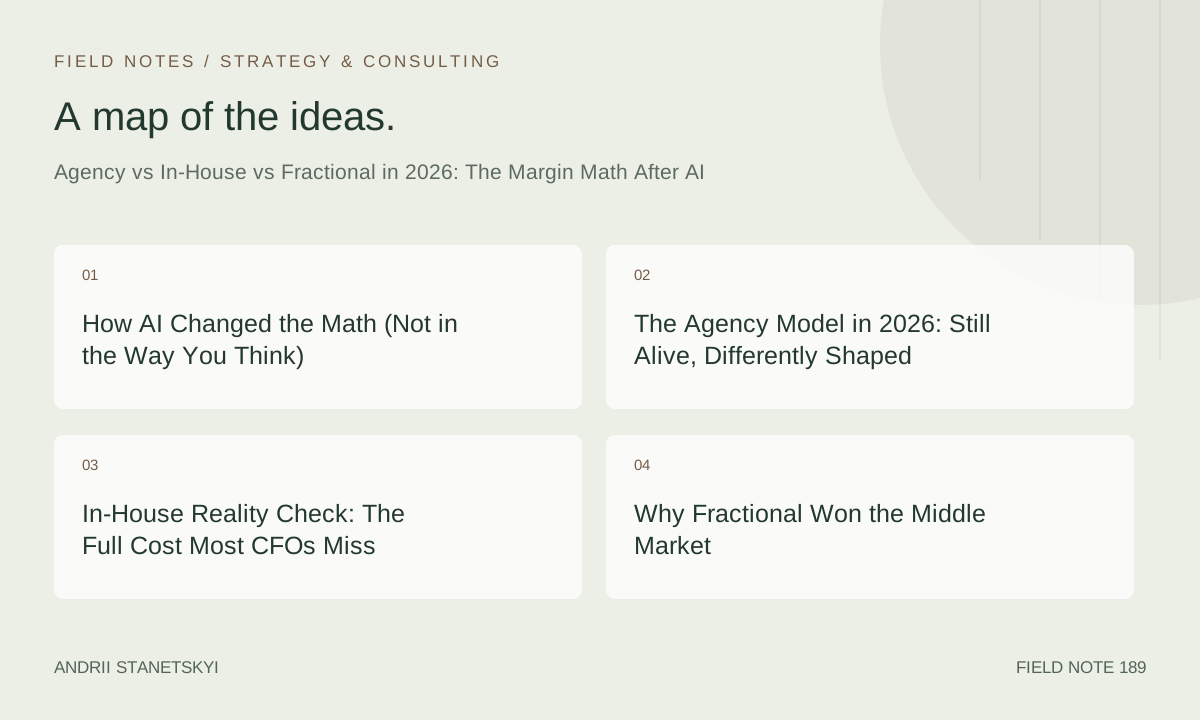
How AI Changed the Math (Not in the Way You Think)
Here's the dirty secret of 2025: AI made agencies faster, but it didn't make them more profitable. The efficiency gains got competed away almost immediately.
When AI writing and content tools hit critical mass around Q2 2024, a content article that used to take 4–6 hours of writer time dropped to 45–90 minutes with decent prompt engineering and editing. At an agency billing $120/hour blended, that's a $480–$720 task becoming a $90–$180 task. You'd think that's enormous margin expansion. Instead, what happened is this: competitors who adopted the same tools started underbidding. Clients noticed that content production costs had dropped publicly—it was all over LinkedIn—and started renegotiating retainers. Some clients started producing content themselves with AI and came to agencies only for strategy and technical work.
Between Q3 2024 and Q1 2026, average SEO retainer values for agencies in the $5k–$15k/month tier dropped roughly 18–23% on new deals. Existing clients who renewed held closer to flat, but that just means you were losing ground in real terms.
The result: agencies running 42–52% gross margins in 2023 are now at 28–38%. Some are lower. The efficiency gains exist, but they're funding price cuts, not profit. This is the core problem that's reshaping how smart operators think about delivery model.
The Agency Model in 2026: Still Alive, Differently Shaped
Agencies aren't dying. But the middle is hollowing out. The agencies still winning fall into two distinct camps:
Camp One: Vertical specialists. Agencies that own a niche deeply—e-commerce for home goods, SaaS with compliance complexity, multi-location healthcare—still command premium retainers because the barrier to replication is domain knowledge, not headcount. A client can't easily replace a firm that's done 60 similar projects with an AI tool and a generalist.
Camp Two: High-volume productized shops. On the other end, agencies that've stripped their delivery to repeatable, template-driven processes—technical audits, link building programs, content production at scale—are operating with very lean teams and AI-heavy workflows. Margins are thin but volume compensates. These shops often look more like software companies in their internal operations than traditional agencies.
The agencies suffering most are the generalist mid-market shops, typically 8–25 people, doing bespoke SEO for clients across multiple verticals at $6k–$14k/month. They have too much overhead for the volume model and not enough specialization for the premium model. Many of the people I know who ran these shops have either niched hard, laid off significantly, or restructured around fractional/embedded delivery themselves.
Agency P&L Snapshot, Q1 2026
This is based on conversations with five agency owners across the US and UK, not my own agency (I exited most of mine in late 2024). These are composite figures, not any single firm.
| Metric | 2023 Typical | Q1 2026 Typical | Change |
|---|---|---|---|
| Average retainer value | $8,400/mo | $6,900/mo | -18% |
| Gross margin | 46% | 33% | -13pp |
| Average client tenure | 14 months | 11 months | -3 months |
| Account manager : client ratio | 1:6 | 1:9 | +3 clients/AM |
| AI tool spend as % of revenue | ~1% | ~4.5% | +3.5pp |
The account manager ratio increasing isn't a sign of efficiency—it's a sign of cost-cutting that's starting to hurt client retention. More clients per AM means less strategic attention per client, which is exactly what's shortening tenures.
In-House Reality Check: The Full Cost Most CFOs Miss
In-house SEO looks cheap on a salary line. It isn't cheap once you do the full accounting.
A mid-level SEO manager in a US metro—not San Francisco, somewhere like Austin or Atlanta—costs $85,000–$105,000 in base salary as of May 2026. Add benefits at roughly 25–30% of base, that's $106,000–$136,500 fully loaded. Then add tools: a reasonable SEO stack (Ahrefs or Semrush, Screaming Frog or equivalent, a content intelligence tool, a rank tracker) runs $700–$1,400/month depending on plan size, or $8,400–$16,800/year. Add onboarding time—most in-house SEOs take 60–90 days to become productive at a new company. Add the cost of their manager's time reviewing work, setting strategy, and handling the inevitable questions that come with someone new to your specific business.
Fully loaded, a single mid-level in-house SEO in 2026 costs $130,000–$160,000 annually before they produce a single ranking. That's $10,800–$13,300/month.
Compare that to a fractional SEO at $5,500–$7,000/month, or an agency at $7,000–$10,000/month, and the calculus isn't immediately obvious. The in-house option has advantages—domain knowledge accumulation, internal relationship-building, full-time availability—but those advantages only pay off if the role stays filled, the person is properly supported, and organic search is genuinely the primary growth lever.
The companies I've seen get burned by in-house hires are the ones that hired one SEO to "own all things organic" when they lacked the technical infrastructure to actually execute. One person, no dev resources, no content budget, no link-building strategy. They spend 40% of their time in stakeholder meetings trying to get anything prioritized. That's not an SEO problem. That's a resourcing model problem.
The Hidden Costs Table
| Cost Item | Agency | In-House (1 FTE) | Fractional |
|---|---|---|---|
| Direct monthly cost | $7,000–$12,000 | $10,800–$13,300 | $4,500–$7,500 |
| Tool costs (included?) | Usually yes | No, add $700–$1,400/mo | Varies; often no |
| Onboarding time to productivity | 4–6 weeks | 60–90 days | 2–3 weeks |
| Internal management overhead | Low | High (1–3 hrs/week) | Low–Medium |
| Exit cost/flexibility | 30–90 day notice | Severance, rehiring cost | 30 days typical |
| Specialization depth | High (if niche) | Varies by hire | High (if matched) |
Why Fractional Won the Middle Market
Fractional SEO—a senior practitioner embedded part-time across multiple clients—is now the default recommendation I give to companies spending $80k–$300k annually on organic search when they don't have a VP of Marketing who can manage an agency relationship properly.
Why? Because the problems the middle market has with agencies are structural, not personal.
An agency's incentive is retention and upsell. A fractional operator's incentive is results, because their referral pipeline depends entirely on client outcomes. Fractional practitioners also tend to be more senior on average—they don't have junior SEOs touching your account because they're a solo or small-team operator. When you pay for fractional SEO at $6,000/month, you're getting the senior person every time, not an account manager who relays information to a junior who does the actual work.
The other structural advantage: fractional operators who work across 3–5 clients simultaneously develop pattern recognition that in-house SEOs don't get from a single account. I'm currently watching the same Google update affect four different clients in four different verticals simultaneously. That cross-client view is genuinely valuable and it's something you can't get from a person who only sees one business.
The fractional model has its limits. It doesn't work when the client needs more than 20–25 hours per week, when the engagement requires constant internal stakeholder management, or when the organization needs SEO ownership, not SEO advisory. Those situations still favor in-house or a deeply embedded agency relationship.
Side-by-Side: Which Model Wins for Which Business
| Business Situation | Best Model | Why |
|---|---|---|
| Early-stage startup, <$2M ARR, organic not primary channel | Fractional (light engagement) | Low cost, senior guidance, no overhead |
| Growth-stage SaaS, $5M–$30M ARR, organic a major channel | Fractional + in-house coordinator | Strategy from fractional, execution support in-house |
| E-commerce, $10M+ GMV, high content velocity needed | Agency (content-specialist) or in-house | Volume requirements favor dedicated capacity |
| Enterprise, $100M+ revenue, organic is mission-critical | In-house team + agency for specialist campaigns | Internal ownership needed; agency for specific tactics |
| Local business, multi-location | Productized agency or fractional | Standardized processes; doesn't justify full in-house |
| SMB, $1M–$5M revenue, testing organic | Productized agency or low-hour fractional | Predictable cost, limited commitment |
Pricing Tables and Real Numbers
These are numbers from real engagements I'm aware of as of May 2026—not list prices from agency websites, which are largely fictional.
| Model | Typical Price Range | What You're Actually Buying | Outcome Alignment |
|---|---|---|---|
| Traditional agency retainer | $5,000–$18,000/mo | Hours + deliverables | Low—paid regardless |
| Performance-based agency | $2,000/mo base + revenue share | Outcomes (traffic, leads, revenue) | High—aligned with results |
| Fractional SEO (10 hrs/wk) | $4,800–$6,500/mo | Senior strategic + execution oversight | Medium—relationship-dependent |
| Fractional SEO (20 hrs/wk) | $8,000–$12,000/mo | Near-FTE senior capacity | Medium-high |
| In-house SEO Manager (FTE) | $10,800–$13,300/mo fully loaded | Full-time ownership + internal relationships | High—career-linked |
| Productized SEO package | $1,200–$3,500/mo | Defined scope, specific deliverables | Low—deliverable-focused |
Two Things the Industry Gets Wrong
Contrarian take one: Outcome-based pricing is not automatically better for clients.
Every consultant I know pushes outcome-based or performance-based pricing as the noble evolution of the industry. And I understand why—it sounds aligned. But for most clients, especially those under $10M in revenue, outcome-based pricing introduces a different set of problems. You either pay for results you can't fully attribute to SEO (traffic went up but so did paid, PR, and product changes), or you're in constant negotiation about what "counts." I've seen outcome-based deals turn adversarial within six months because the attribution methodology disagreed with reality. A well-structured retainer with clear deliverables and quarterly performance reviews is often more functional than a rev-share arrangement with an ambiguous baseline.
Contrarian take two: More senior SEOs don't always produce better results.
The fractional model's pitch is that you get senior people instead of juniors. True. But senior SEOs are often more valuable for strategy than execution. On accounts where the biggest opportunity is publishing 40 well-optimized service pages, a junior-to-mid SEO with good process and a strong brief will outperform a senior fractional who spends their hours in Slack and Notion. Match seniority to the actual problem, not to the prestige signal.
The Mistake I Made Choosing Wrong
In 2024 I recommended a client—a B2B SaaS company at $8M ARR—to hire in-house rather than stay with the fractional arrangement we had. My reasoning was sound: organic was their primary acquisition channel, they had budget, and they'd plateaued in what a fractional could deliver without deeper internal access.
The hire took four months to close. The new in-house SEO was good, but spent her first three months learning the product and the internal politics before she could execute anything meaningful. During that gap, rankings on three key cluster topics drifted. They weren't catastrophic losses, but the traffic decline during that period cost them an estimated $40,000–$60,000 in pipeline. I should have recommended a bridge—either extending fractional on heavier hours or a short agency engagement—while the hire was in process. I didn't. That gap mattered.
The lesson: transition periods between models are the highest-risk moments in SEO resourcing. Plan them, don't just plan the end state.
The CAST Framework for Choosing a Model
I use a four-variable framework when helping businesses decide which model to run. I call it CAST: Capacity Need, Attribution Clarity, Specialization Requirement, Tenure Risk.
Capacity Need: How many effective hours per week does the business actually need from an SEO function? Under 15 hours: fractional. 15–35 hours: fractional or agency depending on task type. Above 35 hours: in-house or dedicated agency team.
Attribution Clarity: Can the business clearly measure SEO contribution to revenue? High clarity favors outcome-based arrangements. Low clarity (mixed channels, long sales cycles) favors retainers or fractional where the practitioner's judgment is trusted over short-term metrics.
Specialization Requirement: Is there a technical, vertical, or competitive specialization that requires specific expertise? If yes, that expertise either needs to live in-house or be found in a specialist agency or fractional practitioner. Generalist agencies tend to underdeliver here.
Tenure Risk: How damaging is it if your SEO resource leaves? High damage = in-house is risky without a succession plan. Low-medium damage = fractional or agency provides more continuity because it's the firm, not the person, on the hook for delivery.
Run your situation through CAST before signing anything. The model choice matters less than the alignment between what you need and what you're actually getting.
Related reading: Running a Fractional SEO Business in 2026: 18 Months and $312k In | Productized SEO in 2026: Why Most Retainer Models Are Dying | Scaling a Solo SEO to Eight People Without the Burnout
External references: Search Engine Land | Moz Blog
If you're still deciding between models in six months and the answer hasn't changed, the problem is probably not the model—it's that you haven't decided what organic search is supposed to do for your business. Start there.