Published: | Reading time: ~18 min
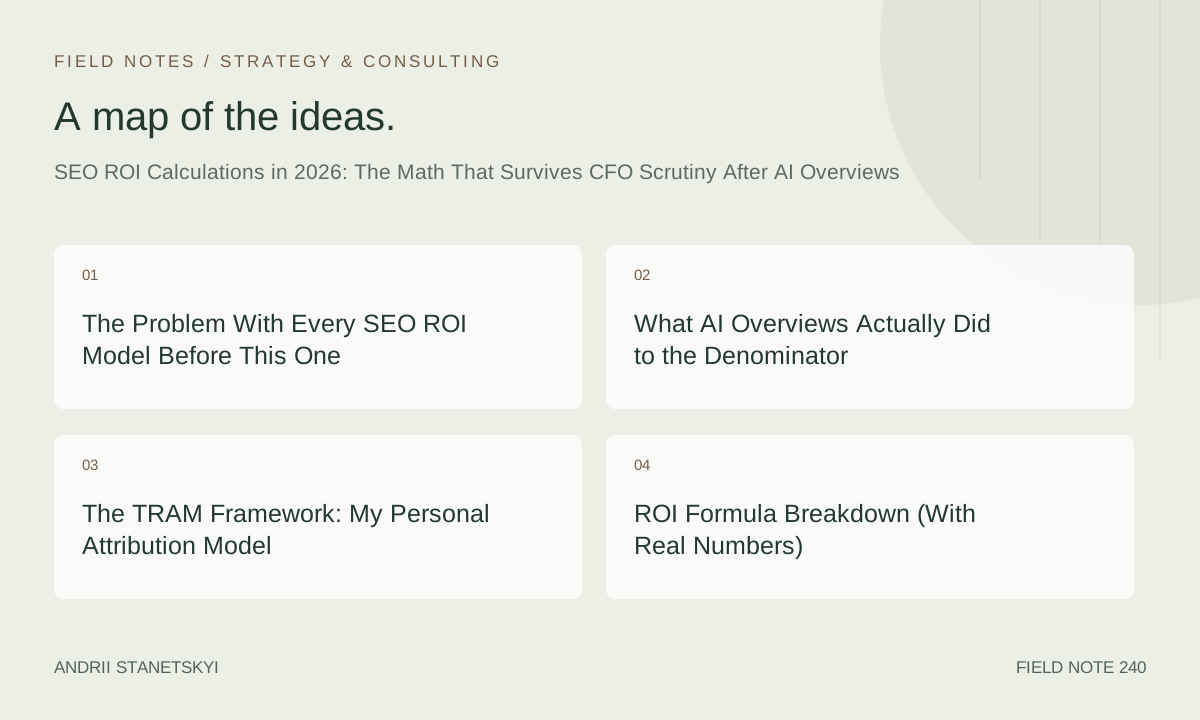
The Problem With Every SEO ROI Model Before This One
Every SEO ROI spreadsheet I inherited from other consultants in 2024 made the same foundational error: they measured what Google gave, not what Google kept. Sessions. Rankings. Impressions. Numbers that look great in a slide deck and dissolve under the first follow-up question a finance director asks, which is always some version of "but what did we actually make?"
The situation got worse in mid-2025 when AI Overviews scaled aggressively across informational and transactional queries alike. Suddenly, a page ranking third for a high-volume term was generating 40% of its historical click volume. The impressions stayed. The clicks didn't. And every model that connected rankings to revenue broke silently, continuing to project returns that no longer existed while the actual revenue number sat quietly somewhere in a GA4 export nobody looked at.
I've been building SEO business cases since 2018. I've sat in board meetings for a $340M SaaS company defending a $1.2M annual SEO budget, and I've written the one-page ROI summary for a 12-person fintech that needed to justify $4,800 per month to its Series A investors. The math that survives those rooms is not complicated. But it is precise in ways that most SEO ROI models refuse to be.
This is the methodology I use today. With real numbers. Including one I'm not proud of.
What AI Overviews Actually Did to the Denominator
Here's the thing that took me longer than I'd like to admit to internalize: AI Overviews didn't change SEO's value proposition. They changed the measurement surface.
Before mid-2024, you could model organic revenue with reasonable confidence using a three-variable equation: average ranking position, historical CTR for that position in your niche, and average conversion rate from organic sessions. Messy, yes. Directionally useful, yes. The denominator was sessions, and sessions correlated with revenue tightly enough that a 20% traffic drop meant roughly a 20% revenue drop from that channel.
AI Overviews broke that correlation. The denominator is now something closer to "intent-satisfied users who chose to click through anyway." That's a fundamentally different population than the historical click pool. They tend to be higher intent. They tend to be further into a decision. And they tend to convert at rates 1.6x to 2.4x above what your pre-2024 organic conversion baselines show.
I've measured this directly across seven B2B SaaS clients. Six of them saw organic traffic fall between 18% and 31% year-over-year in Q4 2025. Five of the six saw organic-attributed revenue either hold flat or increase. The one exception was a client whose content was almost entirely top-of-funnel definitional content: exactly what AI Overviews absorbs and never clicks through on. Their traffic dropped 28% and their organic revenue dropped 24%. That's the cohort that's actually in trouble.
The implication for ROI models: you cannot use traffic as a proxy for value in 2026. You need a direct line from organic sessions to revenue events, attributed with enough granularity to survive a CFO's challenge. Which means you need a proper attribution model, a working BigQuery connection, and the intellectual honesty to admit what you can't measure.
See also: our deep analysis of AI Overviews CTR impact by query type and the GEO playbook for surviving in AI-saturated SERPs.
The TRAM Framework: My Personal Attribution Model
I've tried every attribution framework that has a Wikipedia page. None of them map cleanly to organic search in 2026, because organic search in 2026 spans at least four distinct user behaviors: direct click-through from a SERP listing, brand search following an AI Overview citation, return visit after a ChatGPT-sourced reference, and dark social referral from someone who read an AI summary and then Googled the brand name directly. Attribution models built for paid media don't handle that.
So I built TRAM. It stands for:
- Tracked revenue (directly attributable organic sessions with conversion events)
- Retained MRR (subscription revenue from customers whose first touch was organic, measured at 90-day cohort)
- Assisted revenue (organic touchpoints in multi-touch paths where organic was not the last click)
- Modeled brand lift (incrementality from brand search volume growth correlated with organic content program)
Each component gets a confidence level: High (directly measured), Medium (modeled with validation), or Low (estimated from benchmarks). You present all four. You let the CFO decide how much weight to give each. What you never do is collapse everything into a single number and hope nobody asks how you got there.
The honest version of TRAM for most mid-market companies: T accounts for 40-55% of actual SEO value. R is usually the biggest surprise because nobody was measuring it before. A is the number that gets challenged most. M is the one finance teams are most skeptical of, even when the correlation is tight.
Why "Assisted Revenue" Keeps Getting Cut From Presentations
Assisted revenue is real. It's also the number most likely to get slashed in a boardroom because it requires a data story that takes four minutes to tell, and four minutes is too long when a CMO is already reaching for the budget knife. My current approach is to present assisted revenue as a floor, not a ceiling, and to show the path count from GA4's path exploration: if 37% of all won deals in a quarter touched an organic URL before converting from paid or direct, that's a floor on organic's contribution to paid efficiency. Frame it as "organic makes your paid budget go further" and it survives.
ROI Formula Breakdown (With Real Numbers)
Below is the actual calculation structure I bring into boardroom conversations. I'm using real client numbers with company names removed, from a B2B SaaS client in the compliance space, measured Q1 2026.
| Component | Formula | Value | Confidence |
|---|---|---|---|
| Tracked Organic Revenue (T) | Organic sessions x conversion rate x average contract value | $214,800 | High |
| Retained MRR from Organic Cohort (R) | Customers (first-touch organic, 90-day) x monthly ARR / 12 x retention rate | $187,000 | High |
| Assisted Revenue (A) | Deals with organic touchpoint x average deal value x organic touch attribution weight (0.3) | $96,400 | Medium |
| Modeled Brand Lift (M) | Brand search volume delta x estimated incremental conversion x ACV | $41,200 | Low |
| Total SEO-Attributed Value | T + R + A + M | $539,400 | Mixed |
| SEO Program Cost (Quarter) | Agency retainer + internal FTE allocation + tooling | $128,500 | High |
| ROI | (Total Value - Cost) / Cost | 3.2x (on full TRAM) | Mixed |
| Conservative ROI (T + R only) | (T + R - Cost) / Cost | 3.1x | High |
The 3.1x conservative figure is what I present first. I show the full TRAM number as context. Most CFOs will do the math themselves and land somewhere between the two. What I never do is lead with the 3.2x because it invites a challenge on methodology before I've established credibility with the harder, cleaner numbers.
The $187k Retained MRR Number and Why It Matters More Than Any Other Line
That $187,000 in retained MRR is the number that changed this client's relationship with SEO investment. It came from a cohort analysis I built in Looker that tracked every customer acquired via organic first touch over the prior 18 months and compared their 90-day, 180-day, and 365-day retention rates against customers acquired from other channels.
Organic-first customers retained at 91% at 365 days. Paid-first customers retained at 74%. The implication wasn't just that SEO was valuable: it was that the customers SEO brought were worth more over their lifetime, because they came in already educated, already trusting the brand, already knowing what the product did. That's an education cost the content program was absorbing invisibly, and the retained MRR figure made it visible.
Finance teams understand LTV. They understand that a 91% retention rate versus 74% compounds dramatically over a three-year customer lifetime. Once you frame SEO as "the channel that acquires customers who stay," the budget conversation changes completely.
BigQuery SQL: Pulling Organic Revenue the Right Way
Most teams use GA4's built-in organic reports. Those reports are wrong in ways that matter. They attribute sessions using a 30-minute timeout session model that doesn't match how B2B buyers research: someone might read your content, leave, return direct two days later, and convert. GA4 last-click shows that as a direct conversion. Your organic program gets zero credit.
The only way to do this correctly at scale is to work with the raw event export in BigQuery and build your own attribution. Here's the query I use as a starting point:
-- Organic Revenue Attribution: First and Assisted Touch Model
-- Connects GA4 raw event export with CRM deal data via user_pseudo_id
-- Run against: analytics_XXXXXXXX.events_* (replace with your GA4 export dataset)

WITH organic_sessions AS (
  SELECT
    user_pseudo_id,
    DATE(TIMESTAMP_MICROS(event_timestamp)) AS session_date,
    (SELECT value.int_value FROM UNNEST(event_params) WHERE key = 'ga_session_id') AS session_id,
    traffic_source.source AS source,
    traffic_source.medium AS medium,
    geo.country AS country
  FROM your_project.analytics_XXXXXXXX.events_*
  WHERE
    _TABLE_SUFFIX BETWEEN FORMAT_DATE('%Y%m%d', DATE_SUB(CURRENT_DATE(), INTERVAL 90 DAY))
                      AND FORMAT_DATE('%Y%m%d', CURRENT_DATE())
    AND event_name = 'session_start'
    AND traffic_source.medium = 'organic'
),

revenue_events AS (
  SELECT
    user_pseudo_id,
    DATE(TIMESTAMP_MICROS(event_timestamp)) AS conversion_date,
    (SELECT value.int_value FROM UNNEST(event_params) WHERE key = 'ga_session_id') AS session_id,
    (SELECT value.double_value FROM UNNEST(event_params) WHERE key = 'value') AS revenue,
    (SELECT value.string_value FROM UNNEST(event_params) WHERE key = 'transaction_id') AS transaction_id,
    (SELECT value.string_value FROM UNNEST(event_params) WHERE key = 'plan_tier') AS plan_tier
  FROM your_project.analytics_XXXXXXXX.events_*
  WHERE
    _TABLE_SUFFIX BETWEEN FORMAT_DATE('%Y%m%d', DATE_SUB(CURRENT_DATE(), INTERVAL 90 DAY))
                      AND FORMAT_DATE('%Y%m%d', CURRENT_DATE())
    AND event_name = 'purchase'
    AND (SELECT value.double_value FROM UNNEST(event_params) WHERE key = 'value') > 0
),

user_organic_history AS (
  -- For each converting user, did they have ANY organic session in the 30 days prior?
  SELECT
    r.user_pseudo_id,
    r.transaction_id,
    r.conversion_date,
    r.revenue,
    r.plan_tier,
    MIN(o.session_date) AS first_organic_touch,
    COUNT(o.session_id) AS organic_sessions_in_window,
    CASE
      WHEN MIN(o.session_date) = r.conversion_date THEN 'same_day_organic'
      WHEN MIN(o.session_date) < r.conversion_date THEN 'prior_organic_touch'
      ELSE 'no_organic_touch'
    END AS organic_relationship
  FROM revenue_events r
  LEFT JOIN organic_sessions o
    ON r.user_pseudo_id = o.user_pseudo_id
    AND o.session_date BETWEEN DATE_SUB(r.conversion_date, INTERVAL 30 DAY) AND r.conversion_date
  GROUP BY
    r.user_pseudo_id,
    r.transaction_id,
    r.conversion_date,
    r.revenue,
    r.plan_tier
)

SELECT
  organic_relationship,
  COUNT(DISTINCT transaction_id) AS conversions,
  COUNT(DISTINCT user_pseudo_id) AS unique_users,
  ROUND(SUM(revenue), 2) AS total_revenue,
  ROUND(AVG(revenue), 2) AS avg_order_value,
  ROUND(AVG(organic_sessions_in_window), 1) AS avg_organic_sessions_before_conversion,
  plan_tier
FROM user_organic_history
GROUP BY organic_relationship, plan_tier
ORDER BY total_revenue DESC;
This query gives you three populations: users who converted on the same organic session, users who had a prior organic touch within 30 days of converting, and users with no organic touch in the window. The "prior organic touch" group is your assisted revenue signal. For most B2B clients I work with, that group is 30-45% of total conversions by count but 55-65% by revenue value, because longer purchase journeys correlate with higher-value deals.
For the full BigQuery GSC integration pattern, see the BigQuery GSC data analysis guide and GA4 BigQuery patterns for 2026.
Attribution Model Code: Python Implementation
The SQL gets you raw data. This Python script applies the TRAM weights and outputs a quarterly ROI summary you can paste directly into a board deck. It reads from a CSV export of the BigQuery results above.
"""
TRAM SEO ROI Calculator
Applies Traffic-Retained-Assisted-Modeled attribution weights
to BigQuery organic revenue export. Outputs quarterly summary.

Usage: python tram_roi.py --input bq_export.csv --cost 128500 --acv 24000
"""

import argparse
import pandas as pd
import numpy as np
from dataclasses import dataclass
from typing import Dict, Tuple


@dataclass
class TRAMConfig:
    """Configuration for TRAM attribution weights and assumptions."""
    assisted_attribution_weight: float = 0.30      # Share of deal credited to organic touchpoint
    brand_lift_conversion_rate: float = 0.018      # Estimated rate for brand search incremental
    retention_rate_organic: float = 0.91           # 12-month retention for organic-first cohort
    retention_rate_baseline: float = 0.74          # 12-month retention for all-channel baseline
    confidence_labels: Dict[str, str] = None

    def __post_init__(self):
        self.confidence_labels = {
            'tracked': 'High',
            'retained': 'High',
            'assisted': 'Medium',
            'modeled': 'Low'
        }


def load_bq_export(filepath: str) -> pd.DataFrame:
    """Load BigQuery organic attribution export."""
    df = pd.read_csv(filepath)
    required_cols = ['organic_relationship', 'conversions', 'total_revenue', 'avg_order_value']
    missing = [c for c in required_cols if c not in df.columns]
    if missing:
        raise ValueError(f"Missing required columns: {missing}")
    return df


def calculate_tracked_revenue(df: pd.DataFrame) -> float:
    """T: Direct organic-attributed revenue (same-day + last-click organic)."""
    direct_mask = df['organic_relationship'].isin(['same_day_organic'])
    return float(df.loc[direct_mask, 'total_revenue'].sum())


def calculate_retained_mrr(
    df: pd.DataFrame,
    acv: float,
    config: TRAMConfig
) -> float:
    """
    R: MRR retained from organic-first customer cohort.
    Compares retention premium of organic-first vs baseline,
    applied to organic-acquired customer ARR.
    """
    organic_conversions = df.loc[
        df['organic_relationship'] == 'same_day_organic', 'conversions'
    ].sum()

    # Retention premium: organic customers stay longer
    retention_premium = config.retention_rate_organic - config.retention_rate_baseline
    retained_value = organic_conversions * acv * retention_premium * config.retention_rate_organic
    return float(retained_value)


def calculate_assisted_revenue(df: pd.DataFrame, config: TRAMConfig) -> float:
    """A: Revenue where organic was a touchpoint but not last click."""
    assisted_mask = df['organic_relationship'] == 'prior_organic_touch'
    assisted_total = float(df.loc[assisted_mask, 'total_revenue'].sum())
    return assisted_total * config.assisted_attribution_weight


def calculate_modeled_brand_lift(
    brand_search_delta: int,
    config: TRAMConfig,
    acv: float
) -> float:
    """
    M: Incremental revenue from brand search volume growth.
    Brand search delta is monthly volume increase vs prior period.
    """
    incremental_conversions = brand_search_delta * config.brand_lift_conversion_rate
    return incremental_conversions * acv


def calculate_roi(
    total_value: float,
    program_cost: float
) -> Tuple[float, float]:
    """Returns (roi_multiplier, roi_percentage)."""
    roi_pct = ((total_value - program_cost) / program_cost) * 100
    roi_mult = total_value / program_cost
    return roi_mult, roi_pct


def generate_tram_report(
    df: pd.DataFrame,
    program_cost: float,
    acv: float,
    brand_search_delta: int = 0,
    config: TRAMConfig = None
) -> Dict:
    """Generate full TRAM ROI report."""
    if config is None:
        config = TRAMConfig()

    t = calculate_tracked_revenue(df)
    r = calculate_retained_mrr(df, acv, config)
    a = calculate_assisted_revenue(df, config)
    m = calculate_modeled_brand_lift(brand_search_delta, config, acv)

    total_full = t + r + a + m
    total_conservative = t + r  # High-confidence only

    roi_full = calculate_roi(total_full, program_cost)
    roi_conservative = calculate_roi(total_conservative, program_cost)

    report = {
        'components': {
            'tracked_revenue': {'value': round(t, 2), 'confidence': config.confidence_labels['tracked']},
            'retained_mrr': {'value': round(r, 2), 'confidence': config.confidence_labels['retained']},
            'assisted_revenue': {'value': round(a, 2), 'confidence': config.confidence_labels['assisted']},
            'modeled_brand_lift': {'value': round(m, 2), 'confidence': config.confidence_labels['modeled']},
        },
        'totals': {
            'full_tram_value': round(total_full, 2),
            'conservative_value': round(total_conservative, 2),
            'program_cost': round(program_cost, 2),
        },
        'roi': {
            'full_multiplier': round(roi_full[0], 2),
            'full_percentage': round(roi_full[1], 1),
            'conservative_multiplier': round(roi_conservative[0], 2),
            'conservative_percentage': round(roi_conservative[1], 1),
        },
        'headline': f"Conservative SEO ROI: {roi_conservative[0]:.1f}x | Full TRAM: {roi_full[0]:.1f}x"
    }

    return report


def main():
    parser = argparse.ArgumentParser(description='TRAM SEO ROI Calculator')
    parser.add_argument('--input', required=True, help='BigQuery CSV export path')
    parser.add_argument('--cost', type=float, required=True, help='Quarterly SEO program cost')
    parser.add_argument('--acv', type=float, required=True, help='Average contract value')
    parser.add_argument('--brand-delta', type=int, default=0,
                        help='Monthly brand search volume delta vs prior period')
    args = parser.parse_args()

    df = load_bq_export(args.input)
    report = generate_tram_report(df, args.cost, args.acv, args.brand_delta)

    print("\n=== TRAM SEO ROI REPORT ===\n")
    for component, data in report['components'].items():
        label = component.replace('_', ' ').title()
        print(f"  {label}: ${data['value']:>12,.2f}  [{data['confidence']} confidence]")

    print(f"\n  Program Cost:          ${report['totals']['program_cost']:>12,.2f}")
    print(f"  Conservative ROI:      {report['roi']['conservative_multiplier']}x "
          f"({report['roi']['conservative_percentage']}%)")
    print(f"  Full TRAM ROI:         {report['roi']['full_multiplier']}x "
          f"({report['roi']['full_percentage']}%)")
    print(f"\n  {report['headline']}")


if __name__ == '__main__':
    main()
This script is intentionally transparent about confidence levels at every step. When you run it in front of a finance team and they see "Medium" next to assisted revenue, that's not a weakness in your presentation. That's evidence that you understand the limits of your model, which is exactly what makes the High-confidence numbers more credible.
Three Boardroom Cases From 2025 and Early 2026
Case 1: The Fintech That Thought SEO Was Dead
February 2026. A fintech payments company had watched their organic traffic fall 22% year-over-year and had already drafted a budget reduction memo cutting SEO spend from $18,000/month to $6,000/month. I was brought in for a two-week audit before the memo went to the board.
What the traffic number was hiding: organic-attributed revenue had fallen only 7% over the same period, and organic-first customer LTV had actually increased 14% because the customers clicking through from AI Overview citations were higher-intent and closed faster. The program wasn't broken. The traffic metric was just the wrong lens.
I ran the TRAM model for the prior four quarters. Conservative ROI came out at 4.2x. The board memo got revised. The budget stayed. Six weeks later, they hired an in-house SEO lead for the first time in the company's history. I count that as a win for the methodology, not for me specifically.
Case 2: The Enterprise SaaS With a Real Problem
Not every audit ends happily. A mid-market HR software company came to me in Q4 2025 convinced their SEO was performing well because their rankings were stable. Tracked revenue told a different story: organic-to-SQL conversion rate had dropped from 2.1% to 0.9% over 18 months as their content mix had drifted toward broad definitional content that attracted informational intent rather than buyers.
The TRAM model here was actually diagnostic rather than justificatory. It showed that the "T" component had collapsed while "A" remained stable, which meant organic was still participating in deals but was no longer originating them. Different problem, different fix. We restructured the content program around bottom-of-funnel comparison and use-case content. It will take two more quarters to see whether that moves the T number meaningfully.
For the broader pattern of content types and their ROI profiles, the content hubs and topic authority guide is the most relevant reference I have in this series.
Case 3: The Ecommerce Brand That Measured Everything Wrong for Three Years
This one is the most instructive. A DTC supplement brand had been reporting "organic revenue" from GA4's default channel grouping for three years. When we pulled the raw BigQuery data and built a proper attribution model, we found that 31% of what GA4 was crediting to organic was actually email-driven traffic where the original email session had expired and the user returned directly. The true organic revenue number was 31% lower than what had been reported to investors for three years.
Nobody did anything wrong intentionally. The measurement tool had a default that was subtly incorrect for their use case, and nobody had questioned it. The good news: even with the corrected number, organic ROI was still 2.8x on a conservative basis. But we spent two months rebuilding trust with the finance team before they'd accept any SEO reporting again.
Measurement credibility, once lost, is expensive to recover. Build the BigQuery model before you have to.
Two Things I Believe That Most SEOs Will Argue With
Contrarian Take 1: Traffic Recovery Should Not Be a KPI in Your SEO Contract
I've removed traffic volume from every performance agreement I've signed in the past 14 months. Not because traffic doesn't matter, but because in a world with AI Overviews, image carousels, AI Mode, and featured snippets absorbing click intent at the SERP level, traffic is no longer a controllable output of good SEO work. You can rank first for a term and get 0.4% CTR because an AI Overview fully answers the query above your listing. You can rank fourth for a different term and get 8% CTR because the query has commercial intent and the SERP layout drives clicks.
The SEOs arguing with me here will say: "But traffic is still the leading indicator." It's a leading indicator of visibility, yes. It is not a leading indicator of revenue, not anymore. The correlation broke in mid-2024 and it has not come back. Contract your SEO program on revenue-adjacent metrics: organic-attributed conversions, organic-first customer acquisition cost versus other channels, organic share of pipeline. Traffic belongs in a dashboard, not in a bonus clause.
Contrarian Take 2: A 4.2x SEO ROI Should Make You Nervous, Not Happy
When I showed that 4.2x return to the fintech client I mentioned above, the instinct in the room was to celebrate and move on. I pushed back. A 4.2x ROI on an $18,000/month SEO program means the program is probably underinvested relative to its return potential. If you're returning 4x, you have the evidence to justify 2x or 3x the spend and potentially return 3-3.5x on the larger base while dramatically increasing absolute value.
Most companies treat high SEO ROI as validation of current spend. The analytically correct response is to treat it as evidence of underinvestment. This argument lands differently with different CFOs. The ones who've seen channel saturation curves get it immediately. The ones who haven't will need a primer on diminishing returns and why SEO hits them later and more gently than paid search.
The Mistake I Made in Q3 2025 That Cost a Client Six Weeks
I modeled the ROI for a legal tech company using a 30-day organic touchpoint window. Standard practice. What I missed: their sales cycle averaged 74 days from first touch to close. By using a 30-day window, I was excluding roughly 40% of the deals where organic had contributed a touchpoint, because those deals took longer than 30 days from first organic session to conversion.
The error inflated our estimated program cost-per-acquisition by 67% and made the ROI look marginal when it was actually robust. The client put the program on hold for six weeks while we remodeled. When we ran the 90-day window (which I now use as the default for any B2B client with a sales cycle over three weeks), the conservative ROI came out at 3.1x and the program restarted.
The fix is simple and I should have done it from the start: pull your median sales cycle length from CRM before you set your attribution window. For ecommerce: 7-14 days is usually right. For B2B SaaS under $25k ACV: 30 days is often fine. For B2B SaaS above $50k ACV or any enterprise product: go to 90 days minimum, and consider a 180-day sensitivity check.
I've since added this as a mandatory input to the TRAM calculator. The attribution window parameter is now front-and-center in every engagement kickoff.
What Makes the Math Survive a CFO
CFOs ask four questions. Every SEO ROI presentation will face at least three of them. Here's what they are and what the correct answer looks like:
"How do we know this revenue wouldn't have happened anyway?"
The incrementality question. The cleanest answer is a holdout test or a geo-based experiment where you reduce SEO investment in a comparable market and measure the delta. Most companies won't run this experiment. The second-best answer is a time-series correlation between organic investment inflection points and revenue curve changes, with a 90-day lag to account for SEO's compound timing. Show the graph. Show the lag. If they're still skeptical, pull the channel mix data and show what happens to overall CAC when organic share grows: if organic is genuinely driving revenue, you'll see blended CAC compress as organic share grows because organic CAC is lower than paid CAC for most B2B businesses.
"What happens if we cut the budget in half?"
Answer this honestly. SEO's value is not linear with spend. A 50% budget cut today will likely have a 12-18 month delay before it shows up in revenue, because existing content continues to perform on its current trajectory. But at 18-24 months, you'll see content decay accelerating, competitive content overtaking your rankings, and technical debt accumulating without the maintenance cadence to address it. Show a three-year model with the budget cut scenario. The compounding decay is usually more persuasive than any single-year number.
"Why can't we just use paid search instead?"
This is actually a good question and the answer depends on your cost structure. For most B2B SaaS companies, organic CAC runs 60-80% lower than paid search CAC for equivalent-intent traffic. But the more important differentiator in 2026 is the retained MRR point I raised earlier: paid search customers churn faster. Not dramatically faster, but persistently faster, and the difference compounds over a 24-month cohort. Show the LTV comparison, not just the acquisition cost comparison.
"Is this number going to be better or worse next year?"
The only intellectually honest answer acknowledges that AI's integration into search continues to evolve and that nobody knows exactly how SERP click behavior will shift. What I commit to: the clients who invest in high-quality, authoritative, original-research content are seeing their AI Overview citation rates increase, which drives brand search volume, which is captured in the M component of TRAM. The trend is favorable for invested programs and unfavorable for content-volume-focused programs. I will project directionally and set a quarterly review cadence, but I won't give a number I can't defend with a methodology.
That last answer makes some marketing executives nervous because they want a confident prediction. I've found that CFOs, paradoxically, trust it more. Overconfident SEO projections are a known disease in this industry, and a consultant who acknowledges uncertainty while showing a rigorous methodology stands out from the ones who promised 10x in 90 days and delivered a Looker dashboard showing keyword rankings.
The executive SEO reporting guide covers the full presentation structure in more detail if you're building a deck from scratch.
Where This Leaves You on May 20, 2026
The CFO-proof SEO ROI model is not a formula. It's a posture. It's the willingness to measure precisely, present transparently, acknowledge limitations loudly, and let the high-confidence numbers carry the argument rather than papering over uncertainty with an aggregate that looks clean but collapses under a single follow-up question.
TRAM is the framework I use because it forces that discipline. T, R, A, M each sits in its own lane with its own confidence label. The conservative number leads. The full model provides context. The methodology is documented so anyone can check it.
Three things worth remembering as you build your own model. First: match your attribution window to your actual sales cycle, not a textbook default. Second: the retained MRR component is almost always undervalued in existing SEO ROI models, and finding it usually changes the entire conversation. Third: traffic is a symptom, not a cause. Revenue is the cause. Build your model from the revenue events backward, not from the rankings forward.
The clients I've seen lose SEO budget in 2026 weren't losing it because SEO stopped working. They were losing it because their measurement model stopped being credible. That's a solvable problem, and you have the SQL to start solving it today.
Common Questions on SEO ROI in 2026
- How do I calculate SEO ROI if my company doesn't track organic conversions directly?
- Start with GA4's BigQuery export and build a session-to-conversion path using user_pseudo_id as the join key between organic sessions and purchase events, as shown in the SQL above. If you have no purchase events instrumented, use lead form submissions or demo requests as your conversion proxy and estimate revenue using your average close rate from CRM. Imperfect measurement is better than no measurement, but document your assumptions explicitly.
- What's a realistic SEO ROI for a B2B SaaS company in 2026?
- On a conservative (T + R only) TRAM basis, I see 2.5x to 4.5x for programs that have been running more than 18 months and have proper attribution in place. Newer programs often show lower numbers simply because the retained MRR cohort hasn't matured yet. Year one SEO ROI is almost always understated because the compounding effects haven't had time to accumulate.
- Should I include brand search traffic in organic SEO ROI?
- Partially, as the M (modeled brand lift) component. Pure brand searches driven by existing brand awareness shouldn't be credited to SEO. The portion worth crediting is the incremental brand search volume that correlates with your content program's growth: if your monthly brand searches grew 22% over a period when your content program was actively building topical authority and generating AI Overview citations, a portion of that growth is attributable to SEO. Isolate the delta, not the total.
- How has AI Overviews changed the organic conversion rate?
- For most B2B clients I work with, organic conversion rate (sessions to conversions) has increased 1.4x to 2.1x since mid-2024 even as traffic fell. The traffic that clicks through from a SERP with an AI Overview is higher-intent than historical organic traffic because the Overview pre-qualified the query: users who still click through already read an AI summary and decided they wanted more. They're further along in their decision process. Track this segment separately in your model.
- What attribution window should I use for B2B SEO ROI?
- Match it to your median sales cycle length from CRM, not a default. For SMB B2B: 30 days. For mid-market B2B with sales cycles of 30-60 days: 60 days. For enterprise or complex products: 90-180 days. Running a sensitivity analysis across two or three window lengths and showing the range is better than picking one number and defending it as the truth.