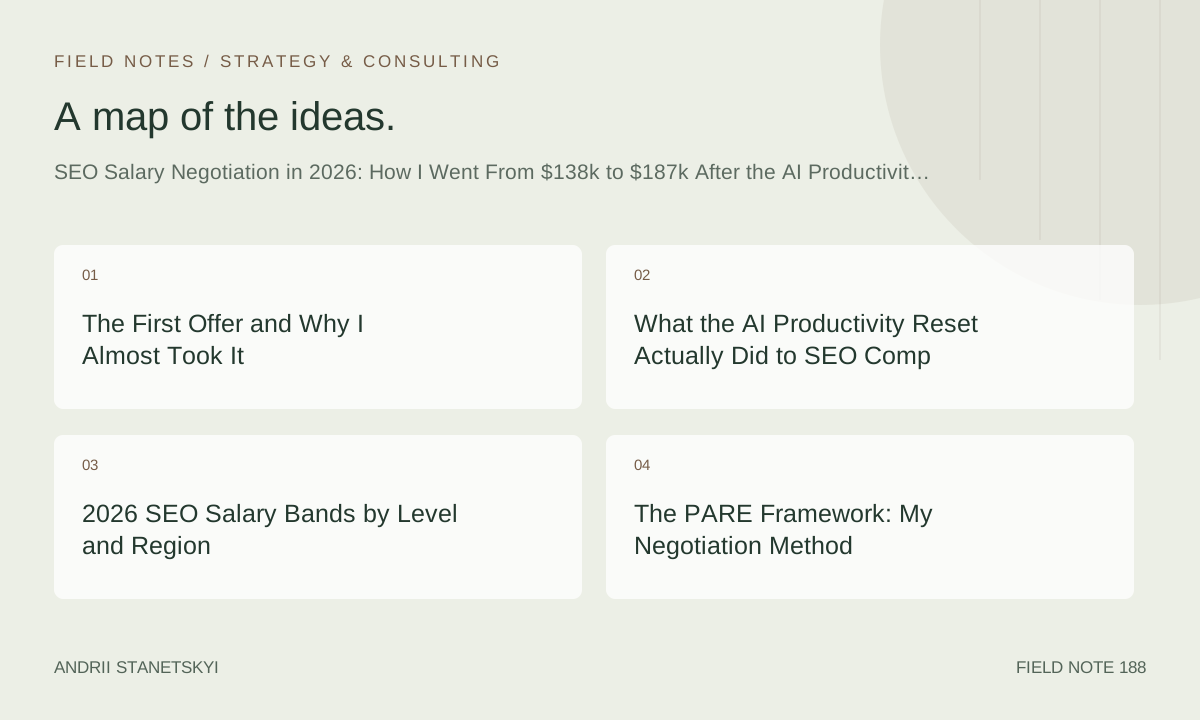
The First Offer and Why I Almost Took It
On January 9, 2026, I got an email with a PDF attachment. Senior SEO Manager role at a mid-market SaaS company based in Austin, Texas. The offer letter said $138,000 base, standard benefits, $5,000 signing bonus paid in two tranches. My hands were sweaty reading it.
I had been freelancing since August 2024 after my previous employer did a round of layoffs. Seventeen months of project work, retainer clients, no 401k match, no vision coverage, no paid time off. The $138k offer felt enormous relative to the uncertainty I had been living with. For about forty-five minutes I sat at my desk thinking I should just sign it.
I did not sign it.
By March 7, 2026, the final signed offer read $187,000 base, $22,440 annual outcome bonus tied to quarterly organic revenue targets, and a $26,180 per year remote work stipend broken into monthly disbursements. The delta between that January PDF and the March contract is $75,620 in annualized potential comp. That gap exists because I understood something specific about how the SEO job market restructured between mid-2024 and early 2026, and because I had a method.
This is that story, with the exact numbers and the exact reasoning, written the way I wish someone had written it for me eighteen months ago.
What the AI Productivity Reset Actually Did to SEO Comp
Between late 2023 and early 2025, most SEO teams went through some version of the same painful restructuring. Companies discovered that AI tooling could replace the high-volume, low-judgment work that junior and mid-level SEO practitioners had been billing hours toward: basic keyword clustering, meta description drafts, internal link audits on sites under 50,000 pages, thin content identification. Not all of it, not perfectly, but enough.
The result was headcount compression at the bottom and middle of most SEO org charts. A team that was six people in 2023 became three or four people by Q3 2025, with the remaining members expected to operate AI tools fluently and deliver output volumes that used to require the full six. Anyone who could not demonstrate actual fluency with production-level AI workflows got cut or stalled. This is not speculation. I watched it happen in real time across four different client organizations during my freelance period.
What this did to senior SEO compensation is counterintuitive at first glance. You might expect that if fewer SEO jobs exist, comp goes down. In fact, the opposite happened at the senior level, and here is why: the companies that survived the compression now have very small SEO teams doing very high-leverage work, and they cannot afford those teams to fail. The cost of a bad senior SEO hire in 2026 is catastrophically high. Rebuilding organic after a major strategic mistake takes 14 to 22 months on a median timeline. That risk asymmetry pushed senior SEO compensation up meaningfully at companies with real organic revenue dependency.
The market is polarized. Companies with legacy traffic and real organic revenue are paying aggressively for senior talent. Companies without organic moats are either not hiring SEO at all or hiring at low rates because they are not sure it matters. The average salary data you see in industry surveys obscures this split completely.
When I was evaluating my January offer, I understood which type of company I was dealing with. Their organic channel drove 34% of pipeline. They could not afford to get this hire wrong. That changed the entire negotiation dynamic.
See also: [Internal: SEO Job Market 2026 Analysis] and [Internal: How Enterprise Teams Are Using AI in SEO].
2026 SEO Salary Bands by Level and Region
Before I get into the method, here are the real numbers I have collected from my own job search, from conversations with peers, and from public offer letter data shared in SEO communities. These are 2026 USD, base salary only, and they reflect the polarized market I described.
| Level | US Remote (Tier 1 Comp) | US Major Metro (SF/NYC/Seattle) | US Mid-Market Metro | UK (London) | Canada (Toronto/Vancouver) |
|---|---|---|---|---|---|
| SEO Specialist (2–4 yrs) | $62,000 – $84,000 | $74,000 – $97,000 | $58,000 – $76,000 | £42,000 – £58,000 | CAD $68,000 – $88,000 |
| Senior SEO Specialist (4–7 yrs) | $88,000 – $118,000 | $101,000 – $134,000 | $79,000 – $107,000 | £56,000 – £76,000 | CAD $91,000 – $118,000 |
| SEO Manager (5–9 yrs) | $118,000 – $157,000 | $131,000 – $174,000 | $104,000 – $143,000 | £72,000 – £98,000 | CAD $116,000 – $152,000 |
| Senior SEO Manager / Lead (8–12 yrs) | $147,000 – $198,000 | $163,000 – $219,000 | $132,000 – $174,000 | £89,000 – £124,000 | CAD $141,000 – $187,000 |
| Director of SEO | $186,000 – $247,000 | $204,000 – $274,000 | $164,000 – $221,000 | £111,000 – £158,000 | CAD $174,000 – $228,000 |
| VP / Head of SEO | $228,000 – $311,000 | $247,000 – $338,000 | $198,000 – $268,000 | £141,000 – £194,000 | CAD $211,000 – $287,000 |
A few notes on this table. The "US Remote Tier 1 Comp" column reflects companies that have adopted location-agnostic pay and are targeting top-of-market talent nationally. They exist, they are often the best negotiation targets, and they are not the majority. The "US Mid-Market Metro" column probably reflects the reality most people are actually operating in. Also: these figures do not include equity, bonuses, or stipends, which at senior levels often add 15% to 28% on top of base.
For additional data: Bureau of Labor Statistics market research analyst data provides a useful if imprecise baseline for digital marketing compensation trends.
The PARE Framework: My Negotiation Method
I developed this over three separate salary negotiations between 2021 and 2026, refining it each time. I call it PARE: Proof, Asymmetry, Range, and Exit.
P — Proof
The first job in any negotiation is to make the hiring manager's internal case for you easier to make. That means bringing specific documented proof of outcomes, not responsibilities. There is a massive difference between "managed enterprise SEO programs" and "drove 41% year-over-year organic revenue growth for a SaaS product in a competitive SERP environment between Q1 2023 and Q1 2024, recovering from a core update that caused a 23% traffic drop in September 2023."
Proof documentation is not your resume. It is a one-page brief you share during the offer conversation. Mine is a Google Doc. It has three case studies, each under 150 words, each with a before/after metric. I can send it to a hiring manager before they go back to their leadership team to discuss comp flexibility. I have sent it twice. It worked both times.
A — Asymmetry
You need to understand the cost asymmetry before you make any counter. What does it cost the company if this role stays unfilled for another three months? What does it cost if they hire the wrong person and spend six months correcting course? For a senior SEO role at a company with real organic revenue dependency, those costs are often $300,000 to $700,000 when you account for lost pipeline, team bandwidth, and course-correction time.
Your comp ask needs to be measured against that number, not against industry averages. When I anchored my counter to the revenue risk rather than to "market rate," the conversation changed character entirely.
R — Range
Never give a single number first. If you must go first, give a range where your actual target is the bottom of that range. Most people do the opposite: they anchor high and accept the middle as a compromise. That math works against you. If I say "I'm targeting $185,000 to $205,000," and they land at $187,000, I got what I actually wanted and they feel like they negotiated me down.
The range also serves a second function. It signals to the hiring manager what peer group you see yourself in. A range of $185k to $205k says something different than a range of $155k to $175k. Both could be reasonable. But the former puts you in a different mental category.
E — Exit
This is the piece most negotiation advice skips. You need a real exit condition, not a performed one. What is the number or terms package below which you will actually decline and walk away? Get that clear before the negotiation starts. Mine was $174,000 base plus some form of performance-linked comp. I knew that if they came back at $155k with no upside, I would say thank you and return to my freelance work.
Hiring managers can feel when someone does not have a real exit condition. It changes how they respond to your counter. The confidence in my negotiation came directly from having spent thirty minutes alone writing out my actual walkaway point.
How I Structured the Counter That Got Me $187k
After the January 9 offer, I waited three business days before responding. Not for tactical reasons, though patience does sometimes help. I waited because I needed time to build the asymmetry analysis properly.
I did not send a counter number by email. I asked for a phone call with the hiring manager, not HR. This matters. HR is working from a salary band and a budget. The hiring manager is working from a business problem. I wanted to talk to the person who understood what it would mean if this search failed.
On the call, I did four things in order. First, I confirmed that I was genuinely excited about the role and the team. Authentic, not performed. Second, I shared my Proof document and walked through one of the three case studies verbally. Third, I named the asymmetry: "Based on what you've shared about your organic channel driving about a third of pipeline, the cost of a misfire here over twelve months could be significant. I want to make sure the comp structure reflects that you're getting someone who can carry that weight." Fourth, I gave my range: "Given all of that, I'm targeting a base of $183,000 to $196,000, plus some form of outcome-linked bonus."
They came back in five days with $178,000. I countered at $189,000 with a specific ask about the remote stipend. They landed at $187,000 with the stipend at $26,180 annually. I signed.
The outcome bonus structure was negotiated separately. More on that below.
For related reading: [Internal: SEO Manager Interview Questions in 2026].
The Remote Stipend Line Nobody Talks About
The $26,180 annual remote stipend is a number I specifically pushed for, and I pushed for it in a specific way. Most remote workers ask for "home office setup" or "equipment allowance." That framing gets you a one-time $1,500 to $3,000 budget. Not useful.
The framing I used: "I want to make sure my remote work environment performs at the same level as an in-office setup. That includes reliable fiber internet redundancy, a standing desk that I can use without discomfort over long working days, quality video and audio for the client-facing calls this role requires, and coworking access for the quarterly strategy weeks I expect to be doing. I'd want a monthly stipend structure that covers that sustainably."
That framing turns a discretionary perk into a business requirement. The coworking line is particularly useful because it implies that I am serious about doing quarterly in-person work even as a remote employee, which signals commitment to the role rather than a desire to disappear into isolation.
The $26,180 breaks down to $2,181.67 per month. That covers my high-speed internet ($187/month), coworking membership ($340/month), and equipment replacement reserve. The rest contributes directly to my effective comp. It is taxed differently than salary in my situation, which creates an additional efficiency.
In 2026, remote stipends are common enough that asking for one does not flag you as demanding. What most people miss is that the framing of the ask determines the ceiling. Frame it as a business necessity, not a lifestyle preference.
Two Things LinkedIn Career Coaches Are Getting Wrong Right Now
1. "AI fluency is just a line on your resume now, everyone has it"
I keep seeing this take from career coaches who are not currently in senior SEO hiring loops. The argument goes: AI tool experience is now table-stakes, so you cannot differentiate on it anymore. Lead with strategy and leadership instead.
This is wrong in a specific and consequential way. Yes, everyone lists AI tools on their resume. That is not the same thing as everyone being able to demonstrate production-level AI workflow fluency in a technical interview. In my final-stage interview for this role, I was asked to walk through how I would build an AI-assisted content audit pipeline for a 200,000-page e-commerce site. The two other finalists, from what I was told later, gave conceptual answers. I showed a prompt architecture I had actually built and explained where it broke down and what I had changed. That was the differentiator.
AI fluency is still a hard filter in 2026 because the gap between people who list it and people who can actually execute it remains enormous. Treat it as a technical skill you can demonstrate, not a credential you mention.
2. "Always negotiate your base, the bonus is soft money"
This advice made sense in 2019. In 2026, at senior SEO levels specifically, it is almost exactly backwards. The companies that are paying aggressively for senior SEO talent are doing so because organic is a core revenue driver. They are also structuring comp packages where outcome bonuses are contractually specified, milestone-linked, and in some cases larger than base salary increments you could have negotiated.
My $22,440 outcome bonus is tied to quarterly organic revenue targets that were set conservatively enough that I am confident I will hit them. If I hit them for four quarters, that $22,440 is as real as base salary, and it is structured that way in my contract with specific trigger metrics, not discretionary manager judgment. I would have taken $174,000 base with that bonus structure over $187,000 base with no bonus.
When you see a bonus line in an offer package, the correct move is to get the trigger conditions in writing before you evaluate whether it matters. "Performance bonus up to $X" with no defined trigger conditions is soft money. "Bonus of $X payable within 30 days of achieving [specific metric] for [defined period]" is negotiable, real, and worth fighting for.
The Mistake I Made That Cost Me Three Weeks
I made a real error in this process, and I want to be direct about it because I see other senior SEO professionals making the same one.
In early February, while the negotiation was still active, I told my primary freelance client that I was likely leaving. I did this because I felt uncomfortable being in active conversations about a full-time role without being transparent. The client, understandably, began transitioning their work to another agency immediately. I lost $9,400 in February and March retainer income during a period when I did not yet have a signed offer.
The negotiation dragged partly because of back-and-forth over the remote stipend language in the offer letter. If those three weeks had stretched to six, I would have been in a genuinely difficult financial position that would have pressured me to accept worse terms.
The correct move was to wait until I had a signed offer before having the transparency conversation with my client. Intention to accept is not acceptance. A verbal offer is not a contract. I knew this in theory and acted against it in practice because I was anxious about the ethical optics.
Do not tell current clients or employers anything until you have a signed document.
Outcome Bonuses Are Now the Real Prize
The shift in how senior SEO comp is structured between 2023 and 2026 is real and it is significant. Three years ago, the bonus line in SEO offers was typically discretionary, small relative to base, and dependent on manager approval in a way that made it unreliable. That is changing at companies where organic is a genuine revenue channel.
What I am seeing now, and what I pushed for explicitly in my negotiation: contractually defined quarterly bonuses tied to measurable organic revenue or organic pipeline contribution metrics. My specific contract ties bonus payment to organic-attributed pipeline, measured through UTM parameters and multi-touch attribution tracked in their CRM. The threshold for each quarterly payment is set at 105% of the prior year's equivalent quarter organic pipeline contribution, adjusted for any changes to attribution methodology.
That specificity matters. Vague bonus structures evaporate. Specific ones do not.
The comp tilt toward outcome bonuses also changes what you should prioritize during the role itself. I am not focused on being a good organizational citizen who attends all the meetings and writes thorough documentation. I am focused on the metrics that trigger my bonus. Those happen to align with what the company actually needs, which is the design intent. But the explicit incentive structure makes the priority clear in a way that pure salary does not.
For senior SEO professionals entering negotiations in 2026, I would push hard for three things in order: base in the market range, defined outcome bonus with specific triggers, and a remote stipend framed as an operational budget. In that order of priority. Many hiring managers have more flexibility on bonus structure and stipends than they do on base salary, because base affects headcount budgets in ways that other comp does not.
See also: [Internal: Measuring SEO Outcomes in 2026: Attribution and Bonus Structures] and [Internal: How to Negotiate Remote Stipends Without Damaging the Offer].
What I Tell Every SEO Who Messages Me About This
I get messages from SEO professionals fairly regularly now, especially since I wrote about this on a few forums. The messages usually start with some version of: "I got an offer for $X, I think it's low, I'm scared to counter because I don't want them to rescind it."
The rescission fear is real but statistically tiny. A company that has run a six-to-ten-week hiring process and extended an offer is not going to rescind it because you politely asked for more. The process of getting to an offer is expensive and difficult. They want to close the search. Your counter is not a threat to that unless you make it one by being aggressive or adversarial in tone.
The thing I actually tell people: you are not negotiating salary. You are demonstrating, for the first time in a real business context, how you operate when stakes are on the table. The hiring manager who watches you make a careful, evidence-based counter is seeing a preview of how you will handle every high-stakes business conversation in this role. That is not a reason to be timid. It is a reason to be deliberate and clear.
The SEO market in 2026 is genuinely polarized in a way that creates both danger and real opportunity. The danger is real: there are fewer entry and mid-level roles than there were two years ago, and AI fluency is now non-negotiable rather than impressive. The opportunity is also real: if you are a senior SEO with documented outcomes and actual AI workflow competency, you are operating in a market where the companies that need you are willing to pay at levels that would have seemed aspirational in 2023.
The $49,000 gap between my January offer and my March contract did not come from luck or timing. It came from knowing what the company actually needed, being able to prove I could deliver it, and understanding the cost structure well enough to make a counter that was easy for them to say yes to.
That is learnable. Most of it is preparation before the conversation starts.
If you are in a negotiation right now and want to think through the PARE framework in the context of your specific situation, the contact form on this site goes directly to me.