In February 2026, I sat in on four senior SEO interviews as an observer for a Series B SaaS company that had asked me to help refine their hiring process. Over those four conversations I watched three people who looked excellent on paper produce answers that made the hiring manager visibly deflate. The fourth got the offer at $174,000 base. I want to talk about what separated them.
I've also been the candidate in that chair. In late 2025 I interviewed for a VP of Organic Growth role at a fintech company—a role I didn't take, but the process gave me a sharp view of what sophisticated teams are testing for now that they weren't testing for two years ago.
The six questions below are real. Some I watched get asked. Some I was asked. All of them are filters. The difference between a good answer and an average one isn't technical knowledge—it's the ability to think in public, at speed, about messy real-world problems where the right answer genuinely isn't obvious.
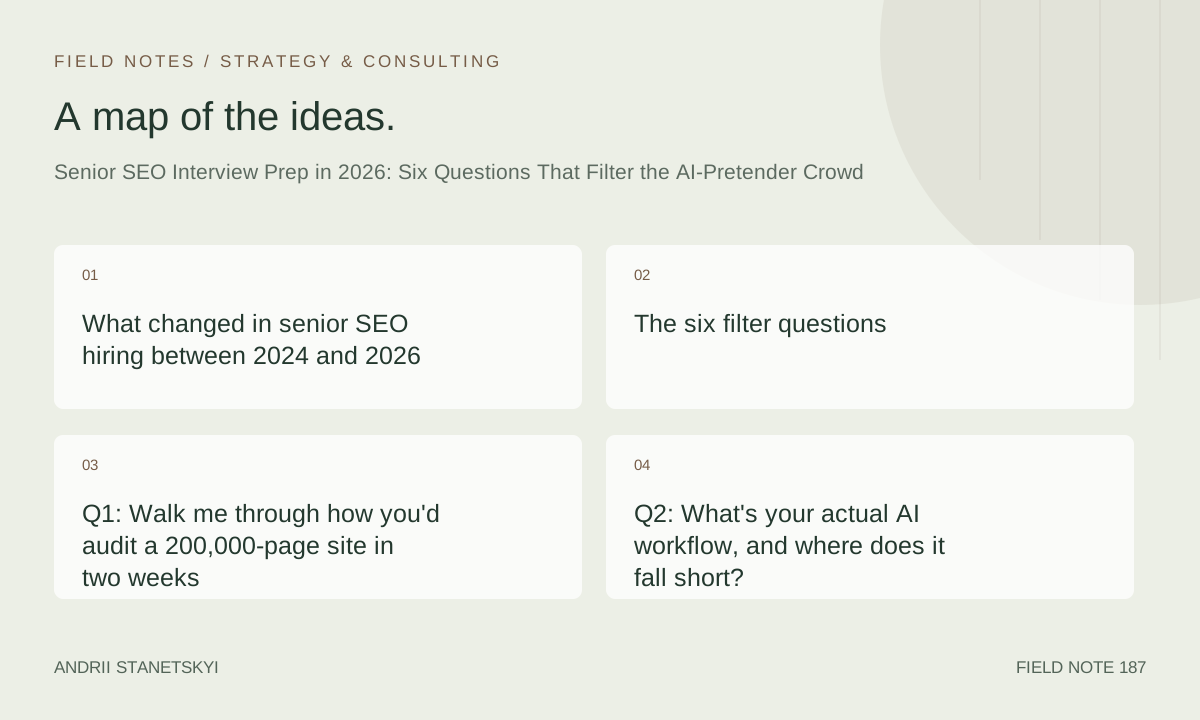
What changed in senior SEO hiring between 2024 and 2026
Three things shifted meaningfully.
First, AI tool fluency moved from a nice-to-have to an active filter. Companies that hired senior SEOs in 2023 expected them to be strong strategists who maybe used some automation. Companies hiring now expect candidates to demonstrate specific AI workflows—what they prompt, how they validate output, where they've built processes that scale. The difference between "I use AI tools" and "here is my audit pipeline and here is where Claude/ChatGPT falls down and why I catch it" is enormous in interview signal.
Second, the technical bar rose while the content strategy bar stayed roughly flat. The market polarized. There's significant demand for SEOs who can speak fluently about rendering, crawl budget, structured data at scale, and log file analysis—and significantly less premium for generalists who primarily think about content and keywords. The salary data bears this out. (See the salary bands in the table below.)
Third, interviews increasingly include a cross-functional scenario. How would you get this SEO recommendation through a product review? How would you explain crawl budget to a CTO who thinks SEO is a marketing problem? What happens when engineering deprioritizes your sprint tickets for three months? Pure SEO knowledge is necessary. It's not sufficient.
The six filter questions
Q1: Walk me through how you'd audit a 200,000-page site in two weeks
This is the most common senior technical SEO question and the one most candidates answer too slowly. The trap is trying to be comprehensive. The right answer is triage and prioritization, not a complete methodology.
What a strong answer includes: where you start (crawl + GSC data in parallel, not sequentially), what you're looking for in the first 48 hours (indexability, crawl anomalies, major redirect chains, rendering issues), how you handle scale (sampling strategy, which pages need individual review vs. which can be assessed at template level), and what the output looks like (a tiered priority list with business impact estimates, not a 400-row spreadsheet with no hierarchy).
What kills the answer: saying you'd use Screaming Frog without specifying how you'd handle 200k pages with it (you can't without custom configuration or a different tool), or describing a comprehensive audit that would take six weeks, not two.
The AI workflow angle here is strong. A candidate who says "I'd use a custom Python script to pull GSC data and cluster query patterns by page template, then use an LLM to categorize the canonical issues I find in the crawl output" is signaling something a candidate who describes a manual tab-by-tab Screaming Frog review is not.
Q2: What's your actual AI workflow, and where does it fall short?
The second half of this question is the filter. Anyone can list tools. The interviewers running the best processes in 2026 are listening for where the candidate has developed genuine skepticism about AI output—and has built that skepticism into their workflow.
A strong answer names specific tools (not categories), specific task types where AI adds real leverage (large-scale content audits, pattern recognition in crawl data, writing brief variations for testing), and at least one specific failure mode the candidate has experienced and adapted to. "I've found that Claude tends to over-index on recency in its content quality assessments—it flags pages that rank well but were published before 2022 as 'thin' based on format rather than substance. I now run a separate check against GSC performance before accepting its audit flags."
The pretender answer: "I use AI to help me work faster and generate content at scale." This tells the interviewer nothing about how you actually think. It's the 2026 equivalent of saying "I use Google Analytics to track performance."
Q3: Tell me about a time SEO conflicted with a product decision, and what happened
This is a behavioral question testing cross-functional maturity. The target answer structure: what the conflict was, what the stakes were, how you made your case, what the outcome was, and—critically—what you'd do differently.
Average candidates describe a conflict where they were right, the product team eventually agreed, and everything worked out. Strong candidates describe a conflict where they were overruled, explain why the overrule happened (often for legitimate reasons they didn't fully appreciate in the moment), and show what they learned about making SEO arguments land with non-SEO stakeholders.
In the February 2026 interview I observed, the candidate who got the job said: "We pushed back on a site redesign for three months citing SEO risk. The product team launched it anyway. Traffic did dip for about six weeks, but the conversion rate improvement on the new design recovered the revenue impact within a quarter. I was technically right about the traffic risk and I lost perspective on what the business actually needed. I've since learned to frame SEO risk in revenue terms with a recovery timeline rather than as a traffic-protection argument."
That answer is worth more than three examples of being right.
Q4: How do you prioritize when everything is urgent?
A question about prioritization frameworks. The obvious answer is "impact vs. effort matrix." Every candidate knows this. The question is whether the candidate can go one level deeper and talk about the specific factors they weight in an SEO context.
Technical issues that block indexing outrank content opportunities on any priority stack. Issues that affect a high-traffic template outrank issues that affect individual pages. Issues that have a clear owner and a fast deployment path outrank issues that require six months of engineering time regardless of their theoretical impact.
The frame I use that tends to land well in interviews: I prioritize around bottlenecks, not tasks. The question isn't "what's most important" abstractly—it's "what is preventing the most downstream work from getting done." Fix the bottleneck first. Everything else accelerates.
Q5: How has your measurement approach changed since AI Overviews scaled?
This question is a 2026 addition. It tests whether candidates have actually adapted their reporting and strategy in response to the AI Overview rollout or whether they're still operating as if click-through rate from organic rankings is the primary success metric.
What a strong answer covers: the recognition that impressions-without-clicks are now commercially meaningful for certain query categories (AI Overviews showing your content is a brand trust signal even when the user doesn't click), the shift toward revenue-attributed organic conversions rather than session counts, and the need to track branded search volume lift as a proxy for AI-assisted discovery.
Weaker answers focus entirely on the click loss narrative without describing what the candidate did about it. "AI Overviews hurt CTR" is an observation. "Here is how I changed my reporting dashboard and what metrics I added to replace clicks as the primary KPI" is an answer.
Q6: What's an SEO best practice you've stopped believing in?
This is the contrarian take question. It separates people who follow received wisdom from people who think. There's no single right answer, but there are several wrong approaches.
Wrong approach: picking something everyone already agrees is outdated. "Keyword stuffing" or "exact-match anchor text." These aren't contrarian—they're consensus. They signal you haven't thought about the question seriously.
Wrong approach: being contrarian for its own sake. Claiming that internal linking doesn't matter or that metadata is irrelevant reads as posturing rather than insight.
Strong answers pick something that's still considered best practice by a meaningful portion of the SEO community—and then give a specific, data-supported reason for skepticism. Some real examples I've heard work well:
- "I've largely stopped treating domain authority metrics as useful inputs for anything except rough competitive benchmarking. The correlation to actual ranking outcomes in my work has been much weaker than the SEO industry's reliance on it would suggest."
- "I don't believe that longer content reliably outperforms shorter content for the same query anymore. The relationship existed in 2019. It's much weaker now that search intent matching is more precise."
- "I've become skeptical of the practice of clustering all keyword variants into a single pillar page. In several projects I've seen individual pages targeting specific sub-intents outperform a single comprehensive page for every variant—including the head term."
The interview rubric I would use if I were hiring
| Dimension | What a 4/4 looks like | What a 2/4 looks like |
|---|---|---|
| Technical depth | Specific tools, specific configurations, can describe crawl/render/index separately | Knows the vocabulary but can't go one level deeper when probed |
| AI workflow fluency | Describes specific tools, specific use cases, specific failure modes with workarounds | Says they use AI tools; cannot give a specific example of where AI output was wrong |
| Cross-functional communication | Tells a story about being overruled and learning from it | Only tells stories where they were right and SEO won |
| Measurement sophistication | Has adapted reporting post-AI Overview; uses revenue-attributed metrics | Reports on sessions and rankings; AI Overviews are "a challenge" |
| Contrarian thinking | Identifies a real, current best practice and has specific evidence for skepticism | Names an outdated practice or picks something no one believes in anymore |
| Prioritization clarity | Has a bottleneck-first mental model; can articulate trade-offs | Defaults to "impact vs. effort matrix" with no further elaboration |
What current interview prep advice gets wrong
Memorizing answer frameworks makes you worse, not better
Every piece of interview prep advice tells you to prepare structured answers. STAR method, challenge-action-result, whatever. These frameworks are useful scaffolding. They become actively harmful when candidates use them to avoid thinking in public.
The interviewers running the best hiring processes in 2026 are specifically listening for moments of genuine uncertainty—where a candidate hits a question they don't have a prepared answer for and shows how they reason through it. Those moments of transparent thinking are more valuable than clean, rehearsed responses. Rehearsed responses that sound too polished generate suspicion now that AI can write a perfect STAR-method answer in 30 seconds.
The take-home audit exercise has replaced the whiteboard problem
If your interview prep is entirely verbal—mock answers to questions—you may be underprepared. Most serious senior SEO hiring processes in 2026 include a take-home exercise that involves actual data: a crawl export, a GSC performance dataset, or a site scenario with a brief. These exercises are explicitly designed to test whether candidates can do the work, not just describe the work.
Preparing for this: get comfortable producing a real audit deliverable under time pressure. Not a comprehensive one—a prioritized one. The evaluation criteria is usually not "did you find everything" but "did you identify the right things and communicate them clearly."
Practical prep for the next 30 days
Pick one real site (yours, a friend's, a public site you have an opinion about). Run a full technical audit. Document every decision: what you looked at first and why, what you ruled out and why, what the three highest-impact findings are. Write a one-page memo for a non-technical CMO explaining your top recommendation and the business case for it.
That exercise answers questions 1, 4, and the cross-functional part of question 3 simultaneously. It also produces an artifact you can reference in interviews when you need a specific example—because "here is a real audit I ran recently, and I can walk you through my reasoning" is infinitely stronger than a hypothetical answer.
For the AI workflow question: if you don't currently have a specific, described AI workflow, build one and use it for a month before your interview. Not because interviewers will be impressed by AI use generally—they won't—but because the quality of your answer to that question depends entirely on having real experience to draw from. Fabricated workflow descriptions collapse the moment the interviewer asks a follow-up.
For the contrarian question: pick your genuine take. If you don't have one, that's worth examining. Strong SEOs have opinions about what's overrated in the field. The absence of such opinions may indicate that you've been practicing SEO by following consensus rather than by testing assumptions against evidence.
Related: SEO Salary Negotiation in 2026 — The Senior SEO Career Path — Building an SEO Portfolio That Converts — LinkedIn Pulse: career and hiring trends