Most SEO engagements fail before a single keyword is researched. They fail in the proposal stage, when vague scope meets optimistic timelines and neither party has defined what "success" actually means. After fifteen years of structuring SEO agreements for Fortune 500 brands, mid-market SaaS companies, and boutique agencies, I can tell you with confidence: the contract is the engagement. Get it right and you have a framework for accountability, trust, and results. Get it wrong and you are heading toward scope creep, payment disputes, and a client who blames you for Google's algorithm updates.
This playbook covers everything a senior SEO consultant or agency principal needs to build airtight agreements in 2026 — from retainer structures and SLA language to kill clauses, IP ownership, and performance-based pricing triggers. I will give you real clause templates, not platitudes.
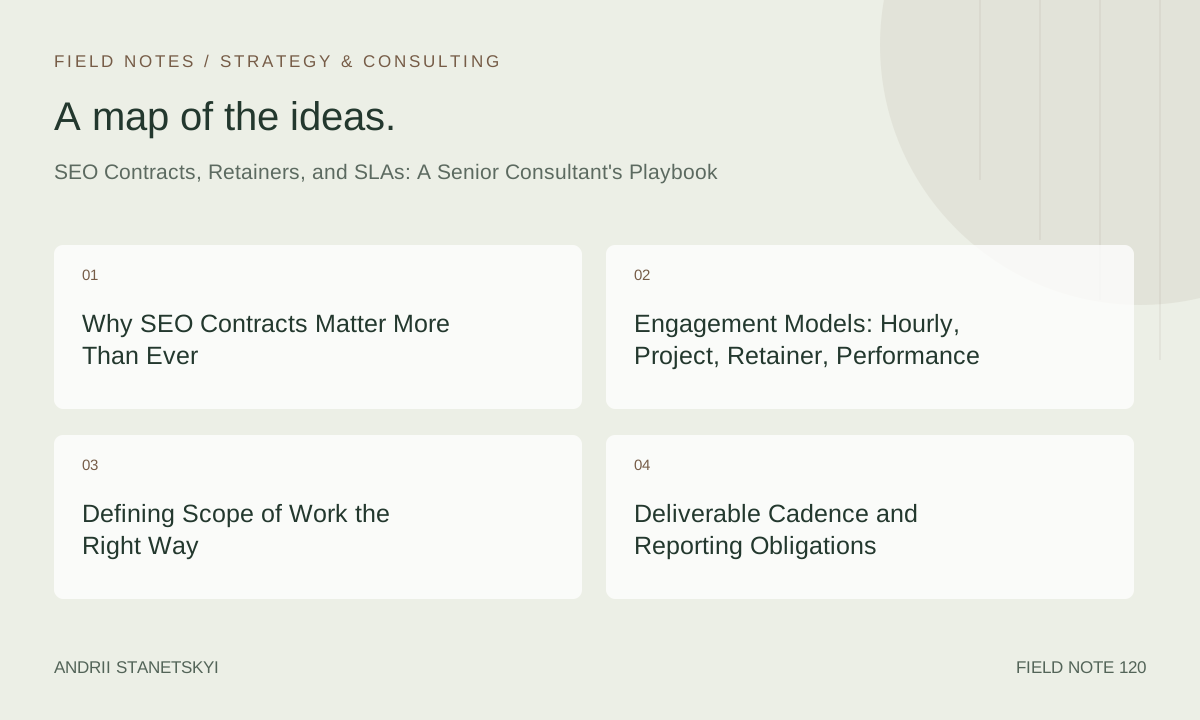
Why SEO Contracts Matter More Than Ever
The SEO industry has matured significantly since the early 2010s, but its contractual standards have not kept pace. Too many practitioners still hand clients a one-page proposal with a monthly fee and call it an agreement. In 2026, that is not good enough for several reasons.
First, Google's Search Generative Experience and AI Overviews have reshuffled ranking dynamics in ways that make timeline promises extraordinarily risky. Organic traffic for informational queries can evaporate overnight when a featured snippet gets absorbed into an AI-generated response. If your contract promises "top-three rankings within 90 days," you are potentially liable for something a large language model decided to do at 2 a.m. on a Tuesday.
Second, clients are more sophisticated. Enterprise procurement teams now routinely run SEO contracts through legal review. If your agreement cannot survive that scrutiny, you will lose deals to competitors whose paperwork is tighter.
Third, the rise of AI-assisted content production has created genuine IP ambiguity. Who owns the content your team produces using AI tools on behalf of the client? Without an explicit clause, you have no answer — and that creates real legal exposure.
A well-structured SEO contract protects both parties. It sets expectations, creates accountability mechanisms, and gives you a clean path to exit if the relationship stops working. Think of it as the technical SEO audit of your business relationship: comprehensive, systematic, and preventative.
For more on structuring your overall consulting practice, see our guide on [Internal: SEO Consultant Business Setup].
Engagement Models: Hourly, Project, Retainer, Performance
Before you can write a contract, you need to choose the right engagement model. Each has distinct risk profiles, cash flow implications, and appropriate use cases.
| Model | Typical Rate Range | Best For | Client Risk | Consultant Risk | Contract Complexity |
|---|---|---|---|---|---|
| Hourly | $150–$400/hr | Audits, one-off advisory, expert witness | Unpredictable spend | Scope underestimation | Low |
| Project (fixed fee) | $5,000–$80,000 | Site migrations, penalty recovery, one-time audits | Deliverable quality | Scope creep, timeline overrun | Medium |
| Monthly Retainer | $3,000–$30,000/mo | Ongoing optimization, content programs, link building | Proving ongoing value | Resource allocation drift | High |
| Performance-Based | Base + % of revenue lift or CPL savings | E-commerce, lead gen with clear attribution | Attribution disputes | External factors outside control | Very High |
My strong recommendation for most ongoing SEO work is a retainer with a performance incentive layer. The retainer covers predictable costs and protects your resource allocation. The performance layer aligns incentives without making your livelihood dependent on Google's mood swings. I will cover how to structure that hybrid model in the performance pricing section below.
Defining Scope of Work the Right Way
The Statement of Work (SOW) is the single most litigated section of any SEO contract. Write it wrong and every conversation with the client becomes a negotiation about whether something is "included."
What to Specify Explicitly
A proper SEO SOW should enumerate deliverables, not activities. Do not write "ongoing technical SEO." Write "monthly technical crawl of up to 50,000 URLs using Screaming Frog, delivered as a prioritized issue report with remediation recommendations by the 10th of each month."
The following categories must be explicitly included or excluded:
- Technical SEO (crawl depth limits, CMS access requirements, developer handoff protocol)
- On-page optimization (number of pages per month, who implements vs. who recommends)
- Content production (word count ranges, AI usage policy, fact-checking responsibility)
- Link acquisition (outreach volume, DR/DA minimums, niche restrictions)
- Local SEO (number of locations, citation management platform)
- Analytics and tracking (GA4 configuration, GSC access, custom dashboards)
- Competitor monitoring (number of competitors tracked, frequency)
- Algorithm update response (included or billed separately)
The Inclusion/Exclusion Table Method
I use a two-column table in every SOW: "In Scope" and "Out of Scope." For a content-focused retainer, Out of Scope might explicitly list: paid search management, social media management, email marketing, PR outreach, website development beyond SEO-related markup changes. This table eliminates the most common source of scope disputes.
Sample SOW Clause — Scope Limitation:
"Consultant's services are limited to organic search optimization as described in Schedule A. Any request for services not enumerated in Schedule A constitutes an out-of-scope request and will require a written change order signed by both parties before work commences. Consultant reserves the right to decline out-of-scope requests. Time spent evaluating out-of-scope requests exceeding two hours per month will be billed at Consultant's standard hourly advisory rate of $[X]."
For guidance on scoping specific deliverable types, see our article on [Internal: SEO Deliverables and Documentation Guide].
Deliverable Cadence and Reporting Obligations
Reporting is the most common source of client dissatisfaction in SEO retainers — not because results are bad, but because expectations around frequency and format were never set. Define both in the contract.
Standard Reporting Cadence for a Monthly Retainer
- Weekly: Async Slack/email status update (no deliverable, progress notes only)
- Monthly: Full performance report (traffic, rankings, conversions, work completed, work planned)
- Quarterly: Strategy review call (60–90 minutes, recorded, action items documented)
- Annual: Full-year retrospective and roadmap refresh
Sample Reporting Clause:
"Consultant shall deliver a monthly performance report by the 5th business day of the following calendar month. Reports will include: (a) organic traffic trends versus prior period and prior year; (b) keyword ranking movements for the agreed tracking list of up to 200 keywords; (c) a summary of deliverables completed in the prior month; (d) a prioritized roadmap for the coming month. Client acknowledges that SEO results are subject to search engine algorithm changes outside Consultant's control, and that ranking fluctuations do not constitute a breach of this Agreement."
That last sentence is not boilerplate. It is essential protection. Include it explicitly.
Dashboard Access vs. Report Delivery
Specify whether reporting is delivered as a static PDF/document or via a live dashboard (Looker Studio, Agency Analytics, etc.). If you maintain the dashboard infrastructure, state who owns that infrastructure and what happens to access upon contract termination.
Writing Enforceable SLA Language
A Service Level Agreement quantifies the minimum acceptable quality of service. In SEO, SLAs are underused but highly effective at building client confidence — when written correctly.
What SEO SLAs Can Reasonably Cover
- Response time to client communications (e.g., "Consultant will respond to client inquiries within one business day")
- Report delivery timeliness
- Deliverable turnaround windows
- Uptime/availability for dashboard tools
- Escalation protocol for urgent issues (site down, manual penalty received)
What SEO SLAs Cannot Reasonably Cover
Do not promise specific ranking positions in SLA language. Any attorney worth their retainer will tell you that a promise of "page-one rankings" is an unenforceable guarantee of a third party's behavior. Google is not your subcontractor. Instead, SLAs should cover your process outputs, not search engine outputs.
Sample SLA Clause — Response and Escalation:
"Consultant commits to the following service levels: (a) Standard communications: response within one (1) business day. (b) Urgent issues (confirmed manual actions, site-wide indexing failures, significant traffic drops exceeding 30% week-over-week): initial response within four (4) business hours during business days (Monday–Friday, 9am–6pm ET). (c) Monthly report delivery: no later than the 5th business day of the following month. Failure to meet items (b) or (c) on more than two occasions in any rolling three-month period entitles Client to a credit of [X]% of that month's retainer fee."
Notice the credit mechanism. It is a meaningful consequence that does not expose you to unlimited liability. A credit is far better than a termination-for-cause trigger.
Kill Clauses and Exit Provisions
Every SEO contract should define exactly how either party can exit the engagement. The absence of clear exit provisions is how retainers turn into hostage situations.
Notice Periods
For monthly retainers, a 30-day written notice period is standard for client-initiated termination. I recommend 60 days for engagements involving content programs or link-building campaigns that require wind-down periods. The consultant should have the same right to terminate, which clients sometimes resist but should always accept.
Termination for Cause vs. Termination for Convenience
Termination for cause (immediate or with a short cure period) should be triggered by: non-payment, client's implementation of tactics that violate search engine guidelines despite written objection from the consultant, or material breach of the NDA. Define a cure period — typically 10–15 business days — before termination for cause becomes effective.
Termination for convenience requires notice but no reason. Either party should have this right. Without it, you have an indefinite obligation.
Sample Kill Clause:
"Either party may terminate this Agreement without cause upon thirty (30) days' written notice to the other party. In the event of termination by Client without cause, Client shall pay for all work completed through the termination date, plus a termination fee equal to one (1) month's retainer fee if termination occurs within the first six (6) months of the Agreement. In the event of Client's failure to pay any invoice within fifteen (15) days of its due date, Consultant may suspend all services immediately upon written notice and terminate this Agreement if payment is not received within ten (10) additional business days."
The early-termination fee is not punitive. It covers your resource reallocation cost and any opportunity cost from turning away other clients.
Performance-Based Pricing: Structure Without Getting Burned
Performance-based SEO pricing is compelling in theory and treacherous in practice. Here is how to structure it so you actually get paid for results you drive.
The Hybrid Model
The cleanest structure is a reduced base retainer (60–70% of your standard rate) plus a performance bonus triggered by specific, measurable outcomes. The base covers your costs. The bonus is your margin and your incentive.
Defining Measurable Triggers
Performance bonuses must be tied to outcomes you can actually influence and measure unambiguously. Acceptable triggers:
- Organic non-branded sessions exceeding an agreed baseline by X%
- Organic-attributed leads or conversions exceeding baseline by X units
- Revenue from organic channel (requires reliable attribution, usually GA4 + CRM integration)
- Keyword ranking improvements (use a basket of 20–50 target keywords, define movement thresholds)
Sample Performance Bonus Clause:
"In addition to the monthly base retainer of $[X], Consultant shall be entitled to a performance bonus calculated as follows: for each calendar quarter in which organic non-branded sessions (as measured in Google Analytics 4, excluding branded keyword traffic as defined in Schedule B) exceed the baseline period average by more than twenty percent (20%), Consultant shall invoice an additional $[Y]. Bonuses are payable within fifteen (15) days of the end of the qualifying quarter. Baseline period is defined as the three (3) calendar months immediately preceding the commencement date of this Agreement."
Attribution Rules Must Be Written, Not Assumed
Specify your attribution methodology in writing before signing. Which tool governs? What happens if GA4 and GSC show different numbers? What is the discrepancy resolution process? I have seen performance bonus disputes entirely caused by clients switching from last-click to data-driven attribution mid-engagement. Write it down.
For a deeper look at attribution modeling in SEO reporting, see our resource on [Internal: SEO Attribution Models for Agency Reporting].
IP Ownership and Work-for-Hire Clauses
This section has become significantly more complex with the proliferation of AI content tools. Here is what you need to address.
Standard Work-for-Hire
Content, audits, and reports produced specifically for a client under a paid engagement should transfer to the client upon full payment. State this explicitly. Do not let it be implied.
Sample IP Transfer Clause:
"Upon receipt of full payment for services rendered, Consultant hereby assigns to Client all right, title, and interest in and to the Deliverables (as defined in Schedule A), including all copyrights therein, to the extent permitted by applicable law. Notwithstanding the foregoing, Consultant retains ownership of all Pre-existing Materials, tools, templates, frameworks, and methodologies used in the creation of Deliverables. Client's rights in Deliverables that incorporate Pre-existing Materials are limited to use of the Deliverables as completed works."
AI-Generated Content Carve-Outs
In 2026, you must address AI tooling explicitly. Who owns prompts? Who owns AI outputs? My standard language now includes: "Deliverables produced using AI-assisted tools are subject to applicable copyright law. Consultant makes no warranty that AI-assisted content is registerable as copyrightable work in any jurisdiction. Client accepts deliverables on an as-is basis with respect to AI-generated components and assumes all responsibility for review, fact-checking, and editorial approval before publication."
Retain Your Tools and Methodologies
Your keyword research frameworks, crawl configurations, reporting templates, and proprietary scoring models are your competitive advantage. Make sure your contract does not accidentally transfer them. The Pre-existing Materials carve-out in the clause above is your protection — but it only works if you define Pre-existing Materials in a schedule.
NDA and Confidentiality Provisions
A mutual NDA is appropriate for most SEO engagements. You will have access to the client's traffic data, conversion rates, revenue figures, and competitive strategy. They will have access to your methodologies and client list. Both exposures warrant protection.
Duration and Carve-Outs
Two to three years post-termination is reasonable for confidentiality obligations. Carve out information that is: (a) publicly available, (b) independently developed, (c) received from a third party without restriction, or (d) required to be disclosed by law or court order (with prior written notice to the other party where legally permitted).
Sample Confidentiality Clause:
"Each party agrees to hold the other's Confidential Information in strict confidence and not to disclose it to any third party without prior written consent, except to employees or contractors with a need to know who are bound by confidentiality obligations no less protective than those in this Agreement. This obligation survives termination of the Agreement for a period of two (2) years. 'Confidential Information' excludes information that: (i) is or becomes publicly available through no fault of the receiving party; (ii) was known to the receiving party prior to disclosure; (iii) is rightfully received from a third party without restriction; or (iv) is required to be disclosed by applicable law, provided the receiving party gives prompt written notice to allow the disclosing party to seek a protective order."
For clients in regulated industries (healthcare, finance, legal), you may also need to address data handling requirements separately — HIPAA BAAs, SOC 2 compliance, or GDPR data processing addenda.
The Kickoff Process as a Contractual Event
Here is an opinionated take that most consultants miss: the kickoff meeting should be defined as a contractual milestone, not an informal call you schedule after signing.
Why This Matters
When the kickoff is a contractual event, you can tie deliverable timelines to it rather than to the contract signing date. This protects you when clients take three weeks to schedule the kickoff after signing. "Deliverables begin 30 days from kickoff completion" is far better than "30 days from contract execution" when the client has not given you CMS access yet.
What Kickoff Completion Requires
Define kickoff completion as the moment when: (a) the kickoff call has occurred, (b) all access credentials have been provided (GA4, GSC, CMS, hosting if needed), (c) the brand guidelines and target audience documentation have been delivered, and (d) the initial keyword target list has been approved. Until all four conditions are met, the clock does not start.
Sample Kickoff Clause:
"Work under this Agreement shall commence upon completion of the Kickoff Process. The Kickoff Process is deemed complete when: (a) an initial strategy call of no less than 60 minutes has occurred; (b) Client has provided Consultant with administrative or read-level access (as appropriate) to all platforms listed in Schedule C; (c) Client has provided written approval of the initial target keyword list submitted by Consultant. Deliverable timelines in Schedule A run from the Kickoff Completion Date, not the Agreement Execution Date. If Kickoff is not completed within forty-five (45) days of Agreement Execution due to Client's failure to provide required access or approvals, Consultant may invoice for one (1) month's retainer fee as a project initiation fee."
That last sentence has saved me thousands of dollars on engagements where clients signed and then went dark for two months. You are holding capacity for them. You deserve compensation for it.
See our related guide on [Internal: SEO Client Onboarding Checklist] for the full access requirements list to reference in Schedule C.
For an authoritative reference on SEO contract best practices from a legal perspective, consult resources from the [External: Search Engine Land] and legal counsel specializing in digital services agreements.
Frequently Asked Questions
How long should an SEO retainer contract be?
For new client relationships, I recommend a six-month initial term with auto-renewal on a month-to-month basis after that. Six months gives you enough time to show meaningful progress (technical fixes implemented, content indexed, initial link equity building) while giving the client a reasonable exit point if the relationship is not working. Avoid twelve-month locks on new relationships unless you are offering a meaningful discount in exchange for the commitment — and even then, include a kill clause after month three tied to SLA performance thresholds.
Should I require payment upfront or invoice in arrears?
Invoice at the start of each month for services to be rendered in that month. This is industry-standard for retainers and is analogous to how software subscriptions work. Never invoice in arrears for retainer work — it turns your receivables into a 30- to 60-day float on work you have already done. For project-based work, use a milestone structure: 50% upon signing, 25% at a defined midpoint milestone, 25% upon final delivery and client approval.
What should I do if a client implements bad SEO tactics against my advice?
This scenario requires a documented paper trail. If a client instructs you to implement tactics you believe violate search engine guidelines (purchased links, cloaking, spammy structured data, etc.), decline in writing and document your objection. Your contract should include a clause stating: "Consultant is not responsible for any penalties, traffic losses, or ranking declines resulting from Client's implementation of tactics not recommended or explicitly discouraged by Consultant in writing." If the client insists and you cannot dissuade them, your kill clause exists for exactly this reason. Use it.
How should I handle attribution disputes in performance-based agreements?
Attribution disputes are the single most common cause of litigation in performance-based SEO contracts. The solution is to define a single source of truth in writing before work begins — typically GA4 with a specific attribution model (data-driven is the 2026 standard). Also define a discrepancy resolution protocol: if the agreed tool shows a result, that result governs, even if CRM data or another analytics tool shows different numbers. Some agreements also include a 5–10% acceptable variance threshold before any dispute mechanism is triggered.
Who owns the content if I use AI tools to produce it?
This depends on jurisdiction and is actively evolving in case law. As of 2026, US copyright law generally does not protect content generated entirely by AI without meaningful human creative input. The practical answer: (a) disclose AI usage in your contract, (b) include a clause that the client is responsible for reviewing and approving all content before publication, (c) transfer whatever rights exist upon full payment, but disclaim warranty of copyright registrability. Do not represent AI-generated deliverables as copyrightable works you are assigning — you cannot assign rights you do not have.
Can I work with competing clients in the same niche?
Yes, unless your contract includes an exclusivity clause. Most SEO consultants do not offer exclusivity, and you should not agree to it without a significant premium — typically 25–40% above your standard rate. If you do agree to exclusivity, define the scope precisely: geography, product category, and NAICS code or keyword niche. "No competing clients" is unenforceable because it is too vague. "No competing clients in the US SaaS project management software vertical, defined as companies whose primary product competes with [Client's Product Name]" is enforceable.
What happens to the client's rankings and data when we part ways?
Upon contract termination, define exactly what handoff looks like. My standard contract requires: (a) Consultant to provide a final report within ten business days of termination date; (b) Consultant to revoke access to all third-party tools and dashboards maintained on Client's behalf; (c) Client to retain all rights to Deliverables paid for in full; (d) Client to remove Consultant from all platform access accounts within five business days of termination. If you have built backlinks, those stay. If you have built a Looker Studio dashboard on your Google account, you either transfer it or archive it — define which one in advance.
Key Takeaways
- A retainer with a performance incentive layer is the optimal structure for most ongoing SEO engagements in 2026 — it aligns incentives without exposing you to factors outside your control.
- Define scope using deliverables and explicit exclusions, not vague activity descriptions. An inclusion/exclusion table prevents the majority of scope disputes.
- SLAs should govern your process outputs (response times, report delivery, escalation protocols) — never search engine outputs like rankings.
- Kill clauses protect both parties. A 30-to-60-day notice period with an early-termination fee for the first six months is the industry standard worth maintaining.
- Tie deliverable timelines to kickoff completion, not contract execution. Define kickoff completion as a multi-condition event requiring client-provided access and approvals.
- IP ownership, AI usage disclosure, and attribution methodology must be defined in writing before work begins — not resolved in a dispute after the fact.
- Mutual NDAs are appropriate for all SEO engagements. Run them for two to three years post-termination with standard carve-outs for public information.
For a ready-to-use contract template based on the clauses in this article, see our [Internal: SEO Contract Template Download]. For agency-specific considerations including team roles and sub-contractor agreements, see our guide on [Internal: SEO Agency Operations and Legal Structures].
Conclusion
A well-written SEO contract is not red tape. It is the structural foundation that determines whether an engagement can succeed. Every hour you invest in tightening your agreements saves you ten hours of difficult conversations, disputed invoices, and client relationships that could have been healthy but were allowed to rot from unclear expectations.
The clauses and frameworks in this playbook are a starting point. Run them by a lawyer who understands digital services contracts before you use them with clients — not because they are wrong, but because jurisdiction matters and your specific situation may require customization. The best SEO consultants are those who bring the same rigor to their business operations that they bring to a technical audit. Start with the contract.