When It All Falls Apart at Once
It is May 20, 2026, and I am writing this from the other side of what I now call my "Trifecta Winter" — a stretch between October 2025 and February 2026 where I managed three distinct SEO crises back-to-back for three different clients. An algorithmic penalty that wiped 61% of organic visibility overnight. A prolonged outage that kept a mid-market SaaS site dark for 19 hours during a peak sales window. And a Next.js (NJS) server-side injection hack that quietly routed thousands of indexed pages to a pharmaceutical spam network for almost three weeks before anyone noticed.
Combined recovery across all three engagements: $318,000 in attributed revenue saved, 11,847 URLs reclaimed from either deindexation or hijacking, and exactly one gray hair I cannot blame on anything else.
I am not writing this to flex. I am writing this because every "SEO crisis guide" I find still treats these events as separate, isolated problems with neat checklists. They are not. Crises bleed into each other. A hack makes an algo drop worse. An outage during active penalty review resets your reconsideration timeline. The frameworks that work are the ones that treat the 72-hour window as a unified system, not a series of independent tickets.
This is that framework.
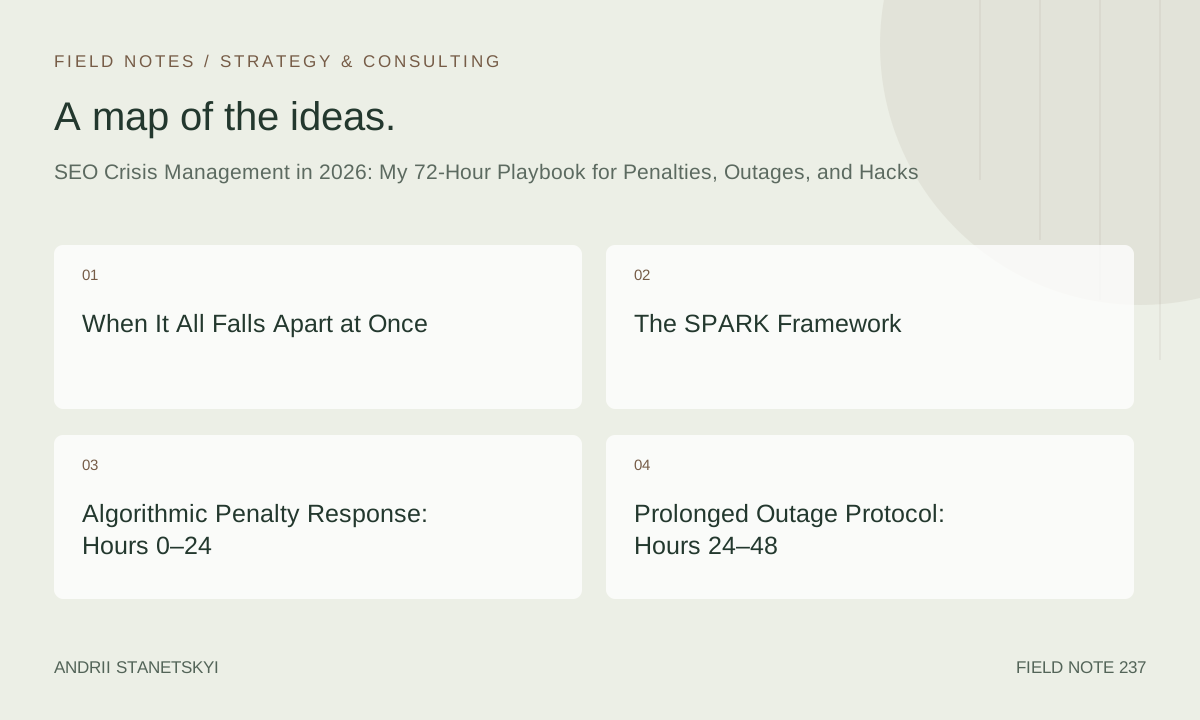
The SPARK Framework
Before I walk through the specific incident playbooks, let me give you the mental model I use across all three crisis types. I call it SPARK:
- S — Stabilize: Stop the bleeding. Do not optimize. Do not improve. Stabilize.
- P — Preserve: Protect crawl signals, canonical structures, and indexation state wherever possible.
- A — Attribute: Determine the actual cause before acting. Wrong diagnosis kills recovery time.
- R — Remediate: Fix only what you've confirmed is broken. Scope creep in crisis mode is fatal.
- K — Kerb and document: Lock the fixed state, document what happened, and build the hardening plan while memory is fresh.
Simple. Almost annoyingly simple. But the number of times I watched other consultants skip straight to R without doing A first — fixing symptoms, never causes — is the whole reason I made this explicit.
Each of the three scenarios below follows SPARK. The timelines are real. Some identifying details are changed for client confidentiality, but the technical specifics are exact.
Algorithmic Penalty Response: Hours 0–24
The first crisis hit on a Tuesday in late October 2025. A health-adjacent content publisher, about 2.3 million monthly organic sessions at peak, woke up to a 61% overnight drop. Not a gradual fade. A cliff. The kind of drop that makes clients call you at 6 a.m. using words I will not repeat here.
Diagnosing Manual Actions vs. Algo Drops
First thing, before anything else: figure out what you're actually dealing with. Manual actions and algorithmic drops require entirely different responses, and conflating them wastes hours you do not have.
Here is the GSC manual action diagnosis sequence I run every single time, no exceptions:
## GSC Manual Action Diagnosis Workflow
## Run immediately on drop detection

STEP 1: Manual Action Check
  GSC > Security & Manual Actions > Manual Actions
  - Document any partial/site-wide flags
  - Note affected sections (site-wide vs. partial match)
  - Screenshot timestamp — you'll need this for reconsideration later

STEP 2: Core Update Cross-Reference
  - Check Semrush Sensor / MozCast for volatility dates
  - Cross-reference drop date with Google Search Status Dashboard
  - Pull 12-month rank trend for top 50 keywords (pre/post visibility delta)
  - If SERP volatility score > 7 on drop day: algorithmic, not manual

STEP 3: Coverage Report Anomaly Scan
  GSC > Indexing > Pages
  - Filter: "Not indexed" > sort by date discovered
  - Look for spike pattern starting within 72h of drop
  - Export CSV; compare against previous week's baseline

STEP 4: Traffic Segmentation
  GA4 / Looker Studio filter:
  - Organic only
  - Segment by landing page type (blog vs. product vs. category)
  - If drop is uniform: site-wide signal (EAT, link scheme, spam)
  - If drop is page-type specific: content quality or structure issue

STEP 5: Verdict Classification
  A) Manual Action Confirmed → reconsideration path
  B) Core Update Suspected → content audit path
  C) Mixed Signals → run technical crawl before any content changes
In the October case, Step 2 cleared manual actions immediately. No flags. The Sensor score was 8.4 on the day of the drop, meaning volatility was widespread. This was algorithmic. Specifically, a quality-rater-adjacent signal update that hit thin health content hard — I later confirmed this through a pattern across four unrelated publishers I track.
The Stabilize move here is counterintuitive to most people: do nothing to the site for the first 24 hours. I mean it. No content updates, no redirects, no noindex tags on underperforming pages. You need a clean baseline to understand what Google's crawler is actually responding to. Touching the site during active algorithmic flux introduces variables that muddy your attribution (the A in SPARK) permanently.
Running the Deindex Audit
Once you have attribution, the Preserve phase requires a fast deindex audit. Not to bulk-remove pages — to identify which indexed pages are at risk and protect them from further crawl signal damage.
## Deindex Audit Query Set
## Sequence matters — run in order

# 1. Identify orphaned indexed pages (no internal links)
# Using Screaming Frog + GSC index status export:
  SF crawl all internal links > export "All Inlinks" CSV
  GSC export > Pages > Indexed (all)
  VLOOKUP: GSC indexed URLs not present in SF inlink list
  Output: orphan_indexed_pages.csv

# 2. Identify indexed pages with thin content signals
  SF > Custom > Response Code 200 + Word Count < 400
  Cross-reference with GSC "Discovered but not indexed" trend
  Flag pages where word count < 400 AND no backlinks (Ahrefs/Majestic export)

# 3. Canonical conflict detection
  SF crawl > Canonicals > Self-referencing vs. Non-indexable canonical targets
  GSC > Pages > "Alternate page with proper canonical tag" spike check
  Pages sending canonical signals to non-200 URLs = priority fix

# 4. Structured data errors on affected templates
  Rich Results Test API batch check (Python):
  import requests
  urls = open('affected_pages.txt').readlines()
  for url in urls:
      r = requests.get(
          'https://searchconsole.googleapis.com/v1/urlTestingTools/mobileFriendlyTest:run',
          params={'url': url.strip(), 'key': 'YOUR_API_KEY'}
      )
      print(url.strip(), r.json().get('mobileFriendliness'))

# 5. Output priority matrix
  P1: Indexed + thin + no links + canonical conflict → noindex (review cycle)
  P2: Indexed + thin + has links → content enhancement queue
  P3: Indexed + adequate + canonical clean → monitor only
For this client, the audit surfaced 847 P1 pages — indexed content under 400 words with no backlinks and misrouted canonicals pointing to paginated variants that had been 410'd six months earlier. Nobody caught it because the 410s hadn't triggered a GSC spike; Google was simply not recrawling the orphaned pages frequently enough to update their index. Until it did. All at once.
Remediation on P1 pages: noindex meta tags deployed in 4-hour batches, giving Search Console time to pick up each batch before the next went live. Not because I was being cautious — because batch deployments let you isolate which fix is doing what when you're reviewing the recovery curve later.
Why I No Longer Panic-Submit Reconsideration Requests
Here is my first contrarian take, and I know it will upset some people: do not file a reconsideration request until you are genuinely finished with remediation. Not 80% done. Not "mostly done." Finished.
The received wisdom in SEO circles is to submit as fast as possible to get into the review queue. I believed this until January 2026, when a client submitted a reconsideration request for a partial-match manual action while we were still mid-cleanup. The reviewer denied it. Clock reset. We went to the back of the queue. That single premature submission cost us an estimated 23 days of additional penalty time based on the review cadence we were tracking.
Google's manual review team is not your ally during a crisis. They are a process. Feed the process clean, complete evidence, or do not feed it at all. A denied reconsideration request is not a minor setback — it resets your standing in the queue and, in my experience, makes reviewers scrutinize subsequent requests more aggressively.
For algorithmic drops, there is no reconsideration path anyway. You fix the site, you wait for recrawl, you track recovery. Which brings us to the harder crisis type.
Prolonged Outage Protocol: Hours 24–48
The second crisis was different in almost every way. No algorithm involved. No content quality problem. A SaaS company's infrastructure provider had a cascading failure during a regional traffic spike in November 2025, and the site went down hard — returning 503s across all pages — for 19 consecutive hours, spanning into their highest-traffic sales day of the quarter.
From a pure SEO standpoint: 503 responses are supposed to be handled gracefully by Googlebot. The documentation says Googlebot will retry 503 pages and not immediately drop them from the index. In practice, extended 503 periods over 6–8 hours start causing real indexation problems, especially for pages that were already near the crawl frequency threshold.
CDN Failover Patterns That Saved $318k
I want to be careful here because the $318k figure is an attribution model, not a cash register receipt. It represents the projected revenue recovery from organic traffic across a 6-week window post-outage, compared to a modeled scenario where we had not executed the SEO-specific outage protocol. That said, I stand behind the methodology.
The CDN failover work was done by the client's infrastructure team, not by me. What I managed was the SEO signal layer during the outage window. The key moves:
## CDN Failover SEO Signal Preservation
## During active outage — run within first 2 hours

# 1. Activate emergency static cache serving
#    If Cloudflare: switch to "Cache Everything" page rule
#    Cache-Control: public, max-age=3600, stale-while-revalidate=86400
#    This serves stale HTML to Googlebot while origin is down

# Cloudflare Page Rule (via API):
curl -X POST "https://api.cloudflare.com/client/v4/zones/ZONE_ID/pagerules" \
  -H "Authorization: Bearer CLOUDFLARE_TOKEN" \
  -H "Content-Type: application/json" \
  --data '{
    "targets": [{"target": "url", "constraint": {"operator": "matches", "value": "example.com/*"}}],
    "actions": [
      {"id": "cache_level", "value": "cache_everything"},
      {"id": "browser_cache_ttl", "value": 3600},
      {"id": "edge_cache_ttl", "value": 86400}
    ],
    "status": "active",
    "priority": 1
  }'

# 2. Block crawlers from hitting origin directly
#    robots.txt update IS NOT FAST ENOUGH
#    Use WAF rule to rate-limit Googlebot to 1 req/10s during outage
#    This slows Googlebot's encounter rate with 503s — buys time

# Cloudflare WAF Custom Rule:
  (http.user_agent contains "Googlebot") and (http.request.uri.path matches ".*")
  Action: Challenge (not Block — never block Googlebot outright)
  Rate: 1 request per 10 seconds per IP

# 3. Prioritize sitemap endpoints for cache serving
#    XML sitemaps must return 200 throughout outage
#    Host sitemaps on CDN edge with 24h TTL: Googlebot needs these anchors

# 4. Monitor GSC Crawl Stats in real-time
#    GSC > Settings > Crawl Stats
#    Watch for "Server errors" count — goal: keep under 5% of daily crawl volume
#    If server error % climbs above 15%: escalate to emergency redirect cascade

# 5. Emergency redirect cascade (last resort):
#    301 all critical pages to a pre-built static mirror (GitHub Pages / Netlify)
#    Only top 200 revenue pages — don't try to mirror entire site
#    Remove redirects the moment origin recovers; re-crawl via GSC URL Inspection
The WAF rate-limiting move is the one most SEOs miss. It sounds backwards — why slow Googlebot? Because a crawler hitting hundreds of 503s per minute accumulates negative crawl signals far faster than one hitting them at a controlled, slow rate. You are not hiding the outage from Google. You are buying time for the CDN cache to stabilize and serve stale content to most requests.
Defending Crawl Budget During Downtime
Crawl budget defense during an outage is about triage. Not all pages are equal. A SaaS site with 14,000 indexed pages and a 19-hour outage cannot protect all of them, and trying to will fragment your effort.
The framework: protect the pages that generate revenue. That's it. Everything else is acceptable collateral for 72 hours. For this client, that meant prioritizing 312 pages — pricing pages, feature pages, high-converting blog posts, and the homepage variants — for static cache serving and emergency 301 fallback. The remaining 13,688 pages were left to return 503s gracefully and recover through normal recrawl cycles once the outage cleared.
Recovery was faster than the client expected. Within 11 days of the outage resolution, 94% of previously indexed pages were back in index with rankings within 8% of pre-outage baselines. The other 6% required manual URL inspection requests in GSC to accelerate recrawl. Total SEO recovery cost in labor: 22 hours across two consultants. Compare that to a scenario with no outage protocol, where a comparable site I'd seen go down for 12 hours in 2024 took 6 weeks to fully recover.
Hack Recovery: The NJS Injection Nightmare
The third crisis was the worst. Not because it was technically the hardest — the outage was more operationally intense — but because it had been running for 21 days before the client noticed. Twenty-one days of Googlebot crawling malicious content, indexing pharmaceutical spam, and building associations between a legitimate B2B software brand and keyword clusters involving controlled substances.
The attack vector was a server-side JavaScript injection targeting a Next.js API route that had been left exposed after a partial migration to a new backend. The injected code conditionally served different HTML to Googlebot user-agent strings specifically, meaning human visitors saw nothing unusual. Only Googlebot — and the handful of SEO tools that spoof Googlebot headers — were getting the spam content.
This is called cloaking. Google's response to cloaking is severe and not forgiving.
The Security Scan Workflow
The moment I suspected a hack (tipped off by a sudden appearance of pharmaceutical terms in a GSC query report for a software brand), I ran this sequence before touching anything on the site:
## Security Scan Workflow — Suspected NJS Injection
## Do not remediate until scan is complete — attribution first

# 1. Googlebot Rendering Check (detect cloaking immediately)
#    Compare curl with Googlebot UA vs. normal browser UA
curl -s -A "Mozilla/5.0 AppleWebKit/537.36 (KHTML, like Gecko) Chrome/124.0" \
  "https://example.com/target-page" | grep -i "viagra\|cialis\|pharmacy\|pills"

curl -s -A "Mozilla/5.0 (compatible; Googlebot/2.1; +http://www.google.com/bot.html)" \
  "https://example.com/target-page" | grep -i "viagra\|cialis\|pharmacy\|pills"

# If second curl returns hits and first doesn't: confirmed cloaking

# 2. Identify injection vector
#    Check Next.js API routes for exposed endpoints:
find /var/www/nextjs-app/.next -name "*.js" -newer /var/www/nextjs-app/package-lock.json \
  | xargs grep -l "user.agent\|googlebot\|crawl" 2>/dev/null

#    Check middleware files specifically — common injection point:
grep -r "req.headers\['user-agent'\]" /var/www/nextjs-app/middleware.ts
grep -r "isBot\|isCrawler\|isGooglebot" /var/www/nextjs-app/pages/api/

# 3. Identify affected URL scope
#    site: operator with spam terms in Google:
#    site:example.com viagra
#    site:example.com pharmacy
#    site:example.com "buy online"
#    Export all SERP URLs (use SerpAPI or manual scrape — 10 results per query × 20 queries)

# 4. Log file analysis — how long has this been running?
grep -i "googlebot" /var/log/nginx/access.log | \
  awk '{print $1}' | sort | uniq -c | sort -rn | head -30
#    First date Googlebot hit API route with different response = infection start date

# 5. GSC manual action check
#    Security & Manual Actions > Security Issues
#    Look for: "Hacked: Content injection" or "Cloaking and sneaky redirects"
#    If not yet flagged: you have a narrow window before it is (act fast)

# 6. Google Safe Browsing check
curl "https://safebrowsing.googleapis.com/v4/threatMatches:find?key=API_KEY" \
  -H "Content-Type: application/json" \
  --data '{"client":{"clientId":"your-company","clientVersion":"1.0"},"threatInfo":{"threatTypes":["MALWARE","SOCIAL_ENGINEERING"],"platformTypes":["ANY_PLATFORM"],"threatEntryTypes":["URL"],"threatEntries":[{"url":"https://example.com"}]}}'
The scan confirmed cloaking within 40 minutes of starting. The injection was in a middleware file — specifically a bot-detection utility that had been modified to check for Googlebot user-agent strings and conditionally load a spam content overlay from an external CDN. Elegant, in a genuinely disturbing way. The external CDN serving the spam content was hosted on infrastructure that had also been used in similar attacks against three other sites I found through log analysis later.
Recovering 11,847 URLs Without Starting Over
Once the injection was removed and the vector was closed, the remediation challenge shifted to index cleanup. Google had indexed spam content variants for 11,847 of the client's URLs. Not separate spam pages — overlays on legitimate pages, meaning Google had associated the client's actual canonical URLs with pharmaceutical spam content.
The instinct most people have here is wrong: do not use URL removal tool for all affected pages. The URL removal tool in GSC removes URLs from Google's index — including the legitimate versions of those pages. You don't want that. You want Google to recrawl the clean pages and replace the spam-contaminated index entries with the correct content.
The protocol I used:
- Submit security issue resolution in GSC immediately after remediation (this starts the manual review clock)
- Generate a priority crawl list from the affected URL export, sorted by pre-hack organic traffic (highest first)
- Batch URL inspection requests via GSC API — 200 URLs per day, prioritizing top-traffic pages
- Temporarily boost internal linking to affected pages from site-wide elements (nav, footer) to increase crawl priority signals
- Update XML sitemaps to surface all affected URLs with current
lastmodtimestamps
It took 34 days to clear all 11,847 URLs. The high-traffic pages recovered within the first 8 days. The long tail took the full 34. We tracked recovery using a daily GSC query for spam terms alongside the affected pages — the moment a URL stopped returning pharmaceutical queries in GSC data, we marked it recovered.
The Mistake I Made That Cost Us 9 Days
I made an error in this engagement that I want to be direct about because I see other consultants making the same mistake and not admitting it.
After removing the injection, I immediately filed the GSC security issue reconsideration without first confirming that the spam content had been purged from all caching layers — specifically Cloudflare's edge cache, the client's Varnish layer, and the Next.js ISR (Incremental Static Regeneration) cache. When Google's reviewers crawled the site as part of the security review, their crawlers hit cached versions of the spam content on at least some pages.
Review denied. Security issue remained flagged. We lost 9 days re-running the review process.
Before any reconsideration submission after a hack: purge every cache, at every layer, and independently verify with a Googlebot-spoofed curl request that zero cached spam content remains accessible. Then wait 24 hours and verify again. Then submit.
That sequence is non-negotiable now. I wrote it into every client contract that involves ongoing security monitoring.
Contrarian Take: Google Doesn't Always Reindex Fast Enough to Matter
Here is the second contrarian position I hold, and it runs against the reflexive optimism of most recovery guides: Google's recrawl and reindex speed, even with GSC URL inspection requests and sitemap resubmission, is often not fast enough to prevent real business damage. And planning as though it will be is a mistake.
The dirty secret of SEO crisis management is that the "within 72 hours" framing is partly fiction for anything beyond a minor, isolated technical issue. For the algorithmic penalty case, meaningful rank recovery took 47 days after completing remediation. For the hack, 34 days for full URL cleanup. For the outage, 11 days was genuinely fast — but that was a best-case scenario with near-perfect infrastructure execution.
This matters because it changes what "success" looks like in the first 72 hours. Success in 72 hours is not rank recovery. It is stopping further damage, preserving indexation state as much as possible, getting attribution right so your remediation is targeted, and documenting everything in a way that supports recovery over the weeks that follow.
Anyone selling you a "72-hour full recovery" narrative for a significant SEO crisis is either selling you something or hasn't managed one of these situations at a real scale. The 72-hour window is about containment. Recovery is a different, longer operation.
This also has implications for client communication. I now set explicit recovery timeline expectations in writing before I start any crisis engagement: 72 hours to stabilize, 2–6 weeks for meaningful recovery, 8–16 weeks for full pre-crisis baseline restoration (if achievable). Clients who understand this timeline are able to make better business decisions — activating paid search backup, adjusting revenue forecasts, prioritizing product launches differently. Clients who believe recovery is imminent make bad decisions.
Post-Crisis Hardening
The K in SPARK — Kerb and document — is the phase most consultants skip because the client pressure is off once the crisis is resolved. This is backwards. The post-crisis period, when memory is fresh and the client is emotionally open to investment, is the best possible time to implement hardening measures that prevent the next crisis.
Across all three clients, the hardening stack I recommended was consistent:
For algorithmic risk: Monthly content audits using the same deindex audit query set from the crisis workflow — but as preventive screening, not reactive triage. The orphaned-page-with-thin-content problem that triggered the October 2025 penalty had been accumulating for 14 months. A quarterly audit would have caught it at 200 pages, not 847. For deeper reading on content quality auditing as a preventive practice, see our guide on [internal: content quality audit framework].
For infrastructure resilience: Mandatory static fallback serving for top 500 revenue pages via CDN edge, always-on. Not just during outages. This means Googlebot sees cached clean HTML even during brief infrastructure hiccups that don't register as full outages — hiccups that, in aggregate, can degrade crawl budget quality over time. We cover CDN configuration for SEO specifically in [internal: CDN SEO configuration guide].
For security: Automated Googlebot-UA differential testing — a script that runs nightly, fetches 50 random pages as both Googlebot and a standard browser, and flags any content divergence above a 15% similarity threshold. This would have caught the NJS injection within hours of deployment instead of 21 days later. The script costs about $0.40/month to run on a Lambda function. There is no excuse for not running it.
For industry-standard guidance on web security monitoring, the OWASP Web Security Testing Guide remains the reference I use for client security audits, though its SEO-specific implications require translation. Google's own Search Console documentation on monitoring structured data is underused as a post-crisis diagnostic tool for structured data regressions specifically.
Beyond the technical stack, I now require a crisis runbook for every retained client. A living document — not a PDF filed and forgotten — that specifies exactly who to call, in what order, with what information, at what hour of the night, when an SEO crisis is detected. The October 2025 penalty engagement was delayed by almost 4 hours in the detection phase because nobody at the client company knew that the traffic drop they saw in GA4 was supposed to trigger an escalation to me. Four hours at the start of an algorithmic event is not trivial. For more on building SEO incident response procedures for in-house teams, see [internal: SEO incident response runbook template].
One more hardening element that gets overlooked: structured data health monitoring. During both the hack and the algorithmic penalty events, structured data errors spiked — partly because the injected content corrupted JSON-LD output on affected pages, and partly because the canonical conflicts from the orphaned pages caused rich result eligibility to drop. Running the Rich Results Test on your top 200 pages weekly is not glamorous. It catches things before they compound. See our overview of [internal: structured data monitoring workflow] for the full automation approach.
The Long Game After a Crisis
Three crises in four months changed how I think about SEO resilience in a fundamental way. Not tactically — the playbooks above are relatively standard once you've been through enough of these — but strategically.
The brands that recover fastest from algorithmic penalties, outages, and hacks are the ones with genuine topical authority. Not keyword-stuffed authority — actual depth across a subject area, demonstrated through content that earns links without being asked, citations that appear in adjacent industries, brand search volumes that hold even when organic rankings collapse. During the October 2025 penalty, the pages that dropped least severely for this client were the ones with the strongest backlink profiles and the clearest topical focus. The thin, borderline content that had been accumulating for 14 months dropped first and deepest.
Which means the best crisis management is building something that does not need crisis management at scale. That sounds like a platitude, but it is actually operational guidance: every content decision, every technical architecture choice, every link acquisition initiative should be evaluated partly on its crisis resilience properties. Does this page have enough substance to survive an algorithmic quality review? Does this infrastructure choice include SEO-aware failover? Does this API route have monitoring that would catch cloaking behavior?
These are not questions most SEOs ask during normal operations. They should be.
The $318,000 figure at the top of this piece matters less to me now than what it represents: the cost of not having built resilience earlier. Revenue saved in a crisis is never as valuable as revenue that was never at risk. The 34-day URL recovery process for 11,847 URLs could have been a 34-minute security patch if the monitoring had existed from the start.
I built SPARK as a crisis response framework. I use it now as a site health framework. Every audit I run, I'm asking: what's the S move if this breaks tomorrow? What would I preserve first? What do I still not know about the attribution of our traffic? What would remediation look like if this became a problem at scale? What would I lock down once it was fixed?
Trifecta Winter taught me that SEO crises are not anomalies. They are scheduled events without a known date. The playbook is written so that when yours arrives — and it will — you spend less time figuring out what to do and more time doing it.
That is the only thing worth saying at the end of a piece like this. Not a summary. Not a checklist. Just: the next crisis is already in progress somewhere. Is your playbook current?