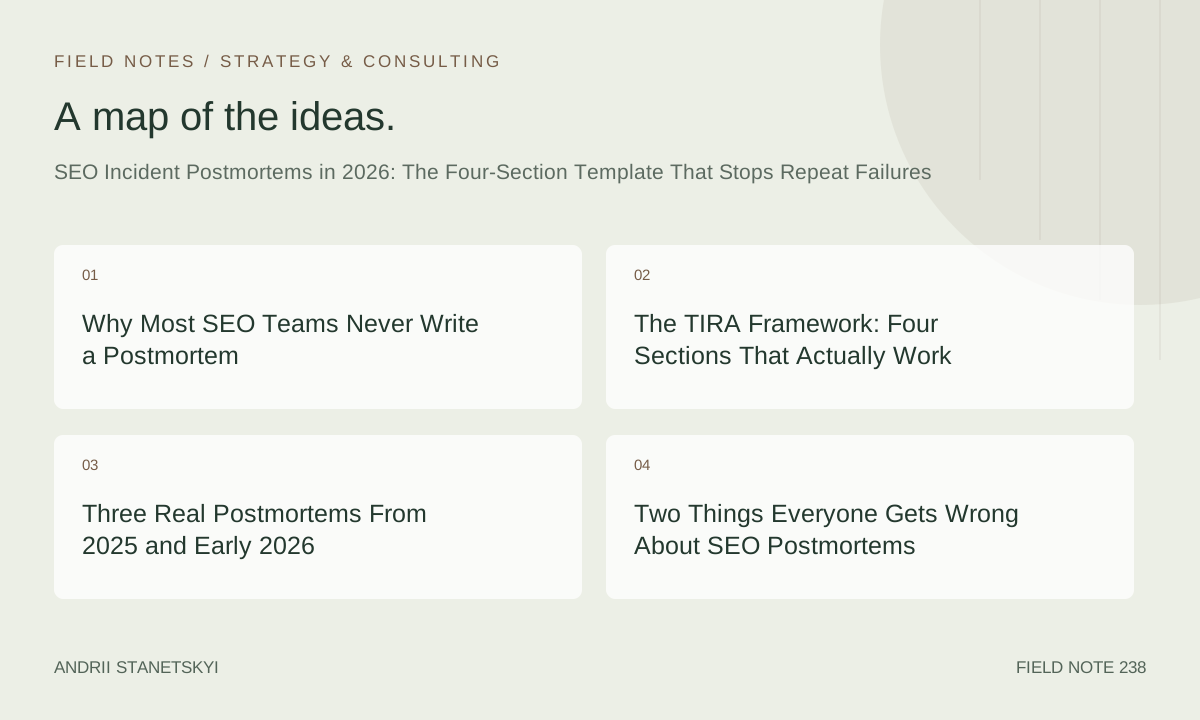
Why Most SEO Teams Never Write a Postmortem
Traffic drops 40%. Panic spreads across Slack channels. Someone schedules an emergency call. Three weeks later, the team has mostly moved on, the site has partially recovered, and nobody has written down what happened or why. This is the default state of SEO incident response in 2026, and it is costing teams millions in repeat failures that were entirely preventable.
I have run SEO for large e-commerce properties, SaaS platforms, and publisher networks since 2018. In that time I have personally participated in or reviewed dozens of post-incident reviews. The honest number of those that resulted in a written document shared across the organization: fewer than a third. The number that followed a repeatable structure: embarrassingly close to zero, at least until I built one.
The engineering world solved this problem fifteen years ago. Site reliability engineers treat postmortems as a core discipline, not an optional exercise. They have templates, required fields, mandatory timelines, blameless cultures. SEO, which moves slower and fails in more ambiguous ways, has mostly ignored this practice. We keep re-learning the same lessons. We keep watching the same categories of mistakes repeat on twelve-month cycles because nobody institutionalized what went wrong the first time.
This article is about fixing that. Specifically, it is about a four-section template I now use for every SEO incident above a certain severity threshold, why each section exists, and what I have learned from the real postmortems that shaped it.
A note on sourcing: the postmortems referenced below are drawn from real incidents at real companies. Details have been anonymized. Traffic numbers, recovery times, and root cause descriptions are accurate to the actual events. I am not going to tell you which companies these are, partly out of professional courtesy and partly because the specific companies matter less than the patterns.
The TIRA Framework: Four Sections That Actually Work
TIRA. Timeline, Impact, Root Cause, Action Items. Four words, four sections, one document that anyone on your team can read and understand six months from now without needing context they no longer have.
I want to be specific about what makes this template different from the "lessons learned" documents most SEO teams produce. Those documents tend to be narrative. They tell a story from the perspective of whoever wrote them. They editorialize. They soften the root cause because someone does not want to name the actual problem directly. They list action items that are so vague they are impossible to verify as complete. TIRA is structured to resist all of those failure modes.
Here is the actual template, which you can copy directly:
SEO INCIDENT POSTMORTEM
=======================
Incident ID: [YYYY-MM-DD-shortname]
Severity: [P1 / P2 / P3]
Author(s): [Name(s)]
Date Written: [Date]
Date of Incident: [Date or date range]

---

TIMELINE
--------
[UTC timestamps for every significant event. Detection, escalation, first
hypothesis, hypothesis rejected, correct hypothesis identified, fix deployed,
traffic recovery confirmed. Do not round to the nearest hour. Be exact.]

IMPACT
------
Organic sessions lost (estimated): [number]
Revenue impact (estimated): [number or range]
Affected URLs: [count or representative list]
Duration of material impact: [start timestamp to recovery timestamp]
MTTR (Mean Time To Recovery): [hours:minutes]
Secondary effects: [e.g., crawl budget changes, link equity redistribution]

ROOT CAUSE
----------
Primary cause: [One sentence. No hedging.]
Contributing factors: [Bulleted list. Each item should be falsifiable.]
What made detection slow: [One sentence. Be honest.]
What made recovery slow: [One sentence. Be honest.]

ACTION ITEMS
------------
[Each action item must include: Owner, Deadline, Success Criteria]

Item 1:
  Owner: [Name or role]
  Deadline: [Specific date]
  Success Criteria: [How will we know this is done and working?]

Item 2:
  ...
Every field exists because I have watched what happens when it is absent. The UTC timestamp requirement exists because I once spent forty minutes in a postmortem review arguing about whether a deploy happened before or after a traffic change, because one person was in London and one was in New York and nobody had specified time zones. The MTTR field exists because without it, teams dramatically underestimate how long recovery actually takes. The "success criteria" field on action items exists because without it, action items become checkbox theater.
Section 1: Timeline
The timeline section is the hardest to write and the most valuable to have. It requires going back through Slack histories, deploy logs, Search Console data exports, and Cloudflare or Fastly logs to reconstruct exactly what happened in what order. This is tedious. It takes time that nobody wants to spend in the days after a crisis, when the temptation is to move on and focus on recovery.
Do it anyway. The discipline of building an accurate timeline almost always reveals something that the team's subjective memory of the incident gets wrong. In at least four of the postmortems I have been involved with, the timeline reconstruction changed the root cause identification entirely. The team thought X caused Y. The timestamps showed Y preceded X by ninety minutes. Entirely different problem.
Minimum timestamp resolution: fifteen minutes. Preferred: the actual minute. Include false starts. If someone deployed a fix at 14:32 UTC, it failed, and then they deployed a corrected fix at 16:07 UTC, both of those events belong in the timeline. The failed fix attempt is often where the most valuable learning lives.
Section 2: Impact
Impact quantification is where SEO postmortems diverge most sharply from engineering postmortems. In engineering, you can often measure impact with high precision: requests failed, error rate percentage, P99 latency. In SEO, you are estimating organic session loss against a counterfactual baseline that does not exist. You are trying to answer "how much traffic would we have gotten if this incident had not happened?" which is inherently uncertain.
This uncertainty is not an excuse to skip the estimate. Pick a methodology and document it. I typically use a seven-day trailing average from the same day-of-week in the three weeks before the incident, adjusted for any known seasonality. The methodology matters less than the consistency. Use the same methodology every time so that your severity classifications are comparable across incidents.
The MTTR field deserves special attention. Mean Time To Recovery in SEO is almost never the time from incident start to "fix deployed." It is the time from incident start to "traffic recovered to within 10% of pre-incident baseline." Those two numbers are often separated by weeks. Googlebot crawl schedules, index processing delays, and the slow propagation of ranking signals mean that even a correctly diagnosed and correctly fixed SEO incident can take fourteen to thirty days to fully resolve in search results. Your MTTR should reflect that reality, even if it is an estimate at the time of writing.
Section 3: Root Cause
One sentence. No hedging. This is the section where most SEO postmortems fail completely.
The failure mode looks like this: "A combination of factors including the site migration, the timing of the algorithm update, and some potential issues with internal linking contributed to the observed traffic decline." That sentence says nothing. It cannot be acted on. It does not tell you what to fix. It is written to avoid assigning responsibility for anything specific, which means it will not prevent the same thing from happening again.
Contrast with: "A canonical tag misconfiguration introduced in the v4.2.1 deploy on March 14 caused 847 product pages to signal self-referential canonicals pointing to noindexed staging URLs, resulting in their removal from the index over a seventeen-day period."
That sentence is actionable. That sentence tells you exactly what broke, when it broke, how it broke, and what the mechanism of damage was. That is what belongs in the Root Cause field.
The contributing factors list is where you can add nuance without diluting the primary cause. "Our staging environment shared URL patterns with production" is a contributing factor. "We had no automated canonical validation in the deploy pipeline" is a contributing factor. Those belong in contributing factors, not in the primary cause sentence, because they are conditions that enabled the failure rather than the failure itself.
Section 4: Action Items
Action items without owners are wishes. Action items without deadlines are intentions. Action items without success criteria are theater.
Every action item in a TIRA postmortem gets all three. The owner does not have to be an individual person — it can be a role or a team — but it must be specific enough that there is a real human being who can be asked "is this done?" The deadline must be a calendar date, not "Q2" or "next sprint." The success criteria must describe an observable state of the world.
Bad action item: "Improve canonical tag monitoring."
Good action item: Owner: Platform Engineering. Deadline: June 15, 2026. Success Criteria: Automated canonical validation runs on every deploy and blocks merge if any canonical points to a URL returning a non-200 status or bearing a noindex directive. Zero exceptions without explicit override approval from SEO lead.
The difference is not cosmetic. The good version can be verified. Someone can look at the CI/CD pipeline on June 16 and determine whether the action item was completed. The bad version cannot be verified, which means it will quietly not happen.
Three Real Postmortems From 2025 and Early 2026
The Retailer That Lost 31% of Organic Traffic in 11 Days
Q3 2025. Mid-size e-commerce retailer, roughly 4.2 million monthly organic sessions at baseline. An infrastructure team migrated the CDN provider over a long weekend. The migration was considered low-risk because the technical implementation was validated in staging. Nobody on the SEO team was informed because CDN changes had historically not required SEO sign-off.
What the infrastructure team did not know: the new CDN provider's default configuration did not pass through the Accept-Encoding header in a way that the site's image optimization middleware expected. The result was that a subset of pages — specifically, pages that relied on next-generation image formats — began returning significantly degraded Core Web Vitals scores. Interaction to Next Paint spiked from a median of 94ms to 387ms for affected page templates. Largest Contentful Paint shifted from 1.8 seconds to 4.1 seconds.
Detection took six days. The traffic decline had begun on Saturday. Nobody checked Search Console over the weekend. Monday's review did not flag anything because one-day traffic variance can be noise. By Thursday, the decline was large enough to trigger an internal alert, but the first hypothesis was a ranking algorithm update, and the team spent two days investigating that before someone thought to look at CWV data.
MTTR: 34 days, 7 hours. That number includes the time from incident start to CDN configuration fix (11 days), plus the time for Google to recrawl and re-evaluate the affected pages and restore rankings (another 23 days). Estimated organic sessions lost during the full impact window: approximately 1.4 million sessions. Revenue impact estimated at $2.1M to $2.8M depending on methodology.
The postmortem revealed three contributing factors that made this incident worse than it needed to be: no SEO stakeholder was included in CDN change approval workflows, no automated CWV monitoring was configured to alert on regressions at the template level, and the team's incident response process had no explicit step for ruling out technical site changes before investigating algorithm updates.
All three became action items. The CDN approval workflow change was implemented within two weeks. The CWV monitoring took longer but was operational by October 2025. The incident response process change was documented the same day the postmortem was written.
The SaaS Platform That Accidentally Noindexed Its Entire Blog
January 2026. B2B SaaS company, blog driving roughly 28,000 monthly organic sessions, which represented about 340 monthly signups by attribution model. A developer was implementing a new robots meta tag management system to replace a legacy plugin. The implementation was tested on a staging environment. What nobody caught: the staging environment was configured to inject noindex on all pages by default, and the new management system inherited that configuration rather than overriding it.
The deploy went live on a Tuesday at 3:17 PM UTC. By Thursday, Googlebot had crawled approximately 60% of the blog. By the following Monday, Search Console was showing index coverage drops. The team noticed on Wednesday, nine days after the deploy.
Nine days. For a bug that was in the page source of every blog post. Discoverable in thirty seconds with any standard SEO crawler or even a browser's view-source. The detection failure was not a tooling problem — the company had Screaming Frog licenses, had access to Sitebulb, had Search Console set up correctly. The detection failure was a process problem. Nobody had a post-deploy crawl in the workflow.
MTTR: 19 days, 3 hours. Fix deployed four hours after detection. Google re-indexed the content over the following eighteen days. Estimated signups lost during the full impact window: 94 to 130, depending on whether you use the pre-incident attribution rate or account for some natural variance.
The root cause sentence in the postmortem: "A noindex directive inherited from staging environment defaults was deployed to production via the new robots meta tag management system on January 14, 2026, and remained undetected for nine days due to the absence of a post-deploy crawl validation step."
The Publisher That Watched Its Crawl Budget Collapse Over Six Weeks
This one is slower and messier. Mid-2025, large publisher, several hundred thousand indexed URLs. A site architecture change was implemented to improve URL structure consistency. The change involved 301 redirects from old URL patterns to new ones. The redirect chains were technically correct — old URL to new URL, HTTP 301, no loops. What the team did not account for: the sheer volume. Roughly 340,000 URLs redirected simultaneously.
Googlebot's crawl behavior shifted almost immediately, though the team did not recognize the signal for weeks. Crawl rate dropped by roughly 47% over the first three weeks. Pages that had previously been crawled weekly were going unvisited for twenty, twenty-five, thirty days. Fresh content was not being indexed. Existing content was not getting updated signals.
Traffic did not drop sharply. It eroded. The team was looking for a cliff and missed a slow bleed. By the time someone pulled the crawl data and noticed the pattern, six weeks had passed and the crawl budget compression had compounded the problem by leaving a significant percentage of the site's content in a stale or de-indexed state.
The MTTR for this incident is genuinely hard to calculate because there was no clean recovery event. Crawl rates normalized over approximately four months as the redirect equity consolidated and Googlebot re-learned the site structure. Traffic recovered partially but never fully returned to the pre-incident baseline for certain content categories. Estimated organic sessions lost across the full impact period: somewhere between 800,000 and 1.2 million, with high uncertainty.
This postmortem took three sessions to write because the root cause was genuinely complicated. The final primary cause sentence: "A simultaneous 301 redirect of approximately 340,000 URLs caused Googlebot to enter a sustained crawl budget reallocation behavior that compressed crawl frequency site-wide for a period of approximately sixteen weeks." Contributing factors included lack of a phased redirect rollout plan, no crawl monitoring alerts configured, and insufficient understanding of crawl budget dynamics among the team members who approved the architecture change.
Two Things Everyone Gets Wrong About SEO Postmortems
Contrarian Take 1: Blameless Culture Is Overrated in SEO
The engineering postmortem tradition places enormous emphasis on blameless culture. The argument is that when people fear punishment, they hide information, and hidden information makes postmortems useless. This is correct for engineering incidents. I am not convinced it translates directly to SEO.
Here is the difference: most engineering incidents are the result of complex systems behaving in unexpected ways under conditions that are difficult to anticipate. Blame is genuinely misplaced because the failure was systemic, not individual. Many SEO incidents, in my experience, are the result of individuals making decisions without adequately consulting people who had relevant expertise. The developer who pushed the noindex bug did not consult the SEO team. The infrastructure engineer who changed the CDN did not include SEO in the change approval. These are not complex system failures. These are organizational process failures with identifiable decision points.
I am not arguing for punitive postmortems. Punishing people for mistakes in good faith is counterproductive and wrong. But I do think there is a version of "blameless" that becomes a euphemism for "consequence-free," and consequence-free environments do not actually learn. The postmortem should identify the decision point where things went wrong. It should name the process that allowed a decision to be made without appropriate input. It can do that without being punitive. But it has to do that. A postmortem that identifies a structural process failure and then writes action items that do not address how that decision got made is not going to prevent the next incident.
Contrarian Take 2: Most SEO Incident Postmortems Are Written Too Late to Be Useful
The engineering convention is to write the postmortem within 48 to 72 hours of the incident resolution. SEO teams routinely wait weeks or months, if they write one at all. The justification is usually that the full impact is not clear until traffic recovers, which can take weeks.
This is backwards. The uncertainty about final impact is not a reason to delay the postmortem — it is a reason to write the postmortem with explicit uncertainty ranges and update it later. The value of writing the postmortem quickly is not that you have perfect impact numbers. The value is that you capture the timeline while it is fresh, you identify contributing factors before people's memories have had time to smooth over uncomfortable details, and you generate action items while the incident is still salient enough to drive urgency.
Write the initial postmortem within a week of detection. Mark impact figures as estimates. Add an "Updated Impact Assessment" section when you have final numbers. This two-phase approach is far better than waiting for certainty and then producing a document that everyone has already mentally moved past.
The postmortems that actually changed how teams worked were all written within a week. The ones written six weeks later became historical documents rather than operational tools. There is a real difference.
The Mistake I Made That I'm Still Embarrassed About
In late 2024 I led a postmortem for a site that had experienced a significant traffic loss following an internal linking overhaul. I had designed the linking strategy. When we got to the root cause section, I wrote a primary cause sentence that was technically accurate but that obscured my own role in the decision. The sentence described the mechanism of the failure without describing the decision that caused the mechanism to be present.
A colleague who reviewed the draft called it out directly. She said something like: "This describes what broke. It does not describe why we made the decision that caused it to break." She was right. I rewrote the root cause section to include my own decision as a contributing factor — specifically, the decision to roll out the linking changes across the full site simultaneously rather than in a phased test on a subset of pages.
The rewritten postmortem was more useful. The action item it generated — a requirement for phased rollouts with traffic monitoring gates for any site-wide structural change — has since prevented at least two other incidents that would have gone the same way. But I would not have written the better version without being challenged on the comfortable version I had produced first.
I share this because I think the instinct to soften one's own role in a postmortem is nearly universal, and nearly universally counterproductive. The framework does not work if you apply it selectively. If you designed the thing that broke, that belongs in the postmortem. Own it, document it, and build the action item that prevents someone from making the same mistake you made.
Building a Postmortem Culture Without the Bureaucracy
The biggest practical obstacle to SEO postmortem adoption is not template design. It is the perception that postmortems are a bureaucratic overhead that slows teams down. This perception is understandable and also mostly wrong, but it needs to be addressed directly if you want to build a culture where postmortems actually happen.
Start with severity thresholds. Not every SEO fluctuation requires a formal postmortem. I use three severity levels, and only P1 and P2 incidents require the full TIRA document.
P1: More than 20% organic traffic loss sustained for more than 48 hours, or any incident causing estimated revenue impact above $50,000. Full postmortem required within 7 days of detection.
P2: 10 to 20% organic traffic loss, or significant indexation loss affecting more than 5% of a site's indexed pages. Abbreviated postmortem (timeline and action items at minimum) required within 14 days.
P3: Smaller incidents worth documenting but not requiring a formal document. These go into an incident log with a one-paragraph summary and any action items.
This tiering matters because it removes the "is this worth documenting?" question from the moment of the incident. The threshold criteria make the answer automatic, which means less organizational friction and more consistent documentation.
The other thing that builds postmortem culture is sharing. A postmortem that lives in a folder nobody reads is not much better than no postmortem at all. I send a brief summary of every P1 and P2 postmortem to a cross-functional distribution list that includes engineering, product, and leadership. Not the full document — a five-bullet summary: what happened, how long it lasted, estimated impact, root cause in one sentence, and the three most important action items. This takes ten minutes to write and does two things: it creates organizational awareness of SEO as a system that can fail and recover, and it generates the kind of peer visibility that makes action items more likely to be completed.
Postmortem Reviews: The Meeting Format That Works
For P1 incidents, I schedule a sixty-minute postmortem review meeting within ten days of the incident. The agenda is fixed: fifteen minutes of timeline walkthrough, fifteen minutes of impact discussion, fifteen minutes of root cause and contributing factors, fifteen minutes of action item review and ownership assignment. Strict time-boxing because postmortem meetings without time limits become therapy sessions that produce no artifacts.
The document is shared 48 hours before the meeting. Attendees are expected to have read it. The meeting is not for presenting the document — it is for challenging assumptions in the document, identifying gaps in the contributing factors, and ensuring that action items have real owners who accept responsibility in a room with other humans present.
That last point matters more than it sounds. An action item that someone accepted in a Slack thread feels different from an action item they accepted while looking at their manager and two colleagues. Social commitment is a real force. Use it.
For teams just starting with postmortems, I recommend looking at how Google's SRE practices handle incident review culture as a reference point, even though the direct translation to SEO requires adaptation. The Google SRE Book's chapter on postmortem culture is freely available and worth reading even if your SEO team has no overlap with site reliability engineering. The principles about psychological safety and learning orientation apply directly.
Internal resources on related topics: understanding how continuous technical SEO monitoring integrates with incident detection can cut your MTTR significantly. The relationship between crawl budget management and incident severity is also worth understanding before your next architecture change. If your team is building out a broader SEO operations practice, the SEO change management framework covers the prevention side of what postmortems address on the review side. For teams in regulated industries, enterprise SEO governance documentation requirements add another layer to what your postmortem archive needs to contain. A discussion of how Core Web Vitals monitoring and alerting fits into a broader SEO observability stack is also relevant context for the CDN postmortem described above.
Where This All Goes From Here
May 2026, and most SEO teams are still operating without a repeatable incident review process. The teams that have built one — and I know several now, some of whom adopted frameworks similar to TIRA after seeing drafts of this piece or earlier versions of the template — are noticeably better at avoiding repeat failures. Not because the framework is magical. Because writing down what happened forces clarity that conversation alone does not achieve.
The hardest part of the postmortem is always the root cause section. The one sentence. No hedging. That sentence is uncomfortable to write when the root cause involves a decision you made or a gap in your team's process that you were responsible for maintaining. Write it anyway. The discomfort is the point. A postmortem that does not make anyone uncomfortable is probably not identifying the actual root cause.
The second-hardest part is the action items. Specifically, the success criteria. Defining what "done" looks like in advance is genuinely difficult because it requires you to commit to a specific observable outcome rather than a direction of effort. Do that work. The specificity is what separates action items that get implemented from action items that get checked off without actually preventing anything.
TIRA is not the only valid framework. It is the one that has worked for me across a wide enough range of incident types and organizational contexts that I am willing to write about it publicly. If you have a different four-section structure that includes the same core elements — accurate timeline, honest impact quantification, specific root cause, owned and verified action items — use that. The template matters less than the practice. The practice matters less than the culture. And the culture starts with a single postmortem, written honestly, shared broadly, and taken seriously.
Write the postmortem. The next incident is coming regardless.