In October 2025 I burned my old portfolio. Not metaphorically. I opened the Webflow editor, deleted 14 anonymized case study cards, and started over with three projects I could actually name, prove, and defend in a 30-minute call. Over the following six months, 47 inbound leads found me without a single cold email sent. Nine became clients. Two of those turned into retainers still running today.
I'm writing this on 19 May 2026, and I want to be honest about what changed and what I got wrong for years before that.
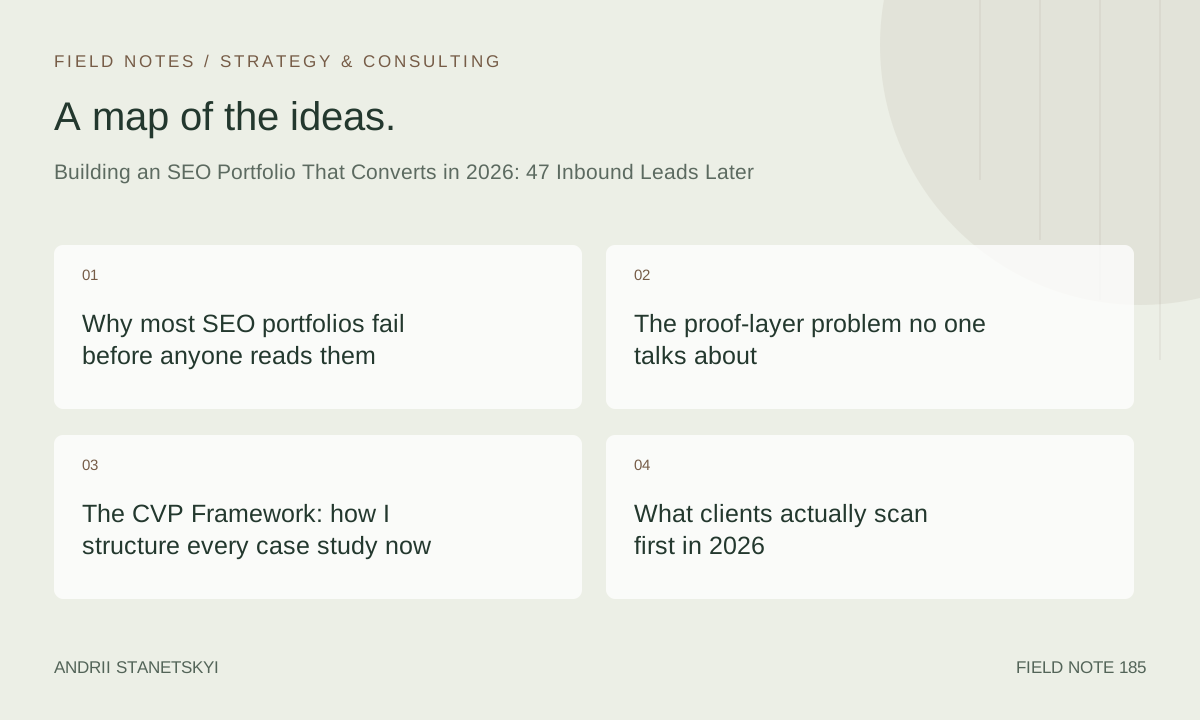
Why most SEO portfolios fail before anyone reads them
The portfolio someone linked me to last month had 22 case studies. Every one said roughly the same thing: "Increased organic traffic by 143% in six months for a mid-market e-commerce brand." No industry. No company size. No channel mix. No screenshot. No mention of what was broken before they touched it.
That portfolio is invisible. Not because the work was bad—I have no idea if the work was good. It's invisible because it gives a prospective client nothing to grip onto. The instinct is to go broad and generic to appeal to more people. That instinct destroys conversion.
Clients in 2026 are faster at scanning and slower at trusting than they were in 2022. AI Overviews have made mid-funnel research faster. Decision-makers now arrive at a sales call having already read your portfolio, skimmed your LinkedIn history, and checked if your claimed results line up with what the company's organic curve actually looks like on SimilarWeb. They show up pre-skeptical.
Generic portfolios don't survive that scrutiny. Specific ones do.
The proof-layer problem no one talks about
There are three layers of proof in an SEO portfolio, and most people only build one.
Layer 1 — Output claims. "Traffic grew 210%." Everyone does this. It's necessary but meaningless alone.
Layer 2 — Process evidence. Screenshots of GSC before/after. A crawl report showing the technical state at project start. The content audit spreadsheet with your decision criteria. This is where most portfolios stop when they bother going past layer one at all.
Layer 3 — Thinking artifacts. The strategy doc you wrote in week two. The recommendation you made that the client pushed back on and why you held the line (or didn't). The explanation of why you prioritized crawl efficiency over content production in month one when everyone else would have gone the other direction.
Layer 3 is where trust gets built in 2026. It signals that you have a repeatable mental model, not just a run of good luck or a favorable market cycle. Senior in-house hiring managers and experienced fractional buyers read portfolios looking specifically for layer 3. They've been burned by people with impressive-looking layer 1 results that unraveled when the market shifted.
The CVP Framework: how I structure every case study now
I built a repeatable structure after the October 2025 rebuild. I call it CVP: Context, Vector, Proof.
Context sets the scene with specificity. Company type, revenue band, team size at project start, what was already in place (CMS, existing domain authority, content team headcount), and why they brought me in rather than doing it themselves. This section is usually 150-200 words. It tells the reader exactly who this story is for.
Vector describes the strategic direction chosen and the specific reasoning. Why technical before content? Why this keyword cluster before that one? What data drove the prioritization? This is the layer 3 section. It should feel like reading a consulting memo, not a press release. Three to five paragraphs. Include the options you considered and rejected.
Proof is the evidence stack: metrics, screenshots, timelines, and the honest accounting of what didn't work. Every CVP case study I write now includes one "what I got wrong" line. Not as false humility theater—because it makes the wins more believable.
The CVP structure runs 600-900 words per case study. Short enough to read in full. Long enough to be unambiguously real.
What clients actually scan first in 2026
I ran an informal test in March 2026. Twelve people who had hired SEO consultants in the previous 18 months agreed to do a 20-minute portfolio review session with me watching over Zoom. I showed them three different portfolio layouts and tracked where their eyes went first.
The pattern was stark:
- Industry and company size — checked immediately, used to self-qualify
- Timeframe — how long did results take
- One screenshot, preferably GSC or revenue attribution
- What the SEO consultant's specific role was vs. what the client's team handled
Nobody read the intro paragraph first. Nobody scrolled to the "about me" section until after they'd read at least one case study. The metrics number in the headline drew their eyes, but the industry label determined whether they kept reading.
This is why "e-commerce brand" as a descriptor is a waste of space. "DTC apparel brand doing $4-8M ARR on Shopify Plus" is a self-filter. The right reader thinks "that's me" and keeps going. The wrong reader self-selects out. Both outcomes are good.
AI tool fluency: the new implicit expectation
Something shifted in late 2025 that most portfolio advice hasn't caught up to. Hiring managers and agency owners now expect to see evidence of how you work with AI tools. Not "I use AI" as a bullet point on a skills list. Actual evidence of your workflow.
In my rebuilt portfolio, one case study includes a section on the AI-assisted content audit I ran: what I prompted, what it surfaced, and where it was wrong and I overruled it. That section generates more questions on discovery calls than anything else. It shows operational fluency without making AI sound like a magic wand.
A portfolio that pretends AI doesn't exist reads as out of touch in May 2026. One that treats it as a tool you've developed a genuine opinion about reads as current.
Two takes that will annoy most SEO coaches
1. Testimonials are almost useless
Every portfolio advice piece tells you to collect client testimonials. I'm going to tell you they barely move the needle for mid-to-senior SEO roles and retainers above $6,000/month. Buyers at that level know that testimonials are cherry-picked. They know you wouldn't publish a bad one. They discount testimonials the same way they discount a restaurant's own description of its food.
What works instead: a reference call offer, upfront. "I'll connect you with two past clients. No pre-screening." That signal—the willingness to take the call unmediated—carries more weight than four glowing testimonial cards ever will. I added a one-line reference offer to my portfolio contact form in December 2025. Conversion on that form went up. Can't isolate causality perfectly, but the timing is hard to ignore.
2. More case studies is not better after a certain point
The conventional advice is to keep adding work. More projects, more industries, more proof. I pushed back against this in my own rebuild. Three case studies with full CVP depth outperform eight case studies with surface-level write-ups. Consistently. The reason is cognitive load. A reader who has to skim eight case studies leaves with a vague impression. A reader who reads three complete ones leaves with a specific mental model of how you think.
Pick your three best. Let them breathe. Add a fourth only when you have something that demonstrates a different skill dimension than the existing three.
The format question: site vs. PDF vs. Notion
Your portfolio should live on a domain you own. Full stop.
A Notion page is fine for sharing in a specific async context. A PDF works as a leave-behind. Neither should be the primary home of your professional proof. The reason is obvious once you say it aloud: you are an SEO professional. If your portfolio isn't indexed, crawlable, and optimized, you are selling yourself short in the most visible possible way.
The domain doesn't have to be elaborate. First-name-last-name.com or your agency brand domain. A simple three-page site: home, case studies, contact. The case studies should be individual pages, not a single long scroll, so each one can attract its own organic traffic over time.
I've gotten three of my 47 leads from people who found individual case study pages through Google searches like "Shopify SEO case study B2B" and "SaaS content audit before after." Niche, long-tail searches. But they arrived with near-zero skepticism because they found me through organic search rather than outreach—and the irony of an SEO professional ranking for SEO case study searches is not lost on either party on the discovery call.
The mistake I made for three years
I kept every client project anonymized by default, without asking whether I could name them. My assumption was that clients wanted confidentiality. When I finally started asking directly in late 2024, more than half said yes immediately. Two more said yes with minor redactions. Only three said no outright.
I had been operating under a false constraint for years. The ask costs you almost nothing. The upside—named, verifiable results—is enormous. If you have not explicitly asked your past clients for permission to name them in your portfolio, do that this week. Send a short email. Explain what you want to share and what you'll redact. Most people say yes when you frame it as mutual benefit (they get a link back to their company).
Showing fractional and advisory work
Fractional SEO is mainstream now. About a third of the senior SEOs I know are doing some combination of fractional engagements, project work, and in-house advisory. The portfolio challenge with fractional work is that you often influence results without being the one executing. You write the roadmap. The client's team implements it.
This is not a weakness. Frame it correctly. A case study that shows "here is the strategy I developed, here is the team that executed it, here is what happened" demonstrates something a fully hands-on execution portfolio can't: the ability to make other people successful. That's a senior skill. It's what VPs of SEO and heads of organic growth are hired to do.
The specific format I use for fractional work: a before/after of the strategic plan (what did the roadmap say versus where they were in month one), the key decisions made during the advisory period, and the 90-day and 180-day outcomes. I show the deliverables I produced—the actual audit doc, the channel priority matrix—not just the results those deliverables generated.
See also: Agency vs. In-house vs. Fractional in 2026, The Fractional SEO Playbook, and SOW Templates That Protect Both Sides.
Where to start this week
If your portfolio is currently a list of logos and percentage lifts, here is the smallest useful next step. Pick one project—just one. Write 800 words about it using the CVP structure. Include one screenshot. Include one thing you got wrong. Publish it on a page on your own domain.
Then ask the client for permission to name them. Then add a reference-call offer to your contact form.
That's it. Three actions. The portfolio rebuild is a ratchet, not a sprint. Each improvement compounds. The difference between where I was in September 2025 and where I am now is not a massive overhaul—it's a series of small specific choices that each made the portfolio a bit more believable and a bit more useful to the person reading it.
Forty-seven leads. Nine clients. Still counting.
Related reading: Writing SEO Case Studies in 2026: The Five Sections Clients Now Actually Read — The Senior SEO Career Path in 2026 — Google's helpful content guidance