Published 19 May 2026 — by Andrii
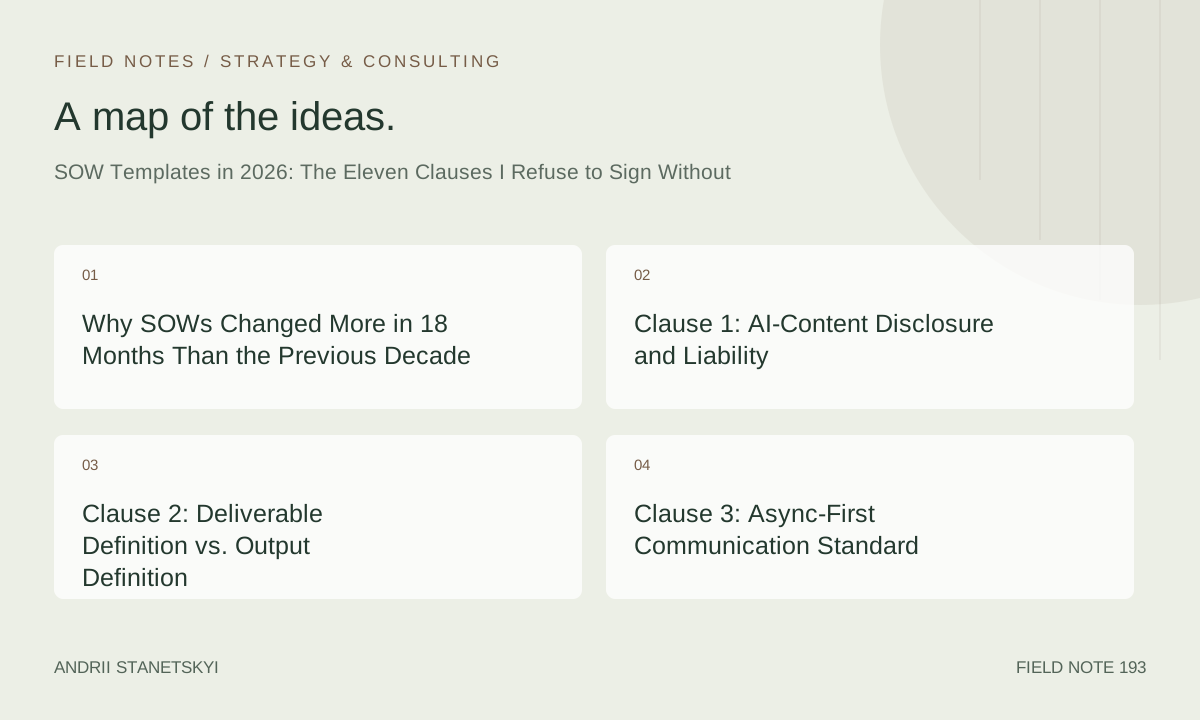
Why SOWs Changed More in 18 Months Than the Previous Decade
I've been running SEO engagements since 2018. In seven years, my statement-of-work template went through maybe three meaningful revisions. Then 2025 happened, and I rewrote it four times.
Two forces hit simultaneously. First: AI-generated content became standard operating procedure at the agency level, which created an entirely new liability surface. When a client's site gets hit by a spam action and half the content was AI-drafted using my recommended workflow, who owns that? The answer, in my old SOW, was embarrassingly ambiguous. Second: the post-Slack-Connect async shift changed how work actually gets done. Clients who used to expect a reply within the hour now operate on a different rhythm—and contracts that don't reflect that rhythm create friction at exactly the wrong moments.
I track eleven clauses now. Some existed in weak form before; some are new. All of them come from an incident, a dispute, or a near-miss in the past 18 months.
A note on framing: I'm not a lawyer. These clauses represent my operational approach, not legal advice. Your jurisdiction, client type, and risk tolerance will affect how you phrase each one. What I'm sharing is the logic behind each clause—why it exists, what it prevents, and what the failure mode looks like without it.
Clause 1: AI-Content Disclosure and Liability
This is the one that didn't exist in standard SEO contracts two years ago. It's now the first thing I look for when reviewing a client-provided SOW, and the first thing I add when drafting my own.
The clause has three parts: disclosure, approval, and liability assignment.
Sample language: "Consultant may use AI-assisted drafting tools in the production of content deliverables. All AI-assisted content will be clearly flagged in the delivery document. Client retains final editorial approval before publication. In the event that published AI-assisted content triggers a manual action or algorithmic demotion from any search engine, liability for remediation costs shall be determined by whether the content was published with or without Client's written approval."
The liability assignment piece is what matters. Without it, you're exposed to a client who approved and published AI-drafted content, got hit in a core update, and is now looking for someone to blame. With it, the approval step creates a clear record.
In practice, I keep a simple Google Sheet per client that logs every AI-assisted piece: the tool used, the draft date, the approval timestamp, and the publication URL. Takes about 90 seconds per piece to update. Saved me from a very uncomfortable conversation with a SaaS client in October 2025 when their blog traffic dropped 41% after the November core update and they wanted to revisit "who recommended the content strategy."
Clause 2: Deliverable Definition vs. Output Definition
Most SEO SOWs list outputs. Mine lists deliverables, and the distinction is not semantic.
An output is a thing I produce: a technical audit, a keyword map, a content brief. A deliverable is a thing I produce that meets defined acceptance criteria. The difference becomes important when a client decides an audit "isn't detailed enough" at the 90-day mark and wants to trigger a revision cycle that wasn't scoped.
Sample language: "Deliverables are defined by the acceptance criteria specified in Exhibit A. A deliverable is considered complete when it meets those criteria, regardless of scope or format expectations not stated in Exhibit A. Revisions requested outside the criteria in Exhibit A are subject to change-order pricing at the rates in Schedule B."
Exhibit A is a one-page document I complete before signing. It specifies things like: technical audit covers domains listed in Section 2, minimum 47 pages, structured per the PACE framework (see below), delivered in HTML format within 21 calendar days of kickoff. Specific. Measurable. Not open to interpretation.
I use what I call the PACE framework for deliverable definition: Parameters (what's in scope), Acceptance criteria (what done looks like), Channel of delivery (where and how it arrives), Expiry (when the deliverable window closes). PACE came out of a 2024 engagement where a client sat on a completed audit for six months, then asked me to "update it" for free because it was "outdated." The SOW now specifies that deliverables not actioned within 60 days are considered accepted-as-is.
Clause 3: Async-First Communication Standard
Async-first isn't a preference anymore. It's infrastructure. The post-Slack-Connect fragmentation of 2025—where clients routed communications through a half-dozen different channels depending on who was talking to whom—made it necessary to contractually specify where work-related communication lives.
Sample language: "All project communication shall default to the designated async channel specified at kickoff (typically the shared project workspace or email thread). Synchronous meetings are limited to the scheduled cadence in Section 4. Ad-hoc synchronous requests from Client outside scheduled calls are subject to availability and may be billed at the advisory rate in Schedule B if they require immediate response during a dedicated work block."
The billing mechanism is the key. I almost never charge it, but its existence stops roughly 90% of the "quick call?" requests that used to fragment my workdays. Clients internalize the cost signal and default to async. It's not about the money; it's about the behavioral architecture the clause creates.
One honest thing: I was too aggressive with this clause early in 2025. A healthcare client in Atlanta felt I was "hiding behind contract language" when they had a time-sensitive indexing problem in March. I've since added a carve-out for genuine technical emergencies, defined as situations where a site issue is actively causing measurable traffic loss and requires immediate consultant input. That carve-out is billed at standard rates but not subject to the scheduling friction.
Clause 4: Reporting Rights and Data Ownership
Reporting has changed structurally. The old model—monthly PDF, 20+ slides, executive summary at the front—is largely dead for clients who run their analytics through AI summary tools. I wrote about this at length in my piece on the three-page reporting rule, but the contract implications are distinct.
The clause covers two things: who owns the dashboards and connected data, and what happens to that data when the engagement ends.
Sample language: "All Google Search Console, GA4, and third-party platform access granted to Consultant is for the purpose of this engagement only. Consultant will not retain, copy, or use Client data for purposes outside this engagement. Upon termination, Consultant will remove access within 5 business days of written notice. Reporting templates, dashboards, and framework documentation created during this engagement are the intellectual property of Consultant unless otherwise specified in Exhibit B."
The IP piece on dashboards and templates trips people up. I've built Looker Studio templates that took me 40+ hours to develop. If a client ends the engagement and expects to keep those templates, that needs to be negotiated upfront—and priced accordingly. Without this clause, two clients assumed they owned my work product in perpetuity.
Clause 5: Algorithm Force Majeure
Google ran 7 confirmed core updates in 2025. Seven. In some quarters, two overlapped. The standard force majeure clause in most professional services contracts covers natural disasters and government actions. It does not cover a situation where Google releases a Helpful Content Update that wipes out 60% of a client's organic traffic three weeks into a six-month engagement.
Sample language: "Search engine algorithm updates that materially alter the competitive environment for Client's domain are considered an external market event outside Consultant's control. Such events do not constitute breach of contract or failure to deliver. Upon occurrence of a qualifying algorithm event (defined as a Google-confirmed core update or spam update causing a measurable change in Client's organic performance), Consultant will provide an impact assessment within 14 calendar days. Strategy adjustments resulting from algorithm events may require a change order if the adjustment materially changes the scope of work."
I added "spam update" specifically after the January 2026 spam update hit three clients simultaneously. Two had content programs that were borderline before the update; the update moved the line. Without this clause, the question of whether I "caused" the decline by recommending the content strategy is legally murky.
Clause 6: Content Approval Timelines
Short one. Simple one. Costs me the most time when it's missing.
Sample language: "Client agrees to review and approve or reject content deliverables within 7 business days of delivery. Content not responded to within 7 business days is deemed approved and may be published. Content rejected without specific written feedback will be returned to Client for feedback completion before revision begins."
The "deemed approved" language makes some clients nervous. Good. That nervousness produces timely feedback. Without it, I had a content queue that sat idle for 23 days at a B2B client in Q1 2026 because the internal approver went on parental leave and no one told me. The content was time-sensitive, tied to a product launch. We missed the window. With the deemed-approved clause, the contract would have clarified responsibility.
Clause 7: Third-Party Tool Access and Cost Allocation
Tool costs are not trivial. My standard stack runs roughly $1,847/month across Ahrefs, Screaming Frog Server, DataForSEO API, and several smaller tools. For a $4,000/month retainer client, that's nearly half the budget if I'm absorbing those costs. I stopped absorbing them in mid-2024.
Sample language: "Third-party tools required for this engagement are specified in Exhibit C with associated costs. Client may elect to (a) provide existing tool access at no additional cost, (b) reimburse Consultant for tool costs at actual cost with no markup, or (c) pay the tool allocation rate in Schedule B. Tool access and costs not specified in Exhibit C are absorbed by Consultant."
The specificity of Exhibit C prevents disputes. If I need DataForSEO API credits for a large crawl project and I list that in the exhibit, the client knows and approves it in advance. If I need something not listed, I absorb it—which disciplines me to think through the full tool requirement before signing.
Clause 8: Conflict of Interest and Vertical Exclusivity
This one is especially relevant for fractional SEO arrangements. When you're serving multiple clients simultaneously, the question of vertical exclusivity comes up. My default position is to disclose rather than exclude—exclusivity has a price, and most clients don't actually want to pay it.
Sample language: "Consultant may work with other clients in the same industry vertical unless Client purchases vertical exclusivity as specified in Schedule B. Consultant will not share confidential Client information (defined in Section 7) with other clients. If Consultant identifies a conflict of interest that may compromise objectivity, Consultant will notify Client in writing within 5 business days of identification."
In early 2025, I was simultaneously working with two e-commerce clients selling competitive products in the outdoor gear space. Neither had exclusivity language. Neither asked. I disclosed proactively and both were fine with it. But "both were fine with it" isn't a legal position. The clause creates the right expectation structure from day one.
Clause 9: Exit Conditions and Wind-Down Protocol
Most SEO retainers have a notice period. Mine has a wind-down protocol.
Sample language: "Either party may terminate this agreement with 30 days written notice. During the notice period, Consultant will: (a) complete all in-progress deliverables with delivery dates within the notice window; (b) document the current state of all ongoing campaigns and strategies in a handoff report; (c) transfer all client-owned assets and access credentials. Wind-down services during the notice period are billed at standard rates."
The handoff report requirement protects the client. It also protects me, because "I handed you a documented transition" is much easier to demonstrate than "I verbally told you what I was working on." Three clean exits using this protocol. Zero disputes about what was or wasn't finished at termination.
Clause 10: Penalty Protection Language
If a client's site receives a manual action while I'm the SEO of record, the question of responsibility needs to be pre-answered. Without penalty protection language, every manual action becomes a potential liability event.
Sample language: "Consultant's recommendations are made in good faith based on current publicly available guidelines from major search engines. Client is responsible for ensuring that all parties with website access (including but not limited to CMS users, other agencies, and internal marketing teams) are operating within search engine guidelines. Consultant is not liable for penalties arising from actions taken by parties other than Consultant, or from actions taken by Client contrary to Consultant's documented recommendations."
The "contrary to documented recommendations" piece is critical. A SaaS client in late 2025 ignored my explicit written guidance against purchasing a link package from a vendor they'd used "for years." They bought it. Manual action, six weeks later. Because my recommendation was in writing in our project workspace, the liability question was clear. Without that documentation trail and the contract language pointing to it, the conversation would have been much harder.
Clause 11: Mandatory SOW Review Cadence
The last clause is about the contract itself. An SOW that isn't reviewed is an SOW that drifts out of alignment with the work actually happening.
Sample language: "This SOW is subject to a mandatory review at the 90-day mark of each engagement year. The review is not a renegotiation; it is a scope-alignment check. If the review identifies material drift between the documented scope and the actual work being performed, either party may initiate a formal scope amendment. If no scope amendment is initiated within 14 days of a review identifying drift, the documented scope governs billing."
The "documented scope governs billing" backstop is the mechanism. Clients sometimes want to treat the review as an opportunity to expand scope without adjusting budget. The clause is explicit that scope expansion requires a formal amendment—which means a pricing conversation.
The Mistake I Made in Q4 2025 That Rewrote My Template
I'm putting this here because it should be in every version of this article.
In October 2025, I started a six-month engagement with a mid-market DTC brand. I used my standard SOW template at the time, which had reasonably good language on most of the above clauses. What it did not have was a clear definition of "organic search" as a channel.
The client's leadership defined organic search to include AI Overview appearances in Google. I defined it as traditional blue-link rankings and their associated traffic. When their AI Overview appearances increased while their click-through traffic declined—a pattern that was extremely common throughout 2025 and into 2026—they felt I was underperforming. I felt I was meeting the defined metrics. We were both right by our own definitions.
It took a three-hour mediation call and a $4,200 credit to resolve. I wrote "organic search performance is defined as clicks and impressions as reported in Google Search Console, standard blue-link positions only, excluding AI Overviews and other zero-click features" into every SOW the next morning.
That's the mistake. Own your definitions before they own you.
Two Things Most SEOs Get Wrong About SOWs
Contrarian take one: Long SOWs are not more protective than short ones. I've reviewed agency contracts that run 34 pages and still contain almost none of the eleven clauses above. Length is not rigor. The question is whether the specific failure modes of SEO engagements—algorithm volatility, approval delays, AI content liability, tool cost ambiguity—are addressed explicitly. A five-page SOW with all eleven clauses beats a 30-page template written for a generic professional services context.
Contrarian take two: The client's legal team is not your adversary in contract negotiations, but treating them like one is the most common mistake I see consultants make. I've started submitting my SOW template to clients' legal review before kickoff rather than after, which sounds backwards. What it does is flush out objections before work starts instead of six months in. In 2025, I did this with 11 clients. Every single one came back with edits. About 60% of those edits were reasonable and I accepted them. The remaining 40% opened conversations about the underlying concern, which in most cases I could address through clarification rather than clause removal. Zero of those 11 engagements ended in a billing dispute.
The clients who refuse to let legal review an SOW before signing are the clients whose legal team shows up after a dispute. That pattern has held consistently across my engagements.
What This Document Actually Is
An SOW is not a legal shield. It's a shared mental model about how an engagement will work, formalized enough to survive personnel changes on both sides. The eleven clauses above are the places where that mental model most commonly breaks down in SEO work specifically.
If you're using a generic professional services SOW template you found online, you're almost certainly missing at least five of these. Not because the template is bad—but because it was written for a world where AI content liability didn't exist, where algorithm force majeure wasn't a real consideration, and where "deliverable" was simple enough not to need definition.
That world is gone. The template needs to catch up.
Related reading: Fractional SEO in 2026 • Agency vs. In-House vs. Fractional • My SEO Kickoff Process Across 60 Engagements • Client Communication Cadence in 2026 • SEO Contracts and SLAs
External references: Google Search Central: AI-generated content • FTC guidance on AI disclosure
| Clause | Primary Risk It Addresses | Most Common Missing Point |
|---|---|---|
| 1. AI-Content Disclosure | Spam update liability | Approval timestamp documentation |
| 2. Deliverable Definition (PACE) | Scope creep on revisions | Acceptance criteria specificity |
| 3. Async-First Standard | Communication fragmentation | Emergency carve-out |
| 4. Reporting Rights | Dashboard IP disputes | Post-termination access removal |
| 5. Algorithm Force Majeure | Core/spam update blame | Qualifying event definition |
| 6. Content Approval Timelines | Queue stalls | Deemed-approved mechanism |
| 7. Third-Party Tool Costs | Margin erosion | Exhibit C specificity |
| 8. Conflict of Interest | Vertical overlap disputes | Proactive disclosure trigger |
| 9. Exit Conditions | Termination disputes | Handoff report requirement |
| 10. Penalty Protection | Manual action liability | "Contrary to recommendation" documentation |
| 11. SOW Review Cadence | Scope drift | Billing governs on non-response |