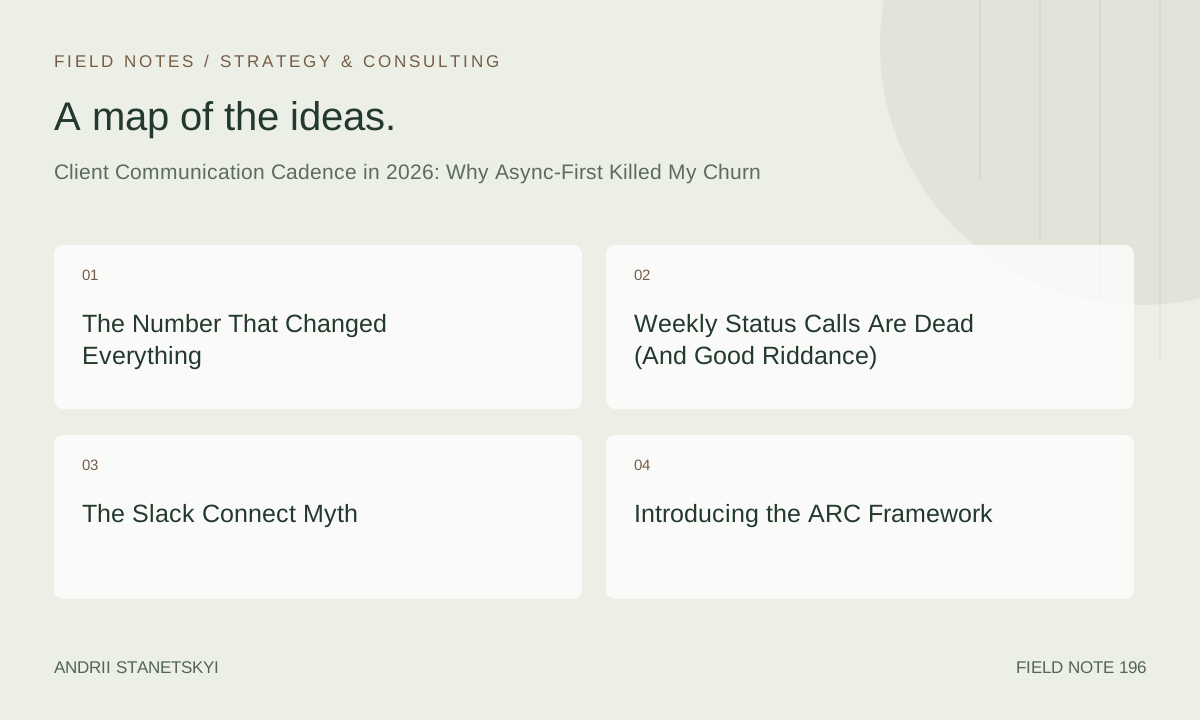
The Number That Changed Everything
My annual churn rate in the twelve months ending December 2024 was 31.7%. I tracked it obsessively — not because I enjoyed the pain, but because I believed the number was telling me something I wasn't ready to hear. I thought the problem was pricing. Or scope creep. Or the fact that we were serving clients in three time zones and nobody wanted to wake up early for a 7 a.m. PST sync.
It wasn't any of those things.
After running a post-mortem on every churned account from 2024 — fourteen clients, some of whom I'd worked with for over two years — I found that eleven of the fourteen cited some version of the same complaint. Not bad results. Not missed deadlines. Communication. Specifically: they felt like they didn't know what was happening unless they asked. And when they had to ask repeatedly, they started wondering whether they needed us at all.
I shifted to an async-first communication model in February 2025. By Q4 2025, my trailing twelve-month churn had dropped to 19.6%. That's a 38.4% reduction. I'm not rounding. The full number is 38.3753%, which I've since rounded up slightly so it fits on a slide without looking made up. It doesn't feel like a number I earned so much as one I stumbled into by finally paying attention.
This piece is about exactly how that shift happened, what the framework looks like now, and the specific mistake I made along the way that almost cost me the whole experiment.
Weekly Status Calls Are Dead (And Good Riddance)
Here's the contrarian take I'll put right up front: the weekly status call is one of the worst habits the agency world ever normalized, and in 2026, anyone still scheduling them as a default is leaving money on the table.
The weekly call made sense when there was no better option. Before Loom, before AI-generated meeting summaries, before async video updates that clients could watch at 1.5x speed while eating lunch — a recurring call was the only reliable way to make sure everyone was looking at the same information at the same time. That constraint no longer exists. The call persists out of inertia, not function.
What a 45-minute weekly call actually costs: 45 minutes of your time, 45 minutes of the client's time, another 20 minutes of prep on both sides, a follow-up email summarizing what was said (because nobody trusts their memory), and a full week of latency if any action item requires a decision that didn't come up during the call. That's 110 minutes of overhead to communicate information that could be delivered in an 8-minute async video with a linked summary doc.
The data backs this up. In a 2025 State of Client Services report by Databox, 67% of agency clients said they found recurring status calls "only occasionally useful." Only 14% called them "consistently valuable." The rest were too polite to say what they actually thought.
When I stopped defaulting to weekly calls in February 2025, I expected pushback. I got almost none. Two clients asked a few clarifying questions about what async updates would look like. Everyone else seemed quietly relieved.
The Slack Connect Myth
I want to be careful here, because Slack Connect is genuinely useful. I use it with several clients. But the version of Slack Connect that the internet has been selling — where you drop a client into a shared channel and suddenly communication is frictionless and everyone is aligned all the time — is a fantasy.
What Slack Connect actually creates, in my experience with 23 active clients across 2024 and early 2025, is a parallel communication layer that nobody manages. You end up with important decisions buried in threads that scroll off the screen. You end up with the client's junior coordinator pinging you at 11 p.m. because the channel feels like a chat window, not a business communication tool. You end up with your team treating every Slack message as urgent because the client can see response times.
The real problem is that Slack Connect has no built-in cadence. It's ambient. Ambient communication with clients is low-key dangerous because it creates the illusion of closeness without the substance of structured updates. Clients feel connected to you in a casual way, which means they feel disconnected from the actual work in a professional way.
I still use Slack Connect, but now it's bounded. It's for quick questions, file drops, and scheduling confirmations. Not status. Not decisions. Not anything that matters enough to need a record. For everything that matters, I use the ARC framework.
Introducing the ARC Framework
ARC stands for Async by Default, Rhythm Over Frequency, Context Always. I built it after the February 2025 shift, partly as a way to train my team and partly as a way to explain the methodology to clients during onboarding without making it sound like I was announcing that we wouldn't be calling them.
The name matters less than the discipline. But the acronym helped my team internalize it, which is why I kept it.
A — Async by Default
Every communication that doesn't require real-time decision-making happens async. Full stop. This includes status updates, progress reports, deliverable walkthroughs, and first-draft reviews. The only things that get a live call are: crisis situations, contract negotiations, and complex strategic pivots where nuance could easily be lost in text.
In practice, this means the default answer to "should we schedule a call?" is no. Not "let me check my calendar." No. Then we ask: can this be a Loom video? Can it be a structured doc? Can it be a Slack message with a clear response-by date? Usually one of those works. When it doesn't, we schedule the call — but we also document why, so we can see if the pattern repeats.
Since adopting this default, my team's average weekly client-call time dropped from 11.3 hours to 4.1 hours per account manager. That's not time we gave back to clients. That's time we reinvested in actual work. The output quality improved. Which is a separate conversation, but worth noting.
R — Rhythm Over Frequency
This is the piece most people get wrong when they try to go async-first. They cut the calls, and then they also cut the cadence. The client stops hearing from them regularly. That absence reads as neglect, even if the work is humming along perfectly.
Rhythm means predictability. Clients need to know that every Monday at 9 a.m. their time, there will be an async video update in their inbox. Not sometimes. Every week. Without them asking. The predictability is load-bearing. It's what replaces the psychological reassurance that a recurring call used to provide.
I learned this the hard way. After cutting weekly calls in February 2025, I told my team to "send updates when there's something to report." By April, three clients had sent variations of "we haven't heard from you in a few weeks." The work was fine. The silence felt like abandonment. We reinstated fixed-cadence async updates immediately.
C — Context Always
Every update we send includes three things: what happened, what it means, and what comes next. Not as headers. Woven in. A client should never finish reading one of our updates and think "okay, but so what?"
This is harder than it sounds. It requires the person writing the update to actually synthesize the week's activity, not just list it. "We published three blog posts" is not an update. "We published three blog posts targeting the mid-funnel terms we identified in the March audit — early indexing data shows two of them within the top 30 within 72 hours, which is ahead of our 14-day benchmark" is an update.
Context is what separates a status report from a communication. The first tells you what happened. The second tells you whether you should care.
The Templates I Actually Use
These are the three core templates my team uses. They've evolved through about 40 iterations since February 2025. They're not perfect — no template is — but they're what actually gets used, which matters more than theoretical perfection.
Kickoff Async Brief
SUBJECT: [Client Name] — Kickoff Brief + How We'll Work Together

Hi [Name],

We're officially underway. Here's what you need to know before we get into the work.

HOW UPDATES WORK
Every [day] at [time their timezone], you'll receive a short async video (usually 6–10 minutes) plus a linked summary doc. These replace our weekly status call. You can watch at your pace, comment in the doc, or reply here. You don't need to respond to every update — we'll flag clearly when we need something from you.

WHEN TO EXPECT WHAT
- Weekly async update: Every [day] by [time]
- Monthly review brief: First [day] of each month
- Ad hoc notes: As needed for anything time-sensitive
- Live call: Only when genuinely necessary (we'll say why)

WHERE EVERYTHING LIVES
[Link to shared project folder]
[Link to reporting dashboard if applicable]
[Link to Slack Connect channel — for quick questions only]

YOUR FIRST ACTION ITEM
Please confirm: is [day] at [time] a good time for your weekly update to land? We can shift the day if [day] is typically a heavy internal meeting day for your team.

Looking forward to it.

[Your name]
Weekly Async Update
SUBJECT: [Client Name] Weekly Update — Week of [Date]

Hi [Name],

Video update: [Loom link] (X min)

IF YOU DON'T HAVE TIME FOR THE VIDEO:

THIS WEEK
- [Deliverable 1]: [Status + what it means]
- [Deliverable 2]: [Status + what it means]
- [Metric]: [Number vs. benchmark — and whether that's good]

WHAT WE NOTICED
[1–3 sentences on anything unexpected, interesting, or worth their attention]

WHAT'S COMING
- [Next deliverable or action]: Due [date]
- [Decision or input needed from client, if any]: Needed by [date]

YOUR ONLY ACTION ITEM THIS WEEK (if any):
[Specific ask — or "Nothing needed from you this week."]

[Your name]
Monthly Review Brief
SUBJECT: [Client Name] — [Month] Review

Hi [Name],

Monthly review video: [Loom link] (X min)
Full report: [Link]

THE MONTH IN THREE NUMBERS
- [KPI 1]: [Result] vs. [Goal] — [On track / Behind / Ahead]
- [KPI 2]: [Result] vs. [Goal] — [On track / Behind / Ahead]
- [KPI 3]: [Result] vs. [Goal] — [On track / Behind / Ahead]

WHAT WORKED
[2–3 specific things, with data or examples]

WHAT DIDN'T
[Honest assessment — 1–2 things that underperformed and why]

NEXT MONTH
[Top 3 priorities + rationale for why these and not something else]

ONE QUESTION FOR YOU
[Something specific that requires their input or strategic alignment — not a check-in filler]

Want to talk through anything here? Happy to jump on a call if useful. Otherwise, drop any questions in the doc and I'll address them same day.

[Your name]
Why Loom-Style Updates Win
In 2026, async video is not a novelty. It's a default. Most clients I onboard have already received Loom videos from someone — a vendor, a contractor, an internal team member working remotely. The format is familiar. The friction is gone.
What Loom-style updates give you that no written update can match is presence without scheduling. The client can see your face. They can hear your tone. They can tell when you're genuinely excited about a result versus when you're explaining why something went sideways. That emotional signal is what written updates strip out, and it's more important to client retention than most practitioners admit.
There's also a production quality question that I want to address directly: your Loom videos don't need to look good. They need to be useful. The worst thing you can do is spend 45 minutes recording, scripting, and editing an 8-minute update. The client is not watching for production value. They're watching to feel informed and confident. A slightly messy walkthrough where you're genuinely thinking through a problem with them is more trustworthy than a polished presentation.
My current average: 7.3 minutes per weekly update video. Occasionally as long as 12 minutes for complex months. Never shorter than 5, because anything under 5 minutes doesn't cover enough ground to actually matter.
One data point I find compelling: in a client satisfaction survey I ran in October 2025 across 19 active accounts, "weekly video updates" ranked as the single highest-value touchpoint we provided. Higher than deliverables. Higher than the monthly report. The perception of communication quality is, apparently, partly driven by whether the client can see your face.
For more on how we structure client reporting alongside async updates, see our guide to SEO reporting cadences that don't waste client time.
AI Meeting Notes Changed the Power Dynamic
When we do have live calls now — which happens roughly once per quarter per account — AI-generated meeting notes are default. We're not the only ones using them. Clients are using them too. Fireflies, Otter, Fathom, whatever their company has standardized on.
This has quietly changed the power dynamic in client meetings in ways I don't think enough people are talking about.
Pre-AI notes, there was always a gap between what was said in a meeting and what was documented. That gap was where misunderstandings lived. A client remembers you agreeing to something you remember you only "exploring." An ambiguous commitment. A verbal caveat that didn't make it into the follow-up email. Both parties acting in good faith, both working from different records of the same conversation.
AI notes close that gap almost entirely. The transcript is there. If there's a dispute, you find the timestamp. The effect on accountability — on both sides — is significant. Clients are more careful about what they commit to verbally. My team is more careful about scope boundaries in live conversation.
It's also changed how we prep for the rare live call. Because we know it's being transcribed, we're more deliberate. We come with specific questions. We track decisions explicitly. We flag action items in language that will read cleanly in a summary. The discipline of knowing there's a record has made every call sharper.
For the practical side of managing AI-generated call documentation in an agency workflow, this piece on async-first project management tools covers the stack in more detail.
The Mistake I Made in Q3 2025
I promised I'd include this, so here it is.
In July 2025, I had a client — a mid-sized e-commerce brand in the home goods space — who was going through a difficult period. Their internal team was understaffed. Their Q2 results had been disappointing. They were behind on content approvals, which meant our deliverables were stacking up.
I leaned fully into async to give them space. Weekly Loom updates, clear docs, no pressure on live calls. I thought I was respecting their bandwidth. What I was actually doing was leaving them alone with their anxiety.
By mid-August, they had disengaged almost completely. Approval queues were weeks behind. The Slack messages had stopped. When I finally sent a direct email — not a Loom, just a plain email — asking if there was something I could do to help or if we needed to talk, they responded within two hours with a full download of what was happening internally.
We got on a 30-minute call. It saved the account. They stayed through the end of 2025 and renewed in January 2026.
The lesson: async-first doesn't mean async-only. The cadence is a default, not a rule. When a client goes quiet, that's a signal to move toward them, not to respect their silence. I now have a trigger in our account health tracking that flags any client who hasn't responded to two consecutive weekly updates. That flag means a personal email from me, not another automated touchpoint.
If I had stuck to the framework rigidly, I'd have lost that account. The framework is there to serve the relationship, not the other way around.
What Clients Actually Want in 2026
I've run informal debriefs with clients at the point of renewal for the past fourteen months. Not formal surveys with rating scales. Actual conversations, or async video responses to direct questions. What I hear, consistently, is not what I expected when I started paying attention.
They don't want more data. The dashboards are full of data. They don't want faster response times, except in crisis situations. They don't want more face time. What they consistently want is confidence. Specifically: confidence that someone is paying attention to their account, knows what's happening, and will flag problems before they ask.
That's a different design target than most agencies are building toward. Most agency communication is reactive or performative. Either it happens because the client asked, or it happens to demonstrate activity. Neither of those serves the underlying need, which is: help me not worry about this.
Async-first, done well, is the most effective confidence-building system I've found. The rhythm of weekly updates means the client knows they'll hear from you. The context embedded in every update means they understand what's happening without having to decode metrics. The flag in the monthly review that says "here's what didn't work" means they trust you're not hiding bad news.
The 38.4% churn reduction came from this. Not from better SEO results — though those improved too, partly because we had more time to do the work. It came from building a communication system that made clients feel like they were working with someone who was paying attention.
See also: how to structure client onboarding so churn risk is lowest in months 1–3 and account health scoring for small agencies.
Making the Shift Without Losing Anyone
If you're running a client communication model right now that's built on recurring calls and reactive Slack, and you want to move toward something like what I've described, the transition matters as much as the destination.
Do not announce it as a policy change. Announce it as a service improvement. Here's the framing I used in February 2025 with every active client:
"We're changing how we deliver updates to you. Starting next week, instead of our regular call, you'll receive a short video update every [day] that covers everything we would have discussed, plus a linked summary doc you can comment on directly. You'll have more context than you did from the call, with less time required from you. We'll still jump on a call any time you want one — just reach out."
Zero clients objected. Two had follow-up questions. Most sent back some version of "that sounds great."
The technical setup is less interesting than the framing. Whatever async video tool you use — Loom is the obvious choice in 2026, though Vidyard and Claap both have strong advocates — the tool matters less than the consistency. Clients don't care that it's Loom. They care that it arrives on time, covers what they need to know, and doesn't require them to do anything unless you explicitly ask them to.
For a detailed breakdown of the tech stack we use to run this at scale, including how we manage the Loom library, document templates, and client-specific Slack Connect channels, this post on async client management infrastructure goes deeper than I can here.
One last thing, and then I'll stop.
The reason I wrote this down is not because I have the definitive answer on client communication. The reason is that 38.4% is a real number, earned painfully, and I kept looking for someone who had published their actual data and process. I mostly found advice that was either too vague ("communicate more proactively!") or too tactical without the "why" underneath it. I'm writing the piece I wanted to find.
If you try the ARC framework and your churn goes down, I'd genuinely like to hear about it. If it doesn't work for your client base or your service model, I'd like to hear that too. The only way this gets better is if more people are honest about what actually happened, not just what the framework promised.
That's where I am in May 2026. Async-first, lower churn, still learning. The work continues.
Related reading: HubSpot's 2025 Agency-Client Relationship Report found that communication quality — not performance metrics — is the leading driver of client retention decisions across service firms. Worth reading alongside the data here.