Published 19 May 2026 — by Andrii
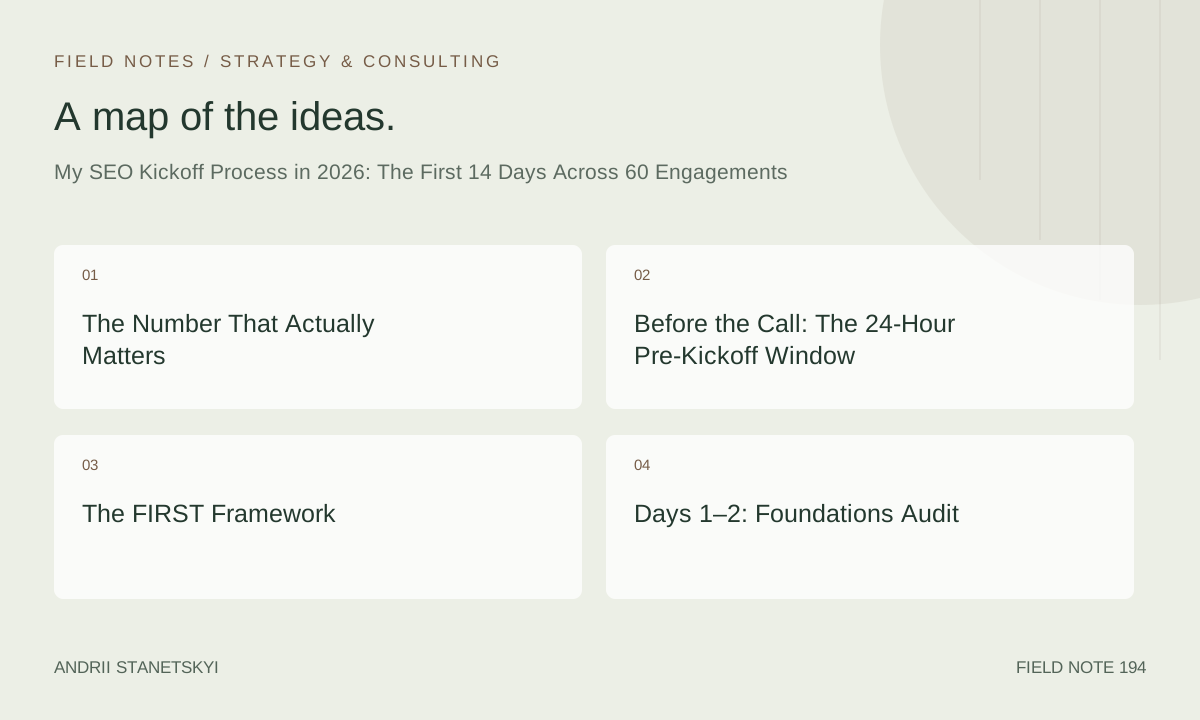
The Number That Actually Matters
Across 60+ SEO engagements, the single metric that most reliably predicts whether a client relationship succeeds past the 90-day mark is how many working days pass between contract signing and the first substantive async update from the consultant.
Not the kickoff call. Not the onboarding questionnaire. The first piece of actual work product delivered in written form.
The average across my engagements is 6.3 days. The engagements that churn before month four almost all share a first-update lag of 11 days or more. The ones that run 12+ months tend to cluster around 3–4 days for that first deliverable. I haven't run regression analysis on this—I don't have enough data for that to be meaningful—but the directional signal is consistent enough that I've built my entire kickoff process around compressing that window.
The first 14 days aren't about impressing the client. They're about establishing the pattern that governs everything else.
Before the Call: The 24-Hour Pre-Kickoff Window
The kickoff call is not the start of the engagement. Contract signing is. The 24 hours between signing and the live call are the most underused asset in the process.
What I send within two hours of a signed contract:
- An access request form (Google Sheet with a tab per platform) asking for GSC, GA4, GTM, CMS read, any existing analytics stack, and the names of three internal stakeholders I should know.
- A pre-kickoff questionnaire with seven questions. Not 20. Seven.
- A calendar invite for the kickoff call with an attached one-page agenda—sent to the client and all stakeholders they've named.
The seven pre-kickoff questions:
- What does success look like in 12 months, in plain language?
- What have you tried before that didn't work?
- Who else is currently doing SEO work on this site (agencies, contractors, internal staff)?
- Are there any pages or sections of the site that are off-limits for changes?
- What is the single most important conversion action on the site?
- What is the biggest internal obstacle to implementing SEO changes?
- Is there anything about the site's history I should know before I start crawling?
Question 7 has saved me enormous amounts of time. In 2025 alone, three clients flagged things in their answers that would have derailed my first crawl: a pending domain migration, a staging environment accessible to crawlers, and a technical rewrite that was two weeks from launch. Without the pre-kickoff questionnaire, I would have invested 8–12 hours in analysis that was about to become irrelevant.
The FIRST Framework
I use a structure I call FIRST for organizing the 14-day kickoff: Foundations audit, Issue triage, Relationship mapping, Strategy alignment, Tempo establishment.
Each phase takes roughly 2–3 days. They overlap slightly. The output of each phase feeds the next. By day 14, I have a functioning picture of the site, the organization, the problems, and the working rhythm. Not a complete picture—that takes longer—but a functional one.
FIRST is not a checklist. It's a sequencing principle. The order matters: you can't meaningfully triage issues before you've established what's foundationally wrong, and you can't align on strategy before you've mapped who internally has authority to approve changes.
Days 1–2: Foundations Audit
The kickoff call happens somewhere in here, usually on day 1 or the morning of day 2. It runs 60 minutes maximum. The agenda is fixed: confirm the pre-kickoff questionnaire answers, identify any gaps, clarify the access requests, and agree on the async channel and reporting format.
That's it. No strategy discussion. No brainstorming. No "what are your goals for organic?" questions that should have been answered in the questionnaire. If the questionnaire was completed, the call is mostly confirmation. If it wasn't completed, the call reveals that the client's internal process is going to be a friction point—which is itself useful information.
Simultaneously (or immediately after the call): I run the initial crawl. My standard Foundations Audit checks:
| Category | What I'm Looking For | Tool |
|---|---|---|
| Index coverage | Crawled vs. indexed ratio, known exclusions | Google Search Console |
| Site architecture | Depth distribution, orphan pages, crawl traps | Screaming Frog / custom crawler |
| Core Web Vitals | LCP, INP, CLS at page level, not just site average | CrUX via GSC + PageSpeed Insights API |
| Canonical structure | Self-referencing, cross-domain, pagination | Screaming Frog |
| Redirect logic | Chain length, soft 404s, redirect loops | Screaming Frog + GSC coverage report |
| Schema markup | Present, valid, and appropriate types | Validator.schema.org + Rich Results Test |
| Mobile/desktop parity | Diff content served on mobile, viewport issues | Mobile-Friendly Test + manual spot checks |
| Existing backlink profile | Toxic link patterns, recent lost links, topical clusters | Ahrefs |
I don't write the full audit report at this stage. I write a priority issue log—a short async document delivered by end of day 2 that flags the top 5–7 issues with severity ratings. This is the first substantive work product the client receives. Its primary purpose is to demonstrate that I'm in the site, I know what I'm looking at, and I've already found things.
Days 3–5: Issue Triage
Triage is different from audit. An audit documents. Triage prioritizes.
I use a severity-by-effort matrix for this phase. Four quadrants: high severity/low effort (fix immediately), high severity/high effort (schedule and resource), low severity/low effort (batch into monthly maintenance), low severity/high effort (defer or ignore). Every issue from the foundations audit gets placed in one quadrant.
The output is a triage document I deliver in the project async channel, not via email. This is deliberate. The async channel is where work lives. Email is where administrative communication lives. If the client hasn't adopted the async channel yet, the triage document is the nudge that gets them using it.
During triage, I also run the keyword gap analysis and pull the GSC performance data for the past 16 months (not 12—16 gives me a full seasonal cycle plus extra context). I'm looking for:
- Traffic loss events and their approximate timing relative to known algorithm updates
- Branded vs. non-branded click split
- Pages with high impressions and low CTR (quick-win candidates)
- Pages with declining position that still have meaningful impressions
- Queries triggering AI Overview appearances where the client isn't appearing in the Overview
That last point is new to 2025–2026 analysis. AI Overview appearance has become a separate strategic consideration from blue-link rankings, and the two don't always correlate. I've had clients in the 3–5 position range who were appearing in AI Overviews for zero of their target queries, and clients ranking 12–15 who were appearing in Overviews for several. The gap between those two metrics tells you something about content structure and entity coverage.
Days 6–8: Relationship Mapping
This phase sounds like management consulting fluff. It isn't. Knowing who inside the client organization has authority to approve what is the difference between a 3-month implementation timeline and a 9-month one.
I map four things:
- Who approves content changes? (And is there a backup if they're unavailable?)
- Who approves technical changes? (Is it the same person, or does dev have its own approval chain?)
- Who owns the relationship with me contractually? (Often different from who I talk to daily)
- Who are the internal skeptics? (Asking directly: "Is there anyone internally who is skeptical about SEO investment?" This question gets answered honestly about 70% of the time, and when it does, I can address the skepticism early.)
The relationship map goes into my internal engagement file, not into any client-facing document. It's operational intelligence, not a deliverable.
The stakeholder interview format
For engagements above $6,000/month, I conduct 20-minute async stakeholder interviews with each mapped stakeholder using Loom. I send a three-question Loom prompt and ask them to record a response of any length. Questions: What's your biggest frustration with the current organic performance? What would success look like to you specifically? What's the one thing you wish our SEO consultant understood about your business?
The responses are consistently more honest than what I get in a group kickoff call. People say things on Loom they won't say with their manager in the room.
Days 9–11: Strategy Alignment
By day 9, I have enough information to draft a 90-day direction document. Not a strategy deck. Not a presentation. A written document, 4–6 pages, that specifies:
- The three highest-priority problem areas based on triage
- The proposed focus for the first 90 days with rationale
- What I am explicitly NOT doing in the first 90 days and why
- The metrics I'll use to measure progress (GSC clicks, target position movement, Core Web Vitals scores, or something more specific to the business)
- The two or three assumptions I'm making that we should validate in the first 30 days
The "what I'm not doing" section surprises clients every time. It's one of the most useful things in the document. SEO engagements fail partly because clients expect everything to be worked on simultaneously. Being explicit about prioritization forces a conversation about what matters most—and creates protection when a client later asks "why haven't you done X" and the answer is "we agreed in writing that X was below Y and Z."
I send the document for async review and request written feedback within 5 business days (per the content approval clause in the SOW—see the SOW article for context). If I get feedback, I incorporate it and confirm alignment. If I don't get feedback, the document is deemed approved per the SOW and I proceed.
Days 12–14: Tempo Establishment
Tempo is the rhythm at which the engagement runs. The kickoff period sets it. Whatever pace of communication, update frequency, and review cadence is established in the first two weeks tends to persist.
The tempo document I send on day 12 specifies:
- Weekly async update: sent every [day], contains [three things]
- Monthly reporting: delivered by [day of month], format per the three-page rule
- Synchronous calls: scheduled monthly, 45 minutes, agenda sent 48 hours prior
- Response time SLA for async messages: 24 hours on weekdays, not applicable on weekends
- Emergency escalation path: [specific channel], defined as [specific conditions]
The response time SLA goes both ways. I commit to 24-hour response on weekdays. The client commits to 7-business-day turnaround on deliverable reviews (already in the SOW). Putting both in a single document makes it feel mutual rather than one-sided.
On day 14, I send a kickoff close summary—a single async message that recaps what was established, who is responsible for what, and what happens next. It's not long. It's a record that the kickoff period concluded and the engagement is in operational mode.
What I Stopped Doing After It Failed Three Times
I used to deliver a full technical audit in the first 14 days. The logic seemed sound: show the client what's wrong, demonstrate expertise, justify the retainer. It failed three times in different ways.
Failure mode one: the audit overwhelmed the client. A 47-page technical audit delivered on day 12 with 94 issues documented across six categories produced exactly zero action items in the first month because no one knew where to start. The triage document (5–7 issues, ranked) produces better outcomes than the comprehensive document at this stage.
Failure mode two: the audit became a negotiating document. One client used a full early audit to argue that the site "was in worse shape than expected" and tried to renegotiate the retainer rate upward. The audit gave them leverage I didn't intend to give. The triage log gives enough information to establish priorities without handing the client a complete inventory of problems they can use for scope negotiation.
Failure mode three: the audit was rendered partially obsolete before it was actioned. The three-week turnaround I mentioned earlier—a client who sat on the audit for six weeks—came back and wanted a "current" version. Which I wasn't going to produce for free.
The full technical audit still exists in my process. It's a separate deliverable, scoped explicitly, delivered at the 30–45 day mark when I have a more complete picture and the client has demonstrated they're ready to act on it.
How Async-First Changed the Kickoff Structure
The 2025 async-first shift changed kickoffs in one specific way that I didn't anticipate: it moved the center of gravity from the kickoff call to the pre-kickoff questionnaire and the first async deliverable.
When the kickoff call was the primary information-exchange event, a lot of the relationship establishment happened synchronously. The conversation built trust. The back-and-forth clarified expectations. Without a substantive live call, you lose that—unless you replace it with something else.
What I've replaced it with is a heavier pre-call investment and a richer first async deliverable. The pre-kickoff questionnaire does more relational work than I initially expected. Getting thoughtful written answers from a client before we've had a live conversation tells me how they think, how they communicate, and how seriously they're taking the engagement. A client who sends two-sentence answers to seven questions is telling me something different than a client who sends detailed paragraphs with supporting context.
The kickoff call itself has gotten shorter and more focused as a result. 60 minutes used to feel tight. Now it often feels long for the agenda I need to cover.
Patterns I've Noticed Across 60 Kickoffs
Some things that have held consistently across enough engagements to be worth noting:
Clients who delay access provision by more than 5 business days after contract signing will also delay content approval, stakeholder interviews, and implementation sign-off throughout the engagement. Access delay is a leading indicator. I now flag it explicitly when it happens and document it in the engagement file.
The "biggest internal obstacle" question (question 6 in the pre-kickoff form) produces the most useful answers when the answer involves a specific person rather than a process. "Getting dev resources prioritized" is less useful than "our CTO doesn't believe SEO works." The latter tells me I need to win the CTO over before I can implement anything technical.
Sites with more than 3 active redirects in their recent history (domain migrations, platform switches, URL restructures) almost always have redirect chain problems that weren't fully cleaned up. This has held true for 23 of the last 28 multi-redirect-history sites I've audited. Not 100%, but consistently enough to be the first thing I look for in the foundations audit.
Clients who've previously worked with an SEO agency tend to have one of two types of GSC histories: very well-organized with clean annotations, or a complete mess with multiple users who no longer work there, properties set up incorrectly, and verification methods that have expired. There's almost no middle ground.
Two Things About Kickoffs That Contradict Common Advice
Contrarian take one: The kickoff call is not your most important communication with a new client. The first async update is. The call is expected—every consultant does one. The first unprompted async update, sent early, with a specific observation about the site, is what differentiates you. It signals that you started working before the call ended, that you're paying attention, and that you communicate proactively. I've had clients mention the first async update in offboarding interviews 18 months later. I've had clients who couldn't remember the specific topics we covered in the kickoff call.
Contrarian take two: Quick wins in the first 30 days are overrated as a strategy concept and underrated as a stakeholder-management tool. I've seen consultants prioritize quick wins at the expense of the most important problems because they want to show early results. That's the wrong sequence. The right approach is to identify the genuine quick wins during triage, pursue the ones that don't require internal resources the client hasn't yet allocated, and use them to build momentum—not as the primary signal of value. The primary signal of value is whether the 90-day plan is credible, specific, and being executed. Quick wins are a side effect of good triage, not a goal in themselves.
The Kickoff Mistake I Still Think About
In February 2025, I started an engagement with an e-commerce client in the home goods space. The kickoff went well by every measure: questionnaire completed on time, strong call, clean access provision, good triage document. By day 14 I had a solid picture of the site and a credible 90-day plan.
What I didn't do was confirm who had authority over the product catalog. The client's site had 4,200 product pages. My 90-day plan included a significant faceted navigation restructure that would affect how those pages were indexed. I drafted the recommendations based on conversations with the marketing director, who was my primary contact.
The marketing director did not have authority over the catalog. That lived with the e-commerce operations team, who reported to a different VP and had no idea an SEO engagement had started. When I submitted the faceted navigation recommendations for approval at week 6, they went to the marketing director, who forwarded them to operations, who immediately had concerns about SKU mapping and inventory sync. We lost eight weeks of implementation time to an internal alignment process that should have happened in the relationship mapping phase.
Now question 6 in my pre-kickoff form reads: "Who has final authority over changes to the site's URL structure, navigation, and product catalog (if applicable)? Please list each separately if different people."
One question. Eight weeks recovered.
Day 15
On day 15, the kickoff is done and the engagement is running. The client knows how communication works, what's being prioritized, and what the next 90 days look like. I know who has authority over what, where the historical problems are, and which three issues matter most right now.
Nothing about that picture is complete. Plenty will change—algorithm updates, internal priorities, personnel shifts. But the FIRST framework gives both sides a functioning foundation instead of a slow, ambiguous ramp-up.
The 14-day kickoff doesn't guarantee a good engagement. It just removes the most common reasons engagements fail in the first 90 days. Which, across 60 kickoffs, turns out to be enough to matter considerably.
Related reading: SOW Templates in 2026 • Monthly SEO Reporting in 2026 • Client Communication Cadence in 2026 • Fractional SEO in 2026 • Writing SEO Case Studies
External references: Google Search Console: Managing users and permissions • Web Vitals: Field data and CrUX