Published 19 May 2026 | By Andrii Benrey
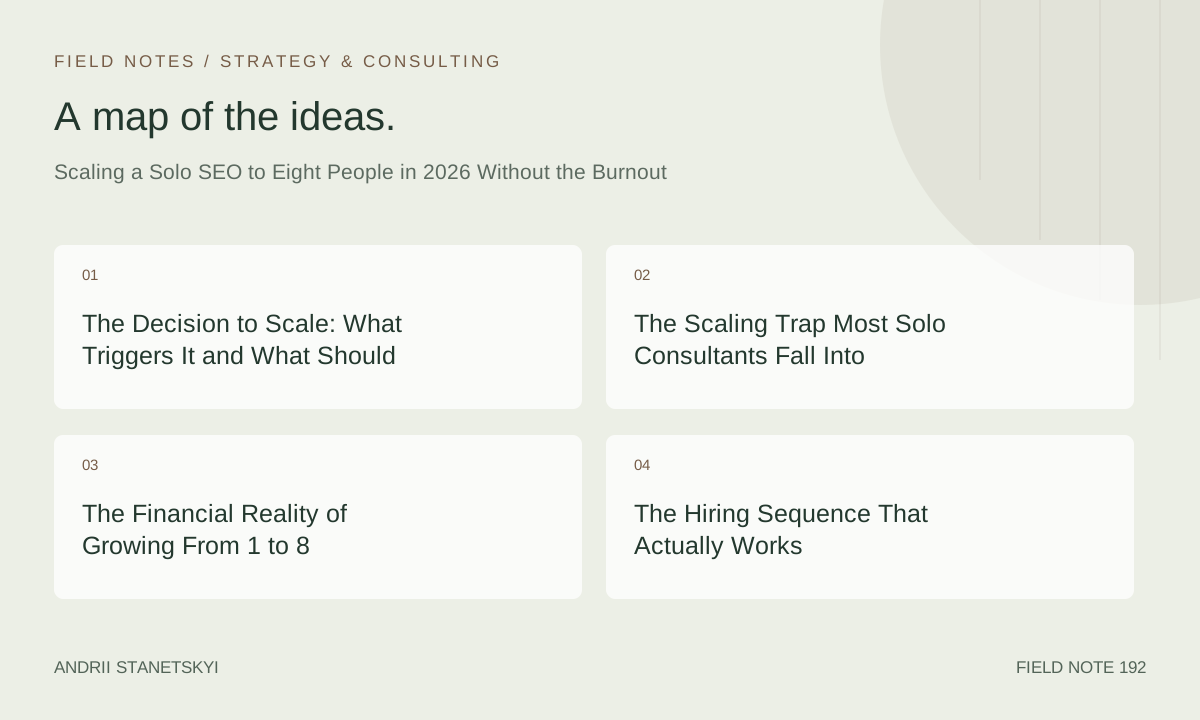
The Decision to Scale: What Triggers It and What Should
Every solo SEO consultant who thinks about scaling has the same thought at some point: "I'm turning away good clients. I need more people." That's the trigger that actually happens. It's not always the right trigger.
Turning away clients is a capacity problem, but capacity problems have multiple solutions. You can raise prices and serve fewer clients at higher margins. You can productize and increase output per hour. You can build a contractor bench that extends your effective capacity without the fixed costs of employees. All of these are valid before you make your first hire.
The right trigger for hiring is more specific: you're consistently turning away qualified work, you've already raised prices and built contractor capacity, and the bottleneck is your own strategic attention rather than execution capacity. When you're the constraint — when clients need more of your brain and not just more output — that's when you hire.
Most people hire because they feel busy. Feeling busy and being the strategic constraint are different things, and confusing them is how you end up with three employees doing work that a better-structured contractor bench would have handled.
The Scaling Trap Most Solo Consultants Fall Into
Here's the pattern I've watched play out with multiple colleagues who scaled in 2024–2025:
Month 1: "I'm at capacity, I need help." Hire a junior SEO coordinator. Revenue: $22k/month. New payroll cost: $4,800/month. Net margin drops from 74% to 62%. Fine.
Month 3: The coordinator is helping but they need management time. Founder is now spending 8–10 hours/week on management. Effective billable capacity drops. They take on two new clients to compensate. Revenue: $31k. Still feel stretched.
Month 5: Hire a content specialist. Payroll now $9,600/month. Revenue $34k. Management time now 15 hours/week. Founder is exhausted and not doing the strategic work that clients are actually paying for.
Month 8: Churn two clients because quality slipped during the management chaos. Revenue back to $26k. Payroll still $9,600. Net margin: 35%. Founder considering going back to solo.
This pattern isn't universal, but it's common enough that I've stopped being surprised when I hear it. The trap is scaling revenue and headcount in lockstep without scaling the operating system. The work expands to fill the team, quality drops during the transition, and the founder ends up doing worse work at lower margins for more stress than they had as a solo.
The Financial Reality of Growing From 1 to 8
Let's run the actual numbers at each stage, using realistic 2026 market rates.
| Stage | Team Size | Monthly Revenue Target | Fully-Loaded Payroll | Tools + Overhead | Net Margin Target |
|---|---|---|---|---|---|
| Solo | 1 (founder) | $25k–$45k | $0 (founder draw) | $1,200–$2,000 | 68–78% |
| Solo + contractor bench | 1 + 3–5 contractors | $40k–$75k | $8k–$18k contractor | $2,000–$3,200 | 55–65% |
| First hire | 2 | $55k–$85k | $7k–$9k employee | $2,800–$3,800 | 42–52% |
| Small team | 4 | $95k–$150k | $28k–$40k | $3,500–$5,000 | 30–42% |
| Mid-size | 6 | $150k–$230k | $52k–$74k | $4,500–$6,500 | 26–36% |
| Target | 8 | $200k–$320k | $72k–$105k | $5,500–$8,000 | 22–31% |
Notice what happens to net margin as you scale: it drops from 68–78% solo to 22–31% at eight people. That's not a failure — that's how team businesses work. But a founder who built their identity around a 70% margin lifestyle practice will find 25% margins psychologically jarring even when the absolute dollar take-home is higher.
The founder's actual take-home at each stage matters more than margin percentages. At eight people and $260k/month revenue with 26% net margin: $67,600/month net, minus owner salary. If you pay yourself $18k/month as a salary line and draw the rest as profit: total founder comp around $22k–$28k/month depending on structure. That's better than solo in absolute terms — but the solo founder at $38k/month gross, keeping 72%, nets $27k without managing seven people.
The math is closer than the "scale your agency" content would have you believe.
The Hiring Sequence That Actually Works
Not all hires are equal at each stage. The sequence of who you hire matters enormously.
Hire 1: The Operator, Not the Strategist
Most solo SEO consultants make their first hire in their own image: another SEO person. Wrong. Your first hire should be someone who takes operational and administrative weight off your plate — a project coordinator, an account manager, or an operations specialist. You need your strategic capacity freed up, not replicated.
The first SEO specialist hire (second hire overall) makes sense only after you have someone managing timelines, client communication, and internal coordination. Otherwise, you get a capable SEO who has nowhere to plug in without taking your time to direct them constantly.
Hire 2: The Specialist, Narrow Scope
Your second SEO hire should be narrow — a content specialist or a technical specialist, not a "full-stack SEO." Generalists at junior-to-mid level in 2026 are harder to manage and more expensive than specialists with clear lane ownership. A content lead who owns the editorial calendar and manages writers is a more productive hire than a "SEO coordinator" who does a bit of everything badly.
Hire 3: The Account Director
Around hire 3–4, you need someone who can own client relationships without your daily involvement. This is the hire that actually frees you to do founder work: business development, strategic partnerships, product development. Without an account director, you remain the client-facing bottleneck even with a full team behind you.
Account Directors in SEO practices in 2026 run $85k–$115k base salary. That feels expensive. It's the hire that pays for itself fastest when you find the right person.
The CAPS Framework: Building the Operating System First
The reason most scaling attempts produce burnout is that people hire into chaos rather than into systems. The CAPS framework — Client Architecture, Asset Library, Process Documentation, Scorecards — is how I recommend building before you hire.
Client Architecture: Every client relationship documented with a single source of truth. Scope definition, objectives, contact hierarchy, content calendar, technical roadmap, reporting cadence. When a client relationship lives in the founder's head and their email inbox, no new hire can take meaningful ownership of it.
Asset Library: Templates, frameworks, audit checklists, content brief formats, link prospecting criteria, reporting dashboards. All in a shared, organized system. Not in a personal Google Drive folder with 4-year-old filenames. New hires should be able to find everything they need without asking you.
Process Documentation: How do you onboard a new client? What's the audit sequence? How do you evaluate a link opportunity? How do you review content before it goes to the client? Every repeatable process should be documented before you hire someone to do it. Writing the SOP forces you to think through the process clearly; the new hire can then improve it.
Scorecards: How will you know if each hire is performing? What are the KPIs? What does a good week look like for the account coordinator? The content lead? The account director? Scorecards prevent the ambiguity that causes underperformance to fester for months before you address it.
Build CAPS before hire 1. Extend it before each subsequent hire. The discipline to build infrastructure before headcount is the main thing that separates scaling with composure from scaling with chaos.
What AI Actually Does to Your Team Structure
Here's the version of this that most scaling guides don't tell you: AI tooling in 2026 changes the optimal team shape, not just the tools people use.
Specifically: junior-level SEO roles are harder to justify. The work that used to require a $55k coordinator — keyword research pulls, basic content briefs, crawl analysis, rank tracking reports — is now largely automated or handled by AI-assisted tools in a fraction of the time. If you hire a junior coordinator to do those tasks, you're paying $4,800/month for work that a senior practitioner with good tooling handles in 4 hours a week.
The result: the optimal 2026 team shape for an SEO practice is denser with senior people and lighter on junior support than the 2021 version of the same team. You want fewer people doing higher-leverage work, and you use AI tooling for the volume tasks that used to require bodies.
A practical example: a 2021 agency serving 20 clients might have run: 4 account managers, 3 content writers, 2 SEO specialists, 1 link builder, 1 technical SEO, 1 director = 12 people. A 2026 version of the same capacity might run: 2 senior account directors, 2 senior SEO strategists, 1 content lead (managing 2–3 freelancers), 1 link acquisition specialist, 1 technical SEO = 7 people. Same or better output. Much better margin. Much smaller management surface.
This also means your hiring standards have to be higher. You can't backfill senior capacity with junior bodies anymore. Every hire needs to be capable of doing independent strategic work with AI tools, not just executing clearly-defined tasks. That's a harder hire, but it's the right hire for 2026.
The Management Tax Nobody Accounts For
Every person you hire takes some of your time. That's obvious. What's less obvious is how non-linearly that cost grows.
One employee: maybe 4–6 hours/week of direct management time. Two employees: not 8–12 hours — more like 10–14 hours because there are now two relationships, two sets of priorities to coordinate, and interpersonal dynamics to manage. Four employees: 20–28 hours/week of management, even with good systems. Six employees: you're spending more than half your time on management and internal communication if you don't have an account director layer.
Eight employees without an account director layer means the founder is a full-time manager with a consulting practice as a side project. That's not a consultancy anymore — it's an agency in denial.
The management tax also has a quality cost, not just a time cost. When you're managing six relationships, your own client work gets less attention. You're responding to Slack messages during strategy sessions. You're reviewing work at 10pm. You're less sharp on the work that matters most — the strategic thinking that your clients are paying for — because your cognitive budget is spent on people management.
Solving this requires either hiring a management layer earlier than feels necessary (expensive, right) or being honest about the client volume ceiling at each team size. An 8-person team should be serving no more than 12–16 clients, depending on complexity. If you're running 8 people and 22 clients, you're going to burn people out.
Two Things Everyone Gets Wrong About Scaling
Wrong take 1: Scaling is the goal. I've talked to a lot of solo SEO consultants who are building to eight people because "that's what success looks like." But success looks like whatever gives you the life you want. Some people peak at $35k/month solo and love their work. Some people run a 12-person agency and hate every Monday. The correlation between team size and founder happiness is basically zero in my experience. Build to the size that serves the outcomes you actually care about, not the size that sounds impressive in a conference talk.
Wrong take 2: The hardest part is getting clients. Client acquisition is actually the easiest part for most consultants who've already been in the industry a few years. The hardest part is building and maintaining a team that delivers quality work consistently without the founder as the daily quality control mechanism. Delegation is a skill most technical practitioners genuinely don't have when they start scaling, and the gap kills a lot of otherwise promising practices. Get obsessively good at delegation and documentation before you optimize for sales.
The Mistake I Watched Three Colleagues Make
I want to be specific here because this pattern is real and preventable.
Three separate colleagues I know well — all talented solo SEO consultants — scaled to 4–6 person teams in 2024 and 2025. All three are back to solo or near-solo in 2026. None of them failed catastrophically; they just found that the economics and the lifestyle of a small agency weren't what they expected, and they downsized deliberately.
The common thread in all three: they hired before they built systems, and the systems never caught up. Client work was always the priority. The SOP that would let an account manager own a client relationship fully was always one week away from being written. The reporting template that would let a junior analyst pull data independently was "good enough for now." Every week, the founder remained the critical path for quality — just with more payroll to cover.
One of them described it to me in March 2026: "I went from making $38k a month doing work I loved to making $42k a month managing people and putting out fires. The four thousand dollars wasn't worth it." He's back to solo now at $41k, working 32 hours a week, and is visibly happier.
That's not a failure story. That's information. It's expensive information, but it's useful.
The lesson: before you scale, do a serious audit of why you're scaling and whether the version of your business that exists at eight people is actually the life you want to be living. For some people it absolutely is. For others, the math works but the life doesn't, and no amount of operational excellence fixes that.
See also: Agency vs In-House vs Fractional in 2026 for the full model comparison — and Running a Fractional SEO Business for what the alternative to scaling looks like in practice.
What Eight People Actually Means
An eight-person SEO practice in 2026 is a real business. It has payroll to meet every month regardless of client churn. It has employment law to comply with. It has management dynamics, team culture, hiring and firing decisions, benefits administration, and the particular loneliness of being the person who's responsible for everyone else's income.
It's also a business that can serve clients at a level a solo operator genuinely can't. A full team can run technical SEO, content production, link acquisition, reporting, and strategic advisory concurrently for multiple clients without anyone being the bottleneck. Done right, an 8-person SEO shop is the most complete service offering in this industry for clients in the $5k–$15k/month range.
Whether that's what you want to build depends on a question that has nothing to do with margin math: do you want to run a business or practice a craft? Both are valid. Only one of them leads to eight people.
If you're building toward that size, build the CAPS framework first. Hire operators before strategists. Hold the management tax in your budget from day one. Keep your client count below the quality threshold at every stage. And be honest with yourself every six months about whether the version of your business you're building is the one you actually want.
The SEO industry in 2026 has more structural options than it's ever had — solo, fractional, productized, embedded, full-service. Scale because it's right for you. Not because it's next.
Related: Productized SEO in 2026 covers the service model that makes scaling more predictable — and less dependent on the founder's strategic attention at every client touchpoint.
External reference: EOS (Entrepreneurial Operating System) is the operational framework I've seen work best for SEO practices growing from 5–12 people — worth evaluating before you hit that stage, not after.
Andrii Benrey is a fractional SEO consultant, former agency partner, and occasional advisor to SEO practice founders. He's based in Europe and works primarily with US and UK clients. May 2026.