Every year, the local SEO community rehashes the same ranking factor lists. Most are correlation studies dressed up as causation. This guide cuts through the noise: these are the factors that have demonstrably moved local pack positions in controlled tests, agency case studies, and practitioner-shared data as of 2026. If you're expecting a padded list of 50 factors, look elsewhere. We're covering the 15 that actually matter and explaining the mechanism behind each.
How Google's Local Ranking Model Works
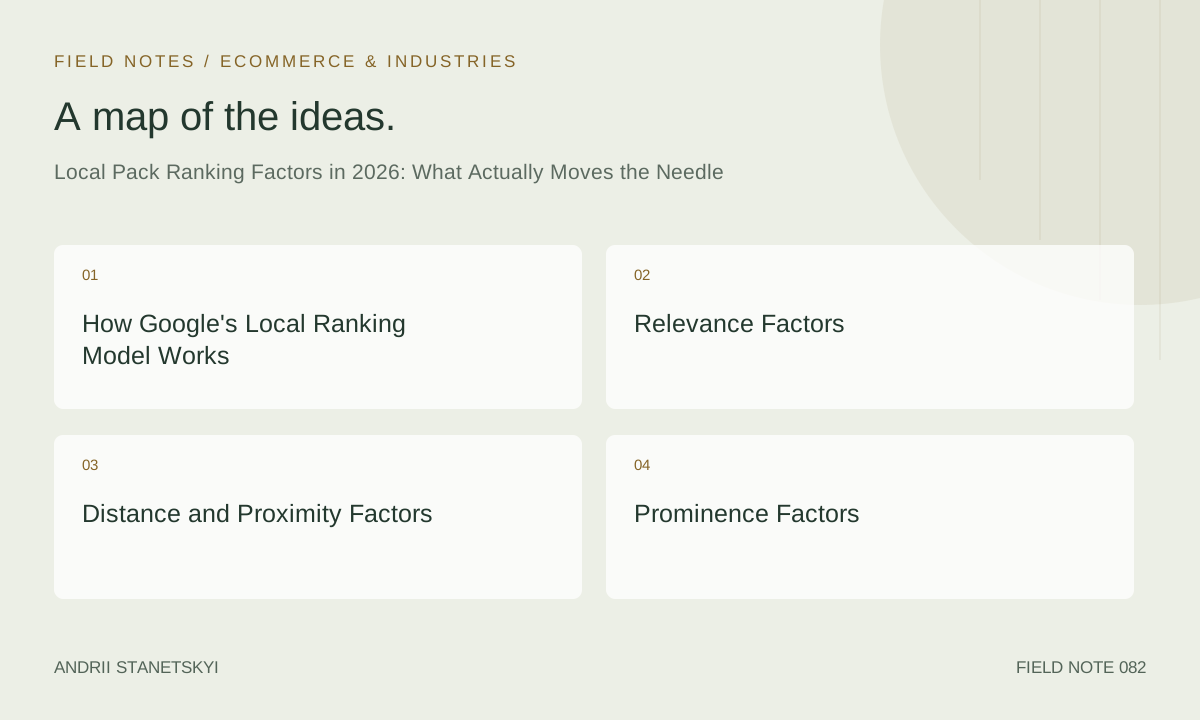
Google's local algorithm is a separate system from its organic web ranking algorithm — they share some signals but operate independently. The local algorithm scores businesses across three axes: Relevance (does this business match what the searcher wants?), Distance (how far is this business from the searcher or the searched location?), and Prominence (how well-known and trusted is this business online and offline?).
Critically, these three factors do not have equal weight in all situations. For queries with explicit location modifiers ("plumber in Austin TX"), distance is deprioritized relative to relevance and prominence. For implicit local intent queries without location ("plumber near me"), distance dominates. Understanding this interaction is prerequisite to prioritizing your optimization effort correctly.
Google confirmed in 2023 (and the mechanism has not changed) that proximity to the searcher — not the searched location — is used for "near me" queries. This means your local pack position will differ depending on where the searcher is physically located, not just which city they type.
Relevance Factors
1. GBP Primary Category
The highest-weight single field in the local algorithm. A mismatched primary category (e.g., "General Contractor" when you should be "Roofing Contractor" for roofing queries) will underperform regardless of review count or citation strength. Audit competitor primary categories using GMB Everywhere or Pleper before optimizing your own.
2. GBP Secondary Categories
Secondary categories expand the query set your profile is eligible for. A dental practice using "Dentist" as primary with "Cosmetic Dentist," "Pediatric Dentist," and "Oral Surgeon" as secondaries has broader relevance coverage than a profile with a single category. There is no confirmed penalty for adding irrelevant secondary categories, but the relevance signal is diluted — only add categories that genuinely describe your services.
3. Keyword Presence in Business Name
This remains a significant relevance signal even in 2026. A business named "Chicago Deep Dish Pizza" outranks "Giordano's" for "deep dish pizza Chicago" in controlled tests, all else equal. This is why spam — keyword injection into business names — works and persists. The ethical approach: if your legitimate business name includes a natural service keyword, you benefit. Do not manufacture it.
4. GBP Services and Service Descriptions
Services added to GBP with keyword-rich descriptions contribute to relevance matching. Google explicitly states it uses all available business information to match searches. A plumbing business that lists "emergency drain unclogging," "water heater installation," and "sewer line replacement" as individual services with descriptions ranks for those specific service queries more effectively than a business with just "Plumbing Services" in its description.
Distance and Proximity Factors
5. Physical Address Proximity
For storefront businesses, physical address location is the primary distance signal. Businesses located in the city center consistently outrank suburban competitors for city-wide queries. This is not an optimization — it's a fixed business decision. However, it explains why agencies advise clients to use a co-working space or virtual office address in the target city. This is a gray-area practice that Google has cracked down on; virtual offices must be verifiably staffed during business hours.
6. Service Area Configuration
For service-area businesses (SABs), configuring service areas at the city and zip code level helps Google understand geographic coverage. SABs are inherently disadvantaged on the distance factor versus storefront businesses because they have no visible address to anchor proximity calculations. Compensating with strong relevance and prominence signals is the only reliable strategy.
Prominence Factors
7. Review Count and Rating
Covered in depth in the review signals section below. Summary: review count has a higher weight than average rating for prominence, but rating acts as a conversion filter at the user level. A 4.2-star business with 300 reviews will often outrank a 4.9-star business with 12 reviews.
8. Citation Volume and Consistency
NAP (Name, Address, Phone) citations across the web remain a prominence signal, though their relative weight has declined as Google's entity understanding has improved. The key metric is not raw citation volume but citation consistency. A single NAP inconsistency on a high-authority directory (Yelp, BBB, YP) can create entity confusion that suppresses local pack performance. See our full guide on NAP citations in 2026.
9. Link Authority of the Business's Website
Traditional domain authority — measured by referring domain count and quality — is a local prominence signal. Businesses with stronger web presence (more editorial links) have higher prominence scores. This is why local SEO is not isolated from traditional link building. A business with 50 quality referring domains will outrank an equivalent business with 5, assuming other local signals are comparable.
10. Organic Ranking Position for Local Keywords
There is a confirmed correlation between ranking organically in the top 10 for a local keyword and appearing in the local pack for the same keyword. Google treats organic web authority and local prominence as related signals. This creates a flywheel effect: strong content + links boost organic rankings, which reinforces local pack visibility.
Behavioral Signals
11. Click-Through Rate from Local Pack
Google measures which listings users click in the local pack and factors this into ranking adjustments. Higher CTR (driven by review rating display, photo quality, and relevance of business name) correlates with improved pack position over time. This is a self-reinforcing signal: better rankings drive more clicks, which reinforce rankings. Invest in elements visible in the pack snippet — rating, review count, primary photo, hours, and whether the business is currently open.
12. Direction Requests and Phone Calls from GBP
User actions taken directly from GBP — direction requests, phone calls, website clicks — are behavioral signals that confirm the listing is satisfying user intent. High action rates relative to impressions signal to Google that the listing is meeting searcher needs. This is why conversion optimization within the knowledge panel (compelling photos, accurate hours, easy phone tap) is simultaneously a UX and ranking strategy.
13. Check-ins and Branded Searches
Branded search volume — users searching your business name directly — is a prominence signal indicating offline brand recognition. Businesses with higher branded search volumes tend to rank better in local pack, even controlling for review count and citation volume. This reinforces the argument that offline marketing (billboards, local radio, community sponsorships) has measurable local SEO value.
Review Signals Breakdown
Reviews deserve their own section because they are among the most actionable prominence signals and the most misunderstood.
| Signal | Factor Type | Ranking Impact | Actionability | Notes |
|---|---|---|---|---|
| Total review count | Prominence | High | High | Most important review metric |
| Average star rating | Prominence + UX | Medium | Medium | Acts as CTR filter; impacts conversion more than rank |
| Review velocity (recent volume) | Prominence | Medium-High | High | Sustained acquisition beats review bursts |
| Keyword mentions in reviews | Relevance | Medium | Low (indirect) | Google NLP extracts service topics from review text |
| Owner response rate | Prominence | Low-Medium | High | Confirmed by Google; easier win |
| Third-party review scores (Yelp, Tripadvisor) | Prominence | Low | Medium | Pulled into Knowledge Panel on some verticals |
Link Signals for Local
14. Local Link Building
Not all links are equal for local SEO. Links from locally relevant domains — city news sites, local business directories, chamber of commerce pages, local blogs — carry disproportionate local prominence value versus generic national links. A link from the Chicago Tribune's local news section is worth more for a Chicago business's local pack ranking than a generic DA 50 link from a national industry blog.
Effective local link acquisition strategies: sponsoring local events and charities (always get the website link), press releases to local journalists, local scholarship programs, and partnerships with complementary local businesses for cross-referral links.
15. Unstructured Citation Mentions
Beyond formal NAP citations, Google extracts entity mentions from unstructured web content — news articles, blog posts, forum discussions. A local business mentioned (even without a link) in a credible local publication adds to its prominence score. This is why PR and content marketing have tangible local SEO value beyond brand awareness.
On-Page and Website Signals
Your GBP profile and your website are distinct ranking inputs that must align. Key on-page signals for local:
- LocalBusiness schema: Consistent with GBP NAP; includes geo coordinates, opening hours, and
sameAslinks to your GBP and directories. - Location pages: For multi-location businesses, individual city/location pages with unique content perform significantly better than duplicate location pages. See our multi-location SEO guide.
- NAP in page footer: Text-based (not image-based) NAP in the site footer ensures crawlability and consistency checking against GBP.
- Local content relevance: Pages that mention local neighborhoods, landmarks, service areas, and local events strengthen geographic relevance signals.
- Core Web Vitals: Page experience signals affect organic rankings which correlate with local pack presence. LCP under 2.5s, INP under 200ms, CLS under 0.1.
{
  "@context": "https://schema.org",
  "@type": "LocalBusiness",
  "name": "Austin Roofing Pros",
  "@id": "https://www.austinroofingpros.com/#business",
  "url": "https://www.austinroofingpros.com",
  "telephone": "+1-512-555-0294",
  "address": {
    "@type": "PostalAddress",
    "streetAddress": "800 Barton Springs Rd",
    "addressLocality": "Austin",
    "addressRegion": "TX",
    "postalCode": "78704",
    "addressCountry": "US"
  },
  "geo": {
    "@type": "GeoCoordinates",
    "latitude": 30.2582,
    "longitude": -97.7628
  },
  "aggregateRating": {
    "@type": "AggregateRating",
    "ratingValue": "4.8",
    "reviewCount": "312"
  },
  "sameAs": [
    "https://www.google.com/maps/place/?q=place_id:ChIJYOUR_PLACE_ID",
    "https://www.yelp.com/biz/austin-roofing-pros"
  ]
}
FAQ
What is the single most impactful thing I can do to improve local pack rankings?
If you have to pick one: fix your primary GBP category if it's wrong. If it's already correct, run a review acquisition campaign. These two actions have the fastest and most consistent impact on local pack position of any optimization activity.
Do social media profiles affect local pack rankings?
Indirectly. Social media profiles can be listed in the sameAs schema property to strengthen entity consolidation. Social signals themselves (likes, shares) are not confirmed local ranking factors. However, social media drives branded searches and brand awareness — both of which contribute to prominence signals.
How much does website authority matter for local pack vs. just GBP?
Significant but secondary. You can rank in the local pack with a weak website if your GBP signals (category, reviews, citations) are strong enough. However, competitive markets require strong website authority to push into the top three. Think of GBP as the floor and website authority as the ceiling.
Do spam tactics like keyword-stuffed business names still work in 2026?
Yes, in many markets, but with diminishing reliability. Google's spam detection has improved significantly through 2025-2026, including expanded crowdsourced spam reporting and algorithmic detection. The risk of a listing suspension outweighs the ranking benefit in most competitive markets. Report competitor spam through the GBP redressal form — Google acts on these more consistently than in previous years.
How long does it take to see results from local pack optimization?
Category and NAP changes can reflect within days to two weeks. Review acquisition campaigns show ranking impact within 30-90 days, depending on starting position and competitive gap. Link building for local prominence takes 3-6 months to compound. Set realistic expectations: local SEO is not PPC. Budget for a 90-day measurement window before evaluating campaign effectiveness.
Is there a confirmed algorithm update cadence for local search?
Google runs local search algorithm updates continuously, with major "broad core" updates that affect local results typically 3-4 times per year. Google does not announce local-specific updates separately from core updates. Monitor local rankings around known core update dates using a grid-based rank tracking tool like Local Falcon.
Key Takeaways
- Relevance, Distance, and Prominence are the three ranking axes — weight distribution shifts based on query type (explicit location vs. "near me").
- Primary GBP category is the highest-leverage single field. Audit competitors before selecting or changing it.
- Review count matters more than average rating for ranking purposes; rating affects CTR and conversion.
- Behavioral signals (clicks, calls, direction requests) are confirmed ranking inputs — GBP UX optimization is a ranking strategy.
- Local link building (locally relevant domains) has disproportionate value versus generic national links.
- Website organic authority correlates with local pack presence — local SEO and traditional SEO are not separate disciplines.
- Spam tactics work but create suspension risk; invest in sustainable signals and report competitor spam.
Conclusion
Local pack rankings in 2026 reward businesses that execute fundamentals at a consistently higher level than competitors — not those chasing algorithmic shortcuts. The factors outlined here are not speculative; they are backed by controlled tests, correlation studies, and Google's own documentation. Prioritize category accuracy, review acquisition, and behavioral signal optimization first. Build local link authority and citation consistency second. And always measure at the grid level — point-based rank checks will mislead you.