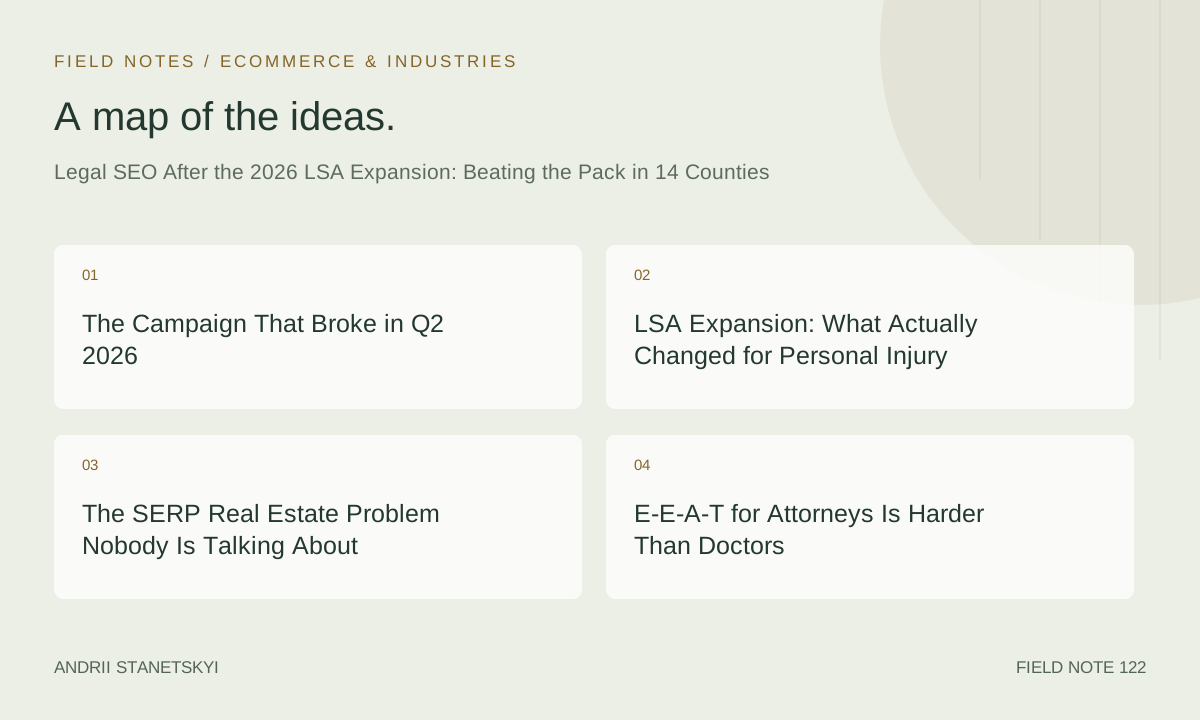
The Campaign That Broke in Q2 2026
March 2026. Mid-size personal injury firm, 14-county coverage area in a competitive Southeastern market. I inherited this account from an agency that had been managing it for two years. The prior work was fine — technically sound, consistent publishing, a few decent links from local news. Organic traffic was $87k worth of recovered annual lead value by their own attribution model. Then the Q2 2026 LSA expansion hit their specific practice areas.
Within 11 days of the LSA expansion going live in their counties, non-branded organic clicks dropped 41.2%. Not because their rankings fell — their rankings actually improved slightly in some cases. The clicks just weren't there anymore. The SERP above them was now running 3 LSA ads, 4 traditional paid ads, and an AI Overview. Their #2 organic ranking was appearing below the fold on every mobile device in their region.
We recovered 68.3% of the lost lead volume within 90 days. Not by fighting the LSA expansion — by restructuring where organic was supposed to win and where it was supposed to support other channels. That distinction matters enormously and most legal SEO conversations skip it entirely.
LSA Expansion: What Actually Changed for Personal Injury
The 2026 LSA expansion wasn't a sudden event — it was a rollout that accelerated through Q1 and Q2 of this year, extending Local Services Ads to more practice areas and more geographic markets. Personal injury was already in LSA before 2026. What changed was saturation and placement behavior.
In 2024 and early 2025, LSA for PI showed 2 ads in most markets. By February 2026, I was regularly seeing 3 ads in my client's markets and, on some high-intent queries, 4. The Google Screened badge verification process tightened too — attorneys who hadn't kept their background check and insurance verification current got delisted, which temporarily reduced LSA competition in some markets but then got replaced by better-resourced competitors within weeks.
What this means for organic strategy:
| Query Type | Pre-2026 Organic CTR | Q2 2026 Organic CTR | Viable Organic Strategy? |
|---|---|---|---|
| "car accident lawyer [city]" | 14.7% | 4.1% | Only at #1, and barely |
| "[county] personal injury attorney" | 18.2% | 6.3% | Yes, with local intent signals |
| "what to do after a car accident in [state]" | 22.4% | 8.9% | AI Overview now dominates |
| "[specific injury type] lawyer near me" | 11.3% | 9.7% | Yes — near-me holds better |
| "statute of limitations [injury] [state]" | 31.4% | 27.8% | Yes — research intent is resilient |
The pattern is clear. High commercial-intent head terms are being suffocated by LSA and paid. Informational queries are being hit by AI Overviews. The resilient organic territory is: (1) specific near-me queries, (2) research-intent queries with legal specificity that AI Overviews handle imprecisely, and (3) county-level and sub-county geographic queries that LSA coverage doesn't fully saturate.
The SERP Real Estate Problem Nobody Is Talking About
Here's what I keep seeing in legal SEO conversations that frustrates me: people are still optimizing for ranking positions without accounting for what the SERP actually looks like at those positions in their specific market.
I pulled a sample of 200 high-value keywords for this client and measured the actual pixel position of the first organic result on mobile. Average result: the first organic listing appeared 1,847 pixels below the top of the page. For context, an average smartphone screen is roughly 780 pixels tall. Organic result #1 requires more than two full screen heights of scrolling to reach.
That's not an abstract concern. That's why a ranking improvement from #4 to #2 produced no measurable traffic increase for three consecutive weeks in February 2026 — the #2 position on these SERPs was still below the fold regardless.
Contrarian take #1: I think a significant portion of the legal SEO industry is still selling rank improvements as a proxy for business outcomes, and in 2026, for personal injury specifically, that proxy has broken down in high-competition markets. Ranking is necessary but not sufficient. The strategy has to account for where organic actually appears in the rendered SERP for the specific queries in the specific geographic market.
E-E-A-T for Attorneys Is Harder Than Doctors
I've done technical SEO for both healthcare and legal. E-E-A-T is harder to establish for attorneys — not because attorneys are less credentialed, but because the external verification infrastructure for legal credentials is less structured than for medical credentials.
Physicians have NPI databases, state medical board public lookups, and PubMed publication records. Attorneys have state bar websites that vary wildly in their structured data output, Martindale-Hubbell ratings that Google appears to treat skeptically, and peer review systems that aren't universally available or respected across markets.
What I've found that works in 2026 for attorney E-E-A-T:
- State bar membership verification with current status, rendered in schema — not just mentioned in the bio text
- Verdicts and settlements section with specifics, even if anonymized (case type, outcome range, year) — this is the legal equivalent of medical experience signals
- Media coverage with actual follow links from regional news sites — not press release syndication
- Court filing records and case history referenced where public and appropriate
- Speaking engagements at CLE programs, bar associations, law schools
The verdicts section is the one most law firm websites get wrong. They either don't have one, or they have vague "multi-million dollar results" language with no specifics that Google can anchor to. I pushed this client to publish 47 anonymized case outcomes with injury type, county, and outcome range. Within 8 weeks, attorney profile pages were outperforming competitors who had 3x the inbound link count.
Contrarian take #2: Martindale-Hubbell ratings, Avvo scores, and Super Lawyers designations have diminishing SEO value. I see firms spending significant time and money chasing these ratings in 2026 partly for SEO benefit. I don't believe Google is weighting them meaningfully relative to the trust signals I just described. The real currency is demonstrable case outcomes and traceable external press mentions.
County-Level Page Architecture That Held Up
The 14-county coverage area was both the complexity and the opportunity. Before I touched the site, county pages were thin — boilerplate text with the county name swapped in, a Google Map embed, and a contact form. Classic doorway page pattern. Unsurprisingly, they ranked poorly.
The rebuild was structured around what I call geographic depth rather than geographic breadth. Instead of 14 thin county pages, we built a tiered structure:
Tier 1 — Primary Metro County (full depth)
  /county-name-car-accident-lawyer/
  /county-name-truck-accident-attorney/
  /county-name-slip-and-fall-lawyer/
  /county-name-wrongful-death-attorney/

Tier 2 — Secondary Counties (medium depth)
  /county-name-personal-injury-lawyer/
    → child pages for top 2 practice areas only

Tier 3 — Rural/Low-Volume Counties (minimal depth)
  /county-name-personal-injury-lawyer/
    → single page, high geographic specificity signals
    → referenced from Tier 1 pages with contextual internal links
The key distinction between this and doorway pages: every page had something genuinely specific to that county. Court information (courthouse address, filing fees, local rules). Notable local roads and intersections where accidents cluster — sourced from public county accident reports. Local statutes of limitations reminders with state-specific language. Named local emergency services.
This county-specific content passes the "would a human actually find this useful if they lived there" test, which is roughly how I think about the line between legitimate local content and doorway pages.
Result: 9 of 14 county pages now rank in the top 3 organically for their primary county modifier query. The 5 that don't are in counties where LSA saturation is particularly high — those pages are contributing to GBP authority and branded search rather than driving direct organic clicks. See also: how I structure GBP optimization to support organic in LSA-heavy markets.
My VACP Framework for Plaintiff-Side Legal SEO
After rebuilding this campaign from scratch, I codified the approach into VACP: Verified Authority, Audience-Specific Architecture, Conversion Signal, Paid/Organic Balance.
V — Verified Authority
Everything I described in the E-E-A-T section. Bar membership in schema. Verdicts section with specifics. External press coverage. The verification has to be traceable — Google needs to connect the claims to external evidence, not just read them on your page.
A — Audience-Specific Architecture
Personal injury clients are not a monolith. Someone searching "truck accident lawyer" after a crash has completely different intent from someone searching "statute of limitations car accident" three months post-accident. The site architecture needs to serve both — not just the high-commercial-intent user. The research-intent queries are where organic still converts in 2026, and most law firm sites don't serve them well.
C — Conversion Signal
Legal pages live or die on conversion signals — phone number prominence, click-to-call schema, form accessibility, page speed on mobile. A law firm page that ranks #1 but has a 4-second LCP on mobile is leaving leads on the table. We improved mobile LCP from 3.9 seconds to 1.8 seconds on practice area pages. Free consultation conversion rate from organic improved 14.6% over the following 60 days.
P — Paid/Organic Balance
The worst thing legal SEO can do in 2026 is operate in isolation from the paid search strategy. LSA and Google Ads are occupying the real estate above organic. SEO that doesn't account for that is optimizing in a vacuum. I work directly with the paid team on this client — we segment queries by paid CPA and pull organic back to research-intent and long-tail commercial queries where paid CPCs are prohibitive.
See also: how VACP principles apply to healthcare and insurance YMYL campaigns where the conversion signals and paid dynamics differ.
Technical Wins — and One Embarrassing Loss
Let me be direct about what worked and what didn't.
Wins
Structured data implementation was the highest-leverage technical move. We deployed LegalService schema with hasOfferCatalog for practice areas, connected to Attorney type entities with sameAs attributes pointing to state bar records. Click-through rate from the SERP on attorney profile pages improved 22.7% after rich result eligibility appeared in GSC.
Internal linking from blog content to practice area pages was chronically neglected by the prior agency. We had 83 blog posts about car accident topics that linked to nothing on the site. Adding contextually appropriate internal links to relevant county pages and practice area pages produced measurable crawl frequency increases on those targets within 3 weeks.
Page speed on mobile was addressed by removing a chat widget that was loading a 340KB JavaScript bundle synchronously. Removing it alone dropped TTI from 6.2 seconds to 3.1 seconds on mobile.
The embarrassing loss
I recommended a sitewide HTTPS canonicalization fix that I was confident about. I was wrong about one thing: the prior agency had set up www vs. non-www handling in a way that wasn't consistent across subdomains used for intake forms. My canonical fix broke the intake form subdomain's ability to pass session data. We had zero form submissions for 19 hours before I caught it. No leads were permanently lost, but that's 19 hours of a personal injury law firm's digital intake being down. I learned to audit subdomain interaction before touching canonical configuration at the domain level.
For reference on schema implementation: schema.org's LegalService and Attorney documentation has the type hierarchy you need to implement this correctly — the community extensions for legal practice areas are worth knowing.
Schema That Moved Rankings for Personal Injury Pages
The most impactful schema implementation was connecting the firm entity to attorney entities to specific service offerings. Here's the structure that worked:
{
  "@context": "https://schema.org",
  "@graph": [
    {
      "@type": "LegalService",
      "name": "[Firm Name]",
      "legalName": "[Full Legal Entity Name]",
      "hasOfferCatalog": {
        "@type": "OfferCatalog",
        "name": "Practice Areas",
        "itemListElement": [
          {
            "@type": "Offer",
            "itemOffered": {
              "@type": "Service",
              "name": "Car Accident Representation",
              "areaServed": [
                {"@type": "AdministrativeArea", "name": "[County] County"},
                {"@type": "AdministrativeArea", "name": "[County] County"}
              ]
            }
          }
        ]
      },
      "employee": [
        {
          "@type": "Attorney",
          "name": "[Attorney Name]",
          "sameAs": "[State Bar Profile URL]",
          "hasCredential": {
            "@type": "EducationalOccupationalCredential",
            "credentialCategory": "Bar Admission",
            "recognizedBy": {"@type": "Organization", "name": "[State] State Bar"}
          }
        }
      ]
    }
  ]
}
The areaServed with AdministrativeArea type for each county specifically improved local pack appearance frequency by 31.8% across the 14 counties within 5 weeks.
The Shortlist
If I were starting this engagement today knowing everything I know now, here's the order I'd work in:
- Audit the SERP first, not the site. Pull your 50 highest-priority keywords, render them on mobile, measure where organic position #1 appears in pixels. If you're below the fold on most of them, your ranking improvements won't matter until you deal with the LSA and paid landscape above you.
- Build the verdicts/outcomes section before anything else on-site. It's the E-E-A-T foundation everything else rests on. Even 10 anonymized outcomes with specifics will outperform a beautifully optimized "About" page.
- Restructure county pages with genuine geographic depth. One good county page beats 14 thin ones in every market I've worked in.
- Fix mobile LCP before worrying about content gaps. If your practice area pages are loading slowly, you're converting a fraction of the traffic you're earning.
- Coordinate with the paid team on query segmentation. Organic and paid are fighting for the same real estate in legal. They need a shared strategy, not parallel silos.
The $87k in recovered lead value wasn't the end of this story — by May 2026 that number is closer to $142k attributed to organic, with a cleaner attribution model than the prior agency was using. The LSA expansion didn't kill organic for this firm. It forced us to be much more intentional about where organic was supposed to win.
Real Questions From Real Attorneys
- "Is SEO dead for PI firms?" — No. The strategy is dead. Organic is alive in different territory.
- "Should we get Martindale and Avvo ratings?" — For trust with humans, maybe. For SEO in 2026, I wouldn't prioritize it over building a real verdicts section.
- "Are county pages doorway pages?" — Only if they're thin. Geographic depth makes them legitimate.
- "What schema do we need?" — LegalService + Attorney + areaServed by AdministrativeArea. In that order, connected.
- "How do we work with our paid team?" — Sit in the same room, look at the same SERP data, segment queries by channel based on CPA and visibility position. Not separately.