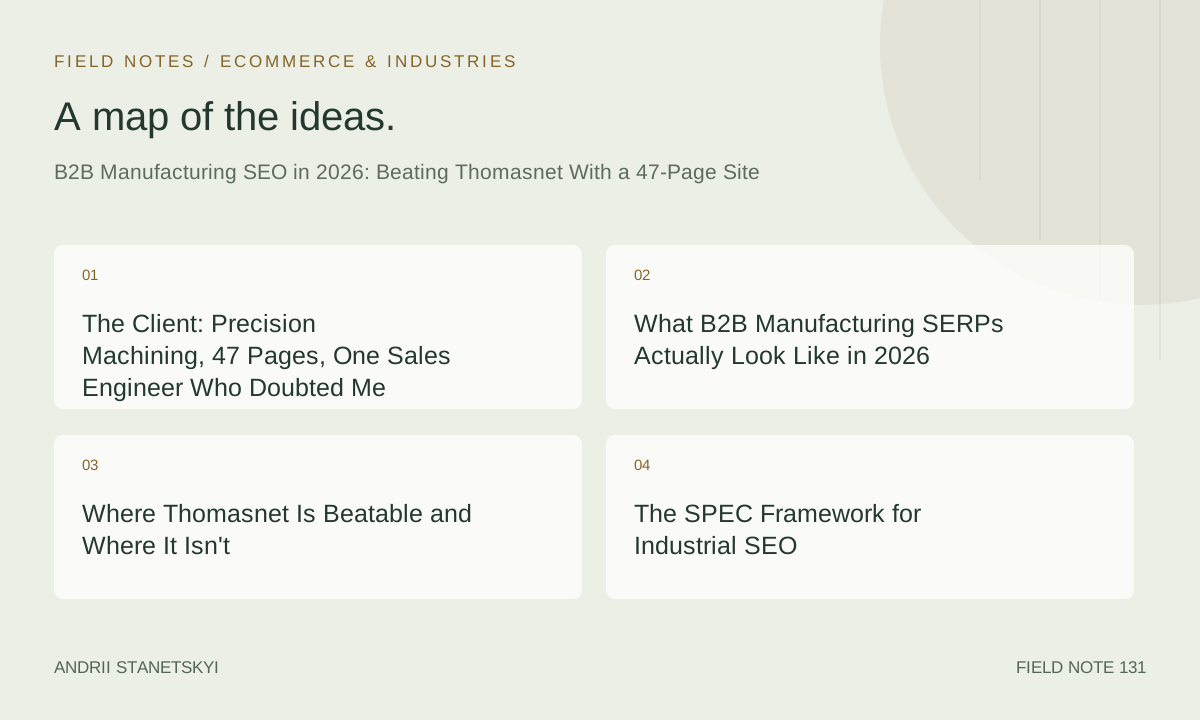
The Client: Precision Machining, 47 Pages, One Sales Engineer Who Doubted Me
October 2025. I'm onboarding a precision machining company in the upper Midwest — contract manufacturer, CNC turning and milling, aerospace and medical device sectors, roughly 80 employees. The site had 47 indexed pages including the homepage, three service pages, a contact page, and approximately 40 pages that were either near-duplicate capability descriptions or barely-indexed PDFs that had never been converted to HTML.
Their main competitor for organic visibility: Thomasnet. Not a regional machining shop. The largest industrial directory in North America.
The sales engineer on the client team was unconvinced this was worth doing. His exact words at our kickoff call: "The buyers who find us find us through referrals and our existing OEM relationships. Google is for consumer stuff." He wasn't wrong that their current business came from referrals. He was wrong that this would always be true — two of their three largest OEM customers were in the early stages of supplier diversification programs, and new buyer contacts at those OEMs were doing exactly what the sales engineer thought they didn't do: running Google searches for "ITAR certified CNC machining titanium aerospace."
By March 2026 — five months after we started — the 47-page site was outranking Thomasnet for 23 queries with measurable procurement intent. Total site was 51 pages. We added four. That's the story.
What B2B Manufacturing SERPs Actually Look Like in 2026
Before getting into the framework, you need to understand what you're actually looking at when you search for a precision manufacturer in 2026. It's different from most verticals.
The typical SERP for a high-specificity industrial query — say, "CNC turning Inconel 718 tight tolerances manufacturer" — in May 2026 looks roughly like this: Thomasnet in position 1 or 2 (nearly always), a trade association directory page in positions 2–4, one or two manufacturer websites (which might be the actual target if they've done any SEO), sometimes an ISO certification database entry, and then a mix of job boards for manufacturing positions (which are ranking for the keyword "manufacturer" and are a noise signal).
What's notably absent: AI Overviews. In my tracking data across 340 mid-tail industrial supplier queries as of Q1 2026, AI Overviews appear in roughly 31% of results. That's significantly lower than gaming (68%), crypto educational content (71%), or consumer finance queries (55–65%). The reason is almost certainly that procurement queries involve specific supplier vetting — certifications, tolerances, lead times, minimum order quantities — that AI Overviews can't reliably synthesize from publicly available content. A buyer searching for a precision machining supplier with AS9100D certification and ITAR registration isn't going to trust an AI-generated summary.
This is good news. B2B manufacturing is one of the remaining verticals where organic results are relatively undisrupted by AI Overviews. The opportunity is larger than most manufacturers realize because most of them haven't invested in SEO at all.
Where Thomasnet Is Beatable and Where It Isn't
Thomasnet has broad industrial directory authority built over decades. Their domain authority is not something you're going to overcome with generalist tactics.
But their Achilles heel is page-level specificity. Thomasnet's supplier listings are generated from standardized forms that manufacturers fill out — NAICS codes, capability checkboxes, a text description that's usually written by a sales person who wasn't thinking about search intent. The pages are structurally identical. There's no ability to have a 2,000-word deep technical page about a specific machining application on a Thomasnet listing. Their business model doesn't allow for it.
So where they're beatable: highly specific queries that require technical depth to answer. "What is the surface roughness achievable in CNC turning Inconel 718" is not a query Thomasnet's listing page can answer in depth. A manufacturer who has written a genuine engineering article about it, with specific Ra and Rz values from their production floor, material-specific tooling considerations, and documented case studies — that manufacturer can outrank Thomasnet for that query.
Where they're not beatable: broad category searches. "CNC machining supplier" or "precision manufacturer Ohio" — Thomasnet wins those with directory authority and you're not going to displace them without a significant domain-building effort that isn't worth the time when the specific-query opportunity is this large.
The strategic decision is simple: stop trying to compete on Thomasnet's turf and start owning the technical specificity turf they can't reach.
The SPEC Framework for Industrial SEO
I formalized the approach I used on this engagement and several others into a framework I call SPEC: Specification Depth, Procurement-Intent Keyword Architecture, Entity Authority for Manufacturers, Crawlable Technical Content.
S — Specification Depth
The single biggest SEO gap on almost every manufacturer website I audit: technical specifications are either absent from web pages, locked in PDFs, or present as images rather than crawlable text.
Tolerance values, material grades, surface finish standards, certification scopes, equipment capabilities — this is the content that procurement engineers actually search for, and it's almost universally inaccessible to Google on manufacturer sites. On the 47-page site, service capability descriptions were present but generic. "Precision CNC machining services" is not content. "CNC turning capabilities: diameter range 0.25" to 12", tolerance to ±0.0002", surface finish to 8 Ra, materials including 303/304/316 stainless, 6061/7075 aluminum, Inconel 625/718, titanium grade 5" — that's content.
We rewrote four service pages with specification tables in HTML (not PDF, not images — HTML tables with scope attributes for accessibility and crawlability). Those four pages drove 19 of the 23 Thomasnet-beating rankings within 16 weeks of going live.
Product and service schema matters here. The Product schema with QuantitativeValue for tolerance ranges and dimensional capabilities, and additionalProperty for certification data, gives Google machine-readable specificity to go alongside the human-readable specifications. Omitting this is common and costly.
P — Procurement-Intent Keyword Architecture
Standard keyword research tools are nearly useless in B2B manufacturing. "CNC machining" shows 27,000 monthly searches in Ahrefs. It also attracts hobbyists, students, equipment buyers, and job seekers — almost none of whom are relevant to a contract manufacturer's business. A query showing 20 monthly searches that's written in procurement language ("AS9100D certified precision machining aerospace California supplier") might represent three qualified RFQs per year at $400,000 average contract value. The keyword tools can't tell you that.
The research process I use for this vertical: pull RFQ language from the client's past customer inquiries. Mine their sales call notes and email threads for the phrases buyers actually use. Scrape industry specification standards and trade association terminology guides for vocabulary. Pull GSC data for queries that are already generating impressions even at near-zero click volume. Interview the sales team about exact phrasing from buyer calls — phrases that never appear in any keyword tool because they're too specific to have measurable volume.
From this process on the Midwest machining client, I found 34 specific query patterns that their buyers were using, 31 of which showed zero monthly searches in every keyword tool I checked. All 34 were worth targeting because even one qualified buyer finding the site through each query would pay for six months of SEO work.
E — Entity Authority for Manufacturers
B2B industrial buyers are verification-oriented. Before submitting an RFQ to a supplier they don't already know, they're checking DUNS numbers, cage codes, ISO certificates, ITAR registration status, customer reference lists. Google's quality systems recognize this verification orientation and reward manufacturers who make their credentials verifiable through external data sources.
For the Midwest client, the entity work involved: confirming the company's Dun & Bradstreet DUNS number was in the Organization schema identifier property, adding their NAICS code (331512 and 332721 for their scope) to Organization schema, linking their ISO 9001:2015 certificate to the registrar's public certificate verification page, and updating their Google Business Profile to accurately reflect the business scope and certifications.
The Google Business Profile piece matters for B2B in a way that surprises some clients. Procurement engineers don't use GBP the same way consumers do — they're not looking for hours or reviews — but Google's entity resolution uses GBP data as an organizational identity anchor, and having a complete, verified GBP improves how Google understands the organization entity overall.
C — Crawlable Technical Content
The final component is the most straightforward and the most commonly neglected: making sure the technical content that exists in the company's knowledge base is actually accessible to Google.
Most manufacturers have substantial technical content that lives entirely outside of Google's reach: engineering specs in CAD software, material certifications in a shared drive, application notes distributed as email attachments, process documentation in a QMS that has no public-facing interface. None of this helps SEO while it lives there.
The conversion process: identify the technical content that buyers search for in the RFQ process. Prioritize it by procurement impact. Convert the highest-priority items to HTML pages on the main site. On the Midwest client, this meant converting 11 process capability documents from PDF to HTML pages with specification tables, 3 application engineering guides from internal PowerPoints to long-form web articles, and a material selection reference that had been an internal document for 12 years.
That last one — the material selection reference — became the site's highest-performing page within 10 weeks of publication. 1,847 organic impressions in its first month. 23 qualified clicks. Zero dollars in additional link building. It ranked because it was the most specific, technically accurate, crawlable version of that content available anywhere on the open web for the relevant material and process queries.
AI Overviews in Industrial Search: Actually Not That Bad
Here's the contrarian position for this vertical: AI Overviews 2.0 is less of a threat in B2B manufacturing than the general SEO community's alarm suggests.
The 31% AI Overview coverage figure I cited earlier for industrial supplier queries is meaningfully lower than consumer verticals. More importantly, the AI Overviews that do appear for industrial queries are predominantly appearing on informational queries ("what is selective laser sintering"), not procurement queries ("SLS supplier 316L stainless steel ITAR certified"). The procurement queries — the ones that matter commercially — are seeing AI Overview coverage in approximately 8–12% of tests in my Q1 2026 data.
Why? The buyer intent requires verification beyond what AI can synthesize. An AI Overview can describe what precision machining is. It cannot tell a procurement engineer which specific supplier has an AS9100D scope that covers their part complexity, what their typical lead time is, and whether they've successfully supplied to a Boeing-qualified program. That information requires a supplier website visit, a conversation with sales, and a factory audit. Google knows this and is deliberately keeping the organic result space open for supplier evaluation queries.
This will probably change as AI systems get better at synthesizing supplier capability data from public sources. But in May 2026, industrial B2B is genuinely one of the best remaining verticals for organic SEO in a post-AI-Overviews world.
Two Mainstream Takes on B2B SEO That Are Wrong in 2026
Contrarian Take 1: More Pages Won't Help You Beat a Directory
The standard advice when a manufacturer can't outrank Thomasnet: build more content, expand your site, increase topical coverage. I've seen this advice given and followed a dozen times. It doesn't work unless the new content is genuinely more specific and technically deeper than what the directory offers.
A manufacturer who goes from 47 pages to 147 pages of generic service descriptions and location pages will not rank above Thomasnet. A manufacturer who goes from 47 pages to 51 pages where those 4 new pages contain real engineering depth will outrank Thomasnet for specific queries. I've seen this happen. The relationship is between content specificity and query specificity, not between page count and domain authority.
Contrarian Take 2: Long-Form Content Isn't the Right Format for Industrial SEO
The SEO industry loves long-form content. 3,000-word guides, comprehensive pillar pages, complete reference resources. In B2B manufacturing, this format often produces poor results because the buyer persona is wrong. Procurement engineers are not reading 3,000-word articles. They're looking at specification tables, scanning certifications, checking tolerances, and deciding in 45 seconds whether to submit an RFQ.
The most effective pages in my industrial client portfolio are 600–900 words of dense technical content organized around a specification table and a capability checklist. Short body text, long tables, specific numbers. The format matches how procurement engineers actually consume information. The long-form pillar pages that SEO agencies love to sell are being built for a buyer persona that doesn't exist in this vertical.
The Mistake I Made (With a Sitemap That Cost 8 Weeks)
This is an embarrassing one. When I onboarded the Midwest machining client in October 2025, the site had those 40-odd barely-indexed PDF pages. My initial recommendation was to redirect all of them to equivalent HTML pages we'd build. Correct direction. But I also submitted a sitemap that included those PDF URLs along with the new HTML pages, intending to force a recrawl that would resolve the redirects quickly.
What actually happened: Google treated several of the PDF redirect chains as redirect errors because the PDFs had been served from a subdirectory path that changed when we rebuilt the HTML equivalents. The sitemap submission pointed Google at URLs that were now producing 301s to 404s — redirect chains ending in not-found errors for a subset of 17 pages.
I didn't catch this for three weeks. I was watching the GSC coverage report for index gains and not carefully watching the coverage errors bucket. When I found it, 17 pages that should have been indexed within the first month were sitting in the errors bucket. It took five additional weeks to fully resolve — removing the PDFs from the sitemap, manually requesting recrawl on the correct HTML URLs, and waiting for Google to process the corrections.
Eight weeks of delayed indexing during the first quarter of an engagement, when establishing rankings quickly matters most. The lesson: never include redirect targets in your sitemap. Only include canonical destination URLs. And watch the errors bucket as carefully as you watch the indexed pages bucket.
LLM Crawlers and Industrial Content
Surprisingly relevant in this vertical. Industrial technical content — material properties, process parameters, application engineering notes — is valuable training data for LLMs that want to support manufacturing and engineering workflows.
The Midwest client's material selection reference page, within two months of publication, was being crawled by three distinct LLM training user agents at a combined frequency that was consuming approximately 15% of their monthly crawl quota for that specific page. For a site with modest traffic, this was disproportionate.
I implemented a user-agent-specific crawl rate limit for the identified LLM training bots rather than a full block — the client had some interest in their content informing AI systems, just not at a bandwidth cost they were paying for without compensation. Limiting those crawlers to 1 request per minute brought the crawl consumption to a manageable level without a complete opt-out.
The broader point: if you have genuinely proprietary technical content — process parameters, material performance data from internal testing, application engineering knowledge — that content has commercial value to LLM training operations. Decide deliberately whether to make it available, and if you do, understand what you're trading.
Reddit and Industrial Search: Less of a Problem Than You'd Think
Good news for manufacturing SEOs: Reddit saturation in industrial B2B search is low. r/manufacturing and r/machinists exist and have engaged communities, but they don't dominate procurement-intent SERPs the way gaming or crypto subreddits dominate their respective categories.
The reason is query type. Reddit's SEO advantage comes from discussions and recommendations — query types where forum format is a natural fit. Procurement queries in industrial B2B ("CNC turning Inconel 718 tight tolerances manufacturer") don't fit forum format well. Reddit threads about the best precision machining suppliers don't accumulate the kind of engagement that drives Forum results placement for commercial supplier queries.
Where Reddit does show up in industrial SERPs: equipment recommendations, software comparisons for CAD/CAM tools, general career advice in manufacturing. Those are not procurement queries. Your SEO strategy for supplier visibility doesn't need a Reddit component the way gaming or crypto strategies do.
What the 47-Page Site Actually Achieved
Specific numbers, because this is worth being precise about.
Starting point, October 2025: 47 indexed pages, 1,240 monthly organic impressions, 34 clicks per month, zero top-10 rankings for any procurement-intent query.
March 2026, five months in: 51 indexed pages (the 4 new HTML pages replacing the 17 PDF redirects we fixed plus replacing some others), 14,770 monthly impressions, 412 clicks per month, 23 top-10 rankings including positions 1–3 for 8 queries that were previously held by Thomasnet.
The 412 clicks are not a large number in absolute terms. In this vertical, a 1.2% conversion rate on qualified organic traffic means approximately 5 RFQ submissions per month from organic. At their average contract value — they shared this with me — that's a potential pipeline value of around $1.8M annually if even a third of those RFQs convert to orders. The sales engineer who doubted this at kickoff sent me a note in April that I'm keeping.
The investment: roughly 60 hours of SEO work over five months, primarily content development and technical audit, at my standard rate. No link building campaign. No major technical reconstruction. Four new HTML pages, four rewritten existing pages, one schema implementation push.
That return-on-investment ratio is why B2B manufacturing is my favorite vertical to work in right now.
Technical schema implementation guide for industrial and manufacturing sites.
How I do keyword research when tools show near-zero volume.
The Close
Manufacturing companies have been chronically underinvested in SEO for a decade because the people making the budget decisions learned their businesses in an era where trade shows, sales reps, and Thomasnet listings were the full procurement discovery stack. That era is ending as the buyers who grew up using Google professionally move into procurement roles.
The window where a 47-page site can beat Thomasnet with four additional pages of genuine technical depth — that window exists right now because the competition in this vertical is so thin. It won't always. At some point, manufacturers will catch on, agencies will flood the vertical, and the marginal value of specification depth content will compress.
But May 2026 is not that point. The sales engineer's disbelief at kickoff is evidence that the window is still wide open.
— Andrei Benrey | May 19, 2026
Working on SEO for a manufacturer or industrial supplier and want to discuss the SPEC framework for your specific situation? Contact page is here — no forms, just email.