The SEO community has been declaring citations dead for half a decade. Every major algorithm update brings fresh proclamations that NAP (Name, Address, Phone) citations have been devalued to the point of irrelevance. After running dozens of controlled citation tests across varied local markets, my answer is more nuanced: citations are not the ranking force they were in 2014, but they remain a necessary infrastructure layer — and inconsistent citations actively harm rankings in ways practitioners consistently underestimate.
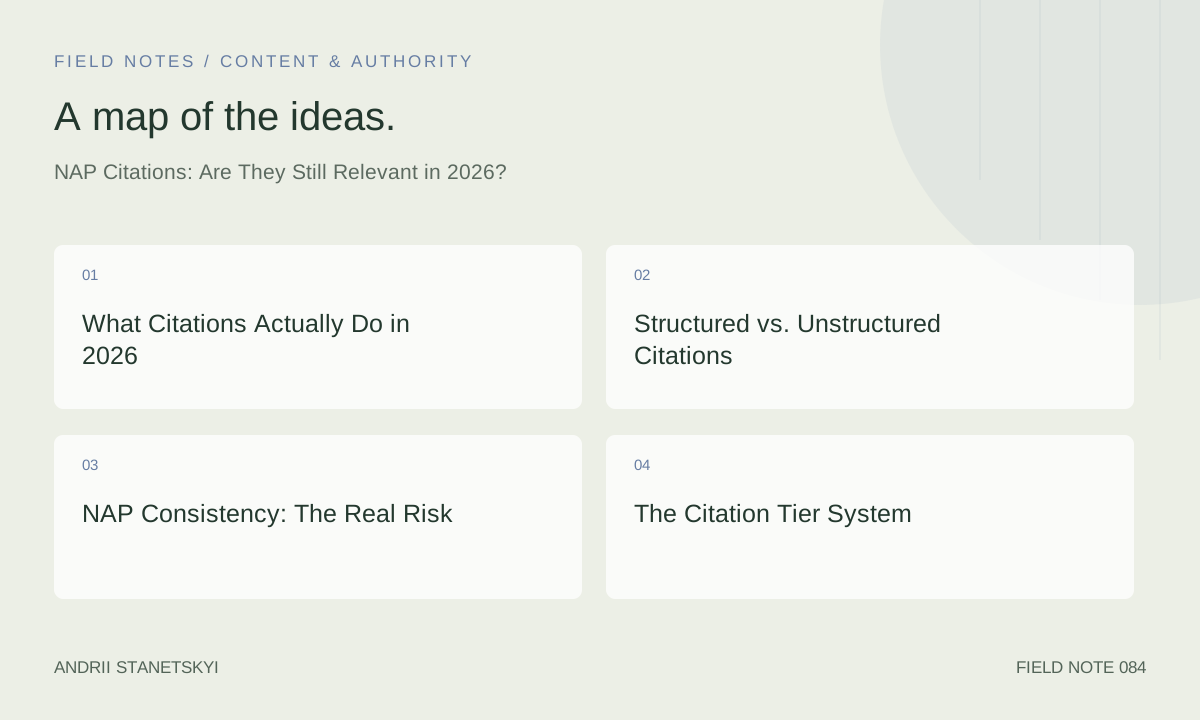
What Citations Actually Do in 2026
To understand citations' current role, you need to understand what they were originally solving. In the early 2010s, Google's Knowledge Graph was nascent, entity understanding was limited, and citations served as the primary signal for establishing a business's existence, location, and category. Google essentially triangulated business data from directory mentions to build its local database.
In 2026, Google's entity understanding is vastly more sophisticated. The Knowledge Graph ingests structured data from thousands of sources in real time, GBP itself provides direct, first-party location data, and machine learning models extract entity information from unstructured web content. The triangulation role citations once played is now largely redundant.
What remains relevant: citations serve as entity verification and disambiguation signals. When Google sees consistent NAP data across authoritative directories, it increases confidence in its entity model for that business. When it sees inconsistency, it introduces uncertainty — and uncertain entities rank conservatively. This is why citation inconsistency is a ranking suppressor even when citation volume is not a ranking accelerator.
Structured vs. Unstructured Citations
The citation landscape divides into two fundamentally different categories with distinct mechanisms and values:
| Type | Definition | Examples | Ranking Mechanism | Actionability |
|---|---|---|---|---|
| Structured | Formal directory listing with defined NAP fields | Yelp, YellowPages, BBB, Foursquare | Entity verification, prominence signal | High — directly submittable |
| Unstructured | Mention of business name/location in editorial content | News articles, blog posts, event listings | Entity recognition, prominence + relevance | Medium — earned through PR/content |
| Data aggregators | Aggregator databases that feed multiple directories | Foursquare, Data Axle, Neustar Localeze | Broad entity verification at scale | High — single submission, wide reach |
Unstructured citations have gained relative importance as Google's NLP capabilities have improved. A business mentioned in a local newspaper article about the best restaurants in the city contributes to local prominence even without a hyperlink or structured NAP data. This is increasingly how Google discovers and verifies entities in information-rich markets.
NAP Consistency: The Real Risk
This is where most practitioners still underinvest. NAP inconsistency is not a passive problem — it actively signals to Google that it cannot trust its entity model for your business. The practical consequences include: GBP profile suppression, reduced local pack frequency, and Knowledge Panel instability.
Common NAP Inconsistency Sources
- Business name variations: "Greenway Plumbing Services," "Greenway Plumbing," "Greenway Plumbing Services LLC" — treat these as different entities to Google's parser.
- Address formatting: "1420 North Milwaukee Avenue" vs. "1420 N. Milwaukee Ave" vs. "1420 N Milwaukee Ave" — abbreviation style must be consistent.
- Suite number inconsistency: Some listings include "Suite 200," others drop it entirely.
- Tracking phone numbers: Using different tracking numbers across directories creates apparent NAP inconsistency — use the same tracking number everywhere, or a local untracked number for citations and reserve tracking numbers for GBP and the website.
- Post-relocation citations: When a business moves, old address citations persist on directories that don't actively update. These are the most damaging inconsistencies.
Establishing a Canonical NAP
Before any citation work, establish a canonical NAP format in a reference document. Define exactly how the business name, street address, suite, city, state, and zip appear in every context. Use this as the master reference for all citation submissions and corrections. The canonical NAP should match the GBP listing exactly.
The Citation Tier System
Not all citations carry equal weight. A well-known mental model divides citations into tiers based on authority and impact:
Tier 1: Core Data Aggregators
Foursquare (formerly Factual), Data Axle, Neustar Localeze. These three aggregators feed hundreds of downstream directories. A correct submission to all three propagates accurate NAP data to dozens of tier-2 and tier-3 directories over 6-12 weeks. These should be the first citations built for any new business.
Tier 2: High-Authority General Directories
Google Business Profile, Apple Maps, Bing Places, Yelp, Facebook, BBB, YellowPages, Angi, HomeAdvisor (service businesses). These sites have high domain authority, high user traffic, and direct integration with search engine Knowledge Graphs. A citation from Yelp is used directly by Siri, Apple Maps, and Bing — multi-platform value beyond Google.
Tier 3: Industry-Specific Directories
Healthgrades, Zocdoc (healthcare), Avvo, FindLaw (legal), TripAdvisor, OpenTable (hospitality), Houzz (home services), G2, Clutch (B2B services). These deliver category-specific relevance signals and often drive direct traffic from high-intent users. Prioritize the top 5-10 directories in your vertical.
Tier 4: Local Directories
City-specific directories, Chamber of Commerce listings, local newspaper business directories. High local relevance, typically lower domain authority. These contribute localization signals that national directories cannot replicate.
Building Citations: Priorities and Process
For a new business or a business rebuilding its citation profile, follow this sequence:
- Fix GBP first. GBP is the citation anchor. All other citations should match GBP exactly.
- Submit to data aggregators. Foursquare, Data Axle, Neustar Localeze. Allow 6-8 weeks for propagation.
- Claim and optimize tier-2 directories. Yelp, Apple Maps, Bing Places, BBB, Facebook in that priority order. Each requires individual claiming and verification.
- Build tier-3 industry-specific citations. Identify the top 10 directories in your vertical using Whitespark's Citation Finder or a manual competitor citation audit.
- Pursue tier-4 local citations. Chamber of Commerce, local business associations, city directories. These take time to identify but deliver strong local relevance signals.
Citation Building Time Expectations
A complete citation build for a new business targeting 50-75 quality citations takes 3-6 weeks of work and 2-4 additional months for full propagation and ranking impact. Do not expect a citation blitz to generate immediate ranking changes — the mechanism is entity verification, which takes time to accumulate and be processed.
Auditing and Cleaning Existing Citations
For established businesses, the citation audit is more important than new citation building. An audit typically reveals: 20-40% of existing citations have some form of NAP inconsistency, 10-15% have outdated information (old address, disconnected phone, wrong hours), and 5-10% are outright duplicates that need to be merged or removed.
Audit Process
- Run a Whitespark or BrightLocal citation audit — these tools crawl hundreds of directories and compare found NAP to your canonical NAP.
- Export all found citations, sort by authority (domain rating), and prioritize corrections.
- For each inconsistent citation: claim the listing if possible and update directly. If the directory doesn't allow claiming, use their submission form or contact support.
- For duplicate listings: request merges through each directory's support channel. Google's GBP duplicate merging process is documented in their help center.
- Document all corrections with dates and expected resolution timelines.
Tools: BrightLocal vs. Whitespark vs. Yext
| Tool | Citation Discovery | Citation Building | Ongoing Management | Best For | Cost |
|---|---|---|---|---|---|
| Whitespark | Best in class | Manual service available | Monitoring included | Agencies, serious local SEOs | $30-80/mo + services |
| BrightLocal | Very good | Citation Builder service | Good monitoring dashboard | Agencies managing multiple clients | $29-79/mo |
| Yext | Good | Automated syndication | Excellent at scale | Enterprise, multi-location brands | $199-999+/yr per location |
| Semrush Local | Good | Listing distribution | Integrated with Semrush | Existing Semrush users | Add-on to subscription |
The Yext lock-in risk deserves mention: if you stop paying Yext, their managed citations revert to previous data or become unmanaged. For businesses that have built their citation ecosystem through Yext, discontinuing the service creates a citation correction crisis. Factor this into your contract negotiations and have a migration plan before signing.
Industry-Specific Citation Sources
Beyond the universal tier-1 and tier-2 sources, these industry-specific directories deliver disproportionate citation value due to their authority and direct consumer usage:
- Healthcare: Healthgrades, WebMD Physician Finder, Zocdoc, Vitals, US News Health, NPI Registry (must match exactly).
- Legal: Avvo, FindLaw, Justia, Martindale-Hubbell, Super Lawyers, State Bar directory.
- Home Services: Angi, HomeAdvisor, Houzz, Thumbtack, Porch, BuildZoom (contractors).
- Hospitality: TripAdvisor, OpenTable, Zomato, The Fork, Michelin Guide (if eligible).
- Automotive: Cars.com, Edmunds Dealer, CarGurus, DealerRater, AutoTrader.
- Financial: NerdWallet, Bankrate advisor listings, NAPFA (fee-only financial advisors), CFP Board.
Schema and Structured Data as Citation Augmentation
Schema markup on your website functions as a first-party structured citation — you are explicitly declaring your entity data to Google's crawlers. The sameAs property in LocalBusiness schema is particularly powerful because it explicitly links your website entity to your GBP, Yelp, and other directory profiles.
{
  "@context": "https://schema.org",
  "@type": "LocalBusiness",
  "name": "Riverside Legal Group",
  "@id": "https://www.riversidelegal.com/#business",
  "url": "https://www.riversidelegal.com",
  "telephone": "+1-213-555-0147",
  "address": {
    "@type": "PostalAddress",
    "streetAddress": "350 S Grand Ave, Suite 2100",
    "addressLocality": "Los Angeles",
    "addressRegion": "CA",
    "postalCode": "90071",
    "addressCountry": "US"
  },
  "sameAs": [
    "https://www.google.com/maps/place/?q=place_id:ChIJ_LA_PLACE_ID",
    "https://www.yelp.com/biz/riverside-legal-group-los-angeles",
    "https://www.avvo.com/law-firms/riverside-legal-group",
    "https://www.facebook.com/riversidelegalgroup",
    "https://www.linkedin.com/company/riverside-legal-group"
  ]
}
This explicit entity linkage helps Google reconcile your website, GBP, and directory listings as a single entity, reducing the ambiguity that inconsistent citations create. See our guide to LocalBusiness schema for more schema templates.
FAQ
How many citations does a local business actually need?
Quality over quantity is the correct framework. For most local businesses, 30-50 high-quality, consistent citations from tier-1 through tier-3 sources outperform 200 low-quality, inconsistent citations. Run a competitor citation audit — identify the citations your top-ranking competitors have that you lack, and prioritize those specifically.
Do paid citation building services deliver real results?
Depends on the service. Whitespark's manual citation building and BrightLocal's Citation Builder deliver vetted, manually-submitted citations on legitimate directories. Fiverr citation packages typically generate bulk submissions to low-authority or spammy directories that provide no ranking value and can introduce NAP inconsistency. Use only services with transparent directory lists and proven track records.
Should I use the same tracking phone number for GBP and citations?
Use the same phone number across GBP and all citations. If you need call tracking, use a static local number for citations and GBP, and track GBP separately using a unique tracking number only in your GBP website URL (via UTM parameters) or through GBP's native call tracking feature. Spreading different tracking numbers across directory listings creates apparent NAP inconsistency.
How long does a citation cleanup take to affect rankings?
Citation correction ripples through the ranking system over 2-4 months in most cases. Data aggregator corrections propagate within 6-8 weeks to downstream directories. High-authority individual directory corrections (Yelp, BBB) reflect faster. Set a 3-month measurement window after completing a citation cleanup before evaluating ranking impact.
Are citations from low-traffic directories still worth building?
Only if they are industry-specific or locally relevant and have consistent domain history. Generic low-authority directories add minimal citation value in 2026 and consume time better spent on review acquisition or content development. Focus on directories that your target audience actually uses — these deliver direct traffic value in addition to citation signals.
What happens to citations if my business moves to a new address?
Update GBP immediately, then systematically update all tier-1 and tier-2 directory citations. Create a correction spreadsheet tracking each directory, the old address, the new address, and the correction status. Expect old address citations to persist on some directories for 3-6 months despite update requests — monitor and follow up. The old address citations during this transition period create temporary NAP inconsistency that may suppress rankings.
Key Takeaways
- Citations are not ranking accelerators in 2026 — they are entity verification infrastructure. Inconsistency suppresses rankings; consistency maintains ranking floors.
- NAP inconsistency is actively harmful. Prioritize citation audits and cleanup over new citation building for established businesses.
- Data aggregators (Foursquare, Data Axle, Neustar Localeze) are the highest-leverage citation targets — one correct submission propagates to hundreds of downstream directories.
- Industry-specific tier-3 citations deliver relevance signals that generic directories cannot — prioritize these for competitive verticals.
- Schema
sameAsproperty augments the citation ecosystem by providing Google with explicit entity linkage signals. - Yext's citation management creates lock-in dependency — plan for migration before signing enterprise contracts.
- Use a single canonical NAP format documented before any citation work begins.
Conclusion
Citations are not dead — they have matured. The era of mass citation blasting for ranking boosts ended years ago. What remains is a foundational infrastructure requirement: Google needs sufficient entity verification signals to confidently show your business in local results. Consistent, high-quality citations across authoritative directories provide those signals. Inconsistent, duplicated, or outdated citations undermine them. Treat citations as plumbing — essential, invisible when working, catastrophic when broken.