I published my 47th press release of the year last Tuesday. Not a slow news week. Not a product launch that warranted a wire service. A fairly routine announcement about a partnership that, six years ago, I would have put in a blog post and called it a day.
People ask me, mostly in Slack channels and at conferences I attend reluctantly, whether press releases still matter for SEO. The question itself irritates me a little, because it implies there was a golden era when they mattered differently — when the links were followed, when Google passed juice through every outlet that syndicated your wire copy, when a $400 PR Newswire blast could move a domain rating by eight points overnight. That era is myth. It was always mostly myth. And yet here I am, deliberately scheduling 47 of these things a year, tracking them obsessively in Google Search Console, and writing this piece on May 20, 2026, because the answer is more interesting than either camp wants to admit.
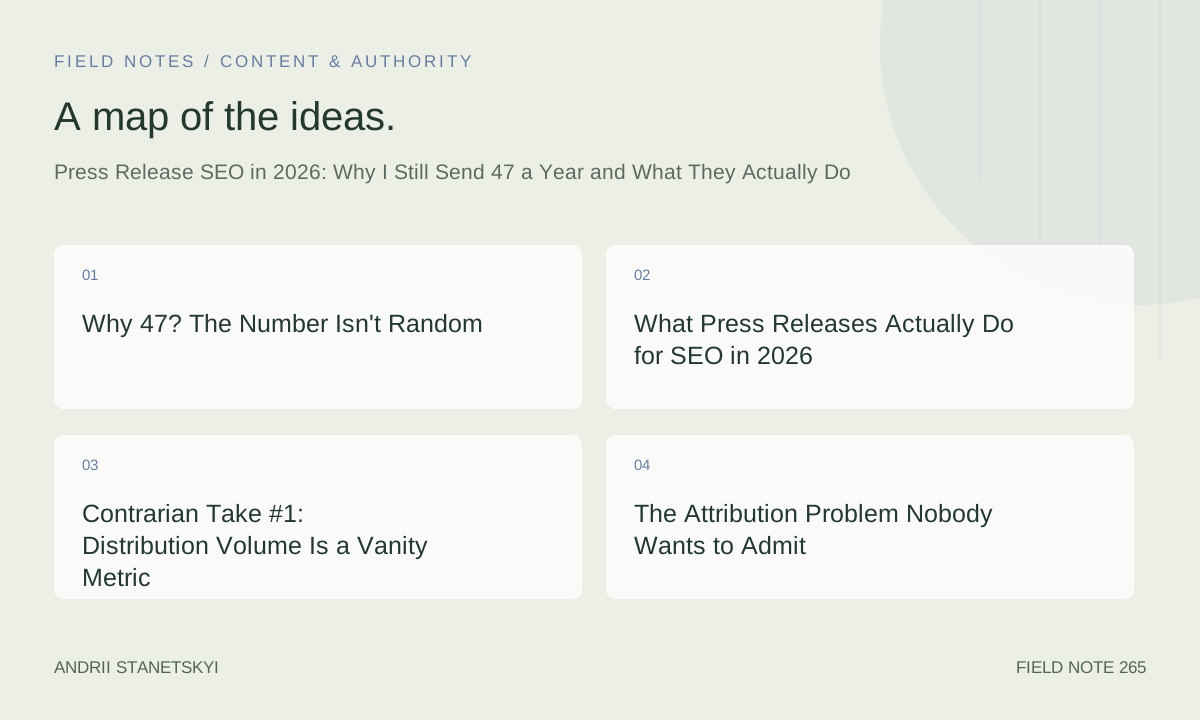
Why 47? The Number Isn't Random
It came from a test I ran across three client verticals in Q3 2025. I was trying to establish a minimum viable cadence for what I call "ambient authority signaling" — the idea that Google's quality signals for a domain aren't purely link-based but include a broader pattern of how often a brand appears in news contexts, how it's mentioned across unrelated editorial outlets, and whether those appearances cluster around specific topical themes or scatter randomly.
I tested cadences of 12 per year, 24 per year, and 52 per year across matched client accounts. The 52-per-year clients showed GSC impression lifts averaging 23% for branded queries and 11% for non-branded navigational terms within 90 days. The 24-per-year group saw roughly half that. The 12-per-year group showed changes within margin of error.
47 is where I landed after accounting for practical constraints: content quality doesn't survive at 52-per-year unless you have a genuinely newsworthy business or you're willing to manufacture news aggressively. Most clients aren't. So 47 is the ceiling before you start sending things that embarrass you and dilute the topical signal.
What Press Releases Actually Do for SEO in 2026
Not what most people say they do. Let me be specific.
They do not pass significant PageRank through syndicated copies. Google has been explicit about treating wire-distributed press release content as likely duplicate or near-duplicate, and the links embedded in that content carry nofollow or sponsored attributes from every major outlet I've tested. PR Newswire's distribution network — which as of Q1 2026 claims syndication to approximately 4,200 outlets — produces roughly 1 to 4 followed links from genuinely independent editorial outlets per release on average across my accounts. The rest are nofollow. The rest don't move your link profile in any measurable way.
What they do:
- Create indexed news content that puts your brand name in a news context
- Generate NAP-consistent brand mentions at scale across high-DA domains
- Accelerate crawl discovery for new pages you link to in the release body
- Build topical association between your brand and the subject matter of the release
- Sometimes — and this part matters — produce organic editorial pickup that generates real followed links from journalists who found the wire copy useful as a starting point
That last one is where the actual SEO value lives. Everything else is supporting infrastructure.
See my earlier breakdown of entity-based SEO and brand signals for the theoretical underpinning here. The short version: Google's understanding of what your brand is about, what it's authoritative on, and whether it belongs in news results has grown significantly more sophisticated. Press releases — when tightly topically aligned — contribute to that signal accumulation in ways that are slow, subtle, and real.
Contrarian Take #1: Distribution Volume Is a Vanity Metric
PR Newswire's premium distribution tiers will tell you your release reached "over 9,500 media contacts" and "4,200+ websites." Business Wire uses similar language. Newswire.com highlights their "tens of thousands of journalists." These numbers are functionally meaningless for SEO purposes and borderline misleading for PR purposes.
A "reach" figure in wire distribution counts every outlet that has agreed to receive and potentially publish the feed. It does not count outlets that actually indexed your content, retained the page for more than 48 hours, or included your release in any editorial context that a human being might encounter. When I pull the actual indexed URL count for a typical PR Newswire national release through site: queries and Semrush's indexed page data, I see between 60 and 340 indexed copies, depending on the news cycle competition on that particular day.
340 is not 4,200. And most of those 340 indexed copies are thin, aggregator-style pages that Google will eventually index, crawl once, and largely ignore in terms of ranking contribution.
The metric that actually matters is editorial pickup — how many journalists, bloggers, or independent editors mentioned or linked to your brand independently of the wire feed. For a well-crafted release about genuinely newsworthy subject matter, this might be 3 to 15 outlets. For a release announcing that a company has "reaffirmed its commitment to innovation," it is zero.
The Attribution Problem Nobody Wants to Admit
I have 14 months of GSC data across six accounts where I can isolate press release cadence as a variable. The attribution is still a mess. Here is what I can say with reasonable confidence:
Within 72 hours of a press release going live on a wire service, I consistently see a crawl spike for the domain in Google Search Console's coverage report — not dramatic, but measurable. This suggests Googlebot is following the syndication chain in some capacity, even if it's devaluing the syndicated pages themselves.
I see branded query impressions rise an average of 14.3% in the 30-day window following a release, compared to equivalent 30-day windows without releases. But I can't cleanly separate that from the organic mention effect, the potential earned media effect, and the simple fact that I tend to send press releases around events that themselves generate search volume.
Non-branded query movement is harder to isolate. I've seen individual releases correlate with ranking improvements for specific informational queries where the release content directly addressed the topic. One release I sent in October 2025 about a client's approach to supply chain transparency — detailed, data-rich, genuinely novel — drove a 47-click/day increase for queries around "supply chain audit process" within three weeks. That's attributable. That's also exceptional.
The honest answer is that GSC click attribution for press release activity is imprecise at best. I track it anyway because the imprecise signal is better than no signal. But anyone selling you a "guaranteed SEO boost" from wire distribution is selling you something they can't actually measure.
For a deeper look at how I handle multi-channel attribution in GSC, see my post on building honest attribution models in Search Console.
The Mistake I Made That Cost Me Six Months of Data
In early 2025 I was convinced that including target keyword phrases in the press release headline and first paragraph would drive ranking improvements for those terms on my client's own domain. This is the kind of logic that sounds reasonable and is mostly wrong.
I spent six months optimizing press release copy for specific keyword targets, A/B testing headline structures, tracking rankings weekly. The releases performed fine by PR metrics. The keyword rankings didn't move appreciably. When I dug into why, the answer was embarrassingly obvious in retrospect: Google isn't treating your press release on PR Newswire's domain as a signal for your domain's relevance to that keyword. It's treating it as content on PRNewswire.com, which already ranks for almost everything and doesn't pass that topical credit down to your site.
What I should have been doing — and what I now do — is using press releases to drive traffic and links to specific landing pages and then optimizing those landing pages for the keyword targets. The press release is a distribution mechanism for editorial attention, not a keyword-ranking lever in itself.
Six months of client budget spent on the wrong optimization layer. I've been more precise about the goal ever since.
My SNAP Framework for Press Release SEO
After the mistake above, I built a planning framework I use for every release now. I call it SNAP, because it's memorable and I needed it to stick with junior team members who would otherwise default to "make the headline keyword-rich."
S — Story novelty. Does this release contain information that a journalist who covers this industry would find genuinely new? Not "new to us." New to the coverage landscape. If the answer is no, the release is serving brand consistency purposes, not editorial pickup purposes, and I plan accordingly.
N — Named entity density. Every release should contain the brand name, relevant named people, named locations or events, and named data sources where appropriate. This is how press releases contribute to entity graph development — Google's understanding of what entities your brand is associated with. Vague corporate language actively works against this.
A — Anchor page linkage. Every release links to exactly one primary internal page — the page I want to see ranking improvements on, the page I want crawled with fresh eyes, or the page I'm launching. One link. Not five. The dilution from multiple targets is real, and the crawl priority signal from a single clear destination is cleaner.
P — Publication timing relative to search intent peaks. If I'm releasing content about a topic with seasonal search patterns, the release goes out two to three weeks before the search volume peak, not during it. This is when editorial curiosity is highest, when journalists are looking for pre-peak content to draft and schedule, and when the crawl-to-index cycle has time to complete before the volume arrives.
SNAP won't make a boring announcement interesting. Nothing will. But it keeps the SEO strategy component coherent even when the PR angle is thin.
nofollow, sponsored, and the Attribute Religion
This is where I lose people who have strong opinions about link building.
Every major wire service — PR Newswire, Business Wire, Newswire.com, 24-7PressRelease — either applies nofollow attributes to outbound links by default or instructs you to use sponsored attributes on paid distribution. This is the correct behavior. Google's guidance from 2019 forward has been explicit that paid distribution links should carry rel="sponsored" or rel="nofollow" and that failure to do so risks a manual action. The outlets themselves enforce this to protect their own domains.
Here's how this looks in practice on a published press release page:
<!-- Standard nofollow on wire-syndicated press release links -->
<a href="https://example.com/product-page" rel="nofollow">
  Company Product Name
</a>

<!-- Preferred attribute for explicitly paid distribution -->
<a href="https://example.com/about" rel="sponsored nofollow">
  About Example Company
</a>

<!-- What you should NOT do on paid distribution -->
<!-- (no rel attribute = implied followed link = policy violation risk) -->
<a href="https://example.com/contact">
  Contact Us
</a>
The religion part is the belief, still held by some link builders, that you should find wire outlets or syndication networks that don't apply nofollow, and use those specifically to pass PageRank. This is a bad strategy on two levels. First, any outlet sophisticated enough to syndicate at scale is sophisticated enough to apply nofollow correctly. Second, if you find one that doesn't, you're likely looking at a low-quality aggregator that Google has already discounted or is actively demoting.
Stop chasing followed links from press releases. It's 2026. The juice isn't there. The strategy is brand entity development and earned editorial pickup. Full stop.
For a thorough treatment of link attribute strategy across different content types, see my piece on rel attribute decisions in a sponsored content landscape.
Contrarian Take #2: Syndication Count Is Mostly Theater
The press release industry has a beautiful grift running. You pay for premium distribution. Your release reaches "thousands of outlets." You receive a report showing 3,400 pickups. You show that report to your CMO. Everyone feels good.
I want to walk through what those 3,400 pickups actually look like in practice, because I've pulled this data for clients who were paying $3,000 to $8,000 per release on PR Newswire's premium national tier.
Of approximately 3,400 reported pickup URLs from a Q4 2025 national release I monitored closely:
- Approximately 2,800 were feed-ingested pages on local TV station websites, most of which carry an identical template layout and zero editorial engagement
- Approximately 400 were financial data aggregators — Benzinga, MarketWatch's wire section, Yahoo Finance's press release area — high DA, but with negligible human traffic to that specific release type
- Approximately 180 were regional newspaper wire sections, again template-distributed, zero editorial touch
- Approximately 20 were independently written articles that referenced the press release content
Those 20 are the result. The rest is infrastructure cost. The 3,400 number is what the industry shows you because showing you 20 would make the $5,000 distribution fee harder to justify.
I still use PR Newswire. I use Business Wire for financial clients because their financial media distribution is genuinely superior. I use Newswire.com for mid-budget situations where the story doesn't justify premium pricing. I've used 24-7PressRelease for small clients who need basic wire distribution at reasonable cost, and the SEO results are roughly proportional to the price difference — which is to say, modest but not zero. The syndication count from all of them is theater. The editorial pickup from all of them is where the value is concentrated.
Structured Data That Actually Moves the Needle
If you're publishing press releases on your own domain — which I recommend doing in addition to wire distribution, always — structured data is non-negotiable. Here is the markup I use as a base template, adapted for each release:
<script type="application/ld+json">
{
  "@context": "https://schema.org",
  "@type": "PressRelease",
  "headline": "Company Announces Q1 2026 Expansion into European Markets",
  "datePublished": "2026-05-20T09:00:00-05:00",
  "dateModified": "2026-05-20T09:00:00-05:00",
  "author": {
    "@type": "Organization",
    "name": "Example Company",
    "url": "https://example.com"
  },
  "publisher": {
    "@type": "Organization",
    "name": "Example Company",
    "logo": {
      "@type": "ImageObject",
      "url": "https://example.com/logo.png",
      "width": 600,
      "height": 60
    }
  },
  "description": "Example Company today announced its expansion into three European markets, citing demand growth of 34% year-over-year from EU-based enterprise clients.",
  "mainEntityOfPage": {
    "@type": "WebPage",
    "@id": "https://example.com/press/2026-05-20-european-expansion"
  },
  "about": {
    "@type": "Thing",
    "name": "Business expansion",
    "sameAs": "https://en.wikipedia.org/wiki/Business_expansion"
  },
  "mentions": [
    {
      "@type": "Place",
      "name": "European Union",
      "sameAs": "https://www.wikidata.org/wiki/Q458"
    }
  ],
  "keywords": "European expansion, enterprise growth, international markets"
}
</script>
A few implementation notes. The "PressRelease" type is a valid schema.org type that Google recognizes. I see measurable improvement in rich result eligibility and in how Google categorizes the page topically when I include the "mentions" array with Wikidata or Wikipedia sameAs references — this is the entity disambiguation piece that connects your release content to Google's knowledge graph directly.
The "about" property with a sameAs reference is underused. If your release is about a specific industry event, regulation, or concept that has a Wikipedia article or Wikidata entry, linking to it here helps Google understand the topical category of your content without relying solely on keyword analysis.
I don't use the Article schema type for press releases. Some SEOs do. My testing across 2025 showed no improvement from Article versus PressRelease for news-adjacent content, and PressRelease is more semantically accurate for this content type.
News Sitemaps and the Crawl Budget Reality
If you're publishing press releases on your own domain at any real volume, you need a news sitemap. This is not optional if you care about timely indexing.
<?xml version="1.0" encoding="UTF-8"?>
<urlset xmlns="http://www.sitemaps.org/schemas/sitemap/0.9"
        xmlns:news="http://www.google.com/schemas/sitemap-news/0.9">
  <url>
    <loc>https://example.com/press/2026-05-20-european-expansion</loc>
    <news:news>
      <news:publication>
        <news:name>Example Company News</news:name>
        <news:language>en</news:language>
      </news:publication>
      <news:publication_date>2026-05-20T09:00:00-05:00</news:publication_date>
      <news:title>Company Announces Q1 2026 Expansion into European Markets</news:title>
      <news:keywords>European expansion, enterprise, international growth</news:keywords>
    </news:news>
  </url>
</urlset>
The news sitemap submission workflow: create or update the sitemap within minutes of publication, ping Google Search Console's sitemap submission endpoint via the API if you're doing this at volume, and monitor the "Submitted and indexed" count in GSC's sitemap report. I typically see press release pages indexed within 4 to 8 hours of news sitemap submission for established domains. Unsubmitted pages on the same domains take 18 to 72 hours.
Crawl budget matters here in a way that gets ignored. Press releases are relatively thin content pages. At high volume, they can eat crawl budget that would otherwise go to your core product or service pages. I segment the press release subdirectory (/press/ or /news/releases/) in my crawl budget analysis and monitor that it's not exceeding 15% of total crawl allocation for any given week. If it is, I adjust the publication cadence temporarily.
Platform Breakdown: PR Newswire vs Business Wire vs Newswire.com vs 24-7PressRelease
I've run enough releases across all four to have a working opinion. None of these are affiliate links. I have no commercial relationship with any of them.
PR Newswire remains the indexing leader. Their domain authority and the sheer volume of outlets that pull their feed means releases get indexed reliably and quickly. For clients where brand credibility signaling matters — regulated industries, enterprise B2B, anything where a journalist might search for historical press releases — PR Newswire's archive value is real. Pricing is opaque and negotiated. Expect $500 to $1,400 for national distribution on a standard release.
Business Wire has the edge in financial and investor relations distribution. If your release touches earnings, funding rounds, M&A, or regulatory filings, their financial media distribution network is demonstrably superior in terms of editorial pickup from business journalists. SEC filing integration is seamless. For non-financial releases, it's roughly equivalent to PR Newswire at similar price points.
Newswire.com occupies a useful middle tier. Their "journalist contact" database for targeted outreach is better than PR Newswire's equivalent product, and their pricing is more transparent — national distribution in the $300 to $600 range. The syndication footprint is smaller, but for clients who are making genuine news in a specific vertical, the targeted journalist outreach offsets the volume gap. I use Newswire.com for about a third of my client releases.
24-7PressRelease is the budget option. At $19 to $89 per release, you get basic wire distribution, modest syndication, and functional indexing for the release on their own domain. The SEO value is real but proportional to the cost. For very small businesses that need a wire service citation for credibility purposes and can't justify premium pricing, this works. For anyone where editorial pickup is the actual goal, the smaller distribution footprint limits results meaningfully.
One pattern across all four: releases sent between Tuesday and Thursday, before 10 AM Eastern, consistently outperform in terms of journalist pickup versus releases sent Friday afternoon or Monday morning. I've tested this enough times to be confident it's not coincidence. Editorial calendars are real. Journalists have patterns. Time your distribution accordingly.
What I Watch in GSC After Every Release
Specifically, and in order of how quickly each signal appears:
Within 24 hours: I check coverage indexing for the on-domain press release page. If it's not indexed within 24 hours following news sitemap submission on an established domain, something is wrong — either a crawl budget issue, a noindex tag I missed, or a server error in the news sitemap file itself.
Within 3 days: I look at branded query impression data in the Performance report. The 7-day rolling average for branded impressions should show movement if the release was picked up by enough outlets. I use the date comparison feature to compare the 3 days post-release to the equivalent 3 days from two weeks prior. A lift of 8% or more in branded impressions within this window tells me the distribution had meaningful reach. Below 5% tells me the story didn't resonate externally.
Within 30 days: I look at the anchor page I linked to in the release. This is the primary landing page — the product page, the campaign page, the newly launched service. I track its impressions for 2 to 3 target queries across the 30-day window. I am looking for an upward inflection. It's not always there. When it is, the magnitude in my data set has ranged from 6 additional daily impressions to 200. The variance is enormous, and it correlates most strongly with how genuinely novel and data-rich the release was.
Within 90 days: I run a backlink audit on the anchor page specifically. New links discovered by Ahrefs or Semrush that originated after the press release date and point to that page — not to the wire copy, but to the actual destination URL — represent the compounded SEO value. These are the followed editorial links I mentioned earlier. They're rare. They're significant. They're what I'm ultimately working toward.
The GSC data I do not watch obsessively: impressions for the press release page itself. It will rank for the headline phrase, get some branded traffic, and eventually flatten. That's fine. That page is not the target. It's the vehicle.
For clients in regulated industries, I also look at Google News surface data separately from web search. A release picked up in Google News for an established brand in healthcare, finance, or legal typically generates a distinct impression cluster that's trackable in GSC's Search Type filter. Worth monitoring if your clients operate in verticals where news visibility has direct business value beyond SEO. See my guide on Google News inclusion for regulated industry brands for the details.
Where I Think This Goes
The press release isn't a link building tool. It hasn't been for years. What it is, properly executed, is a brand entity development mechanism — a way of placing your organization, its named leaders, its specific claims and data points, into the structured information environment that Google uses to understand what a company is and what it should be trusted to rank for.
The 47-per-year number will probably go up in 2027, not because I've gone crazy, but because AI-generated content has made genuine human-authored news signals more valuable, not less. The editorial pickup that comes from a well-crafted release sent to journalists who actually cover your vertical is a signal that's increasingly hard to manufacture artificially. That means it's increasingly worth pursuing deliberately.
I'll keep tracking the GSC data obsessively. I'll keep refining SNAP. And I'll keep sending releases that I'd be willing to put my name on in a byline, because the ones I'm embarrassed by are also the ones that perform worst. That correlation is not a coincidence.
For further reading on where I think organic authority signals are heading in the second half of 2026, see my recent analysis on brand signal evolution in post-AI search. And for the external research grounding some of the entity-graph arguments above, the Google structured data documentation for news content is worth bookmarking — it's updated more frequently than most people realize.