Written 19 May 2026. Present tense throughout—this is the current situation.
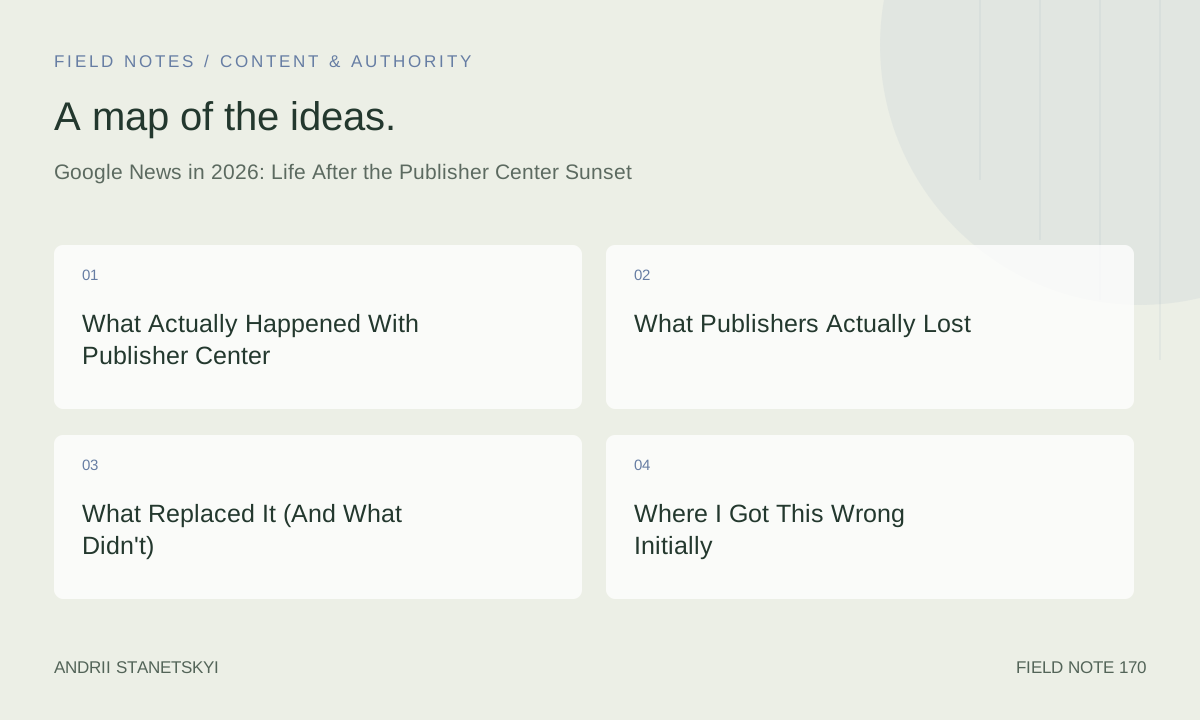
What Actually Happened With Publisher Center
Google Publisher Center—the tool that let news publishers formally register their publications, configure news sections, manage content labels, and in some regions participate in Google News Showcase—was fully sunset in February 2026. The deprecation notice came in late October 2025 with a 90-day wind-down window. Most publishers missed the news. I know this because four of my clients came to me in January 2026 asking what happened to their Publisher Center dashboards, which had gone read-only, and two of them thought their Google News traffic loss was a penalty situation rather than a product shutdown.
The raw traffic impact varied dramatically by publisher size and dependence. One regional news outlet I consult for—about 1.8 million monthly sessions at the time—saw their Google News referral traffic drop 34% in February. Another, a B2B tech trade publication, saw almost no change. The difference, as best I can tell, came down to how much of their News distribution had been actively managed through Publisher Center settings versus how much was running on pure algorithmic signals anyway.
Large publishers that had invested in customizing their News presence lost more. Publishers that had treated News distribution as a passive byproduct of good structured data lost almost nothing. That's not an endorsement of doing less work—it's an observation about which work mattered.
What Publishers Actually Lost
Let me be specific, because the vague framing ("Publisher Center is gone") obscures what was actually valuable in there.
News Sections configuration. Publishers could define custom sections—essentially topic feeds—that influenced how Google News organized and surfaced their content within the app and website. That's gone. Google now assigns topic categorization algorithmically. For publishers with unusual editorial scope (a publication covering both cooking and international affairs, for example), the algorithmic categorization can be genuinely wrong in ways there's no longer any mechanism to correct.
Showcase access. Google News Showcase—the paid licensing arrangement where Google paid publishers for curated content panels—was managed through Publisher Center. The program has not been formally discontinued, but the publisher-side interface for it disappeared with the sunset. Publishers enrolled in Showcase have reported through early 2026 that their agreements continue but that the configuration tools no longer exist. New publishers cannot enroll. Google has not announced a replacement enrollment mechanism as of May 2026.
Content labels and paywalls. The "paywall" content type label that helped Google understand subscription-gated articles was configured in Publisher Center. Without it, publishers relying on that label need to implement it via structured data instead—which is actually more technically reliable, but required migration work most publishers didn't do during the wind-down window.
The support escalation path. This is the loss people talk about least and feel most. Publisher Center had—not a great support experience, but an experience. There was a place to submit problems. There was a history of responses. That's gone. News eligibility issues now have no formal escalation path.
What Replaced It (And What Didn't)
The Fully Algorithmic Inclusion Model
Google's position is that the algorithmic News inclusion model is more equitable than the Publisher Center model, which required publishers to know the tool existed, register, configure it correctly, and maintain it. That argument has merit. Many small publishers were producing excellent news content and never appeared in Google News simply because they hadn't registered. The algorithmic model at least doesn't require active enrollment.
In practice, the algorithm for News inclusion in 2026 appears to weight: consistent publication of original reporting (not aggregated content), newsArticle schema markup, news sitemap submission and freshness, indexed domain age and authority, and E-E-A-T signals including author expertise markers. Publishers who hit all of these reliably tend to get News distribution. Publishers who don't tend not to. The frustration is that there's no visibility into which specific signal is causing an exclusion.
No Appeal, No Support Queue
This is the most consequential operational change. Before February 2026, if a legitimate news publisher wasn't appearing in Google News, there was a path: Publisher Center submission, waiting, potentially escalating through Google support channels. Imperfect, but a path. Now there isn't one. Publishers who believe they should be in Google News and aren't have no formal recourse beyond improving their algorithmic signals and waiting.
I've had three clients in this situation since the sunset. One got News distribution about six weeks after we improved their structured data and news sitemap hygiene. One still doesn't have it after four months—their content is legitimate news reporting, their technical setup is clean, and Google simply hasn't picked them up. The third gave up on Google News as a traffic target and redirected their effort toward Top Stories, which they now appear in regularly. That pivot turned out fine. But it shouldn't have been forced.
Where I Got This Wrong Initially
Honest admission: when the Publisher Center sunset was announced in October 2025, I told two clients it was essentially a non-event. My reasoning was that algorithmic News inclusion had been improving for years and Publisher Center was increasingly ceremonial. I was partly right and mostly wrong.
I underestimated how much Showcase-enrolled publishers had come to depend on the Publisher Center interface for understanding their Showcase performance. I also underestimated how much the paywall content label in Publisher Center had been doing for subscription publishers that hadn't migrated to schema-based paywalled content markup. Both of those gaps created real problems that I then had to help fix retroactively. The lesson: product sunsets that seem ceremonial often affect workflows that aren't obvious until they're broken.
News Sitemaps Still Matter—But Differently
The news sitemap protocol hasn't changed structurally, but its role in the post-Publisher Center world has increased. Without the Publisher Center registration to signal "this is a news site," the news sitemap becomes one of the primary technical signals telling Google to treat your content as news-eligible.
A correctly implemented news sitemap:
<?xml version="1.0" encoding="UTF-8"?>
<urlset xmlns="http://www.sitemaps.org/schemas/sitemap/0.9"
        xmlns:news="http://www.google.com/schemas/sitemap-news/0.9">
  <url>
    <loc>https://example.com/2026/05/19/article-slug/</loc>
    <news:news>
      <news:publication>
        <news:name>Publication Name</news:name>
        <news:language>en</news:language>
      </news:publication>
      <news:publication_date>2026-05-19T09:00:00Z</news:publication_date>
      <news:title>Article Headline Here</news:title>
    </news:news>
  </url>
</urlset>
A few operational notes from current client work: news sitemaps should only contain articles published within the last 48 hours. Google's crawler checks news sitemaps frequently—often within minutes of a fresh ping—and stale content in the sitemap degrades the signal quality. Automated sitemap generation that includes articles older than 48 hours is a common mistake that pre-dates the Publisher Center sunset but matters more now.
Also: submit your news sitemap URL in Google Search Console under the Sitemaps section. This is separate from your regular XML sitemap. Some publishers have one sitemap that combines everything. That's not ideal. A dedicated news sitemap, updated dynamically as articles publish, is the correct setup.
The Schema Setup That Works Now
NewsArticle schema is more important post-Publisher Center than it was before. It signals content type, publication datetime, author identity, and publisher identity—much of what Publisher Center used to handle through profile configuration. The implementation should be precise:
<script type="application/ld+json">
{
  "@context": "https://schema.org",
  "@type": "NewsArticle",
  "headline": "Article Headline—Under 110 Characters",
  "datePublished": "2026-05-19T09:00:00+00:00",
  "dateModified": "2026-05-19T10:30:00+00:00",
  "author": [
    {
      "@type": "Person",
      "name": "Reporter Name",
      "url": "https://example.com/author/reporter-name",
      "sameAs": [
        "https://twitter.com/reportername",
        "https://www.linkedin.com/in/reportername"
      ]
    }
  ],
  "publisher": {
    "@type": "NewsMediaOrganization",
    "name": "Publication Name",
    "url": "https://example.com",
    "logo": {
      "@type": "ImageObject",
      "url": "https://example.com/logo-600x60.png",
      "width": 600,
      "height": 60
    }
  },
  "image": [
    {
      "@type": "ImageObject",
      "url": "https://example.com/images/article-1200x630.jpg",
      "width": 1200,
      "height": 630
    }
  ],
  "description": "Article description, 150-160 characters.",
  "articleSection": "Technology",
  "keywords": ["keyword one", "keyword two"],
  "mainEntityOfPage": {
    "@type": "WebPage",
    "@id": "https://example.com/article-url"
  }
}
</script>
Two details that are easy to overlook: use NewsMediaOrganization as the publisher type (not just Organization) when your site is primarily a news publication. And the sameAs array on author entities is doing quiet but real work for author entity recognition—social profiles, Wikipedia if applicable, and Wikidata entries all help.
The PAVE Framework for News Eligibility in 2026
After working through the post-sunset reality with multiple publishers, I've distilled the eligibility requirements into what I call the PAVE framework. It's not a marketing tool; it's a diagnostic checklist I use when a client asks why they're not appearing in Google News.
P — Publication Signals. Does Google's system recognize your domain as a news publisher? This requires: a news sitemap submitted to GSC, NewsArticle schema on all time-sensitive content, consistent use of NewsMediaOrganization schema for the publisher entity, and a clear publication date pattern (articles published on a regular, dateable schedule).
A — Authorship and Attribution. Are articles attributed to real, identifiable humans with at least minimal web presence? Unbylined content, staff-bylined content without author pages, and AI-generated content without clear editorial attribution all appear to reduce News eligibility scores. Author entity pages with structured data, external profile links, and a consistent publication history are now close to mandatory for News inclusion.
V — Verifiability. Can the factual claims in your content be verified? This is an E-E-A-T dimension that the algorithmic system assesses through a combination of entity linking patterns, sourcing signals (are named sources entities that can be verified?), and domain-level signals built from long-term content quality. Publishers that consistently cite named sources, link to primary documents, and provide original reporting—rather than rewrites of other outlets' work—have stronger verifiability signals.
E — Editorial Entity Signals. Is your publication a recognized entity in Google's Knowledge Graph? This is a longer-term signal, but it matters. Publications with Knowledge Graph entries, Wikipedia articles, or Wikidata entries appear to have stronger baseline News distribution than publications that exist only as websites with no external entity recognition.
Two Contrarian Positions I'm Holding
First: the Publisher Center sunset may ultimately help small, independent publishers more than it hurts them. The old model systematically underserved publishers who didn't know about Publisher Center or found it too technically complex to set up correctly. The algorithmic model, while opaque, at least doesn't require advance enrollment. I've watched three small local news sites—operations running on under $500K/year—start appearing in Google News for the first time in 2026, purely because someone improved their structured data and news sitemaps. They never would have found their way through Publisher Center. This doesn't excuse Google's handling of the sunset, but the destination may be better than the departure was.
Second: chasing Google News inclusion at the expense of Top Stories optimization is the wrong priority for most publishers. Google News drives real traffic, but for most publishers in 2026, Top Stories is a larger referral source and more directly connected to organic search behavior. The optimization paths partially overlap but aren't identical. Publishers putting significant engineering hours into News-specific work—structured data schemas, news sitemaps, entity signals—should confirm they're equally invested in the freshness and quality signals that drive Top Stories. If not, they may be optimizing the smaller channel while neglecting the larger one. See the Top Stories freshness rebalance analysis for specifics on what's actually driving that surface in 2026.
Who Wins Without Publisher Center
The publishers winning in Google News right now fall into two categories. First: large, established news organizations whose entity recognition is so strong that the algorithmic system treats their News eligibility as essentially settled—The Guardian, The Wall Street Journal, Reuters, major regional papers with decades of entity history. They lost some configuration capability with Publisher Center but their distribution didn't change materially.
Second: technically sophisticated smaller publishers who moved quickly after the sunset announcement to ensure their structured data was clean, their news sitemaps were current, and their author entity signals were built out. This second group is actively outperforming some mid-size legacy publishers who were over-relying on Publisher Center configuration and hadn't invested in the underlying technical signals.
The publishers struggling most: mid-size digital-native publications that grew up using Publisher Center as their primary News management tool and had under-invested in structured data infrastructure. They're now doing remedial technical work that ideally would have been in place years ago.
For the technical foundation work: the schema.org advanced guide covers the entity patterns that underpin News eligibility. The enterprise sitemaps piece has the news sitemap implementation detail. For understanding where News distribution intersects with Discover: see the Discover AI curation layer analysis. External reference: Google's News content policies and technical requirements.
Final Notes From the Field
May 2026, and the post-Publisher Center situation is still settling. Some publishers have recovered. Some haven't. Google has given no indication of a new publisher management interface, and their official documentation now makes clear that News inclusion is fully algorithmic with no manual submission path.
The operational reality for news publishers: treat your structured data as your publication registration. Treat your news sitemap as your editorial identity signal. Treat your author entity pages as your editorial team's credentials. These are now doing the work that Publisher Center used to do, except they're doing it continuously and algorithmically rather than through a one-time registration that collected dust between updates.
It's not a cleaner system. It's an invisible one. For publishers who understand that, the path forward is clear enough. For publishers still waiting for a Publisher Center replacement, the honest answer is: it's not coming.