Written 19 May 2026. This is a present-tense account of the current state of Top Stories after the 2025 algorithm changes.
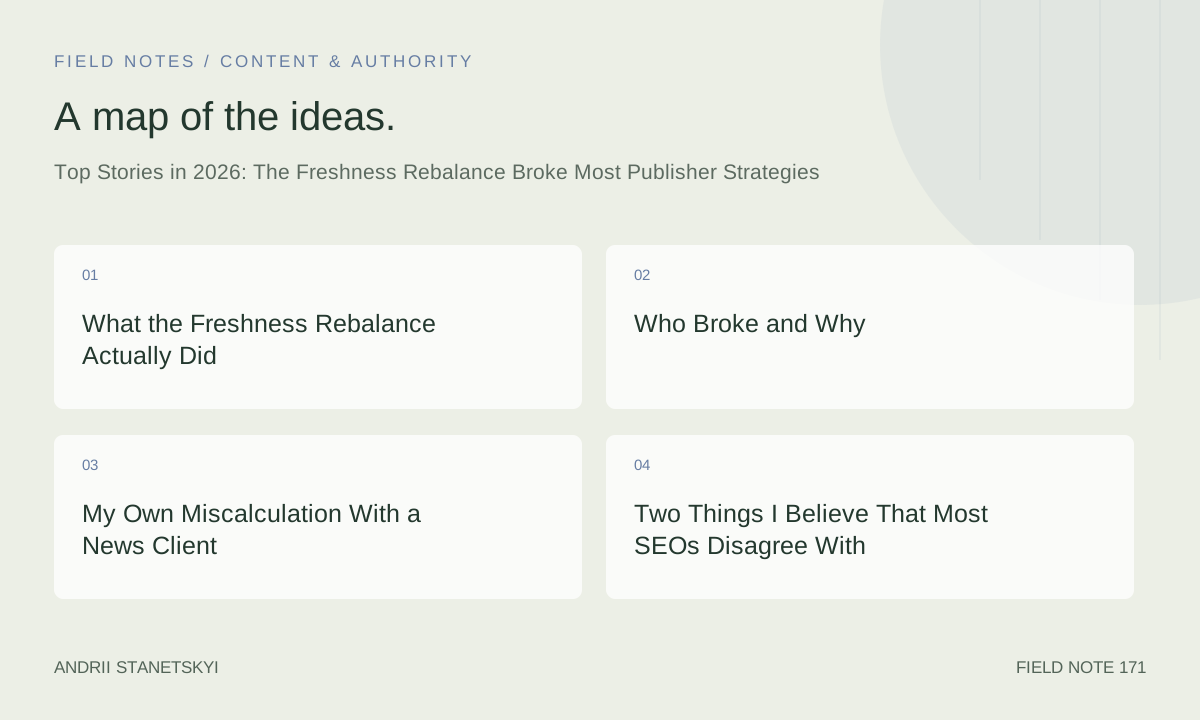
What the Freshness Rebalance Actually Did
Between May and August 2025, Google made a series of changes to how freshness signals are weighted in the Top Stories carousel. The changes weren't announced cleanly—Google described them obliquely in a Search Liaison post about "quality improvements" to news results, dated July 2025. Publishers started noticing the effects in June. Search Console data became the evidence base for what had changed, not any official documentation.
The core change: Top Stories had previously operated on a near-pure recency model for breaking news queries. Publish first, rank first. That model incentivized publishing incomplete, low-quality articles seconds after a story broke—the "placeholder article" strategy where publishers would post a stub and update it as reporting developed. The rebalance reduced the weight of raw publication timestamp in favor of a quality-adjusted freshness signal. Content published 30 minutes after a story breaks but with full reporting, accurate facts, and good E-E-A-T signals now competes effectively with content published immediately but thinly.
The practical effect on GSC data was stark for the publishers affected. One client—a mid-size news aggregation operation—saw their Top Stories impressions drop from about 2.1 million/month to 680,000/month between June and September 2025. That's a 68% decline. Another client, a regional investigative outlet with slower publishing cadence, saw an 89% increase over the same period. Same algorithm change, opposite outcomes, because their publishing models were fundamentally different.
Who Broke and Why
The News Factory Problem
The publishers hit hardest were what I think of as news factories: operations with large publishing teams (or, increasingly, AI-assisted workflows) designed to publish on every news story as quickly as possible. Their entire Top Stories strategy was velocity. Publish a 200-word stub within 90 seconds of an AP wire report, rank at the top of Top Stories while competitors are still writing, generate the traffic spike. The rebalance eliminated the competitive advantage of being 90 seconds faster if your content is 70% thinner.
One pattern I saw repeatedly in client audits through Q3 and Q4 2025: the news factories that lost Top Stories traffic also had very high article abandonment rates in their analytics. Users were clicking through from Top Stories, reading 40 words of a thin stub, and leaving. The quality-adjusted freshness signal appears to incorporate some version of this engagement signal—either directly through user behavior data or indirectly through entity depth and content completeness signals that correlate with engagement.
Evergreen Publishers Who Got Caught
A second, less-discussed casualty: publishers of primarily evergreen content who had been using date manipulation to get into Top Stories. The tactic worked like this—take a high-quality evergreen article, update the datePublished or dateModified timestamp without materially changing the content, and try to get it into Top Stories as "fresh" content on a trending topic. Google's systems have been aware of this tactic for years, but the rebalance appears to have improved detection significantly.
The tell: articles with a long publication history (visible via cache dates, Wayback Machine, or structured data audit history) suddenly appearing in Top Stories for topics where they have no editorial relevance. I saw a health publisher lose their modest Top Stories presence entirely in August 2025 after this tactic was apparently flagged by Google's systems. Their legitimate news content disappeared from Top Stories along with the manipulated content. Recovery took about four months of consistent clean publishing behavior.
My Own Miscalculation With a News Client
I need to be specific about a mistake I made here. A regional news client brought me in for a Top Stories audit in September 2025—they had seen a 41% decline in Top Stories impressions since June. My initial diagnosis, based on timing correlation, was that the rebalance had hit them due to publishing cadence issues. I recommended increasing their update frequency on breaking stories: publish faster, update more often, keep articles fresh through the day.
This was wrong. Their problem wasn't publishing cadence—their articles were already reasonably well-timed. Their problem was structured data: datePublished timestamps were being set inconsistently, sometimes showing the article creation time in their CMS (which was often hours before publication) and sometimes showing the actual publish time. The rebalance had increased the scrutiny on timestamp accuracy, and their inconsistent timestamps were creating conflicting freshness signals.
I spent three weeks optimizing the wrong variable before a GSC log analysis revealed the timestamp inconsistency. After fixing the structured data (CMS configuration change, two hours of engineering work), Top Stories impressions recovered to 94% of their pre-June baseline within six weeks. The lesson: timestamp accuracy in NewsArticle schema matters more after the rebalance, and it's easy to overlook because it's a structural issue rather than an editorial one.
Two Things I Believe That Most SEOs Disagree With
First contrarian take: the freshness rebalance was good for journalism and bad for traffic optimization, and those two things are in tension in ways the SEO community doesn't talk about honestly. Most Top Stories coverage I've read since the rebalance frames it as a problem to solve—how do we recover our traffic? But the change did exactly what good journalism values suggest it should: penalized thin, speed-first content and rewarded complete, accurate reporting. The publishers who lost the most traffic were running models that depended on readers getting less than they came for. Optimizing your way back to that traffic baseline shouldn't be the goal. The traffic loss for many of these publishers was a description of what they'd been doing, not a bug in the algorithm.
Second contrarian take: Top Stories is not the right primary traffic target for most non-news publishers, and framing it as an SEO goal often leads to the wrong work. Every few months I get a new client—usually an e-commerce brand or SaaS company with a content blog—who wants to "get into Top Stories" because they've heard it drives clicks. Top Stories is a news surface. Its audience is looking for recent reporting on current events. A SaaS blog's "2026 market trends" article appearing in Top Stories for a trending B2B topic might generate clicks, but the engagement signals from that audience will typically be poor. Poor engagement signals feed back into content quality assessment. The short-term traffic isn't worth the long-term signal damage for most non-news publishers. There are better content surfaces to target.
What Actually Works in Top Stories Now
Quality-First Freshness
The optimized approach for Top Stories in 2026 is what I call quality-first freshness: publish as soon as you have enough to publish well, not as soon as you can publish anything. The operational translation: articles should be complete—including key facts, named sources, context, and correct structured data—at the time of first publication. The rebalance appears to assess article quality at initial indexing, not just at some later update. Thin stubs that get fleshed out hours later don't recover the quality signal from the initial assessment fully.
Minimum viable article for Top Stories eligibility in the current environment:
- At least 400 words with substantive reporting (not padding)
- Named, verifiable sources where applicable
- Accurate, consistent
datePublishedtimestamp - NewsArticle schema with full required fields
- 1200px+ image with entity-relevant alt text
- Mobile page speed adequate for Core Web Vitals thresholds
The Update Signal Strategy
One tactic that genuinely works post-rebalance: strategic article updates with transparent change disclosure. When a developing story evolves significantly, update the article with a timestamped update note (inline, visible to readers), increment the dateModified in your NewsArticle schema, and re-submit the URL to the Indexing API or via GSC's URL inspection request. Updated articles with substantive new information re-enter Top Stories eligibility windows on the modified timestamp.
The key word is "substantive." Adding a sentence doesn't trigger the update signal effectively. Adding a new section with materially new reporting—a new source, a development in the story, a correction—does. And the update note should be readable by humans, not just machines:
<!-- Visible update note in article body -->
<p><strong>Update, 19 May 2026, 14:30 UTC:</strong> [Description of what changed
and why. Two to three sentences of actual new information.]</p>
Then in your NewsArticle schema:
"datePublished": "2026-05-19T09:00:00+00:00",
"dateModified": "2026-05-19T14:30:00+00:00"
The gap between datePublished and dateModified matters. If your dateModified is identical to datePublished, Google ignores it as an update signal. If it's updated by less than 30 minutes, it often gets treated as a correction rather than a story development. Significant time gaps between publication and meaningful updates are the pattern that re-enters Top Stories eligibility.
The FAST Framework for Top Stories Eligibility
Working through post-rebalance recovery with multiple publishers, I've built what I call the FAST framework for systematic Top Stories eligibility assessment. Each letter represents a dimension that must be healthy for sustained Top Stories presence.
F — Freshness Quality. Not just whether the content is recent, but whether it was complete and accurate at initial publication. Articles that launched as thin stubs carry a quality deficit that updates may not fully repair. Assess this by comparing GSC Top Stories impression counts for articles published complete vs. articles updated significantly post-publication.
A — Attribution Accuracy. Named authors, accurate bylines, consistent structured data attribution. Anonymous or rotating "staff" bylines have weaker attribution signals. Author entities with external presence perform better.
S — Structural Signals. NewsArticle schema with accurate timestamps, news sitemap inclusion for the article, image schema with appropriate dimensions, and mobile performance. These are checkboxes but they need to be checked on every article, not just in your template testing.
T — Topical Alignment. The query-to-article match. Top Stories is query-specific—the carousel appears for specific search queries, not globally. Understanding which queries trigger your Top Stories appearances (via GSC's search query data filtered for Discover/News) tells you which topics your site has established authority for. Publishing on topics adjacent to your established authority tends to perform better than publishing on entirely new topic areas, even if the new topics are trending.
Schema and Sitemap Setup
The full technical stack for consistent Top Stories eligibility:
<!-- robots meta -->
<meta name="robots" content="max-image-preview:large">

<!-- NewsArticle JSON-LD -->
<script type="application/ld+json">
{
  "@context": "https://schema.org",
  "@type": "NewsArticle",
  "headline": "Article Headline—Accurate, Under 110 Characters",
  "datePublished": "2026-05-19T09:00:00+00:00",
  "dateModified": "2026-05-19T14:30:00+00:00",
  "author": {
    "@type": "Person",
    "name": "Reporter Full Name",
    "url": "https://example.com/author/reporter-name"
  },
  "publisher": {
    "@type": "NewsMediaOrganization",
    "name": "Publication Name",
    "logo": {
      "@type": "ImageObject",
      "url": "https://example.com/logo.png",
      "width": 600,
      "height": 60
    }
  },
  "image": {
    "@type": "ImageObject",
    "url": "https://example.com/images/article-1200x630.jpg",
    "width": 1200,
    "height": 630
  },
  "mainEntityOfPage": {
    "@type": "WebPage",
    "@id": "https://example.com/article-url"
  }
}
</script>
And the news sitemap entry for the same article:
<url>
  <loc>https://example.com/2026/05/19/article-slug/</loc>
  <news:news>
    <news:publication>
      <news:name>Publication Name</news:name>
      <news:language>en</news:language>
    </news:publication>
    <news:publication_date>2026-05-19T09:00:00+00:00</news:publication_date>
    <news:title>Article Headline—Should Match Schema Headline Exactly</news:title>
  </news:news>
</url>
Note that the news:title in your sitemap should match the headline in your NewsArticle schema exactly. Mismatches create a conflicting signal that can reduce confidence in either source. I've seen clients with perfect schema and a slightly different sitemap title losing Top Stories slots to competitors with weaker authority but cleaner signal consistency.
Publisher Types Winning Right Now
In May 2026, the Top Stories winners cluster into three distinct publisher profiles.
Established news organizations with strong entity signals. Major national and regional papers, wire services, and large digital-native news brands. They won before the rebalance and they win after it. The rebalance didn't dislodge them; it removed the speed-first challengers who had been competing with them on velocity alone.
Niche vertical publishers with deep topical authority. A cybersecurity publication that covers only cybersecurity news. A healthcare policy outlet that covers only healthcare policy. A legal news service covering only legal industry developments. These publishers have strong topical entity authority for their specific queries, publish with appropriate depth, and benefit from the quality-over-speed weighting. I've watched several niche B2B news publishers triple their Top Stories impressions since mid-2025—not because they changed their publishing behavior, but because the change removed the velocity-publishers who had been ranking above them on thin content.
Local news operations with strong geographic entity signals. Local newspapers and local news sites covering their geographic area with genuine original reporting. The rebalance appears to have been particularly good for local news—the speed advantage that large national publishers had on local story coverage (they could publish aggregated wire content faster) matters less when quality signals are weighted more heavily. Local reporters with local sources, publishing complete local stories, are competing more effectively for local news queries in Top Stories than at any point in the past several years.
Honest Prognosis
Top Stories after the freshness rebalance is a more meritocratic surface than it was. That's not a particularly satisfying conclusion if your traffic is down—and for some publishers, the traffic won't come back, because the strategy that generated it no longer works.
The path forward for most publishers is narrower than it was: publish less, publish better, nail the structural signals, and build genuine topical authority rather than query-level opportunism. The publishers I'm watching most carefully right now are the ones making that transition deliberately rather than waiting for the algorithm to reset in their favor. It won't reset. The quality weighting is where the surface is heading, not a temporary state it will return from.
For related reading: the Google News post-Publisher Center piece covers the parallel changes happening on that adjacent surface. The E-E-A-T breakdown is the foundational reading for understanding the quality signals now driving Top Stories decisions. Featured Snippets optimization covers query-level SERP feature thinking that applies here. External: Google's article structured data documentation.