My client signed the contract on a Thursday. Forty-seven-month term. $1.2 million total. Structured as a $480,000 upfront licensing fee against quarterly royalty payments tied to verified crawl volume. It is 4.2 times the value of the previous deal they almost signed eighteen months ago, when they were about to take a flat $285,000 and walk away grateful.
I am writing this on May 20, 2026. The ink is three weeks dry. I have been doing digital publishing consulting for eleven years and I have never watched a single category of deal move this fast, restructure this completely, or produce this level of disagreement among practitioners who should ostensibly know what they are talking about.
So here is what I actually know, grounded in one specific negotiation I ran for a regional B2B media company with roughly 340,000 unique pieces of long-form editorial content and a 22-year archive. No generic advice. No composite case studies. This is the one deal, the real numbers, and everything I got wrong along the way.
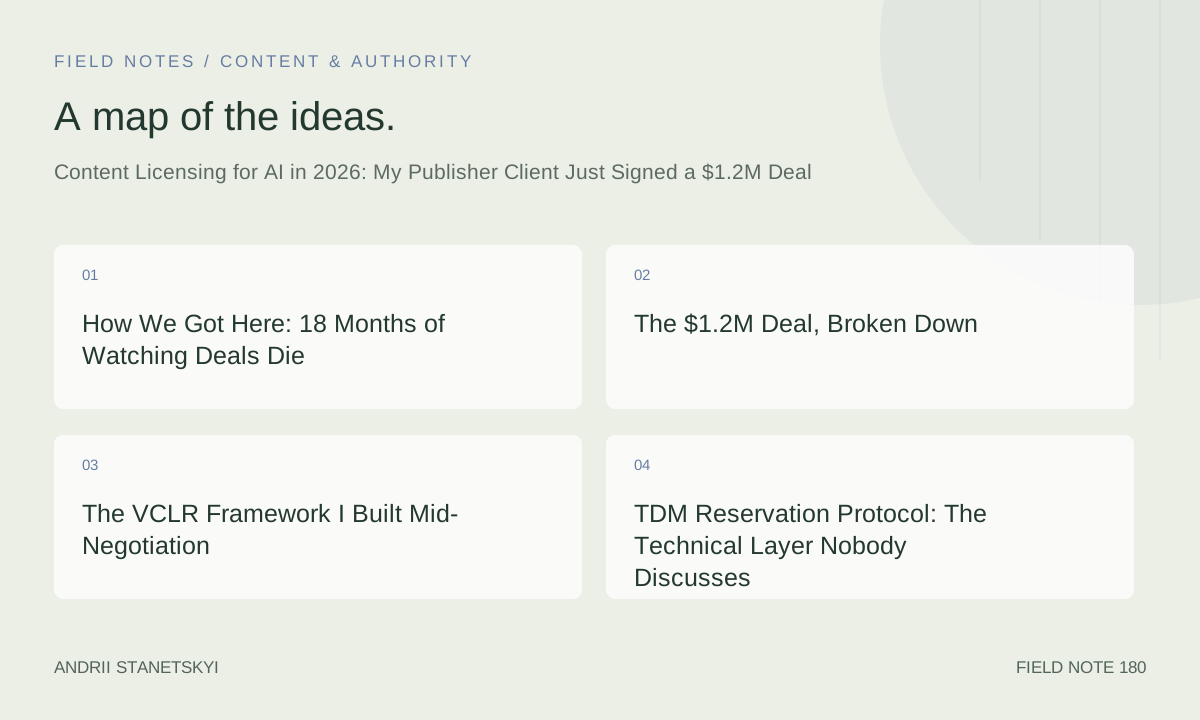
How We Got Here: 18 Months of Watching Deals Die
When the NYT-OpenAI litigation settled in early 2026 — the exact terms remain partially sealed, but reporting from Bloomberg and The Information puts the structured payment component north of $150 million over a multi-year window — it did not so much create a template as it did remove the last credible argument AI companies had for treating content ingestion as fair use without negotiation. The settlement outcome functioned as a market signal. Every mid-tier publisher watching from the sidelines read it the same way: the leverage window is open, but it will not stay open.
My client came to me in October 2024. At that point they had already received two inbound expressions of interest, both from intermediaries rather than from AI labs directly. One was from TollBit. The other was from a broker I will not name who offered a flat $285,000 for "perpetual, sublicensable, non-exclusive rights to the archive." My client was genuinely considering it. They were exhausted. Running a lean editorial operation, they had been watching traffic drop for fourteen months straight as AI Overviews swallowed their informational queries, and the idea of a clean $285,000 check felt like validation that the content was worth something.
I asked them to wait ninety days.
The landscape of reference deals in late 2024
The AP deal with OpenAI, originally announced in 2023 and renegotiated in 2024, established the principle that news wire content commanded different pricing than evergreen B2B editorial. AFP followed with a structurally similar arrangement. Reddit's deal — rumored at around $60 million across a multi-year term — established that platform-scale UGC had its own valuation logic. Springer Nature's licensing framework, concluded in mid-2024, set a precedent specifically relevant to my client: specialist, high-authority long-form content with demonstrable citation value in academic and professional contexts commands a multiplier that general interest content does not.
None of these deals had standardized term sheets. All of them were negotiated bilaterally under NDA. But enough detail leaked through court filings, earnings calls, and sources to construct a rough pricing model. That model became the foundation of the VCLR framework.
The $1.2M Deal, Broken Down
Let me be specific about the structure, because the structure is the lesson.
The $1.2 million breaks into three components. Component one: a $480,000 upfront archive access fee, payable at contract execution, covering training-data use of all content published before January 1, 2025. Component two: a $19,200 per quarter royalty payment tied to verified crawl events on post-2025 content, with a floor guarantee of $76,800 annually regardless of verified crawl volume. Component three: a $144,000 "inference attribution" bonus pool, payable in years three and four, conditional on the client being able to demonstrate through log analysis that their content is being cited or surfaced in AI-generated responses at a rate meeting a defined threshold.
The 47-month term was not arbitrary. It aligns with a content exclusivity window the client negotiated with their primary editorial contributors — their senior writers have 48-month first-look clauses in their contracts. We stopped one month short deliberately, giving the client a one-month window to reassess before any contributor exclusivity questions arose.
The counterparty is a mid-tier AI lab I am not naming at their request. They are not one of the top-three household names. They approached my client because the archive's subject matter — specialist B2B operational content — fills a known gap in their training corpus.
The VCLR Framework I Built Mid-Negotiation
About six weeks into the negotiation I realized I was making decisions without a coherent valuation model. I had been reacting to counteroffers rather than anchoring to a framework my client and I had agreed on in advance. So I built one. I call it VCLR: Volume, Coverage, Longevity, and Replaceability.
Volume is the raw count of indexable, high-quality content units. For my client: 340,000 pieces, of which approximately 190,000 passed a quality filter (1,200 words minimum, no duplicate or near-duplicate flagged, no content older than the client's editorial standards revision in 2008).
Coverage measures how much of the subject domain the archive addresses. I had my client run a topic-cluster analysis against their archive using their internal taxonomy. They cover 847 distinct topic nodes in their primary vertical. That is not comprehensive, but it is deep. Deep, narrow coverage commands a premium in AI licensing because training on it produces measurably better domain performance.
Longevity is the expected shelf life of the content's relevance. Evergreen B2B operational content ages differently than news. My client's archive has a 7-to-12-year relevance window on most pieces. That matters for inference use cases, where an AI model answering questions about, say, industrial procurement processes in 2027 is still drawing on content written in 2019.
Replaceability is the hardest variable. How easily could a well-resourced AI lab generate synthetic equivalents of this content? For general informational content, replaceability is high — the argument for licensing is weaker. For specialist operational content with embedded practitioner knowledge, replaceability is low. This is where my client's position was strongest and where I focused the most negotiation energy.
Running these four variables through a scoring rubric I built in a spreadsheet, my client's content scored in the 73rd percentile of estimated licensing value among comparable publishers — not top-tier, but well above the floor. That score anchored our opening ask and gave me something concrete to defend when the counterparty came back with a lower number.
TDM Reservation Protocol: The Technical Layer Nobody Discusses
Before any deal closes, publishers need a documented TDM (Text and Data Mining) reservation in place. This is not a legal technicality. It is the mechanism by which you establish that you have not implicitly consented to unconstrained crawling — and it directly affects your leverage in negotiations and, where relevant, litigation.
The EU DSM Directive Article 4 opt-out mechanism established TDM reservation as a legally meaningful signal in European jurisdictions. In the US context, its status is murkier, but the NYT settlement language (as reported) included language acknowledging the plaintiff's TDM reservation as evidence of the absence of implied license. That is significant.
Here is the minimum viable TDM reservation implementation:
# robots.txt — TDM reservation block
# Add to existing robots.txt, do not replace existing directives

# TDM Reservation — Article 4 DSM Directive (EU) / Common Law Rights (US)
# Last updated: 2026-01-15
# Contact: licensing@[yourdomain].com

User-agent: GPTBot
Disallow: /archive/
Disallow: /premium/
Crawl-delay: 10

User-agent: Claude-Web
Disallow: /archive/
Disallow: /premium/
Crawl-delay: 10

User-agent: PerplexityBot
Disallow: /archive/
Disallow: /premium/
Crawl-delay: 10

User-agent: Amazonbot
Disallow: /archive/
Disallow: /premium/
Crawl-delay: 10

# TDM reservation meta — machine-readable signal
# See: tdm-reservation.org specification v1.1
# X-Robots-Tag: tdm-reservation=1 (set in HTTP headers)
# See /.well-known/tdm-reservation.json for policy manifest
The /.well-known/tdm-reservation.json file is where the machine-readable policy lives. AI crawlers that have implemented the specification (a subset of them, growing) will read this before indexing. More importantly, having it in place means you can point to a timestamped, version-controlled policy document if the question of consent ever arises.
{
  "version": "1.1",
  "issued": "2026-01-15",
  "publisher": {
    "name": "[Publisher Name]",
    "contact": "licensing@[yourdomain].com",
    "jurisdiction": ["US", "EU"]
  },
  "tdm-reservation": true,
  "training-use": "prohibited-without-license",
  "inference-use": "permitted-with-attribution",
  "crawl-policy": {
    "allowed-bots": ["Googlebot", "Bingbot"],
    "licensed-bots": [],
    "restricted-bots": ["GPTBot", "Claude-Web", "PerplexityBot", "Amazonbot", "CCBot"],
    "rate-limit": "10-second-crawl-delay"
  },
  "licensing": {
    "inquiries": "licensing@[yourdomain].com",
    "intermediaries": ["contact directly — no blanket intermediary agreements in effect"]
  },
  "last-modified": "2026-01-15"
}
Set the X-Robots-Tag: tdm-reservation=1 HTTP header server-wide. On Apache, that is a one-line addition to your .htaccess or VirtualHost config. On Nginx, it goes in the add_header block. Do this before you start any negotiation. Without it, you are arguing from a weaker position.
Cloudflare Pay-Per-Crawl Configuration
Cloudflare's AI crawler metering product — currently in broad availability as of early 2026 — lets publishers charge per verified crawl event against licensed crawlers and block or rate-limit everything else. This is the infrastructure layer that makes the "quarterly royalty tied to verified crawl volume" component of my client's deal actually auditable.
The configuration lives in your Cloudflare dashboard under Security > Bots > AI Crawlers, but you can also set it via the API or Terraform. Here is a representative Workers-based configuration for publishers who need more granular control than the dashboard UI provides:
// cloudflare-worker-ai-crawler-gate.js
// Deploy as a Cloudflare Worker on your zone
// Routes: /*  (or restrict to /archive/*, /premium/*)

export default {
  async fetch(request, env, ctx) {
    const ua = request.headers.get('User-Agent') || '';
    const url = new URL(request.url);

    // Define licensed bots — update as licensing agreements change
    const LICENSED_BOTS = [
      'GPTBot/1.2',       // example: OpenAI — verify exact UA string
      'Claude-Web/2.0',   // example: Anthropic
    ];

    // Define restricted bots — block without license
    const RESTRICTED_BOTS = [
      'CCBot',
      'PerplexityBot',
      'Amazonbot',
      'FacebookBot',
      'Diffbot',
    ];

    const isLicensed = LICENSED_BOTS.some(bot => ua.includes(bot));
    const isRestricted = RESTRICTED_BOTS.some(bot => ua.includes(bot));

    // Log crawl event to KV for royalty auditing
    if (isLicensed) {
      const crawlEvent = {
        timestamp: new Date().toISOString(),
        bot: ua.substring(0, 80),
        path: url.pathname,
        verified: true,
      };
      // Write to KV — key structure: crawl:{date}:{random}
      const key = crawl:${new Date().toISOString().split('T')[0]}:${crypto.randomUUID()};
      ctx.waitUntil(env.CRAWL_LOG.put(key, JSON.stringify(crawlEvent), { expirationTtl: 7776000 }));
      return fetch(request); // pass through to origin
    }

    if (isRestricted) {
      return new Response('Crawling restricted. Licensing inquiries: licensing@[yourdomain].com', {
        status: 403,
        headers: {
          'X-Robots-Tag': 'noindex',
          'Content-Type': 'text/plain',
        },
      });
    }

    // Default: pass through for non-bot traffic and unknown UAs
    return fetch(request);
  }
};
The KV store write gives you an auditable crawl log. At the end of each quarter, you export the KV keys for the period, count verified crawl events, and reconcile against the royalty formula in the contract. My client's deal uses this log — stored in Cloudflare KV with a 90-day retention, then exported to a Google Cloud Storage bucket — as the authoritative source for royalty calculation. Both parties agreed in the contract that this log is the audit record. That agreement was harder to reach than the dollar amount itself.
Contrarian Take #1: Opt-Out Beats Opt-In, Always
The publishing industry consensus, as expressed in most industry association guidance I have seen, is that publishers should participate in opt-in registries — centralized systems where you affirmatively register your content for licensed AI use, set your price, and wait for buyers to find you. The logic seems reasonable. You are making yourself available. You are signaling willingness to deal.
I think this is wrong, and I think it costs publishers money.
Here is why. When you opt into a registry, you implicitly accept two premises: first, that the registry's pricing model is adequate for your content; second, that your content's value is comparable to other content in the registry. Neither premise holds for publishers with genuinely specialized archives.
Opt-out positioning — blocking all crawlers by default, requiring bilateral negotiation for licensed access, maintaining a public TDM reservation — creates scarcity. Scarcity creates leverage. The counterparty has to come to you, explain what they want, and justify a number. That is a fundamentally different negotiating dynamic than competing in a registry catalog where your content is one of ten thousand comparable listings at a standard per-token price.
My client's archive would have generated approximately $38,000 in registry income over a 12-month period based on the rate structures I have seen from the major opt-in platforms. Instead, they are collecting $480,000 at signing. The difference is not explained by the content quality alone. It is explained by negotiating position.
The counterargument is that opt-out requires active management and legal attention that smaller publishers cannot afford. That is fair for very small operations. But any publisher with more than 50,000 pieces of quality content has enough asset value to justify the overhead of bilateral negotiation, or to hire someone to run it for them.
Contrarian Take #2: TollBit Is Overhyped and Here Is Why
TollBit launched with compelling positioning as an infrastructure layer between publishers and AI crawlers — essentially a metered paywall for bot traffic, with automated billing and a marketplace for content discovery. The coverage it received in 2024 was enthusiastic. Several publisher associations recommended it.
I have now watched three of my clients engage with TollBit's process, and my honest assessment is that the product is solving a real problem but at a price point and with a market structure that primarily benefits TollBit, not publishers.
The core issue: TollBit's marketplace creates downward pressure on per-crawl pricing because it aggregates supply. When an AI lab shopping for content can browse a catalog of thousands of publishers at standardized rates, the negotiating advantage sits with the buyer. The lab can pick and choose, mix and match, and walk away from any individual publisher without losing access to the broader content pool. The publisher, by contrast, is one of thousands of similar listings competing on price.
TollBit's own pricing data, shared in a March 2026 blog post, showed median publisher revenue of approximately $2,400 annually per domain. That is not a meaningful revenue stream for a professional editorial operation. It is beer money dressed up as a licensing program.
There are cases where TollBit makes sense — very small publishers who lack the volume or subject-matter specificity to attract bilateral interest, and for whom automated collection of small amounts is genuinely better than nothing. For anyone with a credible archive, I would not lead with it. I would use it as a fallback after bilateral negotiations have run their course, and only then.
Scalepost, the other prominent intermediary, has a slightly different model that I find modestly more favorable to publishers — their rev-share structure puts a larger percentage back to content owners, and they have better tooling for verifying crawl attribution. But the same fundamental critique applies: aggregated supply, buyer's market, compressed pricing.
The Mistake I Made That Cost My Client Eight Months
In January 2025, three months into my engagement, I advised my client to respond to an inbound inquiry from one of the top-three AI labs by providing a full content manifest — essentially a structured inventory of their entire archive, including topic distribution, word counts by category, quality scores, and update frequency by section.
My reasoning was that demonstrating the archive's depth and quality would accelerate the lab's evaluation process and get us to a term sheet faster. I was wrong about the effect, right about the outcome not being what I expected.
The lab took the manifest, spent six weeks evaluating it, and came back with a lowball offer. When we declined and resumed discussions four months later, I discovered through a contact at another publisher that the lab had used our manifest's topic-distribution data to identify gaps in our competitor's archive — and had quietly licensed the competitor's content in the interim to fill those gaps. By the time we got to serious negotiations, the lab's urgency had dropped because they had partially addressed their coverage problem through another source.
Providing the manifest too early, too completely, gave the counterparty map that they used against us. We recovered — the deal I described above is with a different counterparty, one that genuinely needed our specific archive — but we lost eight months of clock and nearly $200,000 in earlier-signing value that would have accrued if we had closed faster.
What I do now instead: provide a tiered content sample — a representative 2,000-piece random draw from the archive, without the full structural metadata — and require an NDA and a preliminary term sheet before releasing the full manifest. The lab needs to have skin in the game before they get the map.
Using Reddit, AP, and Springer as Templates
I have read every public account of the major AI content licensing deals closely enough that I can tell you which elements generalize and which do not.
The AP deal's most replicable element is the distinction between training use and inference use as separately priced rights. Training use — ingesting content to improve a base model — is a one-time value extraction. Inference use — serving AI-generated responses that draw on your content in real time — is an ongoing value extraction. The AP deal, as reported, priced these separately. My client's deal does too. Any publisher who signs a deal that bundles these into a single flat fee is almost certainly undervalued.
From Reddit: the principle that UGC and editorial content command different rates even within the same publication. If you have a comments section, forum content, or user-submitted material, price it separately and lower. Mixing it with editorial content in a single licensing category depresses the editorial rate.
From Springer: the academic citation multiplier. Springer's deal reportedly included a provision that content demonstrably cited in peer-reviewed literature commands a per-piece premium. The logic is sound — high-citation content has demonstrated epistemic authority that transfers to AI outputs, making it more valuable for training. My client's archive includes a body of content that has been cited in industry research reports and trade publications. We identified and inventoried those pieces specifically and priced them at a 2.3x multiplier relative to the base editorial rate.
Rights Manifest Examples
The rights manifest is a machine-readable document that accompanies your licensed content delivery and specifies what the licensee can and cannot do. Getting this right matters because AI labs are increasingly automating their ingestion pipelines — a well-formed manifest gets processed correctly; a poorly formed one either gets ignored or leads to rights violations that neither party intended.
Here is the structure I use for archive licensing deals:
{
  "schema": "content-rights-manifest",
  "version": "2.1",
  "generated": "2026-04-01T00:00:00Z",
  "publisher": {
    "name": "[Publisher Name]",
    "ror": "https://ror.org/[ror-id]",
    "contact": "licensing@[yourdomain].com"
  },
  "licensee": {
    "name": "[AI Lab Name]",
    "agreement_id": "LIC-2026-0047",
    "agreement_date": "2026-04-30"
  },
  "content_scope": {
    "total_pieces": 190412,
    "date_range": {
      "start": "2003-01-01",
      "end": "2024-12-31"
    },
    "excluded_categories": ["sponsored-content", "press-releases", "syndicated"],
    "premium_tier": {
      "pieces": 8204,
      "pricing_multiplier": 2.3,
      "basis": "external-citation-verified"
    }
  },
  "permitted_uses": {
    "training": {
      "permitted": true,
      "scope": "base-model-training",
      "sublicensable": false
    },
    "inference": {
      "permitted": true,
      "attribution_required": true,
      "attribution_format": "url-and-publisher-name"
    },
    "derivative_works": {
      "permitted": false
    },
    "resale": {
      "permitted": false
    }
  },
  "audit": {
    "crawl_log_source": "cloudflare-kv",
    "reporting_cadence": "quarterly",
    "dispute_resolution": "binding-arbitration-AAA"
  }
}
The premium_tier block is something I added after the Springer research. It requires pre-work — you have to actually identify and tag your high-citation content — but it gives the manifest an internal pricing differentiation that the licensee's ingestion pipeline can process automatically. Without it, your premium content gets priced at the base rate by default.
What Publishers Should Be Doing Right Now
The leverage window is real but it is narrowing. Here is the sequence I recommend based on where we are in May 2026.
First, get your TDM reservation in place. Robots.txt, .well-known/tdm-reservation.json, HTTP headers. Do this before you talk to anyone. It takes a developer two hours and it matters more than most legal filings.
Second, run your archive through the VCLR scoring rubric. Volume and coverage you can assess yourself. Longevity requires a content audit, which is a bigger lift but worth doing. Replaceability is the judgment call — get outside eyes on it if you can. The output tells you whether you have bilateral negotiation leverage or whether you are genuinely a registry-tier publisher. Know which you are before you decide on strategy.
Third, do not respond to inbound inquiries with a full manifest. Respond with a 2,000-piece sample and a request for an NDA and preliminary terms. This step alone has saved my clients collectively a substantial amount of negotiating position.
Fourth, price training and inference separately. This is not standard practice yet among smaller publishers and it is a consistent source of undervaluation. Structure your ask with two line items. The lab will push back; that pushback tells you what they value.
Fifth, audit your contributor contracts. If you have freelancers, columnists, or staff writers with content ownership clauses, you need to know what you can and cannot license before you sign anything. My client's 47-month term structure was driven entirely by a contributor contract provision. Discover these constraints before the counterparty does.
See also: managing AI crawlers at the technical level, implementing llms.txt for your publication, defensive scraping countermeasures, tracking AI citation attribution, and why E-E-A-T still matters even after the AI licensing moment.
External reference: the TDM Reservation Protocol specification and the IFLA position statement on AI and information access are the two external documents I reference most often in client-facing materials.
The $1.2 million is not a number I expect every publisher to replicate. It is a function of a specific archive's characteristics, a specific counterparty's needs, and a specific moment in a fast-moving market. What I do expect to generalize: the principle that publisher content has quantifiable licensing value, that bilateral negotiation produces better outcomes than marketplace listing for specialized archives, and that the technical infrastructure to enforce and audit rights is accessible enough that not having it in place is no longer defensible.
My client is now three weeks post-signing and already fielding a second inbound inquiry from a different lab. They are handling it themselves. I consider that the actual measure of a successful engagement — not the dollar amount, but whether my client understands the framework well enough to run the next one without me. So far, so good.
Frequently Asked Questions
What is a TDM reservation and does it have legal weight in the US?
A TDM (Text and Data Mining) reservation is a machine-readable and human-readable signal that a publisher has not granted implicit consent to AI crawling for training or inference purposes. In EU jurisdictions, Article 4 of the DSM Directive gives this reservation explicit legal weight — rightsholders who opt out can prevent commercial TDM even where it would otherwise be permitted. In the US, the legal status is less settled, but evidence from the NYT-OpenAI settlement suggests that courts and negotiating parties treat a documented TDM reservation as meaningful evidence of the absence of implied license. It should not replace legal counsel, but it should be implemented regardless.
How are AI content licensing deals typically structured in 2026?
The emerging standard, based on publicly reported deals and negotiation experience, separates training use from inference use as distinct priced rights. Training use — ingestion for model training — is often priced as a one-time or periodic flat fee tied to archive scope. Inference use — drawing on content to generate real-time responses — is increasingly priced on a per-crawl or per-query royalty basis. Premium content tiers based on citation authority or subject-matter specificity command multipliers above the base rate. Deal terms in 2026 typically run 24 to 60 months, with quarterly royalty reconciliation and auditable crawl logs as standard provisions.
Is Cloudflare's AI crawler metering product actually auditable for royalty purposes?
Yes, with caveats. Cloudflare's KV-based crawl logging, as implemented via Workers, produces a timestamped, path-level record of verified bot interactions. This log is sufficient for quarterly royalty reconciliation when both parties agree in the contract to treat it as the authoritative audit record. The caveat: Cloudflare user-agent matching depends on bots accurately identifying themselves, and some crawlers use rotating or spoofed user-agent strings. For high-stakes licensing deals, supplement Cloudflare logging with server-side access log analysis and, where possible, cryptographic verification tokens provided to licensed bots at session initiation.
Should small publishers bother with bilateral licensing negotiations or just use a platform like TollBit?
The threshold I use is roughly 50,000 pieces of quality content in a specialized domain, or 20,000 pieces with exceptional citation authority. Below that threshold, the overhead of bilateral negotiation — legal review, technical implementation, negotiation time — likely outweighs the incremental value over platform rates. Above that threshold, bilateral negotiation almost always produces materially better outcomes for publishers with specialized archives, because it preserves scarcity and forces the counterparty to justify their valuation rather than shopping a catalog. For publishers in the middle range, a hybrid approach — TollBit or Scalepost for smaller inbound interest while maintaining bilateral capacity for major labs — is reasonable.
What is the VCLR framework for content valuation?
VCLR stands for Volume, Coverage, Longevity, and Replaceability. Volume is the count of quality-filtered content units. Coverage measures how thoroughly the archive addresses its subject domain. Longevity estimates how long the content will remain relevant for AI inference use cases. Replaceability assesses how easily an AI lab could generate synthetic equivalents of the content. Each variable is scored on a defined rubric and combined into a composite score that anchors the opening ask in licensing negotiations. The framework is most useful for establishing an internal anchor before receiving counteroffers — it prevents reactive negotiation and gives both the publisher and their advisor a defensible basis for their number.