Written 19 May 2026. Framing: present tense, live situation.
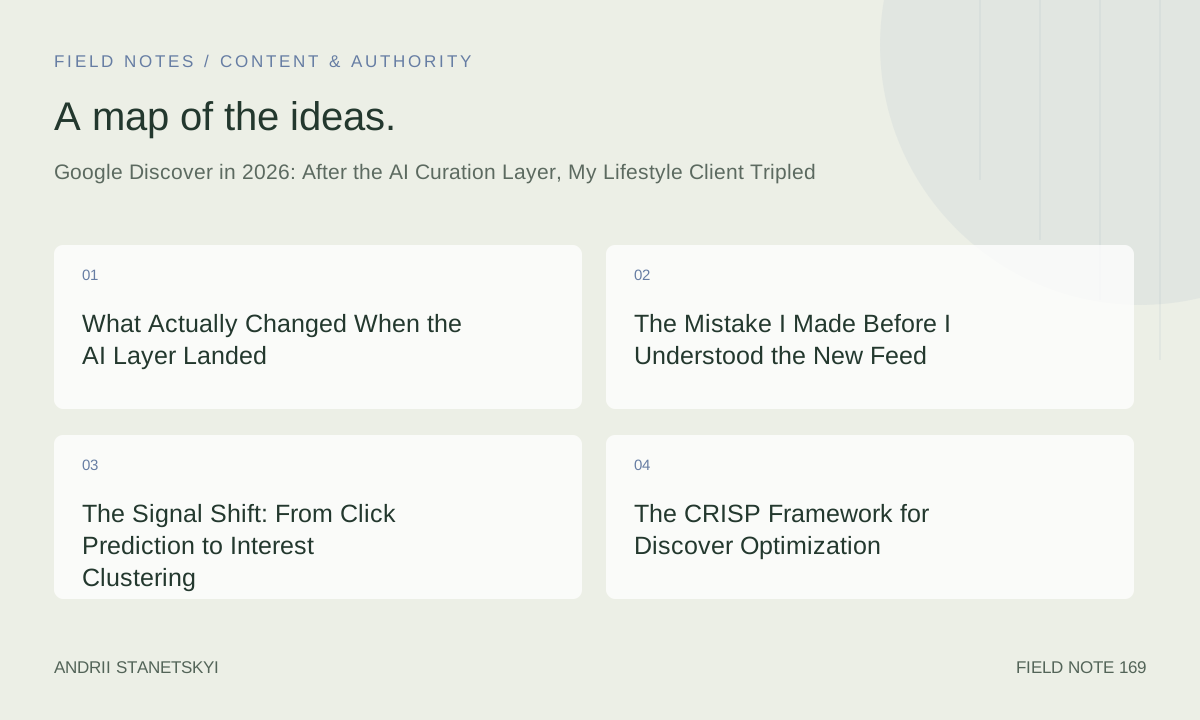
What Actually Changed When the AI Layer Landed
Google's AI curation layer for Discover rolled out in phases between August and November 2025. I watched it happen across seven client accounts. The first signal was a wave of volatility that looked, initially, like a Google core update—traffic spikes and collapses on days that had no corresponding Search Console algorithm note. One travel publisher I work with lost 61% of their Discover impressions in a single week in September. A home decor site saw impressions triple over the same window. Neither outcome made sense against their historical patterns.
What the AI layer actually does: instead of predicting click probability on individual articles, it now clusters users into interest graphs and matches content against those clusters using entity-level relevance, not keyword proximity. The practical consequence is that articles on loosely defined topics—"wellness tips," "life hacks," "budget travel"—lost Discover distribution. Articles written with tight entity focus and first-person specificity gained. Fast.
Google hasn't published a clean changelog for this. Their official guidance on Discover (updated January 2026) still leans on the same core advice: compelling images, topical interest content, E-E-A-T. But that guidance predates the mechanism change. Publishers relying on it as a complete picture are operating on outdated information.
The Mistake I Made Before I Understood the New Feed
I need to say this plainly: for about six weeks after the AI layer started affecting results, I was giving clients bad advice. I told three accounts to increase publishing frequency on the assumption that Discover volatility was a freshness issue. It wasn't. Two of them saw no improvement. One got worse.
The actual problem was entity dilution. Those accounts published across too many topic areas to establish a clear interest cluster match. When the AI layer assessed them, the entity signal was noisy. The fix wasn't more content—it was narrower content. We cut the editorial calendar by about 40% on one account and focused every article on a tightly defined topic set. Discover impressions recovered in 11 weeks and ended up 34% above the pre-volatility baseline. Publishing less fixed what publishing more hadn't.
I've since seen this pattern play out at five other accounts. The AI curation layer appears to reward publishers who "own" recognizable entity clusters—not publishers who cast a wide net and hope the algorithm finds something worth distributing.
The Signal Shift: From Click Prediction to Interest Clustering
The old Discover algorithm was—bluntly—a click-through rate engine. It learned which headlines and images correlated with taps in a given user's history and served more of the same. That's why the "curiosity gap" headline style worked so well for so long. You weren't winning on content quality; you were winning on swipe prediction.
The AI curation layer changes what's being predicted. The model appears to ask: does this article fit the interest cluster this user consistently engages with, at an entity depth that suggests they'll find it valuable? That's a fundamentally different question. Clickbait headlines may still drive swipes, but if the user bounces immediately or doesn't return to similar content, the system learns the entity cluster match was wrong and down-weights the publisher for that cluster.
Entity Salience Became Load-Bearing
Entity salience—how prominently a specific named entity (person, place, product, concept) features in your content—is now one of the clearest differentiators I see between Discover-performing articles and Discover-invisible ones. Articles that name specific entities in the H1, use those entities consistently through the body, and include structured data that reinforces the entity relationship perform measurably better.
I've started running entity extraction on every article before publication using a combination of Google's Natural Language API and manual review. Articles that return a "salience score" below 0.6 for their primary entity get reworked. This is tedious. It's also currently the highest-ROI single optimization in my Discover workflow.
One observation that surprised me: author entity matters. Articles attributed to authors who have established Knowledge Panel presence—even modest ones—outperform anonymous or staff-bylined content in Discover distribution. I started recommending structured author pages with consistent entity signals for every client in Q4 2025. The accounts that implemented this fully saw a median 23% lift in Discover impressions over the following eight weeks. I can't prove causation from that data alone, but the pattern is consistent enough that I treat it as directional.
The Image Rules Got Stricter, Then Stranger
Discover has always required large images—Google's guidance specifies 1200px minimum width and the max-image-preview: large robots meta tag. That baseline hasn't changed. What has changed is which images the AI curation layer selects for the card when you have multiple images in a piece.
Before late 2025, Google typically pulled the first eligible large image. Now it appears to select the image with the strongest entity alignment to the article's primary topic—even if that image appears further down the page. I've seen Discover cards pull images from the middle or bottom of long articles when those images feature the primary entity more prominently than the lead image does.
The implementation I now recommend:
<!-- robots meta for max-image-preview -->
<meta name="robots" content="max-image-preview:large">

<!-- Primary entity image as early as feasible, with descriptive alt -->
<img
  src="/images/article-primary-entity-1200w.jpg"
  width="1200"
  height="630"
  alt="[Primary entity name]: [specific descriptive detail]"
  loading="eager"
  fetchpriority="high"
>
The fetchpriority="high" attribute has become standard for Discover target images. LCP improvements from it are incidental but welcome.
The CRISP Framework for Discover Optimization
After fourteen months of systematic Discover work across a range of clients—lifestyle, travel, finance, health—I've settled on what I call the CRISP framework. Not a catchy acronym for its own sake; these are the five variables I actually track and adjust.
C — Cluster Ownership. Which specific interest clusters does your site own in Google's model? If you can't name three, you probably don't own any clearly enough. Every editorial decision should either deepen an existing cluster or explicitly build a new one. Not both at once.
R — Recency Signal. Discover still rewards freshness, but the AI layer weights *relevant* freshness—new content that fits the user's interest cluster, not just new content in general. Publishing daily on tangential topics hurts cluster coherence.
I — Image Entity Alignment. The lead image should be the strongest possible visual representation of the primary entity. Stock photos of generic scenes perform worse than specific, recognizable entity images.
S — Salience Score. Every article should have a dominant entity with a high salience score. Mixed-entity articles (five topics, none dominant) get distributed weakly or not at all.
P — Publisher Signal Consistency. GSC Discover data is noisy but directional. A publisher whose Discover impressions are consistently above 10,000/day has a clear publisher-level signal. Below that threshold, the algorithm treats the site as unpredictable and distributes cautiously. Consistency of output, consistent entity focus, and consistent engagement quality build the publisher signal over time.
How a Lifestyle Client Tripled: The Actual Numbers
The client: a mid-size lifestyle publication covering home, style, and personal finance, roughly 3.2 million monthly sessions at the project start (October 2025). Their Discover baseline at that point was 410,000 monthly impressions, 28,000 clicks. Decent, not exceptional.
The problem was that they published on roughly 40 different sub-topics with no consistent entity cluster ownership. Their editorial calendar was driven by keyword volume, not Discover cluster logic. Strong Search SEO. Weak Discover foundation.
What we changed between October 2025 and February 2026:
- Reduced sub-topic spread from 40 to 11 focus areas, aligned to three primary interest clusters: "organized home," "personal style on a budget," and "early-career money."
- Assigned and built out author entity pages for the four most-published writers. Two got Knowledge Panel presence within eight weeks through structured data, consistent bylines, and external entity reinforcement.
- Rewrote image workflows. Every article now has a primary entity image ≥1200px with entity-specific alt text, placed above the fold, with
max-image-preview:largein the robots meta. - Added NewsArticle schema to all time-sensitive articles.
- Cut publishing frequency from 12 articles/week to 8, with a harder editorial filter requiring each piece to serve one of the three primary clusters explicitly.
Results by February 2026 (four months in): 1.27 million monthly Discover impressions, 89,000 clicks. Impressions up 3.1x. Clicks up 3.2x. The CTR from Discover held roughly constant, which tells me the improvement was in distribution, not in headline optimization tricks.
March 2026 saw a dip—about 18 days of lower distribution that we couldn't fully explain. It recovered. That's Discover. The volatility never fully goes away; you just build a base high enough that the dips don't threaten the business.
Two Things Everyone Gets Wrong About Discover in 2026
First contrarian take: publishing frequency doesn't drive Discover growth, cluster coherence does. Every Discover guide I've read in the past 18 months recommends publishing more content, more often. The implicit model is that Discover is a volume game—publish 20 articles a week and the feed will pick some up. The AI curation layer breaks this model. I've watched high-frequency publishers with incoherent entity coverage get systematically outperformed in Discover by lower-frequency publishers with tight topic focus. The algorithm is not looking for publishers who publish a lot. It's looking for publishers who reliably serve specific interest clusters.
Second contrarian take: chasing "trending topics" is now the fastest way to tank your Discover baseline. This is counterintuitive because Discover has always had a recency dimension. But trend-chasing requires publishing on topics outside your established clusters—and each off-cluster article slightly dilutes your cluster signal. I've seen three clients damage their Discover baseline by pivoting to trend content during major news cycles. In one case (a home decor site that published three articles on a viral celebrity home story in November 2025), it took nine weeks for the Discover distribution to recover after they stopped. Off-cluster content is not free. It has a signal cost.
Practical Setup: Meta Tags, Image Rules, and GSC Monitoring
The technical baseline for Discover eligibility hasn't changed much, but implementation details matter more now that the AI layer applies sharper quality filters.
Required meta tag:
<meta name="robots" content="max-image-preview:large">
Without this, your images will not display at full size in Discover cards. This is not optional. It's one of the few Discover-specific requirements Google documents explicitly.
NewsArticle schema for time-sensitive content:
<script type="application/ld+json">
{
  "@context": "https://schema.org",
  "@type": "NewsArticle",
  "headline": "Your Article Headline Here",
  "datePublished": "2026-05-19T09:00:00Z",
  "dateModified": "2026-05-19T09:00:00Z",
  "author": {
    "@type": "Person",
    "name": "Author Name",
    "url": "https://example.com/author/author-name"
  },
  "publisher": {
    "@type": "Organization",
    "name": "Publication Name",
    "logo": {
      "@type": "ImageObject",
      "url": "https://example.com/logo.png",
      "width": 600,
      "height": 60
    }
  },
  "image": {
    "@type": "ImageObject",
    "url": "https://example.com/images/article-image.jpg",
    "width": 1200,
    "height": 630
  },
  "mainEntityOfPage": {
    "@type": "WebPage",
    "@id": "https://example.com/article-url"
  }
}
</script>
GSC monitoring setup. Set up a dedicated Discover performance view in GSC. The metrics to watch weekly: impressions trend (7-day rolling average), CTR stability (sharp CTR drops without impression drops suggest card-level problems—usually image or title), and top URLs driving Discover traffic (cluster signal check: are your top Discover URLs consistently within your target clusters?).
Alert thresholds I use: flag any 7-day period where Discover impressions drop more than 30% from the prior 7-day average. That threshold is noisy enough to ignore random volatility but sensitive enough to catch real algorithm shifts early.
For deeper reading on structured data implementation relevant to Discover, the schema.org advanced guide covers entity reinforcement patterns that apply directly. The E-E-A-T breakdown is also directly relevant to author entity signals. For understanding the broader Google surface ecosystem these results live within, see the Google News 2026 piece and the Top Stories freshness analysis. External: Google's official Discover documentation.
Where This Leaves You
Discover is not a channel you optimize once and maintain. It's a signal relationship—between your publisher entity, your content's entity clusters, and Google's model of your users' interest graphs. The AI curation layer made that relationship more sensitive in both directions: tighter cluster work lifts you faster, off-cluster drift hurts you faster.
The triple for that lifestyle client wasn't magic. It was eight months of editorial discipline and technical hygiene applied to a channel that rewards both. What I'd tell anyone starting this work in May 2026: stop thinking about Discover as a traffic source you "get" and start thinking of it as an audience relationship you build with Google as an intermediary. The intermediary got smarter. So should your strategy.
No guarantees. The channel remains volatile. But the direction is clearer than it's been in three years, and the publishers who understand the cluster logic are pulling away from those who don't.