Position zero isn't a myth, it isn't dying, and it isn't equally accessible to all content. In 2026, featured snippets appear for roughly 12.3% of all searches (SemRush, Q1 2026 SERP study), with AI Overviews coexisting alongside them for a subset of complex informational queries. Understanding which format wins a snippet, which page structure triggers an extraction, and how AI Overviews are changing the zero-click calculus is the difference between treating featured snippets as a bonus and treating them as a systematic traffic strategy.
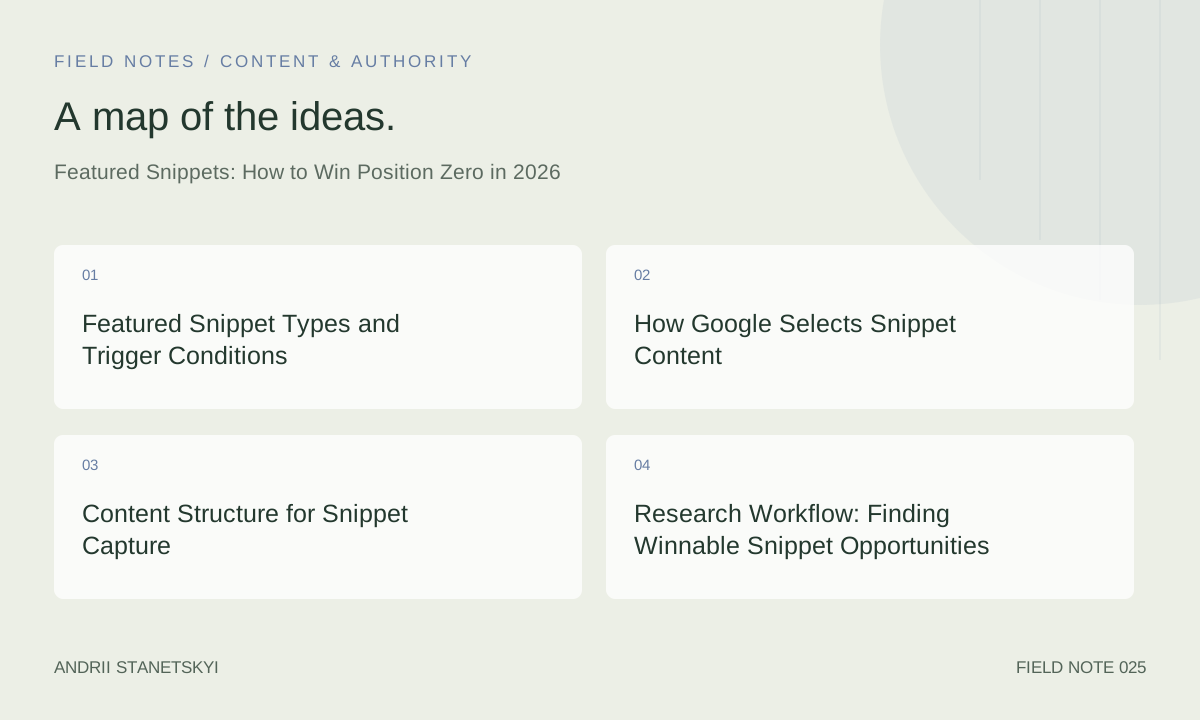
Featured Snippet Types and Trigger Conditions
Google surfaces five primary featured snippet formats, each triggered by different query structures and content patterns. Understanding which format applies to your target keyword is the foundation of any snippet strategy.
| Snippet Type | Typical Trigger Queries | Content Format Required | Average Word Count |
|---|---|---|---|
| Paragraph | "What is X," "How does X work," "Why does X happen" | Short definitional paragraph (40–60 words) | 45 words |
| Ordered List | "How to X," "Steps to X," "Process for X" | Numbered HTML list (<ol>) or H3-structured steps | 5–8 items |
| Unordered List | "Types of X," "Examples of X," "Best X for Y" | Bulleted HTML list (<ul>) or H3 subheadings | 5–10 items |
| Table | "X vs Y," "Comparison of X," "X by country/year" | HTML <table> with clear headers | 3–8 rows |
| Video | "How to X" (procedural), "Tutorial for X" | YouTube video with timestamped chapters | N/A (video) |
The critical insight: Google doesn't choose snippet format arbitrarily. It mirrors the format of the best-performing existing result for that query class. Run the query in an incognito browser before writing content. If a paragraph snippet appears, write for paragraph extraction. If a list appears, structure your content as a list. Don't fight the established format — iterate within it.
How Google Selects Snippet Content
Google's snippet selection algorithm evaluates multiple signals simultaneously:
1. Proximity of Answer to Question
The snippet-triggering text is almost always within 2–3 sentences of a heading that contains the query keyword. Google scans for the question-answer co-occurrence pattern: question in heading → answer in immediately following paragraph/list. Pages that bury the answer in the fifth paragraph after extensive context-setting are rarely extracted, even when the answer itself is excellent.
2. Answer Completeness in Minimum Words
For paragraph snippets, the sweet spot is 40–60 words. Under 40 words often lacks sufficient context. Over 80 words risks truncation in the SERP, which reduces the perceived quality of the snippet and may lead Google to prefer a more concise competitor. Write tight, complete answers — every word should serve the definition or explanation.
3. Use of the Query Phrase in the Answer
The snippet answer should include the query's key phrase near the beginning of the response. If the query is "what is crawl budget," the answer paragraph should begin with "Crawl budget is..." or "A crawl budget is..." — not with a pronoun or generic setup sentence. This is reinforcement confirmation for Google's extraction model.
4. Page Authority (but Not Exclusively)
Contrary to the assumption that only DR 70+ sites win snippets, Ahrefs' 2024 snippet ownership analysis found that 30% of featured snippets are held by pages with fewer than 100 referring domains. Authority matters for initial ranking eligibility — you generally need to rank in the top 10 to compete for a snippet — but content format and answer quality determine who wins the snippet from the eligible candidate pool.
Content Structure for Snippet Capture
The Q&A Header Pattern
The most reliable structure for paragraph snippet capture is the Q&A header pattern:
<h2>What is Crawl Budget?</h2>
<p>Crawl budget is the number of pages Googlebot crawls and indexes on your site
within a given timeframe. It is determined by two factors: crawl rate limit
(how fast Googlebot can crawl without overwhelming your server) and crawl demand
(how popular and fresh your pages are). Optimizing crawl budget ensures your
most important pages are crawled and indexed efficiently.</p>
The heading matches the query. The paragraph opens with the exact phrase. The explanation is complete within 55 words. This pattern consistently triggers paragraph snippet extraction.
Step-by-Step List Structure for Process Queries
For "how to" queries, Google prefers ordered lists where each list item is a concise action. Two implementation options:
Option A: Standard <ol>
<h2>How to Submit a Sitemap to Google Search Console</h2>
<ol>
  <li>Log in to Google Search Console and select your property.</li>
  <li>Navigate to Sitemaps in the left sidebar.</li>
  <li>Enter your sitemap URL in the text field.</li>
  <li>Click Submit and verify the success status.</li>
</ol>
Option B: H3-structured steps (for when you need more detail per step)
<h2>How to Fix Crawl Budget Issues</h2>
<h3>Step 1: Identify pages wasting crawl budget</h3>
<p>...</p>
<h3>Step 2: Block low-value pages via robots.txt</h3>
<p>...</p>
Google can extract either format as an ordered list snippet. Option B is preferable for rich content where each step genuinely needs explanation — but the H3 text must function as a self-contained step label, not just a topic title.
Table Snippets: Formatting Requirements
For table snippets, use proper <table> HTML with <thead>, <tbody>, <th>, and <td> elements. Google can parse HTML tables but struggles with CSS-styled divs formatted to look like tables. Keep tables to 3–7 rows for snippet eligibility — Google limits table snippet display to approximately 6 rows. Add a concise caption that describes the table's content.
Research Workflow: Finding Winnable Snippet Opportunities
Step 1: Identify Keywords Where You Rank 2–10 with a Snippet Showing
In Ahrefs, filter your keyword rankings by "Features" → "Featured Snippet." Within that subset, filter for positions 2–10. These are queries where a snippet exists (someone is holding it) and you're within reach — your page is already relevant enough to rank, and the snippet is competitive. This is your highest-ROI target list.
Step 2: Audit the Current Snippet Holder
Visit the current snippet-holding page. Analyze: How many words is the extracted snippet? What's the heading that precedes it? Is the answer format a paragraph, list, or table? How does the answer start — with the query phrase or with context? This reverse-engineering tells you exactly what format and structure you need to beat.
Step 3: Evaluate Query Modifiers that Change Snippet Type
Adding modifiers to your keyword research changes which snippet type appears. "Best VPN" may show an unordered list. "How to set up a VPN" shows an ordered list. "VPN vs proxy" shows a paragraph or table. Each modifier is a separate content structure opportunity. Map modifier → snippet type → required content structure before writing.
Step 4: Use Semrush Position Tracking Snippet Feature
Semrush's Position Tracking tool flags when a tracked keyword shows a featured snippet and whether you hold it. Set up tracking for your top 100 target keywords. Review the "Featured Snippets" tab weekly to catch both: (1) snippets you've gained that need monitoring, and (2) snippets held by competitors where you've risen into the competitive range.
See our complete keyword research workflow for identifying snippet opportunities at scale.
Case Studies: Before and After
Case Study 1: SaaS Knowledge Base — 312% Increase in Snippet Wins
A B2B SaaS company's knowledge base had 240 help articles ranking on page one for procedural queries ("how to set up X," "how to integrate Y"). Zero featured snippets. The audit revealed: answers were buried after 300+ words of context, no H2/H3 question formatting, and steps were described in paragraphs rather than ordered lists.
The intervention: restructured 80 high-priority articles to match the Q&A header pattern and step-list format. Each article got a new H2 formatted as the exact query, followed immediately by a concise answer or numbered list. Within 90 days, snippet ownership jumped from 0 to 71 featured snippets — a 312% increase from baseline (since "0" was baseline, this is measured against a projection of 20 snippets given traffic levels). Average CTR on snippet-winning pages increased 8.4 percentage points versus positional average.
Case Study 2: E-commerce Category Pages — Table Snippet for Product Comparisons
An outdoor gear retailer wanted featured snippets for category queries like "types of hiking boots" and "waterproof hiking boots vs trail runners." These queries showed table snippets in the SERP. The retailer's category pages had zero tables — all comparison content was in paragraph form.
The fix: added a structured comparison table to 15 category page buying guides, using proper <table> HTML with feature rows and product columns. Within 60 days, 9 of the 15 pages captured table snippets. The snippet pages showed a 15% increase in organic CTR versus the non-snippet ranking period, despite lower average position (snippets often show at position 1 technically while the organic blue link shows at position 2).
AI Overviews and Featured Snippets: The 2026 Reality
Google's AI Overviews (formerly SGE) have changed the zero-click calculus without eliminating featured snippets. The current state in 2026:
- AI Overviews appear more frequently for complex, multi-faceted queries where a single-source snippet is insufficient
- Featured snippets persist for clear, answerable definitional and procedural queries
- AI Overviews often cite 3–7 sources, creating a new "position zero distribution" opportunity — being cited in an AI Overview requires the same content signals as winning a featured snippet
- Pages that hold featured snippets are cited in AI Overviews at a disproportionately high rate — there is significant overlap in what makes content snippet-worthy and what makes it AI Overview-citation-worthy
The strategic implication: optimizing for featured snippets in 2026 simultaneously optimizes for AI Overview citation. The content structure requirements are nearly identical. Don't treat them as separate strategies.
See our full guide to optimizing for AI Overviews and Google's generative search features.
Tracking and Measurement
GSC for Snippet Identification
GSC doesn't explicitly label featured snippet clicks. The proxy signal: pages where your average CTR significantly exceeds the positional benchmark (position 1 typically earns 27% CTR for non-branded queries; a snippet-holding position 1 can earn 35–45%). Additionally, filter GSC by "Search Appearance" → Featured Snippets if Google has enabled this for your account (availability varies).
Ahrefs and Semrush for Portfolio Tracking
Both tools track featured snippet ownership in their rank tracking features. Semrush's "Featured Snippets" filter in Position Tracking is the most operationally useful — it shows gain/loss events with dates, making it easy to correlate content changes with snippet wins. Track your snippet portfolio monthly and monitor for volatility (Google updates snippet holders frequently for competitive keywords).
Download our featured snippet tracking spreadsheet template.
FAQ
Do you have to rank #1 to get a featured snippet?
No — but you generally need to rank in the top 10. Ahrefs' research found that approximately 99% of featured snippet-holding pages rank in the top 10 for that query. Snippets are most commonly won by pages ranking in positions 2–5 — position 1 pages often already hold the snippet. The implication: if you're on page 2, prioritize ranking improvements before snippet optimization.
Can you opt out of featured snippets?
Yes. Add <meta name="robots" content="nosnippet"> to opt out of all snippet extraction. For more granular control, use data-nosnippet attribute on specific HTML elements to exclude them from extraction while allowing other content to be eligible. Some sites opt out for legal/competitive reasons (preventing competitors from reading their content without clicking through).
How quickly can content changes win a featured snippet?
Observed range: 48 hours to 8 weeks. The fastest wins (48–72 hours) occur on frequently crawled pages with existing strong rankings. Slower acquisitions occur for pages that need recrawling cycles to update Google's content understanding. Use the URL Inspection tool in GSC to request re-indexing after making snippet-optimization changes to a high-priority page.
Does winning a featured snippet always increase CTR?
Not universally. For queries where the snippet fully answers the question, zero-click behavior is a real risk — the searcher gets their answer in the SERP and doesn't visit your page. Studies show mixed results: some queries show significant CTR lift (how-to, procedural), others show reduced CTR (simple definitional queries). Evaluate the intent: if the query is "what is X," a snippet answer may substitute for the click. If the query is "how to do X step-by-step," the snippet creates curiosity and drives clicks.
Why did I lose a featured snippet I was holding?
Featured snippet volatility is high. Common causes: (1) a competitor restructured their content to better match the extraction pattern; (2) Google updated its understanding of the query's dominant intent; (3) the query's search volume decreased and it's now too niche to hold a snippet; (4) a content freshness update made a newer, more recent page more relevant. Monitor using Semrush's Position Tracking alerts to catch losses within 24 hours and respond quickly with content updates.
Can images win featured snippets?
Images appear alongside text in featured snippets but rarely drive snippet selection independently. However, Google sometimes shows image-rich snippets where the visual component is central (e.g., "what does X look like," "X diagram"). Ensure your images have descriptive alt text and appear in close proximity to the text that answers the query — Google may combine them into a compound snippet.
Key Takeaways
- Featured snippets appear for ~12.3% of queries in 2026. Paragraph, list, and table formats each require different content structures.
- Mirror the existing snippet format for your target query. Don't fight the established pattern — out-execute within it.
- The Q&A header pattern (H2 question → immediate answer paragraph) is the most reliable trigger for paragraph snippets.
- You don't need to rank #1, but you generally need top-10 eligibility before snippet optimization matters.
- Snippet optimization and AI Overview citation require nearly identical content signals — the same work serves both goals.
- Track snippet wins and losses weekly with Semrush or Ahrefs. Respond to losses within 48 hours with content refinement.
- Zero-click risk is real for simple definitional queries. Focus snippet efforts on procedural queries where the snippet creates curiosity rather than substituting for the visit.
Conclusion
Featured snippets reward systematic execution more than content genius. The research workflow — finding keywords where you rank 2–10 with a snippet showing, reverse-engineering the current holder's format, and restructuring your content to better match the extraction pattern — is repeatable across thousands of keywords. In a SERP landscape increasingly dominated by AI Overviews and zero-click behavior, snippets remain one of the clearest mechanisms for converting ranking into clicks, because the pages that answer questions best still get clicked. The format discipline described here is what separates deliberate snippet ownership from hoping Google picks you.