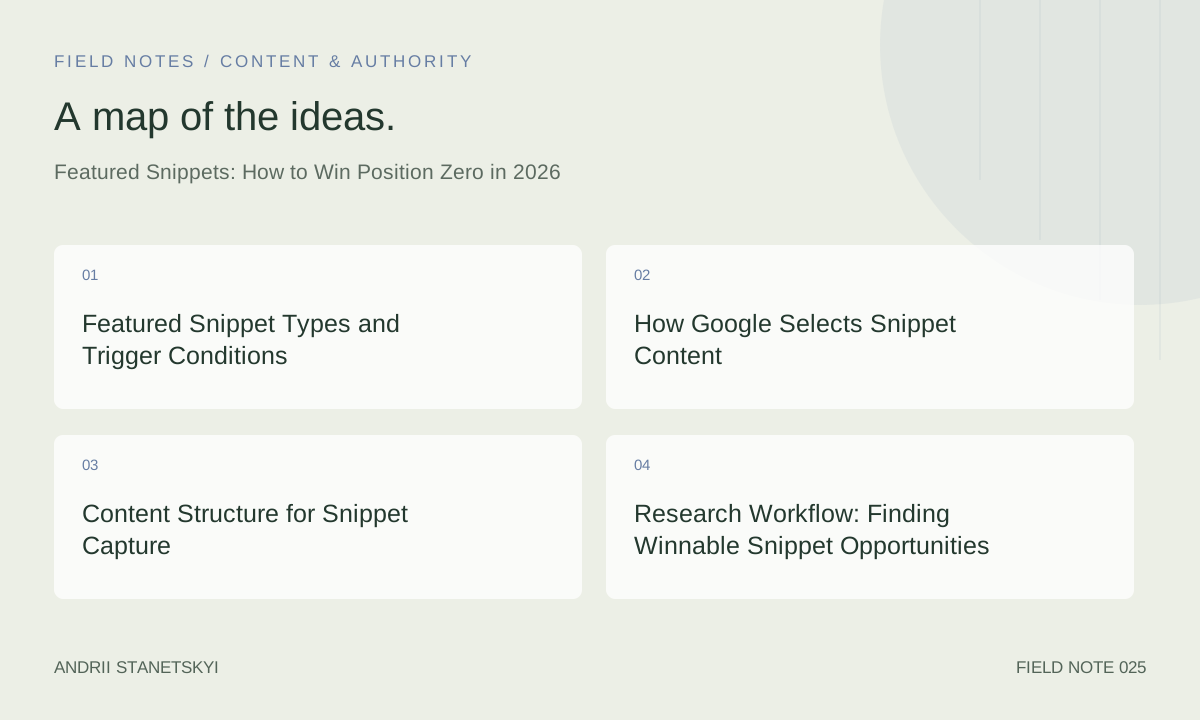
Featured snippets are simultaneously the most coveted and most misunderstood SERP feature in organic search. Every SEO wants them; few approach the pursuit with genuine precision. The dominant advice — "answer questions directly" and "use H2 headers" — is true at the level of a tweet but useless as an operational guideline. It's the equivalent of telling someone who wants to win a marathon to "run fast."
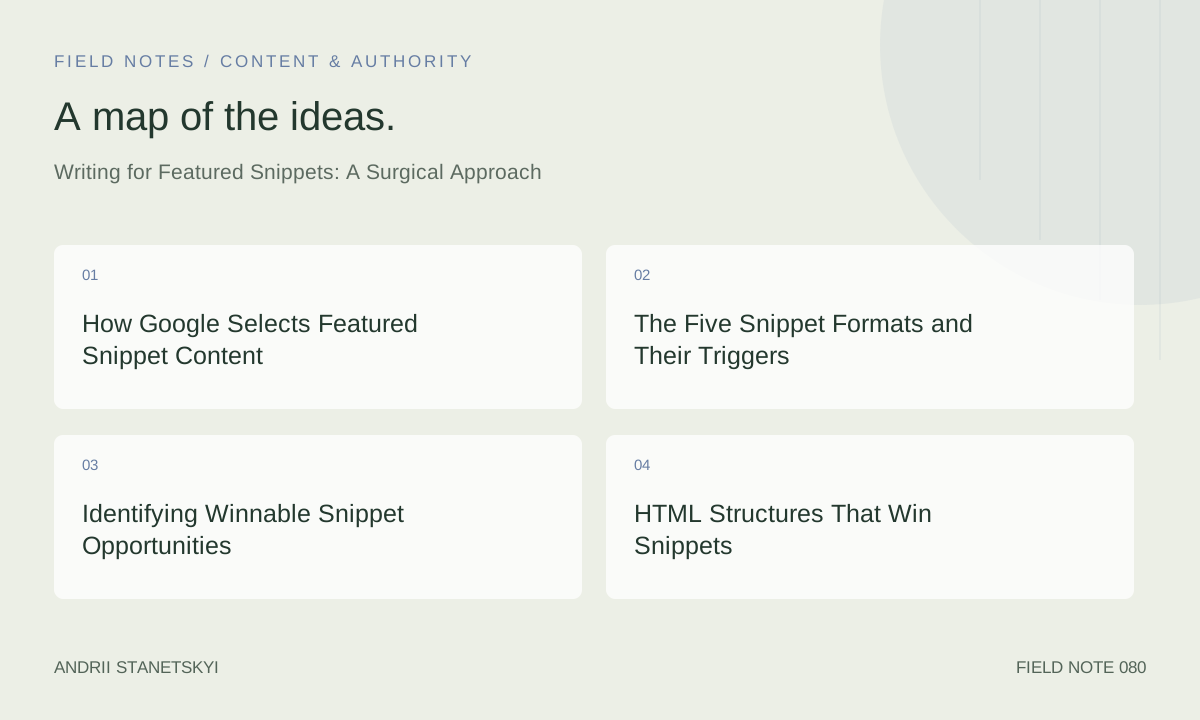
This article is the operational guideline. It covers the mechanics of how Google selects snippet content, the five snippet formats and their distinct optimization requirements, the specific HTML structures that trigger snippet selection, and a repeatable workflow for identifying, targeting, and winning featured snippet positions at scale. The approach is surgical because it treats each snippet opportunity as a distinct structural problem with a specific solution — not a general "optimize for snippets" aspiration.
By the end, you will have a working system: a targeting methodology, format-specific content templates, and a measurement process to track snippet capture over time.
How Google Selects Featured Snippet Content
Google's snippet selection algorithm is not driven by structured data alone — a persistent misconception that sends practitioners down the schema rabbit hole when the problem is actually content structure. Snippets are primarily selected from existing top-10 organic results through a process Google describes as automated extraction of the "most relevant content to answer the query."
The practical implications of this are significant:
- You do not need to rank #1 to win a featured snippet. Pages ranking positions 2–10 win snippets regularly; positions 2–5 are actually the most common snippet sources, since position 1 pages often already "own" the SERP in other ways
- Snippet selection is query-specific. The same page can win a snippet for one query and not another variation of the same topic
- Google can pull snippet content from any part of the page — header, body paragraph, list, table — not just the first paragraph
- Snippet content typically runs 40–60 words for paragraph snippets and shows 4–8 items for list snippets
The selection signal Google is optimizing for: which content block on the page most directly and concisely answers the exact query, in a format appropriate to the query type? Your job is to make that answer unmistakably obvious through structure, language, and positioning.
The "Double Trigger" Requirement
A featured snippet requires two triggers to fire: (1) the page must rank in the top 10 for the target query, and (2) the page must contain a content block that Google's extraction algorithm recognizes as the best direct answer to that query among all top-10 pages. Most snippet optimization guides address only trigger 2. You need to address both. A perfectly structured answer on a page ranking position 28 will never appear in a snippet.
The Five Snippet Formats and Their Triggers
1. Paragraph Snippets
Triggered by: definition queries ("what is"), explanation queries ("how does"), and "why" queries. Google extracts 40–60 word blocks that begin with or directly follow a question or concept statement.
Frequency: ~70% of all featured snippets are paragraph format
Optimization target: Write a 40–60 word answer immediately after an H2 or H3 that matches the query phrasing
2. Ordered List Snippets
Triggered by: process queries ("how to"), step-based queries ("steps to"), and ranked queries ("best ways to"). Google extracts <ol> items or converts H3-structured sections into a numbered list.
Frequency: ~15% of featured snippets
Optimization target: Use <ol> elements or sequential H3 headers for any process-oriented content; keep step labels clear and action-verb-led
3. Unordered List Snippets
Triggered by: "types of" queries, "examples of" queries, and multi-item informational queries. Google extracts <ul> items.
Frequency: ~10% of featured snippets
Optimization target: Use <ul> for non-sequential enumerations; include 6–10 items (Google displays 4–8; more items creates a "more items" expansion link which increases clicks)
4. Table Snippets
Triggered by: comparison queries, pricing queries, specification queries, and "vs" queries. Google extracts HTML table data.
Frequency: ~4% of featured snippets
Optimization target: Use properly marked-up <table> elements with <th> headers; keep tables to 2–4 columns (wider tables render poorly in snippets)
5. Video Snippets
Triggered by: tutorial queries, demonstration queries, and "how to" queries where YouTube content ranks highly. Google may pull a timestamped moment from a YouTube video.
Frequency: ~1% of featured snippets (growing)
Optimization target: Add chapter timestamps to YouTube videos; use the query keyword phrase in the chapter label that corresponds to the direct answer
Identifying Winnable Snippet Opportunities
Not every query that shows a featured snippet is a winnable opportunity for your site. Prioritization requires filtering on three criteria: snippet type match, current ranking position, and competitive extractability.
Step 1: Export Current Snippet Opportunities from Semrush
In Semrush, navigate to Domain → Organic Research → Positions. Filter by SERP Features → "Featured snippet" → "Competitor has this feature." Export this list — these are queries where a competitor holds the snippet, you rank in the top 20, and there is a displacement opportunity.
Step 2: Filter by Current Ranking Position
Focus on queries where you currently rank positions 2–10. Queries where you rank 11–20 require first improving organic rankings before snippet pursuit. Queries where you rank position 1 but a competitor holds the snippet are your highest priority — you have the domain signal; you just need to fix the content structure.
Step 3: Assess Extractability
Visit the current snippet-holding page. Is their snippet content well-structured and authoritative? Or is it poorly formatted, missing key information, or answering a slightly different question than the one being asked? Extractable opportunities are where the current snippet holder has structural weaknesses — vague language, missing key terms, a poorly formatted answer block — that a more surgically structured response can displace.
Step 4: Prioritize by Traffic Value
# Script to prioritize snippet opportunities by traffic value
import pandas as pd

# Load Semrush export
df = pd.read_csv('semrush_positions_export.csv')

# Filter: competitor has snippet, we rank 2-10
snippet_opps = df[
    (df['SERP Features'].str.contains('Featured snippet', na=False)) &
    (df['Position'] >= 2) &
    (df['Position'] <= 10)
].copy()

# Calculate opportunity value (traffic if snippet captured)
# Snippet CTR boost: ~2-4% additional CTR vs same position without snippet
snippet_opps['snippet_traffic_gain'] = (
    snippet_opps['Search Volume'] * 0.03  # 3% CTR boost estimate
)

# Sort by traffic gain potential
snippet_opps.sort_values('snippet_traffic_gain', ascending=False, inplace=True)
print(snippet_opps[['Keyword', 'Position', 'Search Volume', 'snippet_traffic_gain']].head(20))
HTML Structures That Win Snippets
The relationship between HTML structure and snippet selection is not theoretical — it's mechanical. Google's extraction algorithm consistently favors specific patterns. Here are the patterns that work, with exact implementations:
Pattern 1: The Direct Definition Block (Paragraph Snippet)
<h2>What Is Topical Authority?</h2>
<p>Topical authority is a search engine's assessment of how
comprehensively and reliably a website covers a specific subject
domain. It is inferred from content coverage breadth, internal
link architecture, entity associations, and user engagement
patterns — not from any single metric.</p>
<!-- Full explanation continues here -->
Rules: The H2 must mirror the query phrasing. The first paragraph must be 40–60 words. It must define or directly answer the concept in the first sentence — no "According to some experts..." or "Many people wonder..." preamble.
Pattern 2: The Numbered Process (Ordered List Snippet)
<h2>How to Conduct a Content Gap Analysis</h2>
<p>Follow these steps to identify keyword opportunities your
competitors rank for that your site does not:</p>
<ol>
  <li><strong>Export competitor keywords</strong> from Ahrefs
  Content Gap using 3–4 direct competitors</li>
  <li><strong>Filter out your existing rankings</strong> (positions
  1–20) to isolate true gaps</li>
  <li><strong>Segment by topic cluster</strong> using keyword
  modifier filtering</li>
  <li><strong>Prioritize by search volume and difficulty</strong>
  to identify quick wins</li>
  <li><strong>Map gaps to content type</strong> (pillar, cluster,
  or supporting article)</li>
</ol>
Rules: Use bold text for the action verb in each list item. Google displays bold text in ordered list snippets, increasing visual scannability. Keep each item to 1–2 lines maximum.
Pattern 3: Comparison Table (Table Snippet)
<table>
  <caption>Surfer vs Clearscope vs Frase: Feature Comparison</caption>
  <thead>
    <tr>
      <th scope="col">Feature</th>
      <th scope="col">Surfer SEO</th>
      <th scope="col">Clearscope</th>
      <th scope="col">Frase</th>
    </tr>
  </thead>
  <tbody>
    <tr>
      <td>NLP Term Grading</td>
      <td>Yes</td>
      <td>Yes</td>
      <td>Partial</td>
    </tr>
    <tr>
      <td>SERP Analysis</td>
      <td>Yes</td>
      <td>No</td>
      <td>Yes</td>
    </tr>
  </tbody>
</table>
Rules: Always include a <caption> element. Use <th scope="col"> for header cells. Keep the table to 3–4 columns maximum. Tables wider than 4 columns render poorly in snippet containers.
Format-Specific Content Templates
Below are production-ready templates for the two most common snippet formats. Use these as starting points and adapt to your specific query context.
Paragraph Snippet Template
[H2: Exact question text mirroring the target query]

[40–60 word direct answer. Sentence 1: direct definition or answer.
Sentence 2: 1 key differentiator or context. Sentence 3 (optional):
quantifier or example.]

[Continue with deeper explanation for the reader who needs more context...]
Step-by-Step Snippet Template
[H2: "How to [Task]: [Qualifier]"]

[1 sentence overview of what the process achieves]

[Numbered list: 5–8 steps]
1. [Action verb] + [specific object]: [brief clarification]
2. [Action verb] + [specific object]: [brief clarification]
...

[Each step then has an H3 below with full explanation for readers]
Schema Markup and Its Role in Snippet Selection
Schema markup does not directly determine featured snippet selection — this is a common misconception. However, structured data serves two important functions in the snippet ecosystem:
HowTo Schema
For process content, HowTo schema can trigger rich results that appear alongside or instead of traditional featured snippets on mobile. These rich results show step-by-step instructions with images and are particularly prevalent for DIY, cooking, and technical how-to content.
{
  "@context": "https://schema.org",
  "@type": "HowTo",
  "name": "How to Conduct a Content Gap Analysis",
  "step": [
    {
      "@type": "HowToStep",
      "name": "Export competitor keywords",
      "text": "In Ahrefs Content Gap, enter 3–4 direct competitors and export all keywords they rank for that you do not.",
      "position": 1
    },
    {
      "@type": "HowToStep",
      "name": "Filter out existing rankings",
      "text": "Exclude keywords where your site already ranks in positions 1–20 to isolate genuine gaps.",
      "position": 2
    },
    {
      "@type": "HowToStep",
      "name": "Segment by topic cluster",
      "text": "Use keyword modifier filtering to group gap keywords by content cluster.",
      "position": 3
    }
  ]
}
FAQPage Schema
FAQPage schema triggers FAQ rich results in SERPs — expandable question-answer pairs beneath the main result. These appear in addition to a featured snippet (when applicable), effectively doubling a page's SERP real estate. Every article with a genuine FAQ section should implement FAQPage schema.
Mini Case Studies: Snippet Wins and Why They Worked
Case Study 1: Paragraph Snippet Capture (Definition Query)
A legal tech company ranked position 4 for "what is contract lifecycle management" but a competitor held the featured snippet with a vague, 85-word paragraph. The company rewrote their definition block: 52 words, starting directly with "Contract lifecycle management (CLM) is...", followed by a specific differentiator sentence. Within 6 weeks, the snippet shifted to their page. The result: CTR for that query increased from 4.2% (position 4, no snippet) to 9.8% (position 4, with snippet) — a 133% CTR lift from structural change alone, with no ranking position change.
Case Study 2: List Snippet from Position 6
A SaaS productivity blog ranked position 6 for "types of project management methodologies" — a query with 6,600 monthly searches. The snippet was held by a Wikipedia page listing 12 methodologies in paragraph format. The SaaS blog restructured their content: a <ul> list of 9 methodologies, each as a bolded term followed by an 8-word description. Google replaced the Wikipedia snippet with the SaaS blog's list within 4 weeks. The new page captured the snippet from position 6 — evidence that structural superiority can displace even extremely high-authority pages.
Case Study 3: Table Snippet for Comparison Query
An HR software review site targeted "HRIS vs HCM vs HRMS" — a comparison query with a table snippet already in place from a competitor. The competitor's table had 5 columns and was rendering incompletely in the snippet container. The review site created a clean 3-column comparison table with bolded feature names in the first column. Google switched the snippet within 3 weeks. Monthly clicks to the article increased 280% — from 140 to 392 clicks/month — despite no change in organic position (still position 3).
Measuring and Tracking Snippet Performance in GSC
Google Search Console does not have a native "featured snippet" filter, but you can approximate snippet capture with a combination of CTR analysis and SERP feature tracking.
GSC Snippet Tracking Methodology
- In GSC Performance, filter by specific URL or query set
- Export impressions, clicks, and average position by query
- Flag queries where CTR exceeds expected benchmarks for the ranking position (e.g., CTR of 15%+ at position 3 or 20%+ at position 4 strongly suggests snippet ownership)
- Cross-reference with Semrush Position Tracking (SERP Features column) for direct snippet confirmation
-- Identify likely snippet-owning queries via CTR anomaly detection
-- (Using GSC BigQuery export)
SELECT
  query,
  page,
  AVG(position) AS avg_pos,
  SUM(clicks) AS clicks,
  SUM(impressions) AS impressions,
  ROUND(SUM(clicks)/SUM(impressions)*100, 2) AS ctr_pct,
  -- Expected CTR baseline by position
  CASE
    WHEN AVG(position) <= 1.5 THEN 28.5
    WHEN AVG(position) <= 2.5 THEN 15.7
    WHEN AVG(position) <= 3.5 THEN 11.0
    WHEN AVG(position) <= 4.5 THEN 8.1
    ELSE 6.0
  END AS expected_ctr,
  -- Lift ratio: actual vs expected
  ROUND(
    (SUM(clicks)/SUM(impressions)*100) /
    CASE
      WHEN AVG(position) <= 1.5 THEN 28.5
      WHEN AVG(position) <= 2.5 THEN 15.7
      WHEN AVG(position) <= 3.5 THEN 11.0
      WHEN AVG(position) <= 4.5 THEN 8.1
      ELSE 6.0
    END,
    2
  ) AS ctr_lift_ratio
FROM project.dataset.gsc_data
WHERE date BETWEEN DATE_SUB(CURRENT_DATE(), INTERVAL 30 DAY) AND CURRENT_DATE()
  AND impressions > 100
GROUP BY query, page
HAVING ctr_lift_ratio > 1.5  -- 50%+ CTR lift suggests snippet ownership
ORDER BY clicks DESC;
| Snippet Type | Query Pattern | Target Word Count | Key HTML Element | Win Rate vs. Competitor |
|---|---|---|---|---|
| Paragraph | What is / How does / Why | 40–60 words | <p> after matching <h2> |
High (most common displacement opportunity) |
| Ordered List | How to / Steps to / Process | 5–8 items | <ol> with bolded item labels |
Medium (structure-dependent) |
| Unordered List | Types of / Examples of / List of | 6–10 items | <ul> with short item descriptions |
Medium |
| Table | Compare / vs / Pricing / Specs | 3–4 columns, 4–8 rows | <table> with <th> and <caption> |
High (competitors often use oversized tables) |
| Video | How to [visual task] | Chapter timestamps | YouTube chapter labels | Low (requires YouTube ranking) |
FAQ
Can I lose traffic by winning a featured snippet?
Yes — this is a documented phenomenon called "zero-click snippets." For queries where the snippet fully answers the user's question (a brief definition, a simple conversion, a quick fact), winning the snippet can reduce clicks because users get their answer without visiting the page. The mitigation: write snippets that answer the question but create curiosity or need for more — "X is defined as [concise definition]. The 5 implementation challenges most teams miss are covered in detail below." You can't prevent zero-click behavior entirely, but you can reduce it with content framing that makes clicking feel worthwhile.
Does opting out of featured snippets make sense for any site?
Yes. For queries where the snippet fully exposes proprietary content (a detailed step-by-step from a paid guide, for example), opting out via <meta name="googlebot" content="nosnippet"> or data-nosnippet on specific sections preserves content exclusivity. For most sites, the traffic gain from snippet capture outweighs the zero-click risk — but for subscription content sites, the calculation can differ.
How quickly can I expect to win a featured snippet after optimizing?
The range is 1–8 weeks, with most cases resolving within 3–4 weeks once Googlebot recrawls the updated page. You can accelerate crawling by using Google Search Console's URL Inspection → Request Indexing function immediately after publishing the optimized content. Snippet selection can change quickly because it's not a slow algorithmic process — it's a content extraction decision that can update with each crawl cycle.
Should every article attempt to capture a featured snippet?
No. Focus snippet optimization on pages that: (1) rank in positions 2–10 for a snippet-eligible query, (2) have sufficient search volume to make the CTR improvement meaningful (>200 monthly searches minimum), and (3) target a query type that maps to a format you can execute cleanly. Attempting to win snippets for every article dilutes optimization focus. Identify your top 20–30 snippet opportunities and pursue them systematically.
Do featured snippets help with AI Overviews / SGE?
Indirectly. Pages that win featured snippets demonstrate strong relevance signals for specific queries — the same content quality and structural clarity that wins snippets also increases the probability of being cited in AI-generated summaries. The optimization principles align: direct answers, clear structure, authoritative sourcing. Pages that consistently win snippets for a topic cluster are more likely to appear in AI Overview citations for related queries.
Can a page rank below position 10 and win a snippet?
Extremely rarely. Google's documentation states that featured snippets come from web search results, and in practice, nearly all snippets are pulled from the top 10 organic results — with the overwhelming majority coming from positions 1–5. If you're ranking position 15+, focus on improving organic rankings before investing in snippet optimization for that specific keyword.
What's the most underused snippet optimization tactic?
Optimizing for the expanded list snippet. When you structure an unordered list with 8–10 items instead of the 4–6 Google typically displays, Google shows the visible items plus a "More items" link. This link drives additional clicks that a standard snippet never captures. The content requirement: your list must genuinely have 8–10 useful, distinct items — not padding. The click-through lift from "More items" links can be 15–25% above baseline snippet CTR.
Key Takeaways
- Featured snippets require two triggers: a top-10 ranking for the target query AND a content block that Google's algorithm identifies as the best direct answer among top-10 pages. Address both.
- Paragraph snippets (~70% of all snippets) are won with 40–60 word direct answers immediately following an H2 that mirrors the query phrasing. No preamble. No hedging.
- List snippets (ordered and unordered) require proper
<ol>or<ul>elements with bolded action verbs and concise item descriptions. Sequential H3s can also trigger ordered list snippets. - Table snippets are won by using properly structured HTML tables with
<caption>and<th scope>— and keeping tables to 3–4 columns to avoid rendering problems in snippet containers. - Schema markup (HowTo, FAQPage) does not directly determine snippet selection but enables rich results that extend SERP presence beyond the snippet itself.
- The highest-priority snippet opportunities are queries where you rank positions 2–5 and a competitor holds the snippet — you have the domain signal, you just need structural superiority.
- Measure snippet ownership via CTR anomaly detection in GSC: CTR lift ratios significantly above position benchmarks indicate snippet capture without needing direct SERP confirmation.
- Optimize for 8–10 item lists to trigger "More items" expansion links — the most underutilized CTR enhancement in featured snippet strategy.
Conclusion
Featured snippet optimization is the most direct translation of technical SEO precision into measurable traffic gains. Unlike many SEO interventions that require months of link building or content accumulation, a well-executed snippet optimization can produce results in weeks — sometimes days — by changing specific content structures that already rank.
The discipline is in the targeting. Pursue the winnable opportunities — positions 2–5 where a competitor holds a structurally weak snippet — rather than chasing snippets for every query. Apply format-specific templates with precision. Measure CTR before and after. Build a snapshot of your snippet portfolio quarterly. And never confuse "we wrote a good article" with "we wrote an article that wins snippets." They require different craft, and the difference is almost always structural.
Continue: How to audit your full SERP feature portfolio using Semrush