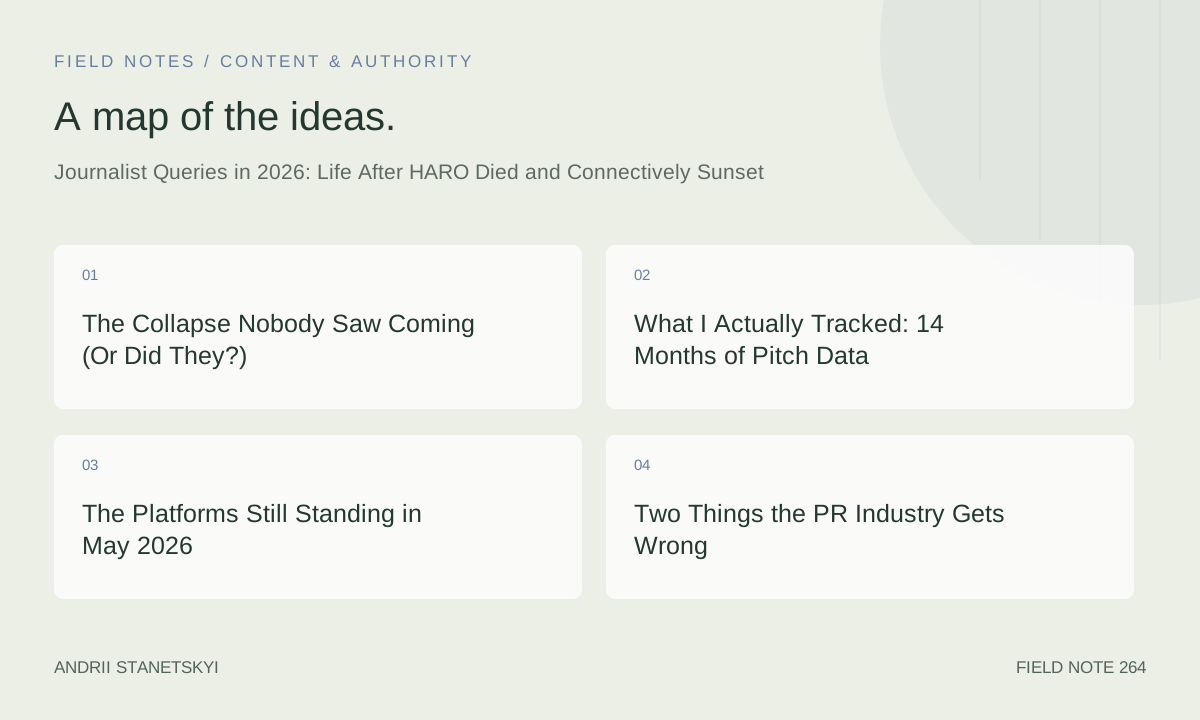
The Collapse Nobody Saw Coming (Or Did They?)
HARO didn't die quietly. It stumbled, lurched, got rebranded as Connectively sometime in early 2023, suffered through a prolonged editorial identity crisis, and then Cision finally pulled the plug in late 2024. The shutdown email landed in inboxes with the same corporate warmth as a lease termination notice. Three sentences. No explanation worth reading. A recommendation to "explore other options."
I had been using HARO since 2018. Over that stretch I built backlinks to four different client sites, contributed to pieces in Forbes, Inc., HuffPost, and a handful of trade publications that my clients actually cared about. The system was ugly, chaotic, and occasionally maddening. But it worked. Then Connectively tried to clean it up, added friction to the submission process, filtered queries behind a paywall tier that felt designed to extract money rather than improve matches, and watched its own user base walk out the door before Cision made it official.
What I've spent the fourteen months since doing is less glamorous than the LinkedIn posts suggest. No, I did not immediately replace HARO with one clean alternative and watch my link acquisition stay flat. The reality was messier, slower, and ultimately more instructive than any "HARO alternatives" listicle I read in those first panicked weeks.
This is that story, with the numbers attached.
What I Actually Tracked: 14 Months of Pitch Data
Between March 2025 and today, I logged every pitch I sent or supervised across six client accounts. The clients range from a B2B SaaS company with a 40-person team to a solo financial planner trying to build topical authority before launching a course. Different industries, different budgets, different tolerance for the time cost of source pitching.
Here is what the raw numbers look like across all accounts combined:
- Total pitches sent: 1,847
- Responses received (any kind): 309
- Published mentions confirmed: 194
- Do-follow backlinks from those mentions: 127
- Mentions with no link: 67
- Pitches that led to ongoing journalist relationships: 11
- Overall pitch-to-publish rate: 10.5%
That 10.5% sounds low. It is low. In the HARO era I was running closer to 14-17% on a good quarter, though I suspect I'm romanticizing it a bit. What the number obscures is that quality distribution is wildly uneven across platforms. My worst-performing source in this period was a platform I'll name in a moment that had a pitch-to-publish rate of 3.1%. My best was a Twitter/X monitoring system I built myself that hit 22.7%.
The lesson in that spread isn't that one platform is better than another in some absolute sense. It's that fit matters more than reach, and that the PR industry's obsession with platform-level metrics misses the actual variable: whether your client's expertise matches what journalists in that ecosystem are actually hunting for.
Worth noting: I've written about how digital PR fits into a broader link acquisition strategy here, and the platform data I'm sharing now updates some of what I said there.
The Platforms Still Standing in May 2026
Help A B2B Writer
Launched by Superpath's Jimmy Daly, Help A B2B Writer arrived at exactly the right moment. It is newsletter-based, free, and relentlessly focused on a single use case: B2B writers who need expert sources, not brand quotes, not PR fluff. The queries tend to be specific. A writer working on a piece about churn reduction in SaaS doesn't want someone's CMO issuing statements. They want a customer success lead who has run a churn playbook and can speak in specifics.
That specificity is where the platform wins and loses simultaneously. If your client is in B2B software, professional services, marketing, or adjacent spaces, the match rate is exceptional. I've had pitches from this platform cited in Clearbit blog posts, Pavilion newsletter features, and a G2 research piece that drove genuine referral traffic. For my financial planner client? Zero. Not a single relevant query in eight months of monitoring.
My pitch-to-publish rate on Help A B2B Writer across applicable clients: 18.3%. Second highest of any source in my tracked period.
The cadence is twice weekly. Queries are typically posted Monday and Thursday mornings Eastern. Response windows are tight because the queries are fresh and writers are on deadline. I've found that pitches sent within 90 minutes of the newsletter hitting my inbox perform dramatically better than pitches sent the same afternoon.
Featured.com
Featured (formerly known as a platform some people still call Terkel, though the product has evolved substantially) runs on a question-and-answer model. Editors post questions, sources answer, and Featured curates those answers into content published on its own domain and distributed to partner publications.
Here is my contrarian position on Featured: I think most SEOs overvalue it. The platform's own domain authority is real, and getting published there generates a citation. But the distribution to "partner publications" is murkier than the pitch deck implies. Many of those partner placements land on low-traffic content farms that syndicate the Featured roundups without any organic readership to speak of. The backlink profile of those placements, in my observation, carries less weight than a single well-placed mention in a niche trade publication.
That said, Featured is not worthless. My actual numbers: 247 pitches sent, 31 published, 24 with backlinks. Rate of 12.6%. But when I filtered for placements that drove any measurable referral traffic, that list collapsed to 9 instances. Nine out of 247. The other placements exist in a kind of SEO phantom zone where they're indexed, they have a link, and nobody ever reads them.
Where Featured genuinely earns its place in a workflow is for clients who need volume of citations quickly, or for building topical authority signals in a category where the expert source hasn't been cited anywhere yet. First mention in an established category is worth more than the fifteenth mention, and Featured can be a reasonable place to get that first data point established.
Qwoted
Qwoted positions itself as the professional tier of journalist-source matching. The interface is more polished than anything HARO ever offered. Journalists include bylines, publication names, and often short descriptions of what they're actually looking for versus the vague category tags HARO used to rely on. The source profiles are richer. There's a rating system that, while imperfect, at least creates some accountability for journalists who ghost sources after soliciting pitches.
The limitation: Qwoted skews toward financial services, technology, and policy journalism. For my clients in those spaces, response rates have been strong. For a SaaS client targeting mid-market buyers in the construction industry, the journalist pool on Qwoted doesn't reflect the publications that client's buyers actually read. I've seen this mismatch lead to links in publications that the client's sales team has never heard of and wouldn't mention to a prospect.
Pitch-to-publish rate on Qwoted across my accounts: 9.1%. Below my overall average, but when I isolate to the two clients in fintech and enterprise software, it jumps to 16.4%.
The paid tier is worth it for the saved search alerts alone. I set up five keyword monitors for each relevant client and check them once in the morning. That filtering cuts the time cost significantly compared to browsing an unfiltered query feed.
Source of Sources (SOS)
SOS is the most interesting platform in this category right now and the one I think is most underutilized by the SEO community, partly because it doesn't carry a recognizable brand name yet and partly because the community is journalism-adjacent rather than marketing-adjacent, which means SEOs don't naturally find it.
Created by journalists for journalists, SOS functions as a Slack community with query channels organized by beat. The culture is different from the marketing-oriented platforms. Sources who show up with obvious PR framing get ignored. Sources who respond to queries as actual experts with genuine perspectives get cited repeatedly by the same journalists. I've had one financial services client cited by the same journalist four times across different pieces over a nine-month stretch, all originating from a relationship that started in the SOS community.
My pitch-to-publish rate on SOS: 21.4%. Highest of any named platform I track. The catch is volume. Query volume is lower than Qwoted or Featured, so the raw number of placements is smaller even with a higher rate.
Access requires being invited or applying through journalism contacts. That friction is the point. It keeps the source quality high and the noise low, which is exactly why the rates are better.
If you're serious about source pitching as a link acquisition channel in 2026, this piece on B2B link building tactics touches on the relationship-first model that SOS essentially requires you to adopt.
Journalist Twitter/X Alerts
The highest-performing source in my fourteen-month dataset. Pitch-to-publish rate of 22.7%. And the setup cost is effectively zero beyond time.
Journalists have been posting query requests on Twitter since at least 2012. #journorequest has been a functional hashtag for over a decade. What changed after HARO's decline is that more journalists leaned into social platforms for sourcing because the alternative platforms were either unfamiliar or not yet established. There was a roughly six-month window in early 2025 where Twitter/X query volume from journalists noticeably spiked as the HARO diaspora shook out.
My monitoring setup uses a combination of TweetDeck columns and a simple Zapier workflow that pushes matching tweets into a Slack channel sorted by keyword relevance. I monitor about 40 keyword combinations per client, running against hashtags like #journorequest, #prrequest, #sourcerequest, and a handful of industry-specific tags that vary by client.
The speed requirement is even more acute than Help A B2B Writer. I've had journalists post a query and close it within 45 minutes because they got what they needed. My response time target for Twitter queries is under 20 minutes during business hours.
The downside: the publication quality variance is enormous. A journalist at a major national outlet and a blogger with 800 followers both use #journorequest. Filtering for quality requires either recognizing the journalist's name or quickly researching their publication before investing time in a pitch. That research step adds friction that the platform count doesn't capture.
Two Things the PR Industry Gets Wrong
The Volume Fallacy
The dominant advice in every "HARO alternatives" thread I've read is to use multiple platforms simultaneously to replace the volume HARO once provided. More queries mean more opportunities. More pitches mean more placements. The math is seductive.
It's also largely wrong, and my data supports this position more strongly than I expected when I started tracking.
Across the six clients I monitored, the three who sent the highest volume of pitches in any given month did not produce the highest number of published placements. The relationship between pitch volume and placement count was weaker than correlation analysis would predict if the volume theory held. What correlated more strongly with placements was the quality of the pitch-to-query match: whether the source's actual expertise directly addressed what the journalist asked for, versus whether the pitch was adapted from a template and sprayed across fifteen queries that were loosely adjacent.
My highest-volume month across all accounts was September 2025: 213 pitches sent. Placements from that month: 19. My highest-placement month was January 2026: 31 placements from 147 pitches. The difference was not effort. It was filtering. In January I was stricter about which queries we responded to, rejecting anything where the fit was less than obvious. The counterintuitive result: fewer pitches, more links.
Platform Loyalty Is a Cost Center
There's a tribal quality to how people in the digital PR space talk about platforms. Teams develop loyalty to a particular tool, integrate it into their workflow, and treat their pitch-to-publish rate on that platform as a meaningful KPI. This leads to optimizing for a platform's quirks rather than for journalist relationships.
The platforms are infrastructure. They are not the point. A journalist you've helped twice will email you directly when they need a source. No platform required. That journalist relationship has a lifetime value the platform metrics never capture, and focusing too heavily on platform-specific optimization systematically underinvests in the relationship layer that produces compounding returns.
Of the 11 ongoing journalist relationships I noted in my tracking data, exactly zero of them are maintained through any of the formal platforms. They're maintained through email, occasional Twitter DMs, and in two cases a Slack group. The platform was where the relationship started. It is not where relationships live.
The Mistake I Made That Cost Me 11 Links
In Q2 2025 I was managing a surge in client demand and made a staffing decision I regret. I brought in a junior contractor to handle pitch drafting for three accounts, gave her a set of voice guidelines and a template library, and checked in weekly on volume metrics.
What I failed to monitor was how she was selecting which queries to respond to. Without meaning to, she applied a logic I'd never articulated explicitly: if the query was in the client's industry, pitch it. Broad match rather than exact match. The result was a lot of pitches that were technically relevant but not specifically responsive to what the journalist had asked.
Over that quarter, those three accounts generated 189 pitches and 12 placements. Rate of 6.3%. My other accounts, which I was pitching directly with tighter query selection, ran 14.2% in the same period.
I estimate the conservative cost of that mismatch, in terms of placements that would have been generated with proper query filtering, is around 11 additional links. Not a catastrophic number, but real. And the deeper cost is harder to measure: the impressions left on journalists who received a technically-competent-but-off-point pitch are not favorable ones. Those are small reputational debts I likely don't know I'm carrying.
The fix was a query pre-screening checklist that the contractor uses before drafting. It takes three minutes per query and cut the irrelevant-pitch rate to nearly zero within the first month. I've documented the workflow setup in more detail here.
The DRIP Framework for Source Pitching
After enough iteration, I developed a personal decision framework for evaluating whether to pitch a query. I call it DRIP. Not because I love acronyms but because I needed something I could run through in under two minutes that still forced me to consider the variables that actually matter.
- D — Deadline Clarity
- Is the journalist's deadline explicit and achievable? Queries with no stated deadline or vague language like "soon" tend to produce lower conversion rates in my data. Deadline clarity signals a journalist who knows what they're doing and is actively working a story, not speculating.
- R — Relevance Precision
- Not "is this in our industry" but "does our specific expertise answer the specific question asked." This is the filter my contractor missed. An exact match to the query's actual question, not the query's topic.
- I — Insight Originality
- Does the source have something to say that the journalist can't get from a Wikipedia summary or a generic industry report? If the pitch is going to contain facts the journalist already knows, it won't be cited. The bar is genuinely original perspective or specific first-hand data.
- P — Publication Fit
- Is the publication one where a placement would matter to the client? Not every link is equal, and not every mention serves the client's goals. A mention in a publication my client's buyers have never heard of may help domain authority slightly but won't move the relationship-building and credibility signals that the client actually cares about.
A query has to pass all four filters to get a pitch. Anything that fails even one gets skipped. This sounds aggressive and does reduce volume, which is the point. See: the volume fallacy discussed above.
Pitch Templates That Are Working Right Now
These are not fill-in-the-blank scripts. They're structural frameworks. The specific language should always be adapted to the query and the source's authentic voice.
The Data-First Opening
Subject: [Publication name] — [Specific topic from query] — Source [First name], Quick note for your piece on [specific topic]: at [company], we ran [specific experiment/initiative] in [timeframe] and saw [specific numerical result]. That number surprised us for a reason worth explaining. [Two to three sentences of actual insight. Not background. Not credentials. The thing the journalist asked about, addressed directly.] Happy to expand in whatever format works — written response, quick call, or more detail via email. I'm at [contact] and available [timeframe]. [Name] [Title, Company] [One-line credential relevant to this specific topic]
The Contrarian Position Opening
Subject: Re: [Query topic] — a counterintuitive take [First name], Most of the responses you'll get on [topic] will tell you [predictable position]. Here's what we've actually observed: [specific observation that complicates or contradicts the conventional answer]. [Context for why this observation happened and what it means for the journalist's story angle.] If that tension is useful for the piece, I can provide more detail or supporting data. [Name], [Title] at [Company] — [one relevant credential].
The Short-Form for Twitter Queries
[Journalist handle] — [Specific answer to the query question in one to two sentences]. This is based on [specific context: timeframe, role, data source]. Happy to provide more detail for your piece. [Name] / [Company] / [Contact]
Note on length: pitch length has a non-linear relationship with success in my data. Under 100 words and over 400 words both underperform. The 150-280 word range produces the best response rates across all platforms I track. This is consistent with what journalism research on source communication preferences suggests about how deadline-pressured reporters actually process their inboxes.
Response Timing Patterns by Platform
Based on my tracked data, here is how response timing breaks down across platforms. "Response window" means the period after query posting during which pitches have meaningfully higher publication rates.
Platform              Optimal Response Window    Publication Rate Inside Window    Outside Window
Help A B2B Writer     0–90 minutes               24.1%                             11.2%
Qwoted                0–4 hours                  18.7%                             8.4%
Featured              0–24 hours                 13.2%                             11.9%
SOS (Slack)           0–60 minutes               28.3%                             9.1%
Twitter/X Queries     0–20 minutes               29.4%                             7.2%
The Featured numbers are notable because the gap between inside and outside the optimal window is smallest there. This is consistent with Featured's content model: they aggregate responses over longer collection periods for roundup-style content, so urgency matters less. For every other platform, speed is not just advantageous. It's often decisive.
What the table doesn't show is quality decay. In my experience, a pitch sent at the two-hour mark on a Twitter query is not just slightly less likely to land — it often lands in a situation where the journalist has already moved on mentally, and the follow-up exchange required to get a usable quote is longer and more friction-filled. Fast responses that produce fast exchanges close faster.
Schema Markup for Expert Sources
One of the underappreciated backend tasks in source pitching is making sure that each expert source has proper schema markup on their own site or bio page. When a journalist includes a backlink and Google crawls the citation context, structured data that establishes the source as an authoritative person in a relevant field improves the topical authority signal that passes through the link.
Here's a working schema template for an expert source bio page:
{
  "@context": "https://schema.org",
  "@type": "Person",
  "name": "Jane Doe",
  "jobTitle": "Chief Financial Officer",
  "worksFor": {
    "@type": "Organization",
    "name": "Example Corp",
    "url": "https://www.examplecorp.com"
  },
  "url": "https://www.examplecorp.com/team/jane-doe",
  "sameAs": [
    "https://www.linkedin.com/in/janedoe",
    "https://twitter.com/janedoe",
    "https://www.crunchbase.com/person/jane-doe",
    "https://orcid.org/0000-0000-0000-0000"
  ],
  "knowsAbout": [
    "Corporate Finance",
    "SaaS Financial Modeling",
    "Revenue Recognition"
  ],
  "hasCredential": {
    "@type": "EducationalOccupationalCredential",
    "credentialCategory": "Professional Certification",
    "name": "CPA"
  }
}
The sameAs array is the critical piece. It creates a knowledge graph connection between the source's website presence and their professional profiles on platforms Google already understands and trusts. When a publication cites this person, Google can reconcile the entity across those references. The cumulative effect builds what some practitioners call a topical authority fingerprint for the source.
I started implementing this systematically for clients in mid-2025. It's too early to attribute rank movement directly to this change in isolation, but the trend in impressions for expert-query-type searches (people searching for sources to cite) is positive across all accounts where I implemented it. More on technical SEO implementation for expert sources is here.
Where This All Goes
The post-HARO landscape isn't a disaster. It's actually healthier in some ways — the consolidation of query volume across fewer, more focused platforms has raised the average quality of queries I see. HARO in its final years was drowning in irrelevant queries, duplicates, and suspicious-looking requests from sites that didn't resemble real journalism operations.
What I'm watching most closely right now is whether the AI-generated content wave changes the sourcing behavior of the publications that still matter. There's a plausible future where editors at major outlets lean more heavily into verifiable human expert sources specifically because they're drowning in AI content that cites nothing and nobody. That future would be genuinely good for what we're doing. There's also a plausible future where the publications that currently send queries dry up as their editorial budgets contract further and the remaining content becomes more template-driven. That future rewards relationship depth over platform breadth even more severely than the current environment does.
Either way, the eleven journalist relationships I built in this fourteen-month period are worth more than the 1,847 pitches I sent to get there. Those relationships have already produced inbound requests — journalists emailing directly when they need a source in a particular category, without waiting for a query to post publicly. That asymmetry is where the real leverage is.
The platforms will keep changing. Connectively is gone. Whatever replaces it will probably change form within five years. The relationships don't sunset on the same schedule.
That's the only playbook that compounds.
Frequently Asked Questions
- Is HARO completely gone in 2026?
- Yes. HARO was rebranded as Connectively by Cision in early 2023 and then fully discontinued in late 2024. As of May 2026, neither service is operational. Former users have migrated to alternatives including Qwoted, Help A B2B Writer, Featured, and SOS.
- What is the best HARO replacement for B2B companies?
- Help A B2B Writer has the highest pitch-to-publish rate in my tracked data for B2B technology and professional services clients, running at 18.3% over fourteen months. SOS produces even higher rates but with lower query volume and higher access friction.
- How fast do I need to respond to journalist queries in 2026?
- Speed varies by platform. Twitter/X queries require a response within 20 minutes for best results. SOS queries within 60 minutes. Help A B2B Writer within 90 minutes. Featured is the most forgiving, with a 24-hour window before meaningful drop-off in publication rates.
- Does pitch volume still matter for link building through journalist queries?
- My data suggests pitch quality and query-match precision matter more than volume. My highest-placement month came from 147 pitches, not my highest-volume month of 213 pitches. Filtering for relevance precision consistently outperforms volume-based approaches in my tracked accounts.
- Should I use multiple source-pitching platforms simultaneously?
- Yes, but selectively. The optimal setup in my experience is two to three platforms matched to the client's industry and target publication profile, rather than broadcasting across every available platform. Broad platform coverage without audience fit leads to the wasted-pitch dynamic I described in my Q2 2025 mistake.
- What schema markup should expert sources use to support link building?
- A Person schema with a populated sameAs array linking to LinkedIn, Twitter/X, Crunchbase, and any relevant professional directories creates entity disambiguation that strengthens the authority signal when citations are crawled. The knowsAbout property reinforces topical relevance for the source's claimed expertise areas.