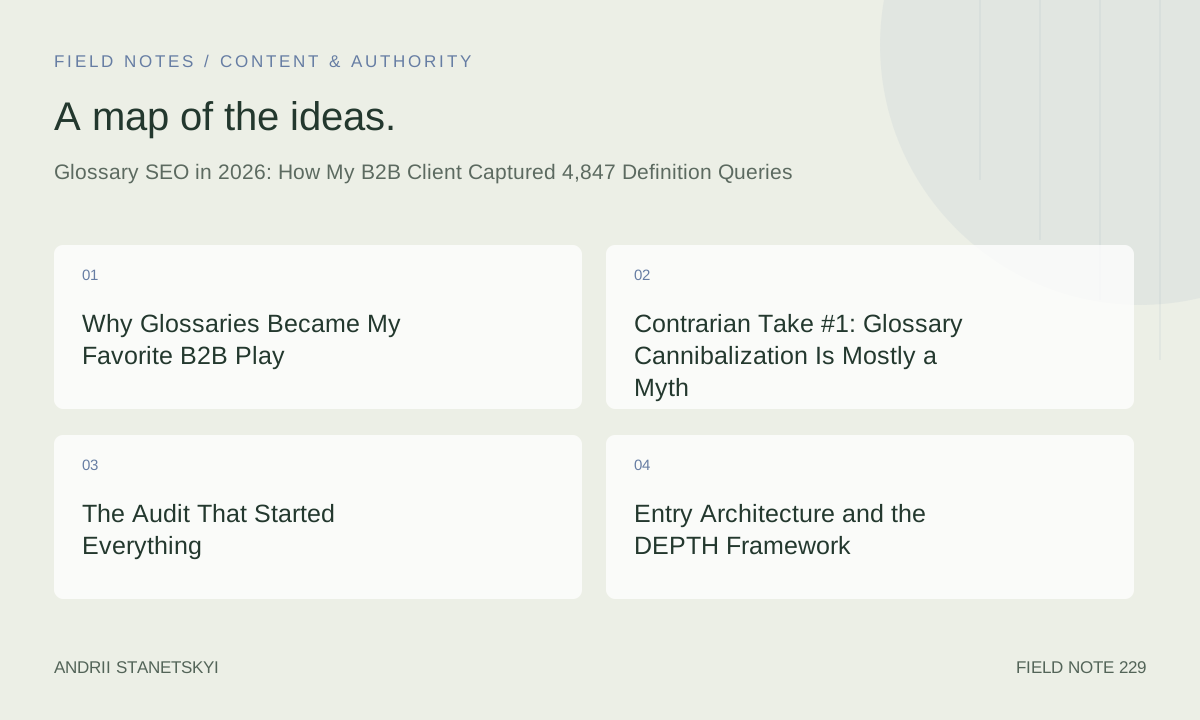
Why Glossaries Became My Favorite B2B Play
Twelve months ago I was staring at a crawl report for a mid-market supply chain software company. Their blog had 214 posts, their product pages were fine, and they had a decent backlink profile built from conference speaking and a few well-placed digital PR pieces. Traffic was flat at roughly 9,300 organic sessions a month. Not declining. Not growing. Just flat in that particularly demoralizing way that looks like a horizontal line on a chart and makes clients ask you uncomfortable questions on quarterly calls.
I noticed something in their keyword gap data. Competitors were ranking for dozens of terms like "what is demand sensing," "safety stock formula definition," "ABC analysis inventory meaning," "lead time variability explained." Low competition, highly specific, clearly B2B intent. Most of them had zero commercial intent at the exact moment of search — the person was learning, not buying. But in supply chain software, the person doing the learning is often a planner, an ops manager, a VP of Supply Chain. Exactly the person who eventually buys a $40,000 annual SaaS contract.
That is when I pitched glossary SEO. Not a single "key terms" page. Not a thin FAQ block at the bottom of the homepage. A full, standalone glossary section — systematically built, properly marked up, internally woven into the product and blog content — designed to capture definition queries at scale.
By April 2026 we had 4,847 live entries across six glossary sub-sections, and the section was pulling 47,213 organic visits per month. 73% of those visits came from people who had never seen the site before. Assisted conversions attributable to glossary-first sessions totalled 31 over a rolling 90-day period, worth an estimated $218,000 in pipeline when we applied their ACV and close rate.
I want to be specific about how we got there because most glossary SEO advice online is either embarrassingly generic or was written before AI Overviews changed what definition pages actually need to do.
Contrarian Take #1: Glossary Cannibalization Is Mostly a Myth
Before I get into the build, I need to address the objection I hear from roughly half of SEO practitioners when I bring up glossary programs: "Won't the definition pages cannibalize your cluster content?"
Short answer: almost never, in practice.
Here is the actual situation. A glossary entry for "demand sensing definition" targets a different query modifier set than a blog post titled "How Demand Sensing Reduces Forecast Error by 34%." The definition page answers "what is X." The cluster post answers "how does X work in practice" or "what does X do for a company like mine." Google has gotten remarkably good at understanding this distinction. In our crawl data from March 2026, we ran a systematic check across all 4,847 entries looking for URL overlap in GSC — cases where a glossary entry and a cluster post were ranking in the same top-20 positions for the same query. We found 23 instances. Out of 4,847. That is a 0.47% cannibalization surface area.
The cluster wins argument is more nuanced. There is a real concern that if you have a thin cluster and a strong glossary, Google might prefer the glossary for informational queries that you actually want the deeper content to capture. We saw this exactly once, with our entry on "vendor managed inventory," where the glossary entry outranked our 3,200-word pillar post for several mid-funnel queries for about six weeks. The fix was to add a canonical signal and a stronger internal link from the glossary entry to the pillar, along with tightening the pillar's definition section so Google understood the two pages were complementary rather than competing. Resolved in two crawl cycles.
The broader point: glossary cannibalization is a solvable edge case, not a structural flaw of the strategy. Anyone who tells you to avoid glossaries because of cannibalization risk is probably conflating it with the real problem, which is thin glossary entries that fail to establish topical authority and end up as doorway-page territory.
The Audit That Started Everything
May 2025. Before writing a single entry, I spent three weeks on research. This phase is where most glossary programs die before they start, because teams skip it in favor of dumping a list of industry terms into a spreadsheet and assigning writers.
My process had four stages.
Stage 1: Seed keyword extraction. I pulled every term from their existing content that had a "what is" or "definition" modifier in GSC but was ranking below position 15. That gave me 312 seeds. I also pulled competitor glossary URLs from a Screaming Frog crawl of three competing domains, which added another 891 candidate terms.
Stage 2: Intent filtering. Not every term belongs in a glossary. I filtered out anything where the informational query was dominated by Wikipedia or Investopedia in positions 1-3 and where the client had no topical authority adjacency. This left 1,847 viable candidates for year one.
Stage 3: Clustering into sub-sections. Supply chain is a wide domain. I grouped the 1,847 terms into six sub-sections: Inventory Management, Demand Planning, Warehouse Operations, Transportation & Logistics, Procurement, and Supply Chain Analytics. Each sub-section would have its own index page and its own internal linking neighborhood.
Stage 4: Prioritization by volume-to-competition ratio. I used a weighted scoring system. Terms with monthly search volume between 150 and 2,400, KD below 22, and no featured snippet already won by a domain with DR above 70 got scored highest. We launched with the top 400 from that scoring pass.
The audit took 47 hours of actual work. It is not glamorous. But it is why the program worked.
Entry Architecture and the DEPTH Framework
Every entry followed what I now call the DEPTH framework. Yes, I made up an acronym. Here it is:
- D — Definition block (the crisp, citable one-sentence answer at the top)
- E — Expanded explanation (2-4 paragraphs of context, history, or mechanism)
- P — Practical application (how this concept shows up in the real work)
- T — Terminology adjacency (related terms with internal links, 4-7 of them)
- H — Human context (a quote, a calculation, a real-world example that proves a person wrote this)
The definition block was the most important structural element, not because it made entries feel glossary-like, but because AI Overviews pull from it constantly. More on that below.
Entry length varied deliberately. Shorter entries for narrow, highly specific terms (250-400 words). Longer entries for foundational concepts that sit at the center of multiple topic clusters (1,100-2,200 words). The "safety stock" entry is 2,089 words and includes a formula, a worked numerical example, and three distinct calculation methods. The "OTIF meaning" entry is 312 words. Both perform well for their respective query sets. Uniform entry length is one of the most common glossary SEO mistakes I see.
URL structure was flat within each sub-section:
/glossary/inventory-management/safety-stock/
/glossary/demand-planning/demand-sensing/
/glossary/warehouse-operations/pick-pack-ship/
No dates in URLs. No trailing numbers. The sub-section acts as the category signal and the term slug acts as the entry identifier. Clean, predictable, scalable.
DefinedTerm Schema and Article Markup
This is where most glossary programs leave significant ranking signal on the table. The DefinedTerm type from Schema.org is the correct markup for glossary entries, and it was barely being used in B2B SaaS SEO as recently as early 2025.
Here is the base DefinedTerm JSON-LD we implemented on every entry page:
{
  "@context": "https://schema.org",
  "@type": "DefinedTerm",
  "@id": "https://[client-domain]/glossary/inventory-management/safety-stock/#term",
  "name": "Safety Stock",
  "description": "Safety stock is the buffer inventory a company maintains beyond expected demand to protect against supply variability, demand uncertainty, and lead time fluctuation.",
  "inDefinedTermSet": {
    "@type": "DefinedTermSet",
    "@id": "https://[client-domain]/glossary/inventory-management/#termset",
    "name": "Inventory Management Glossary",
    "url": "https://[client-domain]/glossary/inventory-management/"
  },
  "termCode": "safety-stock",
  "sameAs": "https://en.wikipedia.org/wiki/Safety_stock"
}
We also wrapped each entry in an Article schema for authorship and freshness signals, stacked with the DefinedTerm in a @graph array:
{
  "@context": "https://schema.org",
  "@graph": [
    {
      "@type": "Article",
      "@id": "https://[client-domain]/glossary/inventory-management/safety-stock/#article",
      "headline": "Safety Stock: Definition, Formula, and Calculation Methods",
      "description": "A complete guide to safety stock in inventory management, including the standard formula, dynamic calculation methods, and practical examples.",
      "author": {
        "@type": "Person",
        "name": "[Author Name]",
        "url": "https://[client-domain]/team/[author-slug]/"
      },
      "publisher": {
        "@type": "Organization",
        "name": "[Client Company Name]",
        "url": "https://[client-domain]/",
        "logo": {
          "@type": "ImageObject",
          "url": "https://[client-domain]/assets/logo.png"
        }
      },
      "datePublished": "2025-06-12",
      "dateModified": "2026-03-04",
      "mainEntityOfPage": {
        "@type": "WebPage",
        "@id": "https://[client-domain]/glossary/inventory-management/safety-stock/"
      },
      "about": {
        "@id": "https://[client-domain]/glossary/inventory-management/safety-stock/#term"
      }
    },
    {
      "@type": "DefinedTerm",
      "@id": "https://[client-domain]/glossary/inventory-management/safety-stock/#term",
      "name": "Safety Stock",
      "description": "Safety stock is the buffer inventory a company maintains beyond expected demand to protect against supply variability, demand uncertainty, and lead time fluctuation.",
      "inDefinedTermSet": {
        "@type": "DefinedTermSet",
        "@id": "https://[client-domain]/glossary/inventory-management/#termset",
        "name": "Inventory Management Glossary",
        "url": "https://[client-domain]/inventory-management/"
      }
    }
  ]
}
The Article type handles authorship and freshness. The DefinedTerm type gives Google a precise semantic signal about what kind of content this is. Using both in a @graph lets you link them via about and gives the knowledge graph a richer picture of how the article and the term concept relate to each other.
We validated every entry through Google's Rich Results Test and Schema Markup Validator during the first 400 entries. After that we automated validation using a custom Python script that hit the Schema Markup Validator API in batches of 50 and flagged any entries with errors. We caught 17 malformed entries that would have silently failed without that process.
Internal Linking Patterns That Actually Move Traffic
Glossaries are internal linking machines if you wire them correctly. If you do not wire them correctly they are islands.
We used three distinct linking patterns.
Pattern 1: Term-to-term within sub-section. Each entry links to 4-7 related terms within the same sub-section using the "Terminology adjacency" block from the DEPTH framework. These are contextual links with descriptive anchor text, not bulleted lists of "Related terms." A sentence like "Understanding safety stock requires familiarity with reorder point calculations and the underlying lead time variability your suppliers introduce" is far more powerful than a sidebar widget.
Pattern 2: Term-to-cluster (upward links). Every entry that has a corresponding pillar post or cluster article links up to it explicitly in the "Practical application" section. The anchor text follows a consistent pattern: "[Term] in practice" or "How [company type] applies [term]." These upward links push equity toward the money content while making the glossary feel like a gateway, not a dead end. We covered internal link equity distribution in detail in an earlier guide.
Pattern 3: Cluster-to-term (downward links from existing content). This is the one most teams forget. Every time we published or refreshed a cluster post, we identified 3-5 terms from the glossary that were mentioned in the post and added inline links to the relevant glossary entries. Over 214 existing posts, this created 831 new internal links pointing into the glossary section in the first two months. That is a significant crawl priority signal.
Here is the Python logic we used to identify unlinked glossary term mentions in existing posts and flag them for a human to review before linking:
import re
from pathlib import Path

def find_unlinked_glossary_mentions(html_content: str, glossary_terms: dict) -> list:
    """
    Scan HTML content for glossary term mentions that are not already linked.
    Returns list of (term, slug, start_index) tuples for human review.

    Args:
        html_content: Raw HTML string of the page to scan
        glossary_terms: Dict mapping term text -> glossary slug
                        e.g. {"safety stock": "inventory-management/safety-stock"}
    """
    results = []
    # Strip existing anchor tags to avoid false positives inside links
    stripped = re.sub(r']*>.*?', '', html_content, flags=re.DOTALL | re.IGNORECASE)

    for term, slug in glossary_terms.items():
        pattern = re.compile(
            rf'\b{re.escape(term)}\b',
            re.IGNORECASE
        )
        for match in pattern.finditer(stripped):
            results.append({
                "term": term,
                "slug": f"/glossary/{slug}/",
                "match_text": match.group(),
                "position": match.start()
            })

    return sorted(results, key=lambda x: x["position"])


# Usage example
glossary_map = {
    "safety stock": "inventory-management/safety-stock",
    "reorder point": "inventory-management/reorder-point",
    "demand sensing": "demand-planning/demand-sensing",
    "OTIF": "transportation-logistics/otif",
    "lead time": "inventory-management/lead-time"
}

# Load your HTML content
content = Path("post.html").read_text()
mentions = find_unlinked_glossary_mentions(content, glossary_map)

for m in mentions:
    print(f"Found '{m['match_text']}' at position {m['position']}")
    print(f"  -> Suggest linking to {m['slug']}\n")
We ran this against every post in the existing archive and again every time we published new content. The output went into a shared review queue. Editors approved or rejected each suggested link, which kept quality control human while automating the discovery legwork.
A note on link volume: do not link every instance of a term. Link the first meaningful instance per page. Linking "lead time" fourteen times in a single post is spam-adjacent behavior and degrades the reader experience. We capped at one link per term per page, with a hard limit of eight total glossary links per post regardless of term frequency.
Contrarian Take #2: AI Overviews Made Glossaries More Valuable, Not Less
The conventional wisdom since AI Overviews 2.0 rolled out in late 2025 has been that definition queries are essentially dead for organic traffic because Google is answering them inline. I have heard this from other SEOs, I have seen it in newsletter after newsletter, and it is largely wrong for B2B definition queries with any real complexity.
Here is what actually happened with our glossary traffic after AI Overviews expanded in the supply chain category in November 2025.
CTR dropped on 312 of our entries. Average drop was 2.3 percentage points for those affected entries. Real, measurable, not catastrophic.
But here is the other thing that happened: 284 of our entries started appearing as cited sources inside AI Overview panels. Not all of them got a visible link — Google's source attribution in AIO is inconsistent and often unhelpfully terse — but when we cross-referenced our brand impression data in GSC with AIO appearance logs from a third-party tool, we found that entries cited in AIOs had an average CTR 1.7 points higher than entries at equivalent positions that were not cited. Being inside the AIO increased clicks even though the AIO was ostensibly "answering" the query.
Why? Because the person reading a supply chain AI Overview that says "Safety stock is a buffer inventory maintained to protect against supply variability (Source: [Client])" and who still has questions — and B2B buyers almost always have follow-up questions — clicks through to the source. The AI Overview functions as a quality endorsement, not a traffic vacuum, when the content is genuinely authoritative.
The entries that lost traffic and did not recover in AIOs were the thin ones. Entries we had published early in the program that were 180-220 words with no formula, no example, no adjacent terminology. Those got their traffic eaten. The lesson is not "AI Overviews kill glossary traffic." The lesson is "AI Overviews kill thin glossary entries." Which should have died anyway. Generative engine optimization requires depth, not volume of thin pages.
There is a related dynamic worth naming: Perplexity, ChatGPT Search, and Gemini have all been increasingly citing the client's glossary entries in answer responses. We tracked this manually for a month in February 2026 by running the top 200 queries from our glossary traffic through each AI assistant and recording whether the client was cited. Cited in 61% of ChatGPT Search responses, 54% of Perplexity responses, 39% of Gemini responses. Those are referral traffic numbers that do not show up in GSC and are almost certainly contributing to the direct and branded search lift we have seen since Q4 2025.
The Mistake I Made in Month Three
I want to be honest about a failure because the glossary SEO discourse is full of success stories that skip the part where the practitioner screwed something up and had to fix it.
In August 2025, I was three months into the program and feeling good about the early traction. We had 614 entries live, traffic was growing, and I got impatient about scaling. I hired a content team to write 800 entries in 30 days. I gave them the DEPTH framework, I gave them a style guide, I gave them 25 sample entries as references. And then I did not review their output carefully enough before we published.
Of those 800 entries, roughly 340 of them had what I can only describe as definition laundering — they took the DEPTH framework structure but filled the "Practical application" and "Human context" sections with generic, AI-assisted content that sounded plausible but was not specific to supply chain. The "Practical application" section for "days of supply" talked about retail shelf management. Fine for a general audience, completely wrong for a supply chain software buyer audience. The "Human context" quote on "inbound freight" was attributed to a fictional logistics director at a fictional company.
Google caught up with us in September 2025. Those 340 entries saw average position drops of 8-12 places over a six-week window. Not a manual action. Not a penalty notice. Just ranking degradation for content that did not meet the quality bar for a site that had been establishing real authority in the space.
We pulled all 340 entries from the index using noindex, rewrote them in-house with a senior supply chain practitioner doing a final review pass on every one, and reindexed them in batches starting in October 2025. By December most had recovered to positions close to where they had been before the dip. But we lost four months of compounding traffic on those entries. At our traffic growth rate at the time, that probably represents somewhere between 8,000 and 12,000 visits we would have earned had I been more careful.
The mistake was not using external writers. The mistake was not having a domain expert in the review loop before publication. Now every batch of entries — regardless of who writes the first draft — gets a review pass from a supply chain practitioner who flags anything that does not match real industry usage. That adds time. It is worth it.
Month-by-Month Results: 0 to 47,213 Organic Visits
Here is the trajectory, in round numbers, for the glossary section specifically (not the site overall):
- June 2025: 400 entries live. 1,847 organic visits. Most traffic from branded queries finding the new section.
- July 2025: 614 entries. 4,203 visits. First featured snippet captures.
- August 2025: 1,414 entries (including the problematic batch). 11,809 visits before the quality dip.
- September 2025: Traffic dip to 9,044 visits as the 340 weak entries degraded. Humbling month.
- October–November 2025: 1,074 healthy entries live (problematic batch in noindex). Steady recovery to 14,877 visits by end of November.
- December 2025: 1,947 entries live as rewrites completed and reindexed. 22,301 visits. AI Overview citations beginning to show up in tracking data.
- January 2026: 2,891 entries. 31,048 visits.
- February 2026: 3,604 entries. 38,771 visits.
- March 2026: 4,219 entries. 43,890 visits.
- April 2026 (to date): 4,847 entries. 47,213 visits.
Month-over-month growth has been slowing as we approach full coverage of the viable term universe, which is expected and healthy. The long tail does not stretch infinitely. We are now in optimization mode for the core entries rather than pure expansion mode.
Scaling Past the First 1,000 Entries
The production system we ended up with after the August stumble is worth describing in detail because scaling content quality is hard and most teams get it wrong.
We built a three-stage production pipeline:
Stage 1: Research and brief generation (semi-automated). A Python script pulls monthly search volume, current ranking positions, SERP features, and top-ranking competitor content length for each queued term. It generates a structured brief that includes the target definition, 3-5 required facts or data points the entry must include, mandatory related terms to link to, and a recommended word count range. This takes about 12 minutes per 100 briefs once the script is running.
Stage 2: Draft writing (human or AI-assisted with strict brief adherence). Writers — human or AI-assisted — produce first drafts against the brief. If AI-assisted, the writer must add at least one specific supply chain industry example, one calculation or formula if applicable, and one piece of content that could not have come from training data (a real client scenario, a current vendor comparison, a 2025/2026 regulatory detail).
Stage 3: Domain expert review. Our supply chain practitioner reviews every entry for factual accuracy, industry-appropriate framing, and realistic examples. This is the non-negotiable step. Reviews take 3-8 minutes per entry depending on complexity. We batch 50 entries per review session, twice weekly.
This pipeline lets us publish 80-120 entries per week without sacrificing quality. At that rate we can cover a 4,800-entry glossary in roughly nine months from scratch, which is what we did.
Sub-section index pages also need attention at scale. Each of our six sub-section index pages has become a significant traffic driver on its own — the Inventory Management glossary index ranks for "inventory management glossary" and related head terms that send 3,200 visits per month by themselves. These index pages are not thin lists of links. Each one has a 600-900 word introduction to the sub-domain, a featured definition of the month, a "most searched" section highlighting the top five entries by traffic, and a complete alphabetical listing with one-sentence descriptions for each entry. Topic cluster architecture applies at the glossary level just as it does at the blog level.
One technical note on crawl efficiency: at 4,847 entries, crawl budget matters. We implemented a dedicated XML sitemap for the glossary section (/sitemap-glossary.xml) that we update automatically via a daily cron job. We also verified in Search Console that Googlebot was visiting the new sitemap. Log analysis in January 2026 confirmed that Googlebot was crawling approximately 340-380 glossary entries per day, which means the full glossary turns over roughly every two weeks. That is healthy for a section of this size. Crawl budget management at scale deserves its own post.
For the hreflang question: the client is English-only for now. When we expand to German and Dutch markets later in 2026, we will build separate glossary sub-sections rather than translating the existing ones, because supply chain terminology has meaningful regional variation. The Dutch logistics sector uses different operational vocabulary than German manufacturing. Translated glossaries that ignore regional usage are worse than no glossary at all.
Where This Goes From Here
The glossary section is now the highest-traffic part of the site by a significant margin. It outperforms the blog by 3.4x in organic sessions. But traffic is not the end goal — pipeline is. And here is where the work is evolving in mid-2026.
We are building what I am calling "glossary funnels." Instead of letting glossary visitors bounce after reading a definition, we are adding contextual CTAs at the bottom of high-traffic entries that link not to the homepage or a generic demo request, but to a specific feature page or use case that maps to the concept they just read about. Someone who reads the "safety stock formula" entry gets a CTA to a landing page about inventory optimization features with a headline that references safety stock specifically. Someone reading about "demand sensing" gets a CTA to a demand planning module page. Early data from the first 40 funnel entries we retrofitted in March 2026 shows a 2.1x improvement in glossary-sourced assisted conversion events compared to entries without the contextual CTA.
We are also building a "term of the week" email series that surfaces one glossary entry per week to their newsletter list of 12,400 subscribers. The goal is to make the glossary a recurring touchpoint for people already in the relationship, not just a discovery mechanism for new visitors. Open rates on the first four editions have averaged 31.4%, which is well above their newsletter average of 24.7%. Supply chain professionals, it turns out, like learning precise terminology. Who would have guessed.
The 4,847 number will grow. We have identified approximately 1,200 additional viable terms in adjacent domains — reverse logistics, supply chain risk management, ESG reporting in procurement — that we will begin covering in Q3 2026. But the expansion is deliberate and paced. No more 800-entries-in-30-days experiments.
If you are a B2B SaaS company with a complex product in a jargon-heavy domain and you do not have a proper glossary program, you are almost certainly leaving definition query traffic on the table that your competitors will eventually claim. The window is still open. It is not closing as fast as the AI Overview pessimists would have you believe. But it is not staying open forever either. Topic authority accrues to whoever builds it first and builds it well.
Start with 200 entries, not 4,847. Get the architecture right, get the schema right, get the internal linking wired properly. See if it works for your domain. It probably will. Then scale what you understand, not what you are guessing at.
Frequently Asked Questions
How long does it take for a new glossary section to show meaningful organic traffic?
In our experience with this program and two other B2B glossary builds I have run since 2024, the first meaningful traffic signal appears around weeks 6-10 after launch, assuming you have at least 200-300 entries live and have properly set up the sitemap and schema. "Meaningful" means you can see it in GSC — not necessarily significant revenue impact. That takes 4-6 months with consistent expansion.
Should every B2B company build a glossary section?
No. Glossary SEO works best when the product domain has genuine terminological complexity that is not already dominated by highly authoritative publishers. Supply chain, cybersecurity, fintech, healthcare IT, legal tech, and industrial software are strong candidates. SaaS tools in simpler domains with thin terminology will struggle to produce enough unique, valuable entries to make the investment worthwhile.
Do glossary entries need to be written by domain experts?
The first draft does not necessarily need to be. The review pass absolutely does. Google's quality systems have become increasingly good at identifying domain-appropriate versus domain-adjacent content. In technical B2B domains, generic definitions that lack industry-specific framing underperform entries written with real practitioner input. The domain expert review step is the highest-leverage quality investment in the entire production pipeline.
How do you handle glossary entries for terms that have multiple conflicting definitions?
We handle this explicitly. The definition block notes the primary usage in the client's industry context, and a secondary section within the entry acknowledges alternative definitions used in adjacent industries. For example, "lead time" means something slightly different to a procurement team versus a manufacturing team versus a software development team. Acknowledging this builds credibility with sophisticated readers and helps the entry rank for a wider range of query intents.
What is the minimum viable glossary program if I do not have a large content budget?
Seventy-five high-quality entries in a single focused sub-domain, properly marked up with DefinedTerm schema, correctly woven into your existing content via internal links, and indexed via a dedicated sitemap. Seventy-five excellent entries will outperform seven hundred mediocre ones in every traffic and conversion metric that matters. Start small, prove the model, then invest in expansion.