Most SEO advice collapses B2B and B2C into the same bucket. Rank higher, get more traffic, convert more visitors — the logic sounds universal until you realize that a B2B software company selling a $120,000/year platform to a committee of seven enterprise stakeholders has almost nothing in common with a DTC brand selling $40 sneakers to a solo impulse buyer. The search intent, the funnel depth, the conversion definition, the content format, the link-building calculus — all of it diverges at the strategic level.
This article is for practitioners who already know what SEO is and want a clear-eyed, opinionated breakdown of where B2B and B2C strategy genuinely split. No platitudes. No recycled beginner advice. Just the structural differences that determine whether your SEO program generates pipeline or just pageviews.
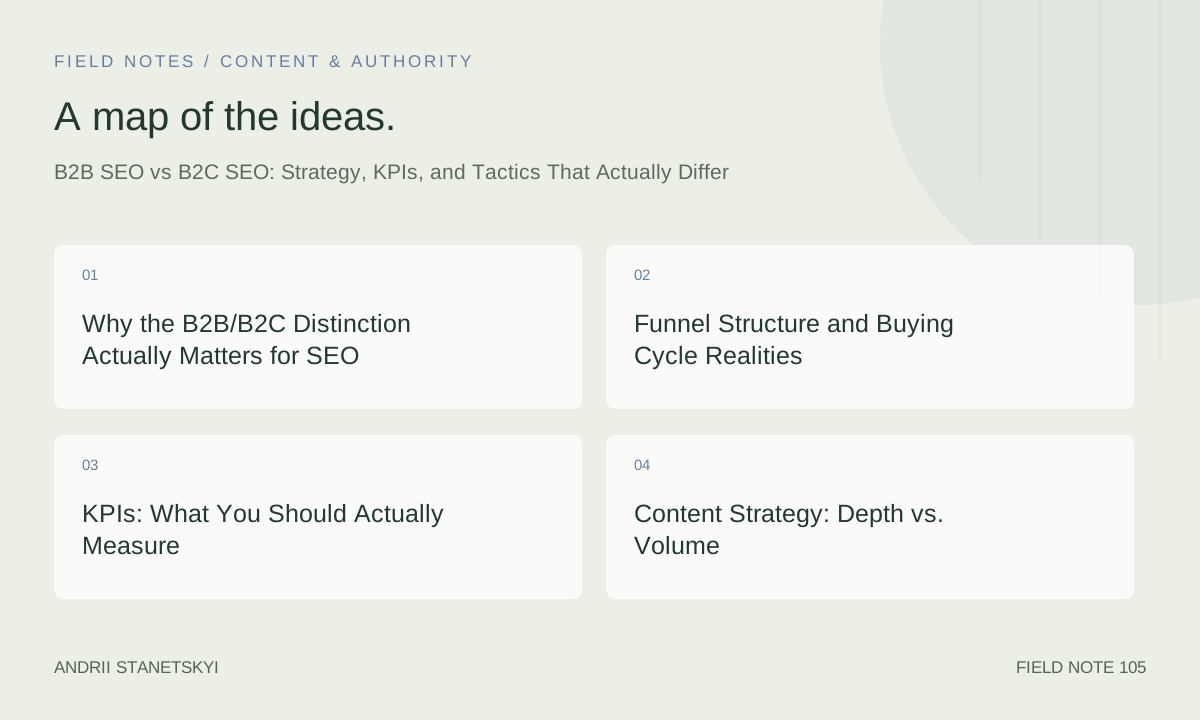
Why the B2B/B2C Distinction Actually Matters for SEO
The single biggest mistake B2B marketers make is optimizing for traffic volume instead of account quality. A B2C e-commerce site can legitimately celebrate 500,000 monthly organic visitors because a meaningful percentage of that traffic converts at checkout within the same session. A B2B SaaS company with a $60,000 ACV (annual contract value) would be better served by 5,000 highly qualified monthly visitors from companies that match their ICP (ideal customer profile) than by 500,000 visitors with no buying intent.
This is not a soft philosophical point — it has hard financial consequences. B2B sales cycles average 6–18 months for enterprise deals, sometimes stretching to 24 months for deals above $500,000 ACV. During that window, organic search plays a multi-touch role across awareness, consideration, and late-stage validation. Google Analytics 4's default attribution will misrepresent this entirely unless you've configured proper cross-channel attribution and extended your lookback windows.
B2C cycles, meanwhile, can compress to minutes. A paid social ad drives a searcher to Google, they land on your product page, and they buy. The organic channel's job is often to capture branded and high-commercial-intent queries at the bottom of a funnel initiated elsewhere.
Understanding this structural difference reshapes every decision downstream: which keywords to target, what content to produce, how to measure success, and where to invest link-building resources. See our guide on search intent mapping for a framework that applies across both models.
Funnel Structure and Buying Cycle Realities
The B2B Buying Committee Problem
Gartner's research consistently shows that a typical B2B enterprise purchase involves 6–10 stakeholders, each consuming content independently and at different stages. Your SEO program needs to address the CFO's ROI concerns, the IT security team's compliance questions, the end-user champion's workflow objections, and the procurement team's vendor risk requirements — often through separate landing pages, separate content types, and separate keyword clusters.
This is why B2B keyword research can't stop at volume and difficulty scores. You need to map keywords to personas and funnel stages simultaneously. A query like "SOC 2 compliance checklist" is being searched by the IT security evaluator, not the economic buyer. If your content converts that visitor to a trial signup, great — but you should also be building content that helps that security evaluator build an internal business case, because that's what actually moves deals.
The B2C Impulse and Consideration Spectrum
B2C is not monolithic either. A $15 impulse purchase has a different SEO strategy than a $3,000 mattress or a $25,000 engagement ring. The key variable is consideration length, and it correlates closely with price point. High-consideration B2C purchases exhibit some B2B characteristics: comparison content, expert reviews, detailed spec pages, and user-generated social proof all matter. The difference is that even high-consideration B2C purchases usually involve one decision maker and close within weeks, not months.
For standard B2C e-commerce, organic search primarily serves two functions: capturing existing demand (branded + category keywords) and accelerating discovery-to-purchase cycles through content that pre-qualifies intent before the user even hits your site.
KPIs: What You Should Actually Measure
B2B SEO KPIs
The cardinal sin of B2B SEO reporting is presenting organic traffic trends to a revenue-focused leadership team without connecting them to pipeline. Here are the KPIs that actually matter:
- MQL rate from organic: Marketing Qualified Leads sourced from organic search, defined as contacts that meet your lead scoring threshold (e.g., title match + engagement score above 50 in HubSpot or Marketo).
- SQL rate from organic MQLs: Sales Qualified Leads — MQLs that sales has accepted based on BANT or MEDDIC qualification. Tracking MQL→SQL conversion by channel reveals organic's quality relative to paid.
- Organic-influenced pipeline: Deals where organic was a touchpoint at any stage, not just first touch. This requires proper UTM discipline and multi-touch attribution in your CRM.
- CAC from organic: Customer Acquisition Cost when organic is the primary source. B2B organic CAC is typically 3–5× lower than paid search CAC over a 12-month horizon, once content production costs amortize.
- LTV:CAC ratio by channel: Organic often attracts customers with higher LTV because they've done more research and arrive with clearer product-market fit expectations.
- Account-level traffic from ICP companies: Using Clearbit Reveal, 6sense, or Demandbase, you can identify which target accounts are visiting your organic content. This is a leading indicator that matters far more than raw session counts.
Here's an example GA4 exploration query structure to segment organic MQL performance:
-- BigQuery export from GA4
SELECT
  session_source,
  session_medium,
  COUNT(DISTINCT user_pseudo_id) AS organic_users,
  COUNTIF(event_name = 'generate_lead') AS lead_events,
  COUNTIF(event_name = 'generate_lead') / COUNT(DISTINCT user_pseudo_id) AS lead_rate
FROM
  your_project.analytics_XXXXXXXXX.events_*
WHERE
  _TABLE_SUFFIX BETWEEN '20260101' AND '20260430'
  AND session_medium = 'organic'
GROUP BY 1, 2
ORDER BY organic_users DESC;
B2C SEO KPIs
B2C reporting is more straightforward because the conversion event (purchase, signup, subscription) typically happens in the same session or within a short attribution window:
- Organic revenue and ROAS equivalent: Revenue directly attributed to organic, divided by content/SEO investment.
- Organic conversion rate by landing page: Critical for CRO prioritization — which organic entry points convert best?
- Organic new customer rate: What percentage of organic purchasers are new vs. returning customers?
- Category page ranking distribution: How many product category pages rank in positions 1–3, 4–10, 11–20?
- Core Web Vitals by revenue-generating template: PDP (product detail page) LCP and CLS scores, because Google's ranking signals directly impact your highest-converting pages.
- Organic share of voice vs. competitors: Visibility score across your primary keyword universe relative to direct competitors.
Content Strategy: Depth vs. Volume
B2B: Authority Depth Over Publishing Cadence
B2B SEO content strategy in 2026 has largely abandoned the "publish 3× per week" model. What works is building comprehensive topic clusters — a pillar page that thoroughly covers a broad topic paired with 8–15 cluster pages that address specific subtopics — and then not touching them again until they need refreshing based on performance data.
The content types that generate B2B pipeline via organic:
- Problem-aware comparison pages: "[Your Category] vs. [Competitor]" and "Best [Category] Software for [Industry]" pages capture high-intent buyers in active evaluation mode.
- Implementation guides and technical documentation: These serve practitioners who are your internal champions. Ranking for "how to set up [your product] with Salesforce" means you're visible exactly when IT evaluators are doing pre-purchase technical due diligence.
- ROI calculators and TCO frameworks: Interactive tools embedded in blog content that help economic buyers justify spend. These also generate backlinks from industry analysts.
- Original research and benchmark reports: Proprietary data that creates first-party IP. If you're a sales intelligence platform, publishing an annual "State of B2B Sales Cycles" report generates both backlinks and top-of-funnel awareness among your ICP.
B2C: Volume, Freshness, and Commercial Intent Capture
B2C content strategy is more volume-dependent because the keyword universe is broader and product catalog pages need continuous optimization. The highest-ROI content investments for B2C SEO:
- Product category and collection pages: These are your money pages. They need clean taxonomy, faceted navigation that doesn't create duplicate content, and rich structured data.
- Buying guides and gift guides: High-volume informational queries that can rank quickly and feed commercial intent through internal linking.
- User-generated content at scale: Review schema, Q&A sections, and customer photo galleries improve both CTR and engagement signals.
- Trend-reactive content: B2C brands that can publish trend-reactive content within 48 hours of a social media trend surfacing often capture significant long-tail organic traffic before the market saturates.
For a deeper treatment of topic cluster architecture, see our post on topic cluster strategy for SaaS.
Link Building: Authority vs. Relevance
B2B Link Building
B2B link building prioritizes topical authority and credibility signals over raw Domain Rating. A link from a niche industry analyst firm (DR 45) is worth more than a link from a general business directory (DR 80) if your buyers trust that analyst firm during their evaluation process.
Effective B2B link acquisition channels:
- Original data/research: Industry surveys that journalists and analysts cite.
- Podcast appearances and transcripts: B2B buyers consume podcasts heavily; transcripts with backlinks are a secondary SEO benefit.
- Partner and integration ecosystem pages: If you integrate with Salesforce, HubSpot, or Slack, their app marketplace listings pass link equity and qualified referral traffic.
- Thought leadership on LinkedIn: While LinkedIn links are nofollow, LinkedIn articles rank in Google and build topical association for your personal brand, which then earns editorial links.
B2C Link Building
B2C link building scales differently because the product catalog often contains hundreds or thousands of linkable assets. Effective tactics:
- PR-driven product launches: Major media coverage tied to product releases, seasonal campaigns, or brand stunts.
- Affiliate program management: Affiliate links are nofollow but affiliates often produce editorial content that earns organic followed links from their own readers.
- Resource page link building: Gift guides, "best of" pages, and curated resource lists on editorial sites.
- Creator partnerships: YouTube and TikTok creators who mention products in video descriptions with links to your product pages.
For a broader treatment of link acquisition, consult Moz's link building guide as a reference baseline.
Technical SEO Priorities
Where They Overlap
Core Web Vitals, crawl budget management, canonical tags, and XML sitemaps are universally important. Both B2B and B2C sites need fast page loads, clean crawl paths, and proper indexing signals.
Where They Diverge
B2B technical priorities:
- Proper handling of gated content (PDF whitepapers, webinar replays) — don't block Googlebot from all gated pages; use summary landing pages with indexable content.
- Schema markup for SoftwareApplication, Organization, and Review types.
- International SEO for enterprise products sold globally — hreflang implementation for multi-language, multi-region sites.
- Handling of trial/demo signup flows without creating thin-content redirect chains.
B2C technical priorities:
- Faceted navigation and pagination at scale — preventing duplicate content on filtered product listing pages.
- Product structured data (schema.org/Product) with price, availability, and review aggregate ratings.
- Image optimization at massive scale — next-gen formats, lazy loading, proper alt text for product images.
- Handling out-of-stock and seasonal products — redirects vs. 410 vs. keeping thin pages indexed.
Intent Data Tools: Clearbit, 6sense, Demandbase
One of the most significant advantages in B2B SEO that has no B2C equivalent is the use of intent data platforms to qualify and act on organic traffic at the account level.
Clearbit Reveal (now part of HubSpot) uses IP-to-company resolution to identify which companies are visiting your organic content in real time. You can configure HubSpot workflows that alert your SDR team when a target account visits your pricing page or competitor comparison content. This closes the loop between SEO-generated awareness and sales outreach.
6sense operates at a more sophisticated level, aggregating intent signals from across the web — not just your own site — to predict which accounts are actively researching your solution category. A 6sense "in-market" signal for an account in your ICP is a strong prompt to prioritize that account in outbound sequences, even if they haven't yet visited your site.
Demandbase combines account identification with advertising, allowing you to run targeted display ads to ICP companies that are engaging with your organic content but haven't converted. This is particularly powerful for enterprise-tier products where the sales cycle requires multiple touches across multiple channels before a demo request materializes.
The practical workflow looks like this:
// Clearbit + HubSpot intent workflow (pseudocode)
trigger: page_view WHERE url CONTAINS '/pricing' OR '/vs-competitor'
condition: clearbit_company_domain IN [target_account_list]
condition: clearbit_employee_count >= 500
action: create_task(owner = assigned_SDR, priority = HIGH)
action: enroll_in_sequence('Enterprise Organic Intent - Outreach')
action: slack_notify('#sdr-alerts', company_name + ' visited pricing page')
This integration means your SEO program is no longer just a top-of-funnel awareness driver — it becomes an active pipeline signal generator that feeds real-time sales motion. No B2C equivalent exists for this workflow because the buyer is anonymous and individual, not identifiable at the account level.
For connecting SEO to CRM data more broadly, see our article on CRM attribution for organic search.
Mini Case Studies
B2B Case: Enterprise Data Governance Platform
A mid-market data governance SaaS (ACV: $85,000, sales cycle: 9 months average) was generating 180,000 monthly organic sessions but only 12 MQLs per month from organic — a 0.0067% MQL rate. Analysis revealed that 70% of their traffic was coming from informational data management content (e.g., "what is a data catalog") attracting junior analysts and students, not the data officers and CTO personas who signed off on purchases.
The fix was a content pivot: they retired low-converting informational content, built out an ICP-targeted cluster around "enterprise data governance frameworks," "GDPR data lineage requirements," and "data governance for financial services," and added Clearbit identification to route ICP visitors into an ABM sequence. Within 8 months, organic MQLs grew to 47/month despite traffic declining to 140,000 sessions. Organic-sourced pipeline grew 3.1×.
B2C Case: Premium Outdoor Apparel Brand
A DTC outdoor apparel brand with AOV of $220 was under-indexing on category pages for their highest-margin product lines. Technical audit revealed faceted navigation was generating 4,200 near-duplicate URLs competing for the same category keywords. After implementing canonical tags, consolidating facet parameters, and improving product schema on their top 200 SKUs, organic revenue increased 34% over 6 months with a 12% lift in organic-to-purchase conversion rate on mobile — driven primarily by improved Core Web Vitals scores on product detail pages.
Full Comparison Table: B2B vs B2C SEO
| Dimension | B2B SEO | B2C SEO |
|---|---|---|
| Buying cycle | 6–24 months; committee decisions | Minutes to weeks; individual decisions |
| Primary conversion event | Demo request, MQL, trial signup | Purchase, subscription, account creation |
| Keyword volume priority | Low — quality over volume | High — broad capture at scale |
| Content depth | Deep; 2,000–5,000+ word assets | Varied; PDP copy can be 200–500 words |
| Content types | Whitepapers, case studies, comparison pages, ROI tools | Buying guides, product pages, UGC, trend content |
| Top KPIs | MQL/SQL rate, organic pipeline, CAC, LTV:CAC | Organic revenue, CVR, new customer rate, share of voice |
| Link building focus | Topical authority, analyst coverage, integration ecosystem | PR/media, affiliate, creator partnerships |
| Technical priority | Gated content handling, schema for software, international SEO | Faceted nav, product schema, image optimization at scale |
| Intent data | Clearbit, 6sense, Demandbase for account identification | Not applicable at individual buyer level |
| Attribution model | Multi-touch, 12–24 month lookback window | Last-click or data-driven, 30–90 day window |
| Typical CAC from organic | $800–$8,000+ (offset by high LTV) | $5–$80 (offset by high volume) |
| Persona complexity | Multiple stakeholders per deal (6–10) | Single buyer or household unit |
| Competitor content | [Competitor] alternative pages are high-ROI | Price comparison and review aggregators dominate |
| CRM integration depth | Deep — Salesforce/HubSpot pipeline attribution | Moderate — e-commerce platform reporting |
For a companion breakdown of content formats by funnel stage, see our post on SEO content types by funnel stage.
Frequently Asked Questions
Is organic search actually worth the investment for B2B companies with long sales cycles?
Yes — and the ROI argument is stronger for B2B than B2C over a 24-month horizon. Because B2B content amortizes over years (a well-optimized comparison page can generate MQLs for 3–5 years), the CAC from organic drops significantly relative to paid channels. The compounding effect of organic is amplified in B2B because buyers do extensive pre-purchase research, meaning they will find your content multiple times across the cycle. The mistake is measuring organic ROI on a 90-day window — it requires an 18–24 month evaluation period to reflect actual pipeline contribution.
How do you define an MQL and SQL for organic attribution purposes?
MQL (Marketing Qualified Lead): A lead that has met your predefined scoring threshold based on firmographic fit (company size, industry, title) and behavioral signals (pages visited, content downloaded, webinar attended). In HubSpot, this typically means a contact has reached a lifecycle stage of "Marketing Qualified Lead" based on a score above your agreed threshold — for example, 50 points from job title match + 3+ page visits in the last 30 days. SQL (Sales Qualified Lead): An MQL that has been reviewed and accepted by a sales rep as worth pursuing based on confirmed budget, authority, need, and timeline (BANT) or equivalent MEDDIC qualification. Organic attribution means the first or most influential touchpoint in that contact's journey was an organic search session.
Can B2C brands use intent data like 6sense or Demandbase?
No — these tools are built on B2B data infrastructure: firmographic databases, company IP ranges, and corporate buying signals. They have no utility for anonymous individual consumers. B2C brands needing intent signals rely on first-party behavioral data (on-site engagement, email open rates, purchase history), third-party audience segments from data providers like LiveRamp or Nielsen, and predictive audiences built in GA4 or your CDP. The behavioral intent is surfaced differently, but the principle of matching content to readiness-to-buy is the same.
Should a B2B company care about organic traffic volume at all?
Yes, but with a ceiling. Brand awareness, topical authority signaling to Google, and the law of large numbers all mean that higher qualified traffic is always better than lower qualified traffic. The mistake is chasing volume at the expense of quality — publishing content that attracts job seekers, students, and researchers who will never buy. A useful heuristic: if a keyword can only realistically be searched by someone who is or could be in your ICP, pursue it regardless of volume. If it's broad enough that most searchers are clearly outside your ICP, be very intentional about the commercial linkage before investing.
What's the right content publishing cadence for B2B SEO?
Quality over cadence — publish when you have something genuinely better than what currently ranks, not on a fixed schedule. Most B2B companies with mature SEO programs publish 2–6 new assets per month and dedicate 40–50% of content production effort to updating and expanding existing content. Topical authority is built through depth and interlink density, not through volume of thin posts. A single well-researched pillar page that ranks position 1–3 for 20 long-tail variants is worth more than 20 blog posts that collectively rank on page 3.
How should a B2C brand handle seasonal keyword fluctuations in reporting?
Year-over-year (YoY) comparisons are far more meaningful than month-over-month for most B2C categories. A 15% decline in October organic sessions versus September is expected if your peak is Q4 — report it against October of the prior year. Build seasonal adjustment into your GA4 dashboards using comparison date ranges, and model your keyword universe by seasonal search volume curves (available in Google Search Console performance data filtered by query + date). Proactively publishing seasonal content 8–10 weeks before peak season is a standard tactic that consistently outperforms reactive publishing.
What's the single biggest technical SEO mistake specific to B2B SaaS sites?
Blocking Googlebot from crawling meaningful content behind login walls or aggressive JavaScript rendering without server-side rendering (SSR) fallback. Many B2B SaaS platforms are built as React or Next.js SPAs where dynamic content — integration pages, documentation, feature descriptions — renders client-side and is never seen by crawlers. This means that the exact content your buyers search for (product feature documentation, integration how-tos) is invisible to Google despite being technically "on your site." Fix: audit your crawled pages in Google Search Console against your internal page count and immediately identify what's not being indexed. For reference, see Google's JavaScript SEO documentation.
Key Takeaways
- B2B SEO is fundamentally account-quality-driven; B2C SEO is volume-and-conversion-rate-driven. Applying the wrong model to the wrong business type destroys ROI.
- B2B buyers go through 6–18 month sales cycles involving 6–10 stakeholders — your content strategy must address multiple personas at multiple funnel stages, not just top-of-funnel awareness.
- MQL and SQL attribution to organic requires proper CRM integration, multi-touch attribution, and a 12–24 month lookback window. 90-day attribution consistently undervalues organic for B2B.
- Intent data platforms (Clearbit, 6sense, Demandbase) transform B2B organic traffic from an anonymous vanity metric into actionable pipeline signal that feeds real-time sales motion.
- B2C SEO scales through product catalog optimization, faceted navigation hygiene, product schema, and trend-reactive content — none of which apply meaningfully to B2B SaaS.
- Link building in B2B prioritizes topical authority from niche-relevant sources; B2C link building scales through PR, affiliates, and creator partnerships.
- Technical SEO diverges significantly: B2B must solve for gated content and JavaScript rendering; B2C must solve for faceted navigation, duplicate content at catalog scale, and image optimization.
- The organic CAC advantage in B2B is real but only visible with correct attribution — typically 3–5× lower than paid search CAC over a 12–24 month horizon once content costs amortize.
Conclusion
The temptation to apply a single SEO playbook across B2B and B2C is understandable — the technical foundations overlap, and many agencies sell a unified service. But the strategic layer diverges so fundamentally that treating them the same is a category error that will consistently produce either misdirected effort or misleading reporting.
If you run B2B SEO, your job is to generate pipeline-quality traffic from accounts that match your ICP, connect that traffic to revenue through CRM attribution, and use intent data tools to transform organic behavior into sales intelligence. Traffic volume is a lagging indicator, not a success metric.
If you run B2C SEO, your job is to capture existing demand efficiently, optimize conversion paths from organic entry to purchase, and scale content production to match the breadth of your keyword universe. CAC per organic customer and organic revenue share are your anchors.
The practitioners who will win in 2026 and beyond are the ones who have stopped asking "how do I rank higher" and started asking "how does ranking higher for this specific keyword contribute to revenue for this specific business model." That's a harder question — and the right one. For a practical audit checklist to evaluate your current SEO strategy against these principles, see our SEO audit checklist for growth-stage companies.