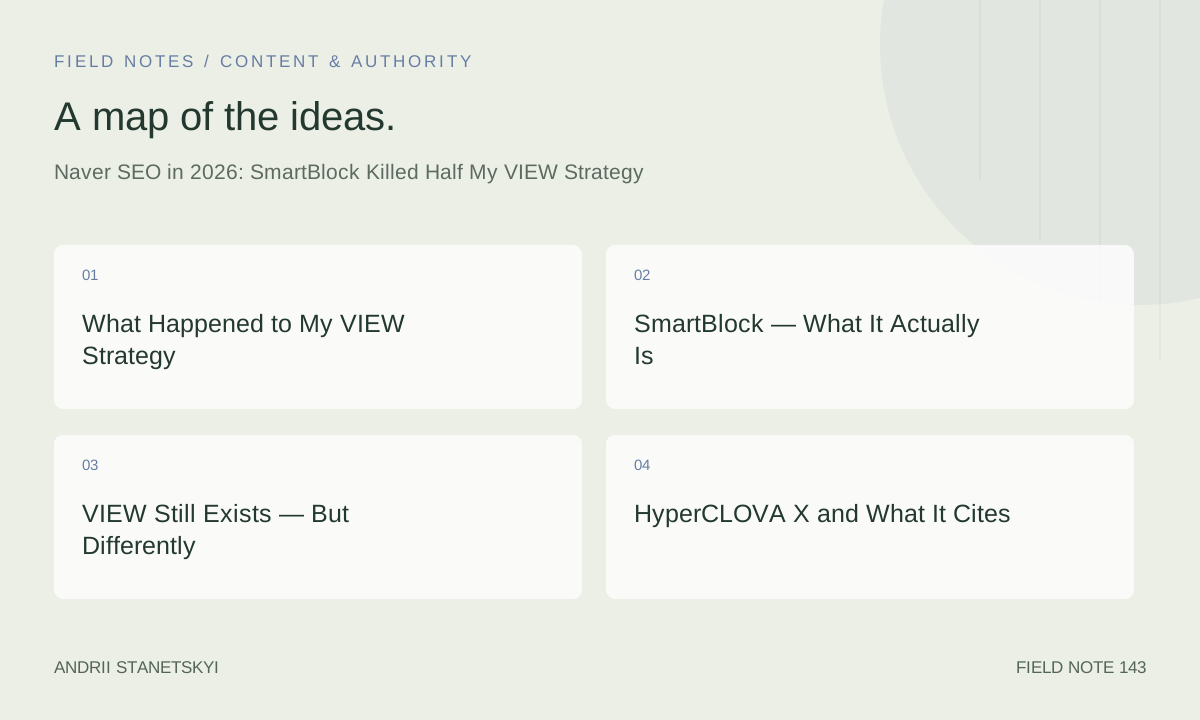
What Happened to My VIEW Strategy
In August 2025, I noticed that two of my Korean clients' VIEW tab traffic had dropped by 41% and 53% respectively, despite consistent publishing schedules, strong engagement metrics, and no manual actions in Naver Search Advisor. The blogs hadn't been penalized. The content hadn't degraded. The VIEW rankings hadn't disappeared. Traffic just stopped arriving at the same rate.
It took me about six weeks of investigation to understand what was happening. Naver had been quietly expanding SmartBlock — the topic-segmented SERP layout that groups content into horizontal scroll units — across more and more query types. Users were finding what they needed in SmartBlocks without ever tapping through to the VIEW tab. The VIEW tab still existed. The rankings still existed. The users were just being caught upstream.
This is not a penalty story. It's a SERP architecture story. And understanding it changed how I think about Naver SEO entirely.
SmartBlock — What It Actually Is
SmartBlock is Naver's answer to the same problem that Google tried to solve with AI Overviews: how do you help users who want a quick answer without clicking through to a full article? Naver's approach is different from Google's. Instead of generating a text summary, Naver groups results by content type and intent into labeled horizontal blocks that appear before the traditional feed.
A query like "제주도 맛집 추천" (Jeju Island restaurant recommendations) in 2026 produces a SERP that looks nothing like the old VIEW feed. The top of the page has a map block showing nearby results from Naver Maps. Below that is a SmartBlock for "블로그 리뷰" (blog reviews) with horizontally scrollable cards. Then a SmartBlock for "유튜브 영상" (YouTube videos). Then a SmartBlock pulling from Naver's own content curation. The traditional VIEW tab is there — but it's one tap away, not the default view.
SmartBlock Types in 2026
As of May 2026, I've catalogued the following SmartBlock types actively appearing across queries I track:
- 블로그 (Blog reviews and informational)
- 카페 (Naver Cafe — community and enthusiast content)
- 지식iN (Naver's Q&A platform)
- 쇼핑 (Shopping — Naver Shopping product listings)
- 뉴스 (News — Naver News partners and press releases)
- 동영상 (Video — primarily YouTube, some Naver TV)
- 지도 (Map — Naver Maps local listings)
- 이미지 (Images)
- 전문정보 (Expert information — pulls from verified professional sites)
Each SmartBlock has its own ranking algorithm. A piece of content that ranks #1 in the VIEW tab might not appear in the Blog SmartBlock for the same query if it doesn't match the SmartBlock's quality threshold. These aren't the same ranking.
Why This Broke Existing Strategies
The VIEW-first strategy that dominated Korean SEO from roughly 2019 to 2024 worked on a simple premise: rank in VIEW, get clicks. VIEW was the main organic surface. The formula was: create high-engagement Naver Blog content, get it to the top of VIEW, capture traffic.
SmartBlock disrupts this at the user behavior level. Users scrolling through a SERP now interact with SmartBlock cards before they ever consider tapping "VIEW." Click behavior has shifted upstream. The blog post that ranks #1 in VIEW but doesn't appear in the Blog SmartBlock for the same query gets a fraction of the previous clicks.
The August 2025 traffic drop I observed was this shift. My clients' VIEW rankings hadn't changed. The SmartBlock hadn't demoted them. The SERPs had just reorganized, and the new architecture put the answer before the click.
VIEW Still Exists — But Differently
I want to be clear that the VIEW tab isn't dead. For queries where users want to do extended reading — in-depth guides, multi-step how-tos, personal experience narratives — VIEW remains the primary surface. These are queries where a SmartBlock card doesn't satisfy the intent; the user wants to read something substantial.
What changed is the distribution. Roughly 60% of the queries I was tracking for blog-formatted content have seen meaningful SmartBlock displacement of VIEW clicks. The remaining 40% — primarily long-tail, high-intent, experience-heavy queries — are largely unaffected. The Naver Blog content strategy that I'd recommend today is explicitly targeted at that 40%, not at the full query universe the way it was in 2023.
Engagement signals inside VIEW have also shifted. In 2025, Naver placed increased weight on "공감" (like/empathy) signals and save-to-collection rates as indicators of content quality. Posts that generate saves — meaning users found them worth returning to — are getting ranking preference over posts with high view counts but low return behavior. This is similar to what YouTube did with watch time as a substitute for raw view counts.
HyperCLOVA X and What It Cites
Naver's CLOVA X AI assistant — powered by HyperCLOVA X, the large language model developed in partnership with Korean AI research institutions — now appears for roughly 27% of queries I track in Korean search, as of May 2026. The interface presents a generated summary with source citations and then the traditional SERP below.
What CLOVA X cites is worth understanding. The pattern I see across 90 days of citation tracking:
Naver News articles from registered news partners get cited most frequently for factual claims. Official company and organization websites get cited for specific facts about those entities. High-engagement Naver Blog posts get cited for experience and review content. External expert sites (government, universities, professional associations) get cited for technical or regulatory information.
Thin content — whether on Naver Blog or an external site — gets cited rarely even if it ranks in VIEW. The citation selection appears to weight engagement depth (공감 saves, read-through rates) more than raw VIEW ranking position. I've seen VIEW #1 posts get passed over in CLOVA X citations in favor of VIEW #4 posts with significantly higher engagement-to-view ratios.
The practical implication: if CLOVA X citation is part of your strategy (and it should be for brand awareness in Korean search), optimize for engagement quality rather than VIEW rank alone.
The MAP Framework for Naver Content
Out of the wreckage of my August 2025 VIEW traffic drop, I developed what I now call the MAP Framework — Match, Anchor, and Platform — as the sequencing logic for any new Naver content strategy.
Match. Before creating content, identify which SmartBlock type is winning for the target query. Run the query in Naver and observe which SmartBlock appears first, second, third. This tells you what format Naver believes satisfies the intent. Create content that matches the leading SmartBlock type, not just content that fits your preferred format.
Anchor. Identify the 2–3 highest-engagement queries in your topic cluster where VIEW is still the primary surface — where SmartBlock displacement is minimal. These are your anchor pieces: long-form, experience-rich, narrative content designed to dominate VIEW for high-intent queries. They drive consistent baseline traffic and CLOVA X citation opportunities.
Platform. Choose the publishing platform based on which SmartBlock type you're targeting. Blog SmartBlock requires Naver Blog. Cafe SmartBlock requires a well-established Naver Cafe post. Expert information SmartBlock requires an external website with strong Naver Search Advisor signals. Platform selection isn't a preference anymore — it's a strategic input.
Platform Selection Is Now a Strategy Decision
Naver Blog in 2026
Naver Blog content ranks in the Blog SmartBlock and VIEW. Of the platforms available, it still has the lowest barrier to entry and the most predictable ranking timeline. A well-written blog post with genuine personal experience, appropriate images, and consistent engagement signals (공감, comments, saves) can rank in 4–8 weeks for mid-competition queries.
What's changed in 2026: Naver's blog quality assessment has gotten significantly better at identifying posts that exist primarily for promotional purposes. Posts that replicate generic information without personal experience or original perspective are being filtered out of the Blog SmartBlock more aggressively than in 2024. The "blokken" (블로그 SEO 최적화) style posts — heavy keyword repetition, minimal original content — are seeing declining performance even when engagement metrics look acceptable.
Naver Cafe — The Underestimated Channel
Naver Cafe is underused by most practitioners outside Korea. A Cafe is a topic-focused community, somewhat like a hybrid between a subreddit and a Facebook Group, but hosted on Naver's infrastructure. The Cafe SmartBlock appears prominently for product research queries, hobby queries, and community-knowledge queries.
For the Korean beauty brand client I manage, Cafe-native content started outperforming Blog content for purchase-decision queries in Q1 2026. A post in a relevant 화장품 (cosmetics) Cafe — written by a community member, not a brand account — drove more referral sessions to the brand's Naver Shopping listing than any blog content from the same period. We didn't write the post. We sent samples to the community admin and the community member wrote it organically.
That's the right Cafe strategy: genuine participation and product seeding, not brand-operated Cafe accounts trying to simulate community. Naver's quality filters have become good enough to identify and downweight obvious brand-controlled Cafe content.
External Websites on Naver
External websites have historically been second-class citizens in Naver SERPs. That's still partially true in 2026, but the Expert Information (전문정보) SmartBlock creates a surface where external sites can compete directly with Naver-native content — provided they meet specific conditions.
The conditions: verified in Naver Search Advisor, structured data correctly implemented, genuine Korean-language backlinks from other Korean domains, and content that Naver's quality system classifies as authoritative in a professional or technical sense. Government agency sites, university research sites, and professional association sites benefit most from Expert Information SmartBlock. Brands can appear there for technical product specifications and safety documentation.
Technical Naver Implementation
Naver Search Advisor
Naver Search Advisor (네이버 서치어드바이저) is the external website verification and monitoring platform. Verification via Search Advisor is a prerequisite for external site presence in any Naver SERP surface — without it, your site is essentially invisible to Naver's trust framework.
The most important Search Advisor function that most Western practitioners miss: the "Preferred Version" setting. Naver lets you specify whether www or non-www, http or https, is the canonical version of your domain. Getting this wrong — having both versions serve content without a clear Naver-recognized preferred version — causes crawl confusion that's different from Google's canonical handling.
<!-- Naver site verification meta tag -->
<meta name="naver-site-verification" content="your_verification_code_here">

<!-- Naver Search Advisor sitemap submission endpoint -->
<!-- Submit via dashboard OR via ping URL: -->
<!-- https://searchadvisor.naver.com/ping?sitemap=https://your-domain.com/sitemap.xml -->

<!-- robots.txt — Naver's crawler is Yeti -->
<!-- Ensure Yeti is not blocked: -->
User-agent: Yeti
Allow: /

<!-- Naver also uses: -->
User-agent: NaverBot
Allow: /
Naver Schema and Open Graph
For Naver Blog posts, Open Graph tags control how content appears when shared in Naver's ecosystem — including how SmartBlock cards render the thumbnail and title. Poorly configured OG tags result in SmartBlock cards with auto-generated thumbnails that consistently underperform custom thumbnail cards on click-through rate.
For external websites, Naver processes standard schema.org markup. The schema types that trigger rich results in Naver SERPs in 2026 are Product, Recipe, Article, FAQPage, and HowTo. LocalBusiness schema feeds Naver Maps integration. The FAQPage schema triggers a dedicated FAQ expansion in Naver SERPs — it's more reliably rendered on Naver than on Google in my experience.
<!-- Naver-optimized Open Graph for Blog and external content -->
<meta property="og:type" content="article">
<meta property="og:title" content="핵심 키워드가 포함된 제목 | 브랜드명">
<meta property="og:description" content="검색자가 원하는 답변을 명확히 전달하는 설명">
<meta property="og:image" content="https://your-domain.com/images/og-1200x630.jpg">
<meta property="og:image:width" content="1200">
<meta property="og:image:height" content="630">
<meta property="og:url" content="https://your-domain.com/page-slug">
<meta property="og:locale" content="ko_KR">

<!-- Article-specific -->
<meta property="article:published_time" content="2026-05-19T09:00:00+09:00">
<meta property="article:author" content="작성자 이름">
Two Contrarian Takes on Korean SEO
First: the common advice that "Naver is all about blog content" is now actively misleading. It was a reasonable simplification in 2022. In 2026, a strategy built entirely around Naver Blog ignores the Cafe SmartBlock, the Expert Information SmartBlock, CLOVA X citation opportunities, and the Naver Shopping ecosystem. Practitioners who tell clients to "just start a Naver Blog" are giving 2021-era advice in a 2026 environment.
Second: I've seen multiple Korean SEO guides suggest that link building is irrelevant on Naver because Naver favors its own platforms. This is wrong in a specific way. Links from Korean domains to your external website are a meaningful ranking signal for external site presence in Naver SERPs. They're less important than engagement signals for Naver-native content, but they're not irrelevant. The confusion comes from conflating Naver Blog SEO (where traditional backlinks don't matter) with external website SEO on Naver (where Korean backlinks do matter). These are different problems with different signal sets.
The Mistake That Wasted Four Months of Blog Posts
In January 2025, I launched a blog content campaign for a Korean travel client. We created 68 posts over four months, all targeted at informational travel queries, all on Naver Blog, all with genuine photography and first-person narrative. Solid content.
What I didn't do before launching: run a SmartBlock audit on each target query. Had I done that audit, I would have seen that 71% of the target queries were displaying a Map SmartBlock and a Video SmartBlock as the primary surfaces — not a Blog SmartBlock. The content format that would dominate those queries was short-form video (primarily YouTube, which feeds Naver's video SmartBlock) and Naver Maps listings.
We built 68 blog posts for queries where blog posts weren't the preferred content type. They rank. They just don't get the clicks they would have gotten pre-SmartBlock, because users find what they need in the Map and Video blocks before they scroll down to the blog results.
The campaign wasn't wasted — the posts do get traffic and they provide CLOVA X citation material. But the traffic estimate was 65% wrong because I hadn't factored in SmartBlock displacement. Since that project, every Naver content campaign I plan starts with a SmartBlock audit of the full keyword set. It takes 3–4 hours to do manually for a 200-keyword set. It's worth every minute.
Where I Am in May 2026
SmartBlock is not a problem to solve. It's a new SERP architecture to understand and plan around. The mistake is treating it as an obstacle to the old strategy rather than the new surface to optimize for.
My current Korean SEO playbook starts with three questions: Which SmartBlock types appear for the target query cluster? What content format and platform does each SmartBlock prefer? Where does CLOVA X citation opportunity exist within that query set? Those questions replace "how do I rank in VIEW?" as the framing.
VIEW is still part of the answer — particularly for long-tail, high-intent queries where users want substantial content. But it's one surface in a richer SERP architecture, and treating it as the only surface leaves significant traffic opportunity uncaptured.
For clients entering Korean search for the first time in 2026, my standard advice: start with Naver Search Advisor verification, run a SmartBlock audit of your target queries, build a platform matrix (which content goes on Blog, which on Cafe, which on external website), and reserve at least 30% of content budget for formats that feed non-Blog SmartBlocks. Then revisit every 60 days because Naver is deploying SmartBlock expansions faster than any other non-Google engine I track.
For further reading on how AI search features are reshaping organic strategies more broadly, see AI Overviews and CTR impact and SEO for generative engines. For the Yandex parallel — another engine where behavioral signals and SERP architecture matter more than raw content quality — see Yandex SEO in 2026.
External reference: Naver Search Advisor — official platform
SmartBlock behavior observed and documented May 2026. SmartBlock composition varies by query type, user geography, and device. All observations based on Korean-market desktop and mobile testing from Seoul-based proxy.