Brian Dean's Skyscraper Technique was one of the most influential link building frameworks of the 2010s. The core logic was elegant: find what already earns links, build something better, ask the people linking to the original to switch their link to you. In 2026, that core logic still holds. But every operational detail of how to execute it has changed. The 2015 version of the Skyscraper Technique — "make it longer and prettier" — produces failure rates above 90%. The 2026 version demands genuine intellectual contribution, precise targeting, and a value-exchange pitch that goes beyond "my page is better." Here is the updated framework.
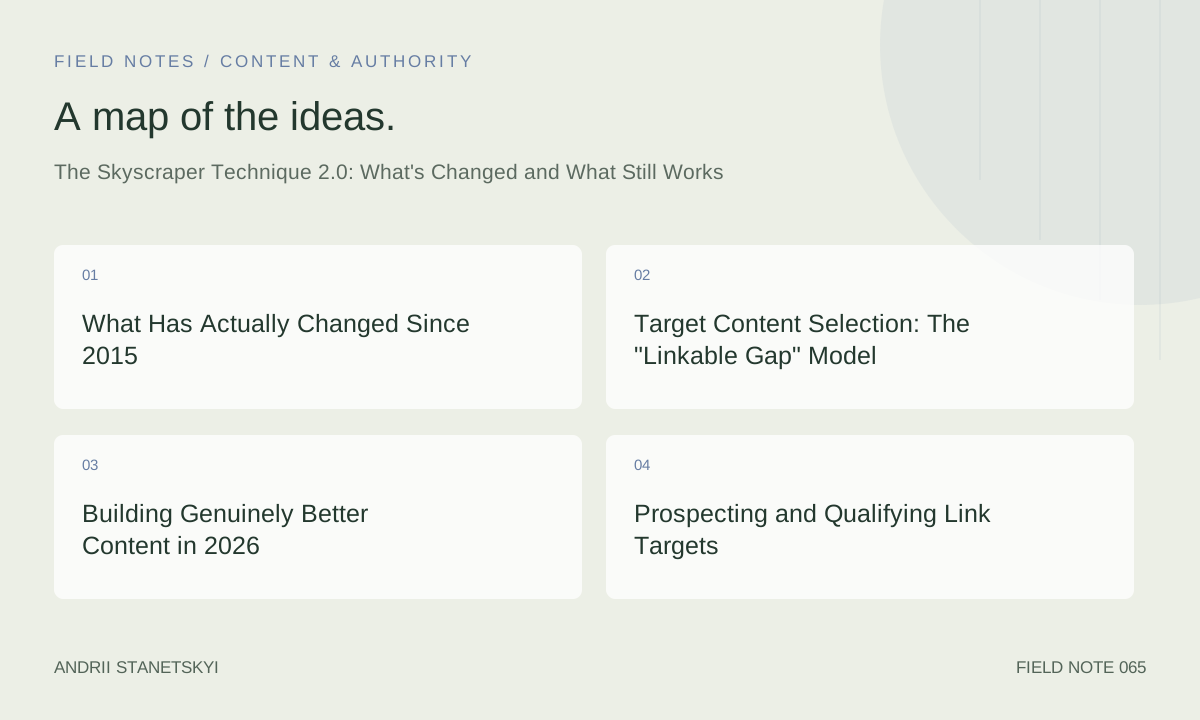
What Has Actually Changed Since 2015
Three things have changed so fundamentally that they require rethinking every step of the original technique:
1. "Longer" Is No Longer a Differentiator
In 2015, most top-ranking content was 800–1,500 words. A 3,000-word comprehensive guide was genuinely rare and valuable. In 2026, virtually every competitive query has multiple 3,000–8,000 word articles competing for the top 10. Word count is now table stakes, not a differentiator. The "better" in Skyscraper 2.0 must mean something other than "more words."
2. Google's Helpful Content Evaluation Has Matured
Google can now reliably detect content that is "comprehensive" in structure but thin in genuine expertise. A Skyscraper page that covers all the same points as the original article but in more words, with more subheadings and prettier images, is likely to be evaluated similarly by the algorithm — unless it adds genuine first-hand expertise, original data, or a meaningfully different perspective.
3. Webmasters Are Saturated with Skyscraper Pitches
The technique went mainstream around 2016–2018. By 2020, "I noticed you linked to X — I've written a more comprehensive piece" had become the most recognizable link outreach pattern on the internet. Open rates dropped, response rates collapsed. Sending the classic Skyscraper pitch template today marks you immediately as a link builder, not a colleague sharing a genuinely useful resource.
Target Content Selection: The "Linkable Gap" Model
The 2026 version starts with a different question. Instead of "what earns the most links that I can make a longer version of?" ask: "what does the linking audience actually need that the most-linked piece doesn't fully provide?"
The Linkable Gap Analysis
- Find the most-linked piece. In Ahrefs Content Explorer, search for your target topic, sort by referring domains, filter for DR 20–80 to exclude mega-sites. Export the top 10 most-linked pages.
- Analyze the link context, not just the content. For each piece, look at who links to it and why. The anchor text and surrounding context in the linking page reveals what the linker valued. This is your intelligence data.
- Map the gap between what linkers cite and what the content actually delivers. Common gaps: the piece has good aggregate data but no methodology explanation, so researchers link to it but can't actually use the data. Or it has actionable steps but no real examples, so practitioners link to it because it's the best available but supplement it with their own explanations.
- Build content that fills the exact gap. If the gap is methodology: add a rigorous methodology section plus raw data. If the gap is examples: add 5–10 detailed case studies. If the gap is recency: update every data point and add a "2026 update" section.
Prospect Filtering Before Building
Only pursue Skyscraper targets where the original content has 30+ referring domains in your target DR range. Below that threshold, the outreach pool is too small to justify the content creation investment. Use this Ahrefs filter setup:
Ahrefs Content Explorer Settings for Skyscraper Target Discovery:
Search: [your target keyword or topic]
Filters:
  - Referring domains: min 30
  - DR (of linking sites): 30–80
  - Organic traffic: 1,000+/month
  - Published date: exclude last 6 months (too new for full link profile)
  - Language: English

Sort by: Referring domains (desc)
Export top 20 for manual review
Building Genuinely Better Content in 2026
"Better" in 2026 means at least one of the following that the original lacks:
| Differentiator Type | What It Looks Like | Outreach Appeal | Production Effort |
|---|---|---|---|
| Original primary data | Survey results, proprietary dataset, original experiment | Very high — journalists and academics specifically seek primary sources | High (4–8 weeks) |
| Real expert contribution | 10+ named practitioners sharing actual workflows, not opinions | High — provides social proof from known experts | Medium (2–4 weeks) |
| Verified case studies | Named companies, real before/after metrics, honest failure notes | High — practitioners cite real-world evidence | Medium (2–3 weeks) |
| Interactive functionality | Calculator, tool, quiz, configurable dataset | Medium-High — utility drives recurring links | High (dev required) |
| Superior visual explanation | Custom diagrams, process flowcharts, comparison visuals | Medium — linkers embed images and attribute | Medium |
| Recency + comprehensiveness | Updated data, added 2025–2026 context, expanded coverage | Low-Medium — only works when original is genuinely outdated | Low-Medium |
The honest conclusion from this table: "recency + comprehensiveness" — the classic Skyscraper play — has the lowest outreach appeal. Build it as a baseline, but pair it with at least one high-appeal differentiator.
Prospecting and Qualifying Link Targets
Export backlinks for the original piece from Ahrefs. Apply these filters before adding to your outreach list:
Ahrefs Backlink Export Filters for Skyscraper Outreach List:
- Link type: Dofollow
- One link per domain: ON
- DR of linking domain: 25+
- Organic traffic of linking domain: 500+/month
- Linking page traffic: 100+/month
- Exclude: forums, wiki pages, Q&A sites (nofollow dominant)
- Exclude: pages where link appears in footer, sidebar, or comment section

Target export size: 50–150 qualified prospects per campaign
For each prospect, manually verify the linking context. The link from the original piece — is it cited as a source, recommended as a resource, or embedded in an article? Each context requires a different outreach angle.
Outreach Approach and Email Templates
The biggest shift in Skyscraper 2.0 outreach is abandoning the explicit "replace their link with mine" frame. In 2026, that frame is too recognizable as a link building pitch. Instead, you are sharing a resource that may be useful to their audience, and the link replacement is the natural outcome if they find it valuable.
Primary Outreach Template — Skyscraper 2.0
Subject: Re: your link to [original content title]

Hi [First name],

I saw you linked to [original article title] in your piece on [their page title].
That's still a solid reference — wanted to share something that might add value for
your readers.

We just published [your content title] which covers the same ground with:
- [Specific differentiator 1, e.g., "original survey of 600 practitioners"]
- [Specific differentiator 2, e.g., "step-by-step workflow with real client examples"]
- [Specific differentiator 3, e.g., "updated 2026 data on X"]

If you think it would be useful for your readers, it might be worth a mention alongside
[or: as an additional resource / as a more current reference].

Happy to send you a summary or the raw data if useful.

[Name]
For Personal/Blog Sites (DR 30–55)
Subject: Your article on [topic] — related resource

Hi [First name],

Really liked your piece on [topic] — the section on [specific detail] was particularly
well-observed.

I've been working on a deep-dive on the same topic and would love your perspective:
[your URL]. We included [specific differentiator] that I think changes the conventional
take on [specific aspect of the topic].

If you end up finding it useful for your readers, a link would be great — but either way,
curious if your experience matches what we found.

[Name]
Realistic Success Rates by Niche and DR Tier
Based on multi-year campaign data, here are honest benchmarks for Skyscraper 2.0 outreach:
| DR Tier of Target | With Primary Data Differentiator | With Expert Roundup Differentiator | Recency Only |
|---|---|---|---|
| DR 60–80 | 8–14% | 5–9% | 1–3% |
| DR 40–59 | 12–18% | 8–14% | 3–6% |
| DR 25–39 | 15–22% | 10–16% | 5–10% |
The message from this data: if you're going to target DR 60+ sites, you need primary data as your differentiator. Recency alone will not move high-authority sites. See our digital PR guide for how original data campaigns compare to Skyscraper campaigns in cost-per-link terms.
Mini Case Study: Legal Tech, 38 Links from One Skyscraper Asset
Client: Legal document automation SaaS, DR 46, targeting "legal automation" and "contract management" topic clusters.
Original piece targeted: A 2021 guide to legal technology adoption with 80 referring domains (DR range 25–72). Content was outdated (all statistics from 2020–2021) and lacked real implementation examples.
Skyscraper asset built: "Legal Technology Adoption Report 2026" — a combination of:
- Original survey of 450 in-house legal teams on technology adoption, workflow, and ROI
- 12 verified case studies from named law firms and corporate legal departments
- Expert commentary from 8 named legal operations professionals
- Full methodology and raw aggregate data available for download
- Total length: 6,800 words plus embedded charts and data tables
Outreach: 94 prospects extracted from the original article's backlink profile (DR 25+), contacted via Pitchbox with the "data + case studies" differentiator framing.
Results:
- Response rate: 24%
- Links placed: 38
- Net conversion: 40.4%
- DR range: 28–71
- 21 links from DR 40+ sites
- 3 organic links earned with no outreach (the asset was shared in legal operations communities)
Key insight: The 40% net conversion rate is well above the typical Skyscraper benchmark because the differentiators were substantive. The original 2021 piece was specifically cited as outdated by 11 of the 38 webmasters who replaced it — validating that recency alone, when the original is genuinely dated, can be compelling in specialist niches where practitioners care about data currency. See our guide on backlink profile auditing for how to monitor the long-term performance of Skyscraper-earned links.
FAQ
Is the Skyscraper Technique dead?
The original 2015 formula — find the most-linked piece, make it longer and prettier, send the template — is effectively dead. Conversion rates with that approach are 1–3% at best. The updated 2026 framework with genuine content differentiation achieves 10–20%+ conversion rates. The name is overloaded; the underlying logic of competing on content quality is valid.
How many referring domains should the target piece have for Skyscraper to be worth it?
Minimum 30 referring domains in your target DR range (25+). Below that, the outreach pool is too small to justify the content investment. Sweet spot: 50–200 referring domains. Above 200, the original piece is usually so entrenched that replacement conversion rates drop significantly.
Should I reach out to everyone who links to the original, or be selective?
Be selective. Sites that have linked to 20+ external resources on a single page are doing broad curation — lower conversion. Sites where your target piece is one of 3–5 links are more likely to care about the specific quality of that link. Also skip sites in your direct niche if they are potential competitors — they'll rarely replace a link with yours.
How do I handle it when the webmaster asks why I want them to link to me?
Answer honestly: you built a resource you're genuinely proud of and believe it would serve their readers better than the current link. Do not apologize for having an interest in the link — webmasters respect transparency. What they dislike is being manipulated into thinking the outreach is purely altruistic.
Can Skyscraper work for product pages, not just content?
Rarely. The technique works when the linking intent is informational — people linking to the original piece because it explains or evidences something. Product pages rarely earn links through this mechanism. Review Backlinko's original Skyscraper case study for historical conversion benchmarks.
How do I avoid looking like every other Skyscraper outreach email?
Lead with a specific observation about their content (not a generic "great article"). Name your specific differentiator in concrete terms. Avoid the phrase "more comprehensive" — it has become a red flag in outreach inboxes. Reference actual findings from your content that would be genuinely interesting to their audience.
Key Takeaways
- The classic "longer and prettier" Skyscraper play is dead. Genuine intellectual contribution — original data, expert case studies, functional tools — is required for meaningful conversion rates in 2026.
- Before building, identify the "linkable gap" — what the original piece doesn't provide that its linkers actually need.
- Avoid the explicit "replace their link with mine" framing. Frame it as sharing a useful resource for their audience.
- Realistic conversion rates range from 8–22% depending on differentiator strength and target DR tier.
- Only target pieces with 30+ referring domains in your DR range. Below that, the ROI math doesn't work.
- Primary survey data as a differentiator is the single highest-converting approach for DR 60+ targets.
Conclusion
Skyscraper 2.0 is really just "content-led link building done seriously." The technique's name has become baggage — practitioners who succeed with it in 2026 don't think of it as a link building tactic but as a content strategy that happens to earn links. Build something that fills a genuine gap in your field's knowledge base, tell the people who should care about it, and the links follow. That has always been the real formula.