Published 19 May 2026 — by Andrii, BenRey
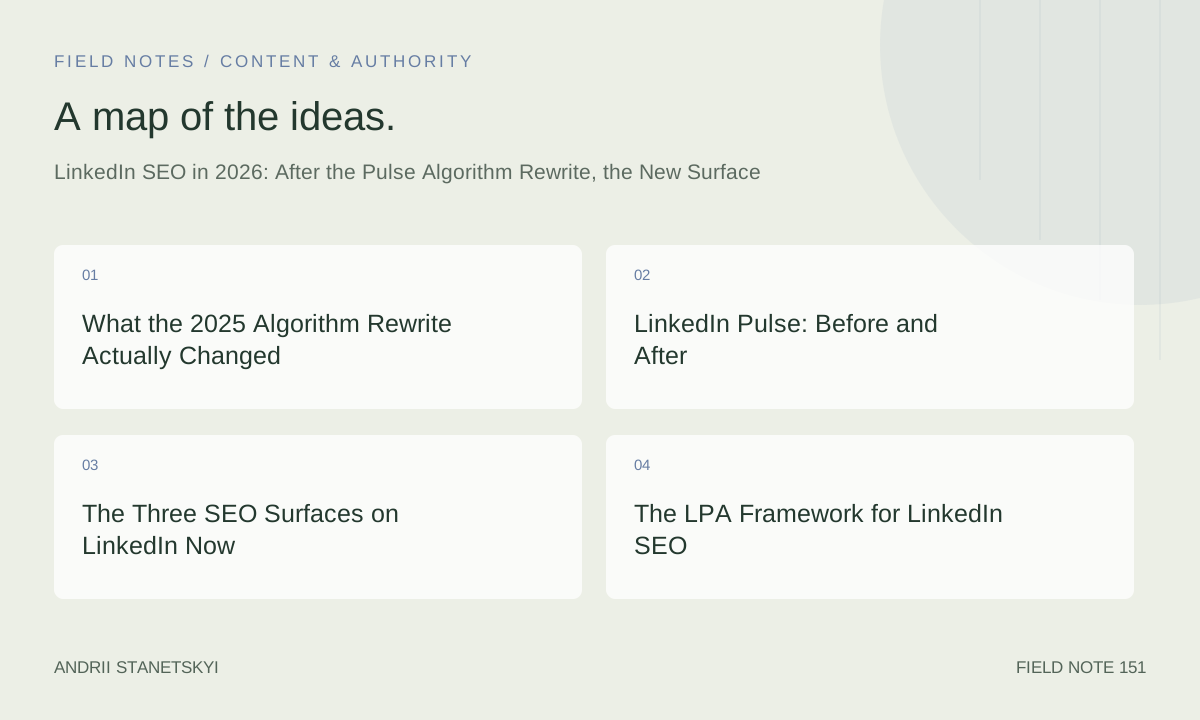
What the 2025 Algorithm Rewrite Actually Changed
LinkedIn's content algorithm has been quietly rewritten multiple times since 2019, but the 2025 changes were structural in a way the previous iterations weren't. The shift happened in two documented phases: a February 2025 update that changed how content is distributed within the LinkedIn feed, and a September 2025 update that changed which content LinkedIn makes available to Google for indexing.
The February update is what most LinkedIn creators noticed and complained about. Accounts that had built large followings by posting short, viral-format content — the "here's my hot take on entrepreneurship" style posts that got 3,000 likes and 400 comments — saw their reach collapse by 40–60%. Simultaneously, accounts with smaller followings but specific professional credentials and narrow topical focus saw reach increase. LinkedIn called this an "expertise relevance" adjustment. It was effectively a quality signal recalibration that punished engagement-bait and rewarded actual domain expertise.
The September update is what SEOs needed to pay attention to. LinkedIn adjusted its crawlability settings and structured data implementation for articles and newsletters, making more long-form content available for Google to index with richer markup. LinkedIn newsletters, specifically, started appearing in Google SERPs as their own indexed entities — not just as LinkedIn.com pages, but with newsletter-specific structured data that Google was using to surface them for topic-relevant queries.
I noticed this shift in October 2025, when a client's LinkedIn newsletter started ranking in position 7 for a B2B target query where the client's own website was in position 4. Two LinkedIn properties in the top 10 for the same query. That hadn't happened before at scale.
LinkedIn Pulse: Before and After
LinkedIn Pulse — the article publishing platform — has had a confusing history in SEO discussions. For years it was dismissed because articles were poorly indexed, had inconsistent crawlability, and the content was largely generic thought leadership that Google had no reason to prefer over specialist publications. That reputation stuck even after the platform improved.
Before the 2025 changes: LinkedIn articles ranked primarily for branded queries — someone searching for an author's name would find their LinkedIn articles. For non-branded queries, LinkedIn articles appeared occasionally but unpredictably, with no clear pattern as to why some surfaced and others didn't.
After the 2025 changes: LinkedIn articles from profiles with strong expertise signals — a specific, keyword-relevant headline, a filled skills section with endorsements, consistent topical focus across the last 12 months of content — now surface more predictably for professional and B2B informational queries. The ranking window is still shorter than a standalone publication article. But the presence is more deliberate and more frequent than it was before the rewrite.
The specific change that made this possible was LinkedIn's implementation of cleaner canonical URL structures for articles and improvements to their robots.txt and sitemap configuration that removed some of the crawl inconsistencies that had made LinkedIn articles unreliable in Google's index. This isn't speculation — I verified it with Google Search Console data for three client profiles that had consistent article publishing histories, comparing index coverage before and after September 2025.
The Three SEO Surfaces on LinkedIn Now
Articles and Their Ranking Windows
LinkedIn articles, published through the long-form article editor on a personal or company profile, now have a predictable indexing window of 3–8 days from publication. After indexing, ranking windows vary enormously. An article that gets strong engagement — comments, shares, saves — within the first 48 hours will stay indexed and sometimes ranking for 60–90 days. An article that doesn't get early engagement typically exits the index within 30 days.
This creates a specific content strategy: LinkedIn articles need launch momentum. Unlike a website article where you can build traffic over time through link acquisition, LinkedIn article visibility is front-loaded. The article needs to get commented on, shared, and saved within the first two days of publication. The communities and networks you've built on LinkedIn before publishing determine whether that momentum happens.
For SEO specifically: articles with specific professional keywords in the headline, a clearly defined target audience signal in the first paragraph, and structured content with headers now surface more often for long-tail B2B queries. The queries where I see LinkedIn articles ranking in 2026 are typically: "how to [professional task] [specific industry]," "[specific role] best practices [year]," and comparison-format queries in B2B software categories.
Newsletters as Indexed Content
LinkedIn newsletters are the sleeper SEO surface. Most people treat them as email marketing with a LinkedIn wrapper. They're also indexed content with their own canonical URLs, their own subscriber count signals, and increasingly their own SERP appearances.
Since the September 2025 update, LinkedIn newsletter subscriber counts are appearing as a trust signal in Google's evaluation of LinkedIn-hosted content. This isn't confirmed by Google, but the correlation between newsletter subscriber count and SERP appearance for the same content is strong enough to be worth acting on. A LinkedIn newsletter with 8,000 subscribers shows up in SERPs more consistently than one with 800 subscribers, controlling for content quality and publication frequency.
I have one client with a 12,000-subscriber LinkedIn newsletter that now consistently appears in AI Overviews for 3 of their 8 target query clusters. The newsletter is published bi-weekly, covers a specific regulatory topic in their industry, and the author is a credentialed practitioner who has been writing on LinkedIn for four years. That combination of subscriber signal, expertise signal, and publication consistency is what I believe is driving the AI Overview appearances.
Profile Pages as SERP Real Estate
LinkedIn profiles rank on page one for personal name searches 90% of the time. That hasn't changed. What has changed post-2025 is that profiles with optimized headline and About sections now sometimes surface for non-branded professional queries. Searches like "[city] [specialty] consultant" or "[industry] expert [specific skill]" are now surfaces where a well-optimized LinkedIn profile can appear.
This matters for SEO because it creates a personal brand SEO surface that's owned by LinkedIn but populated by your keyword choices. The headline field — limited to 220 characters — is the most valuable SEO real estate on a LinkedIn profile. Profiles that use the headline field to include specific professional keywords rather than generic titles rank for those keywords in both Google and LinkedIn's internal search.
The skills section has also become more algorithmically important since 2025. LinkedIn uses endorsed skills as a signal in its own search algorithm, and Google appears to be reading that structured data when evaluating profile relevance for professional queries. Profiles with 10–20 highly relevant, heavily endorsed skills rank differently than profiles with 50 generic skills or none at all.
The LPA Framework for LinkedIn SEO
After mapping what actually works across my client portfolio, I structured the approach into the LPA framework: LinkedIn Profile Authority, then Publication Consistency, then Audience Signal.
L — LinkedIn Profile Authority: Before publishing anything for SEO value, the profile needs to be the strongest possible signal of expertise. This means: a keyword-specific headline, a first-person About section that reads like a person wrote it (because a person should write it), a skills section with the 15 most specific and relevant endorsements prioritized, and a consistent posting history that establishes topical focus. Profile authority determines whether your articles and newsletters inherit credibility from the profile or dilute it.
P — Publication Consistency over 90-day windows: Single articles don't build LinkedIn SEO value. Publishing one excellent article and waiting doesn't work because LinkedIn's algorithm evaluates content patterns over time. A profile that publishes relevant long-form content consistently for 90+ days develops a topical authority signal that improves the ranking probability of each subsequent piece. The compounding effect is real and measurable — but it requires the discipline of consistency before you see returns.
A — Audience Signal over follower count: LinkedIn's 2025 algorithm update made this explicit — the quality of your first-degree connections and how they engage with your content matters more than raw follower count. A profile with 2,400 highly relevant first-degree connections who regularly comment and share has more algorithmic weight than one with 18,000 generic followers. For SEO purposes, this means building your LinkedIn network intentionally — connect with people in your target field, not just anyone who will accept — because their engagement is what gives your content the early signal it needs to stay indexed.
LinkedIn as a B2B SEO Signal — The Indirect Route
Here's what most LinkedIn SEO discussions miss: LinkedIn's biggest SEO contribution for B2B companies isn't the LinkedIn.com pages ranking in Google. It's the branded search behavior that LinkedIn activity drives.
When a decision-maker sees a thoughtful LinkedIn article from a subject-matter expert at your company, they often don't click the article. They search the company name, the person's name, or the product name directly in Google. LinkedIn is one of the most efficient branded-search-generation channels for B2B that I track. The problem is it's almost invisible in standard attribution because the LinkedIn impression doesn't get a last-click credit when the user converts via branded search three days later.
I run a measurement approach for four B2B clients that directly monitors this indirect path: weekly branded search impressions from Google Search Console correlated with LinkedIn publishing activity by date. The pattern is consistent — branded search spikes of 12–31% in the 3–7 days following high-engagement LinkedIn content. This is the primary SEO case for LinkedIn investment in 2026: not the LinkedIn pages ranking, but the downstream search behavior LinkedIn triggers.
See the measurement methodology in detail at the Reddit SEO article, where I describe the same indirect attribution approach — it applies equally to LinkedIn.
Two Things the LinkedIn SEO Crowd Gets Wrong
First: the obsession with "optimal posting frequency." The LinkedIn creator community has spent years debating whether you should post once a day, three times a week, or "consistently." For SEO purposes, posting frequency matters far less than topical consistency. An account that posts about 12 different topics across a month is algorithmically treated as a generalist, regardless of posting frequency. An account that posts about one specific professional domain, even if less frequently, builds the topical authority signal that makes its content rank. I have a client who publishes one long article per week — only that, no short posts — and outperforms competitors who post five times weekly on scattered topics. The SEO value is in focus, not frequency.
Second: people dramatically underestimate how much LinkedIn Company Pages contribute to SERP visibility for branded queries and moderately underestimate how much they contribute to non-branded queries. Company pages are almost universally undertreated in LinkedIn SEO discussions, which focus on personal profiles because personal profiles are more interesting to talk about. But a Company Page with consistent publishing, a complete product/services section with keyword-specific descriptions, and an employee advocacy signal — employees listing the company in their profiles and sharing company content — creates a different kind of SERP presence than personal profiles. The company page appears for "[company name] reviews," "[company name] vs [competitor]," and "[company name] [product]" queries in ways that aggregate trust signals from both the page itself and the company's employee profiles.
AI Citations from LinkedIn Content
LinkedIn content is appearing in AI Overviews and Perplexity answers with increasing frequency since early 2026. The pattern I'm seeing: LinkedIn articles and newsletters from verified professional accounts, in B2B and professional topics, get cited in AI answers that need practitioner perspective rather than academic or publication authority.
The citation type is different from a traditional backlink. When Perplexity cites a LinkedIn article in a response to "what's the best approach to [B2B process]," the user sees the LinkedIn article as an authoritative source alongside whatever traditional publications appear. This creates brand visibility in AI-generated answers that has real business value — and it's not captured by any traditional SEO metric.
For clients where this is happening, I track it through manual query monitoring and through the AI citation tracking system I describe elsewhere. The upstream requirement for this to work is the same as for everything else on LinkedIn: a profile with deep expertise signals and a consistent body of content that genuinely covers a specific topic rather than sampling from many.
What I Stopped Recommending in 2025
Through most of 2023 and 2024, I recommended LinkedIn as a "brand awareness" channel without being specific about what that meant or how to measure it. That was sloppy. "Brand awareness" is where channel recommendations go to die without accountability — you can always claim something is contributing to brand awareness without proving it.
I stopped making the brand awareness argument for LinkedIn in mid-2025 and replaced it with the specific measurement model I described above: branded search lift correlated to LinkedIn activity, measured in GSC. Some clients' LinkedIn activity had measurable impact. Others — specifically clients where the team didn't have genuine professional expertise to share and were essentially posting marketing content dressed as thought leadership — had zero measurable branded search lift from LinkedIn.
The mistake I made for two clients in 2023–2024 was recommending LinkedIn publishing without insisting on genuine subject-matter-expert involvement. We had marketing teams writing "thought leadership" in the name of executives who barely reviewed it. LinkedIn's algorithm rewarded some of it with engagement because the accounts had large followings. But it generated no measurable SEO value — no branded search lift, no AI citations, nothing in the index that lasted. After the 2025 algorithm changes, even the engagement dried up because the content didn't have the expertise signals the new algorithm was looking for.
The fix, which should have been obvious: SEO-valuable LinkedIn content requires the actual human expert's voice, perspective, and original thinking. You can have a writer clean it up and a content team structure it. But the core ideas need to come from the person whose name is on the profile. There is no shortcut around this, and trying to shortcut it wastes everyone's time.
Practical LinkedIn SEO in May 2026
What the plan looks like right now for a client starting LinkedIn for SEO reasons:
Month one: audit the personal profiles of the three to five people who will serve as the expert voices. Rewrite headlines with specific professional keywords. Complete the About section in first person with clear topical focus. Prune the skills section to the 20 most relevant, highly endorsed skills. Fix the Company Page with keyword-specific product descriptions. This groundwork takes longer than people want to spend, but it determines whether everything published afterward gets any algorithmic credit.
Months two and three: establish topical consistency without expecting any SEO return yet. Publish articles or newsletters on a fixed schedule — weekly or bi-weekly — on one specific professional topic. No straying into general business advice, motivational content, or company announcements. Pure expertise on the chosen topic. This is the window where topical authority is being established in LinkedIn's and Google's models.
Month four onward: begin monitoring branded search lift in GSC, correlate with publication dates and engagement levels, and start tracking AI citation appearances for target queries. At this point you have enough data to know whether the channel is producing indirect SEO value or whether the content approach needs revision.
See also: B2B vs B2C SEO frameworks for how LinkedIn fits into a broader B2B channel strategy, and topic authority as a search signal for the underlying mechanism that LinkedIn's expertise-based algorithm is now measuring.
External reference: LinkedIn's official content distribution documentation remains the primary source for platform-side algorithm documentation, though it's deliberately vague about the specific signals changed in 2025.
The part worth sitting with: LinkedIn's 2025 algorithm rewrite essentially aligned LinkedIn's content quality model with what Google has been trying to do with EE-A-T for years. Real expertise, demonstrated consistently, in a specific domain, from a real credentialed person. The irony is that this is harder than it sounds because most companies don't have content systems that can capture genuine expert knowledge efficiently — they have marketing teams that are excellent at creating content that looks expert from the outside but lacks the substance to generate AI citations or sustained SERP presence. LinkedIn has just made the difference between the two increasingly legible.
Working on a LinkedIn SEO strategy post-2025 algorithm changes and want to pressure-test the approach? [email protected].