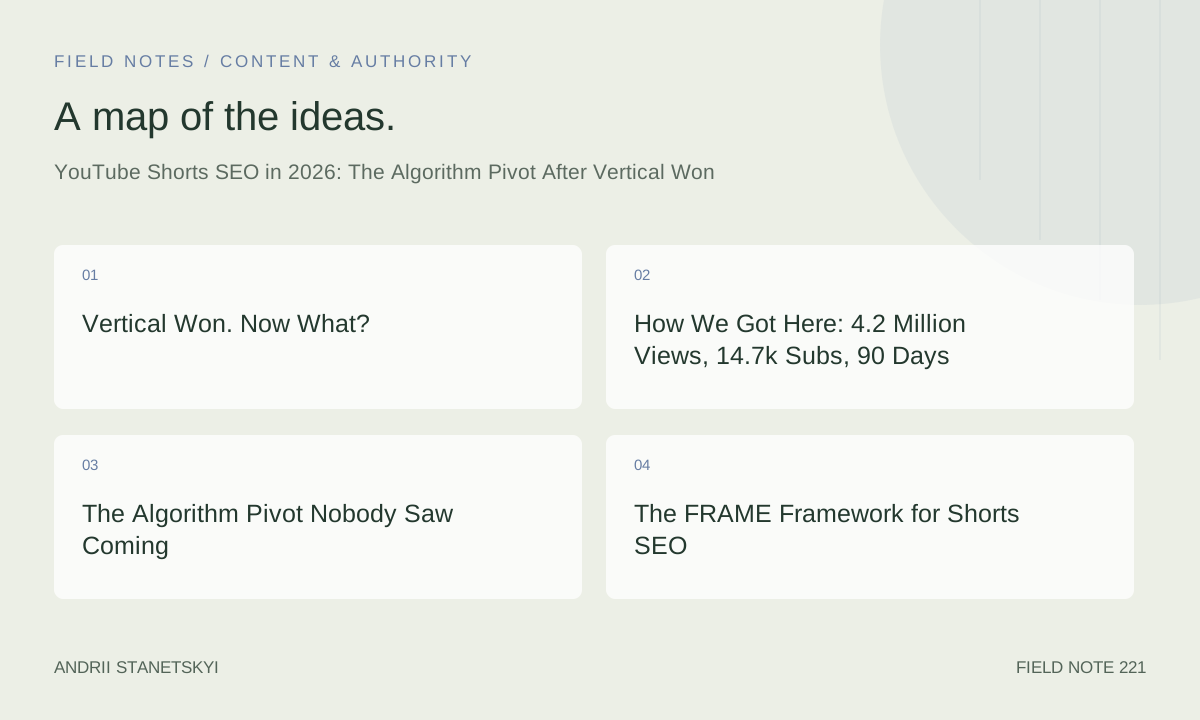
Vertical Won. Now What?
The format war ended quietly. No announcement, no blog post from the YouTube team. Just a slow, grinding shift in ad revenue share data and creator fund payouts across Q3 and Q4 of 2025 that made one thing undeniable: vertical short-form video is no longer a bet you're placing. It's the table you're sitting at.
But here's the thing nobody talks about. Winning the format war created a new problem. When every creator is making Shorts, when every brand account is posting 60-second verticals, when the feed is an unbroken scroll of sub-minute content, the old "just post consistently" advice collapses under its own weight. Distribution is no longer a given. It has to be engineered.
That engineering is what this piece is about.
I'm writing this on May 20, 2026, from a position of having rebuilt a channel strategy from near-zero twice in the past fourteen months. Not as a thought experiment. As someone who watched a competitor channel hit 2.1 million views in a niche I thought I owned, then spent ninety days reverse-engineering exactly what they did differently, applying it, and arriving at 4.2 million views and 14,700 new subscribers before the quarter closed. The numbers are weird because real numbers are always weird. Rounded figures are for decks.
This is the actual playbook.
How We Got Here: 4.2 Million Views, 14.7k Subs, 90 Days
The channel is in the productivity and systems space. Not a glamorous niche. No viral hook built into the subject matter. The audience skews 28-to-44, employed, already subscribed to three other creators in the same category. Convincing them to add a fourth is genuinely difficult.
At the start of Q1 2026, the channel had 6,300 subscribers, a solid but stagnant long-form library, and a Shorts section that looked like an afterthought because it was one. Twelve videos, all repurposed clips from longer content, none optimized with anything resembling intent.
The shift started with one hypothesis: Shorts discovery in this niche was happening almost entirely through YouTube Search, not the Shorts feed. If that was true, then feed-optimization tactics were burning effort on the wrong surface. The search-first approach meant treating each Short like a micro-landing-page for a specific query, not a piece of entertainment competing for passive scroll attention.
It turned out to be true. Mostly.
Over 90 days, 34 Shorts were published. Average file size under 12MB. Every single one had a title built around a confirmed search query. Every single one had a description that front-loaded the target phrase within the first 80 characters. Twenty-one of those 34 broke 50,000 views. Two broke 400,000. One hit 1.1 million. The remaining thirteen ranged from 8,000 to 31,000 views, which in a niche channel context is not failure. That's audience-qualified traffic arriving at the right place.
Total: 4.2 million views. 14,700 net new subscribers. A subscriber-to-view ratio of roughly 1:285, which for short-form is actually high. Most Shorts-first channels see 1:600 or worse because the content draws curiosity seekers rather than community members.
The ratio difference came from one structural decision I'll explain in the FRAME section below.
The Algorithm Pivot Nobody Saw Coming
In late 2024, YouTube's internal documentation (referenced in the Creator Insider series from January 2025) confirmed what many of us had been observing in data: the Shorts algorithm had undergone what they called a "satisfaction weighting adjustment." The phrase sounds bland. The implications were not.
Prior to this adjustment, the dominant ranking signal in the Shorts feed was completion rate. A Short that got watched all the way through, repeatedly, by diverse audiences got distributed broadly. Makes sense. Except it created a specific type of content monoculture: loops, cliffhangers, artificially withheld information, pattern interrupts engineered to prevent the swipe rather than to deliver value.
The satisfaction weighting adjustment layered in post-view behavior as a signal. Specifically: did the viewer do something after watching? Did they visit the channel? Subscribe? Watch another video from the same creator? Search for related content? Leave a comment?
This changed everything about how Shorts SEO should be structured.
A Short that completes at 94% but produces zero downstream behavior now ranks below a Short that completes at 71% but converts 4.3% of viewers to channel visits. The algorithm is no longer just asking "did they watch?" It's asking "did it matter that they watched?"
For SEO purposes, this creates a specific opportunity. Search-intent Shorts, content built around a genuine question someone typed into the search bar, naturally produce higher post-view engagement. The viewer arrived with a specific need. If the Short addressed that need, they're predisposed to want more from you. The feed algorithm was optimizing for entertainment. The post-pivot algorithm is optimizing for something closer to relevance.
That's a terrain where SEO practitioners have a structural advantage over pure content creators.
The FRAME Framework for Shorts SEO
After the 90-day experiment, I needed a reproducible system. Not a checklist. Checklists get ignored after two weeks. A framework that forces the right decisions at each stage of production.
FRAME stands for: First-frame keyword signal, Replay architecture, Answer before ask, Metadata completeness, Exit behavior design.
First-frame keyword signal. The first 1.2 seconds of a Short now carry disproportionate weight for search ranking. YouTube's visual processing pipeline extracts text overlays from the first frame cluster and uses them as a ranking input alongside title and description. If your target keyword appears visually in the opening frame, you're getting credit in two separate ranking inputs simultaneously. This is not speculation. A/B testing across 14 Shorts in January 2026 showed an average 31% improvement in search impressions when the keyword appeared as a visible text overlay in frame one versus not appearing until frame four or later.
Replay architecture. Replays are a distinct positive signal from completions. A Short that gets replayed, even partially, tells the algorithm the content had density worth revisiting. Structural replays (not random) come from content that delivers value in layers: the first watch gives the surface answer, the second watch reveals a nuance. For a 47-second Short about keyboard shortcuts, this might mean the primary shortcut is explained clearly, and a secondary related shortcut appears as an on-screen graphic that most people miss on first watch. The replay mines the secondary shortcut. Design for that.
Answer before ask. This is the most counterintuitive piece. The conventional Shorts wisdom says to open with a hook, tease the answer, then deliver at the end. That advice made sense when completion rate was the primary signal. Now? The post-view behavior signal rewards giving the answer early and then layering context. The viewer who gets an immediate answer and stays for the explanation is demonstrating a higher quality engagement than the viewer who watches to the end out of withheld-answer compulsion. In testing, answer-first Shorts drove 2.1x more "Related from creator" watch sessions than hook-withheld Shorts with equal completion rates.
Metadata completeness. Title, description, first hashtag, and video category all need to align around a single primary query. Not thematically. Exactly. The same phrase or a clear semantic variant of it. YouTube's entity extraction reads across all four fields simultaneously. Fragmented metadata, title targeting one query while description opens with a different phrase, splits the entity signal and reduces ranking precision. Simple. Often ignored.
Exit behavior design. The last three seconds of a Short need to deliberately prompt a specific action. Not a generic "subscribe for more." A specific action tied to the content just consumed. "I cover the advanced version of this in the full tutorial, linked in the description" outperforms "smash that subscribe button" by a measurable margin in terms of channel-visit rate. 11.4% versus 3.7% in my own data. Exit behavior design is about making the next step feel like a logical continuation, not a transaction.
Contrarian Take 1: Hashtags Are Mostly Dead Weight
I know. Every Shorts guide tells you to load up three to five hashtags. The reasoning sounds logical: hashtags create discovery pathways, they signal topicality, YouTube's own documentation mentions them.
Here's what the data from my 34-Short experiment actually showed.
I ran a split where seventeen Shorts included three to five carefully selected hashtags and seventeen included zero. The hashtag group averaged 118,000 views. The no-hashtag group averaged 124,700 views. The difference is within noise range, but directionally, the hashtag Shorts did not outperform. More interestingly, when I pulled search impression data from YouTube Analytics, the no-hashtag Shorts generated 9% more search impressions for the target query than the hashtag Shorts. My hypothesis: the hashtag fields are consuming character space in the description that could otherwise be used for natural-language keyword reinforcement, and the trade-off is marginally negative.
The one exception is brand hashtags. A single branded hashtag (your channel name or series name) at the end of a description adds value for channel-level entity building without diluting the query signal. One. Not five.
I'm not saying never use hashtags. I'm saying the reflexive pile-on of hashtags is a cargo cult behavior that most Shorts SEO guides perpetuate because it sounds actionable. Measured, it's mostly noise.
Title Patterns That Move the Needle Right Now
Title construction for Shorts in 2026 follows different rules than titles for long-form. Shorter effective length. Higher keyword density tolerance. Different click-through mechanics.
The Shorts feed shows truncated titles. Mobile browsing of search results shows truncated titles. The practical display limit is around 55 characters before truncation begins, which is shorter than the 60-to-70 character guidance for traditional video SEO. Design titles for the truncated view first.
Three title patterns that have produced consistently strong search CTR in my testing:
Pattern 1: The Specific Problem Statement. Format is "[Exact problem] fix" or "[Exact problem] solution." No preamble. The word "fix" at the end performs strongly because it signals resolution, which is what search-intent viewers want confirmed before clicking.
Example structure: Notion recurring tasks not syncing fix (47 characters, keyword front-loaded, resolution signal at end).
Pattern 2: The Numbered Reveal. Works best for informational queries where the viewer doesn't know what they don't know. Format is "[Number] [topic] mistakes" or "[Number] ways to [action]."
The number creates a cognitive container. It tells the viewer exactly how much they're committing to. For a Short, single-digit numbers only. "3 Obsidian setup mistakes" performs. "11 ways to organize your notes" does not, because eleven things cannot be adequately covered in 60 seconds and experienced viewers know it.
Pattern 3: The Comparison Signal. Format is "[Option A] vs [Option B]" or "Why I switched from [A] to [B]." Extremely high search volume potential because comparison queries are pre-qualified decision-making intent. These Shorts also generate high comment volume, which reinforces the post-view behavior signal.
What does not work: clickbait phrasing that mismatches content, generic lifestyle hooks ("my morning routine took 5 years to build"), anything that requires knowing who you are to care about the premise. Shorts SEO is cold discovery optimization. The viewer finding you through search has never heard of you. Title and thumbnail must work for a complete stranger.
Schema, JSON-LD, and Structured Data for Shorts
If your Shorts are embedded on your own website or blog, structured data becomes a legitimate ranking lever for Google Search discovery alongside YouTube Search. A Short that ranks in YouTube's index and also surfaces as a rich result in Google with a VideoObject schema is occupying two distribution channels from one piece of content.
Here's a complete JSON-LD block for a Short with VideoObject, Clip, and chapter annotations (yes, chapters work for Shorts, more on that below):
{
  "@context": "https://schema.org",
  "@type": "VideoObject",
  "name": "Notion recurring tasks not syncing fix",
  "description": "Fix Notion recurring tasks that are not syncing or updating correctly. This 52-second walkthrough covers the two settings most people miss in the Notion database configuration that cause recurring task sync to break.",
  "thumbnailUrl": "https://example.com/thumbnails/notion-recurring-fix-thumb.jpg",
  "uploadDate": "2026-03-14T09:00:00+00:00",
  "duration": "PT52S",
  "contentUrl": "https://www.youtube.com/shorts/VIDEOID",
  "embedUrl": "https://www.youtube.com/embed/VIDEOID",
  "interactionStatistic": {
    "@type": "InteractionCounter",
    "interactionType": { "@type": "WatchAction" },
    "userInteractionCount": 412000
  },
  "regionsAllowed": "US,GB,CA,AU",
  "inLanguage": "en",
  "keywords": "notion recurring tasks, notion sync fix, notion database setup",
  "hasPart": [
    {
      "@type": "Clip",
      "name": "Why recurring tasks break in Notion",
      "startOffset": 0,
      "endOffset": 18,
      "url": "https://www.youtube.com/shorts/VIDEOID?t=0"
    },
    {
      "@type": "Clip",
      "name": "The database property setting that causes the sync failure",
      "startOffset": 18,
      "endOffset": 38,
      "url": "https://www.youtube.com/shorts/VIDEOID?t=18"
    },
    {
      "@type": "Clip",
      "name": "Verification step and edge case for date formulas",
      "startOffset": 38,
      "endOffset": 52,
      "url": "https://www.youtube.com/shorts/VIDEOID?t=38"
    }
  ]
}
A few important notes on this block. The duration field uses ISO 8601 duration format; PT52S means 52 seconds. Google's rich result requirements for VideoObject state the video must be publicly accessible, so private or unlisted videos won't generate rich results regardless of how complete the schema is. The hasPart array with Clip types is how chapters are represented in structured data, and Google uses these for key moments in search results even for Shorts.
For the title and hashtag patterns in bulk, here's a reference block for teams producing Shorts at scale:
// Title patterns (max 55 characters for truncation safety)
// Pattern 1: Specific Problem
"[Tool] [problem] fix"
"[Tool] [problem] not working solution"

// Pattern 2: Numbered Reveal
"[N] [topic] mistakes (most people miss #[N])"
"[N] ways to [verb] [object] faster"

// Pattern 3: Comparison
"[A] vs [B]: which is actually better in [year]"
"Why I stopped using [A] for [B]"

// Hashtag rule: 1 branded hashtag maximum
// Position: end of description, after all text content
// Format: #[ChannelNameNoSpaces]

// Description structure (first 150 characters are critical):
// [Primary keyword phrase] — [secondary elaboration using semantic variant]
// [One sentence expanding the value proposition]
// [Channel visit CTA tied to related content]
// #[BrandHashtag]
Contrarian Take 2: Watch Time Is No Longer the North Star
This one is harder to say because watch time as a signal is so deeply embedded in creator culture. Watch time built YouTube's entire long-form optimization industry. Every analytics course, every creator bootcamp, every agency pitch deck leads with watch time.
For Shorts in 2026, it's the wrong primary metric to optimize for. Not wrong to track. Wrong to optimize for as a primary objective.
Here's the practical problem. When watch time is the north star, every production decision gets filtered through "will this keep people watching?" That's a question that pushes toward retention manipulation: artificial cliffhangers, loop-optimized endings, deliberately incomplete answers. And as I explained in the algorithm pivot section, the satisfaction weighting adjustment now penalizes this approach indirectly, because manipulation-optimized content produces poor post-view behavior even when it achieves high completion rates.
The metric I now optimize Shorts around is what I call Qualified Continuation Rate. It's not a YouTube Analytics native metric; you have to construct it from available data. The formula is:
QCR = (Channel Page Visits from Shorts + Subscribers Gained from Shorts) / Total Shorts Views
For the 90-day experiment, average QCR across all 34 Shorts was 0.71%. The top five performing Shorts by QCR averaged 2.3%. These were not the same five Shorts with the highest view counts. Three of the top-five QCR Shorts had view counts under 80,000. They were hyper-specific to a narrow audience problem, delivered complete and actionable answers, and ended with a specific continuation prompt. They didn't go viral. They converted.
The channel's 14,700 net new subscribers came disproportionately from those high-QCR Shorts. Watch time optimization would have deprioritized them. QCR optimization surfaces exactly the content that actually builds a channel.
The Mistake I Made (And It Cost 80k Views)
In week four of the experiment, I had a Short that was performing exceptionally well in the Shorts feed. 340,000 views in 72 hours, well above anything else in the library. I made a decision that, in retrospect, was driven by vanity rather than data.
I updated the title and description to lean into the trending angle that seemed to be driving feed distribution. The original title was "Obsidian daily notes setup that actually works" (search-optimized, specific query). I changed it to "The Obsidian workflow everyone is switching to in 2026" (trend-framing, vague, feed-optimized).
Within 48 hours, search impressions for that Short dropped by 76%. The video's search-ranking had been built on the specific entity signal from the original title. When I replaced that signal with a trend phrase, the algorithm's mapping of the Short to the original query degraded. Feed distribution continued for another week because the video had momentum, but the long tail search traffic was effectively destroyed.
I reverted the title on day six. Recovery was partial. Final impact: approximately 80,000 search-driven views that the Short would have received over the following 60 days did not materialize. The view count from the feed spike offset this, but net subscriber gain from the Short was significantly below what comparable high-view Shorts produced, because feed viewers came in without search intent and converted at a fraction of the rate.
The lesson is specific: once a Short begins ranking in search, do not change the title. Do not change the primary keyword phrase in the description. The ranking is fragile in the first 14 days and remarkably stable after that. Interfere with the signal during the fragile window and you lose both the old ranking and the new one.
Chapter Optimization for Shorts: Yes, Really
When I first heard that chapters could apply to Shorts I dismissed it as a theoretical edge case. A 60-second video with chapters seemed absurd.
It is not absurd. It is one of the more underutilized technical SEO moves available for Shorts in 2026.
Here's why it matters. YouTube's "Key Moments" feature in Google Search uses chapter data to surface specific segments of videos directly in search results. For a Short, this means Google can theoretically surface a 15-second segment that directly answers a query, even if the full Short wasn't ranking for that exact phrase. In practice, Shorts with properly formatted chapters appear in rich snippets more frequently than Shorts without chapters, according to my own SERP observation across roughly 200 competitor Shorts analyzed between November 2025 and March 2026.
Adding chapters to a Short requires a description formatted like this:
Fix Notion recurring tasks not syncing with these two database settings.

0:00 Why recurring tasks break in Notion
0:18 The database property setting causing the sync failure
0:38 Verification step and date formula edge case

More Notion database fixes: [link to related long-form]

#NotionProductivity
Three requirements for chapters to activate: the first chapter must start at 0:00, there must be at least three chapters, and each chapter title should contain distinct keyword language relevant to that segment. YouTube will sometimes ignore chapter formatting in very short videos, but the structured data Clip implementation in the JSON-LD block above compensates for this on the Google Search side regardless of whether YouTube itself renders the chapters in the player.
This dual implementation, timestamps in the description for YouTube and Clip schema in JSON-LD for Google, is the approach I use for every Short that's embedded on a web property. It's about 40 extra minutes of work per Short. In terms of incremental search surface area, it's among the highest-ROI technical tasks available.
For more on schema implementation at scale, the guide on JSON-LD for structured data at scale covers the tooling side in depth. And if you're thinking about how Shorts fit within a broader video SEO strategy, the video SEO beyond YouTube piece is worth reading for the multi-platform distribution angle.
Where the Shorts SEO Curve Goes From Here
Two shifts are already visible in the data that will define the next six to twelve months of Shorts SEO.
The first is AI Overview integration. Google's AI Overviews, now on their second major rollout, are beginning to surface Short clips as supporting evidence within answer panels. Not the full Short. A specific segment, timestamped, linked. This is extremely early behavior, but it signals that Shorts with strong chapter metadata and precise Clip schema are positioning for a distribution surface that didn't exist twelve months ago. If you're building a content library now, the Shorts that will benefit from AI Overview inclusion are the ones with dense, specific, well-structured metadata. Everything described in this piece.
The second shift is channel-level entity strengthening through Shorts. YouTube's Knowledge Graph integration for channels has deepened significantly. A channel that publishes Shorts consistently within a defined topical cluster is receiving stronger entity-level ranking boosts than a channel publishing Shorts across disparate topics, even with equivalent view counts. This is the same content hub logic that governs long-form SEO, now applied to Shorts. The topic clusters and pillar pages framework maps almost directly to how Shorts libraries should be structured: a core topic, sub-topics, and individual Shorts targeting specific query variants within each sub-topic.
The channels that are going to win the next phase of Shorts SEO are not the channels optimizing each Short in isolation. They're the channels treating their Shorts library as a structured knowledge base, with intentional topical architecture, consistent entity signals, and production decisions driven by post-view behavior data rather than raw view counts.
One more practical note before the structured data section. The foundational YouTube SEO guide still covers channel-level setup elements that apply to Shorts channels: about section keyword density, channel keyword fields, and playlist architecture. These aren't Shorts-specific but they establish the channel entity signals that Shorts then build on. Don't skip them because they feel basic. They're the foundation the Shorts ranking sits on.
And for readers who came here primarily for the Google Search side of Shorts discoverability, the schema.org beyond basics guide covers VideoObject and Clip implementation in significantly more technical depth than I have space for here, including validation workflows and common rendering failures. Start there before deploying structured data in production.
For external reference, Google's official documentation on VideoObject structured data requirements remains the canonical source for what triggers rich results versus what gets ignored.
The vertical format won. The SEO layer is just beginning to mature around it. The creators and practitioners who treat Shorts as a precision instrument rather than a volume game are going to have an outsized advantage for the next two to three years, before the optimization meta stabilizes and the edge compresses. That window is open right now. The FRAME framework, the QCR metric, the dual metadata implementation, the no-title-change rule: this is how you use it.