Marketing acronyms get conflated constantly. SEO, SEM, and SMM are treated interchangeably in agency pitches, confused in job descriptions, and misunderstood in budget conversations. The confusion costs money — specifically, the money spent on the wrong channel at the wrong stage of business growth, or the opportunity cost of not understanding how the three channels amplify each other.
This article defines each term precisely, explains what each actually does for a business, maps when each is appropriate, and — most usefully — explains how thoughtful practitioners use all three together to compound results that no single channel produces alone.
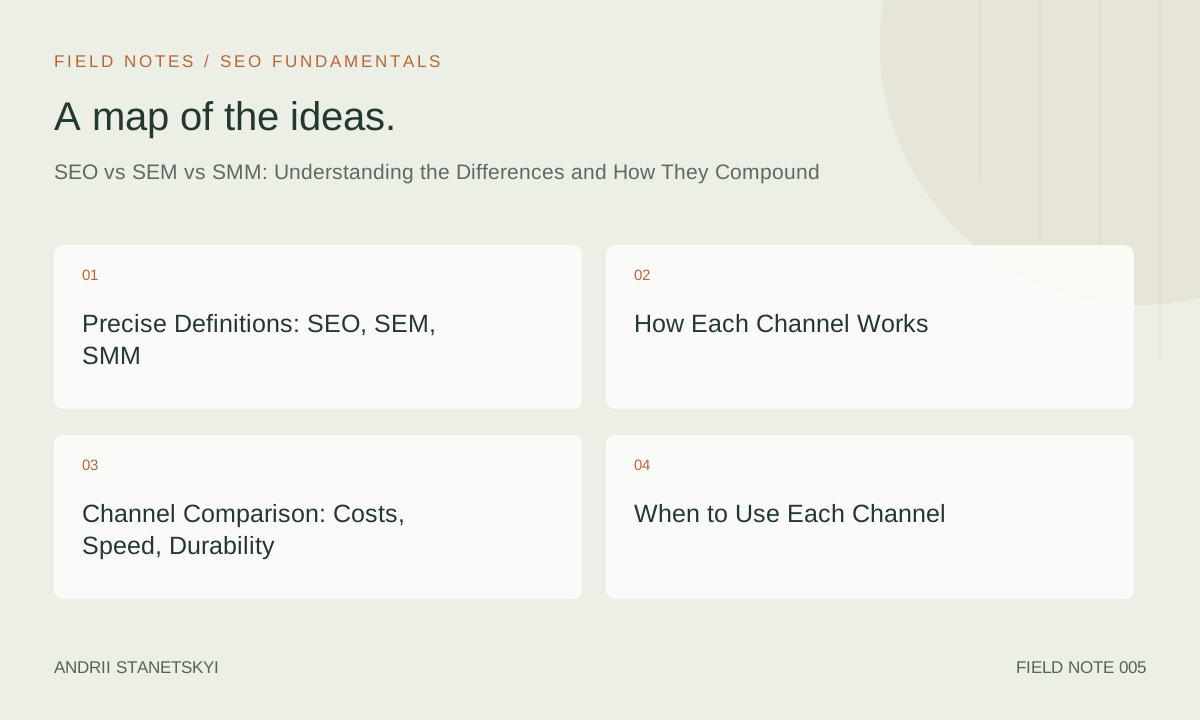
Precise Definitions: SEO, SEM, SMM
SEO: Search Engine Optimization
SEO is the practice of improving a website's visibility in unpaid (organic) search results. When someone types a query into Google, Bing, or another search engine, organic results appear because a search engine's algorithm determined they were the most relevant — not because the site owner paid for placement. SEO is an investment in the platform's trust over time; it generates traffic without a per-click cost once rankings are established.
SEM: Search Engine Marketing
SEM is paid advertising on search engines — primarily Google Ads (formerly AdWords) and Microsoft Advertising (Bing Ads). You bid on keywords; when a user searches that keyword, your ad may appear above the organic results. You pay per click (PPC model) or per thousand impressions (CPM model). SEM traffic stops the moment you stop paying. It's rented visibility, not owned visibility.
Note on terminology drift: SEM historically referred to all search marketing — both paid and organic. In practice, industry usage has shifted so that SEM now almost exclusively means paid search. Some sources still use the original broader definition. In this article, SEM = paid search advertising.
SMM: Social Media Marketing
SMM encompasses both organic social media activity (posting content on Facebook, Instagram, LinkedIn, TikTok, X/Twitter) and paid social advertising (boosted posts, Meta Ads, LinkedIn Sponsored Content). Social media platforms are discovery engines with user intent that's generally lower-funnel than search — users on social are usually not actively looking for a solution to a problem the way a search query implies.
How Each Channel Works
How SEO Works
SEO targets users with expressed intent — someone who typed a query has told you exactly what they want. Your job is to have the best answer when they ask. SEO compounds over time: a well-optimized page can generate traffic for years without additional investment. The mechanism involves technical optimization, content creation, and link acquisition — all signals that help search engine algorithms determine your page's relevance and authority.
Key SEO metrics: organic sessions (GA4), organic click-through rate (GSC), average position (GSC), backlink profile growth (Ahrefs, Semrush), Core Web Vitals pass rate.
How SEM Works
SEM targets users with expressed intent as well — same queries as SEO, different mechanism. You bid on keywords; Google's auction system determines which ads appear and in what position based on bid amount and Quality Score (a function of expected CTR, ad relevance, and landing page experience). Immediately after activating a campaign, your ads can appear for target queries. Immediately after pausing, they stop.
Key SEM metrics: cost per click (CPC), click-through rate, conversion rate, cost per acquisition (CPA), Quality Score, impression share.
How SMM Works
SMM targets users based on demographic, psychographic, and behavioral signals — not search intent. You're interrupting someone's feed with content or an ad. The best social media content earns attention through entertainment, education, or emotional resonance. Organic social reach has declined dramatically on most platforms since 2018; for most businesses, "SMM" in practice means a combination of modest organic presence and paid social amplification.
Key SMM metrics (organic): reach, engagement rate, follower growth, link clicks. Paid social: CPM, CPC, CTR, conversion rate, ROAS (return on ad spend).
Channel Comparison: Costs, Speed, Durability
| Attribute | SEO | SEM (Paid Search) | SMM |
|---|---|---|---|
| User intent | High (active search) | High (active search) | Low-medium (passive browsing) |
| Speed to results | Slow (3–12 months) | Fast (hours to days) | Fast (hours to days) |
| Traffic durability | High (persists after investment) | Zero (stops with budget) | Low-medium (platform algorithm-dependent) |
| Cost structure | Upfront investment, low marginal cost | Ongoing cost per click | Time (organic) or ongoing ad spend |
| Scalability | Moderate (limited by search volume) | High (increase budget) | High (increase budget or content) |
| Brand building | Indirect (visibility over time) | Low | High (direct audience relationship) |
| Audience targeting | Keyword-based intent | Keyword + audience | Demographic + behavioral + interest |
| Platform dependency | High (Google algorithm) | High (Google policy + auction) | Very high (platform algorithm + policy) |
| Best for | Long-term organic growth | Immediate conversions, testing | Awareness, community, remarketing |
When to Use Each Channel
Use SEO When:
- You have a 12+ month horizon — SEO requires patience to pay off
- Your target queries have clear search volume and manageable competition
- You want to build a durable traffic asset that doesn't require ongoing ad spend
- Your industry has meaningful organic search demand (most B2B and B2C categories do)
- You have content resources: writers, subject matter experts, or editorial process
Use SEM When:
- You need traffic and leads now — a new product launch, seasonal campaign, or pre-revenue testing phase
- You want to test keyword-to-conversion rates before investing in SEO for those keywords
- Your organic presence is too weak to rank for high-value commercial queries — SEM buys time while SEO builds
- You have high margin products/services where even expensive CPCs generate positive ROI
- Competitors dominate organic and you need SERP presence regardless
Use SMM When:
- Your product benefits from visual demonstration (apparel, food, home goods, lifestyle)
- You're building brand awareness for an audience that doesn't know they have your problem yet
- You want to remarketing to users who've visited your site (combining social with SEO/SEM-acquired traffic)
- Your audience is actively engaged on specific social platforms (B2B → LinkedIn; consumer → Meta/TikTok)
- You have community-building or customer retention goals beyond direct acquisition
How SEO, SEM, and SMM Compound
The highest-performing digital marketing programs don't choose one channel — they design the three channels to reinforce each other. Here's how that works in practice.
SEM Data Informs SEO Strategy
Before investing 6 months in SEO content for a keyword, run SEM ads on that keyword for 30 days. You'll get real conversion data: does this query actually convert for your business? What landing page copy resonates? What CPC does the market support? SEM is the fastest way to validate keyword-to-conversion assumptions before committing SEO resources.
Concrete example: an e-commerce brand runs Google Ads on 20 target keywords for 30 days. 6 convert at positive ROI; 14 don't. The SEO team now knows to focus content and link-building investment on the 6 that actually convert — not spread effort across all 20 based on search volume alone.
SEO Reduces SEM Costs Long-Term
As organic rankings improve, you can reduce paid bids on those keywords. For many businesses, SEO effectively "retires" paid spend on specific queries over time. A keyword that cost $4.50 CPC in paid search becomes free traffic once your organic result consistently appears at position 1–3.
SMM Builds Brand Signals That Help SEO
Branded search volume — the number of people who search for your company name directly — is a quality signal Google has confirmed using. A strong SMM presence that grows brand recognition increases branded search volume, which strengthens the overall entity signals for your domain. Social content also generates organic links when it goes viral or gets referenced by publishers.
SEO Content Fuels SMM
Long-form SEO content can be repurposed into social content: key statistics become infographic posts, how-to sections become carousel posts, expert quotes become pull quotes. This extends the ROI of content investment and keeps social feeds active without requiring entirely separate content creation budgets.
Remarketing Connects All Three
A user discovers your brand through an SEO blog post. They don't convert. A paid social ad (SMM) retargets them with a product-specific offer. They click but still don't buy. A Google remarketing ad (SEM) appears when they later search a related term. They convert. This multi-touch sequence — SEO awareness, SMM remarketing, SEM bottom-funnel — is how modern acquisition funnels actually work for most e-commerce and lead-gen businesses.
See building a full-funnel SEO content strategy for how to structure content across funnel stages.
Budget Allocation Frameworks
There's no universal split that works for every business. But there are useful frameworks for common business stages.
Early-Stage Business (Under 12 Months Old)
SEO requires authority that takes time to build. A brand-new site competing organically is starting from zero. Typical allocation: 60–70% SEM and paid social (for immediate traffic and testing), 20–30% SEO (building the foundation — technical setup, core pages, initial content), 10% organic SMM (building audience).
Growth-Stage Business (1–3 Years, Established Product-Market Fit)
SEO is beginning to generate results. Start reducing paid spend on keywords where organic is ranking. Typical allocation: 40% SEO (aggressive content and link building), 35% SEM (maintaining presence on high-value commercial queries, testing new keywords), 25% paid and organic SMM.
Mature Business (3+ Years, Strong Domain Authority)
SEO is the primary traffic driver. Paid search is targeted and surgical. Typical allocation: 50–60% SEO (maintenance + expansion), 20–25% SEM (high-intent commercial terms, branded defense, competitor campaigns), 15–20% SMM.
For a complete strategic planning approach, see building your first SEO strategy: a step-by-step framework.
FAQ
Is SEM the same as PPC?
In common usage, SEM and PPC (pay-per-click) are often used interchangeably to mean paid search advertising. Technically, PPC is a billing model (you pay per click, not per impression), while SEM is the broader category of paid search marketing. All PPC on search engines is SEM; not all SEM is technically PPC (some use CPM billing). In practice, when someone says "SEM" or "PPC" they almost always mean Google Ads campaigns.
Can social media directly help SEO rankings?
Social signals (likes, shares, followers) are not direct Google ranking factors — Google has confirmed this. However, social media activity can indirectly support SEO by: generating links (content that gets shared widely earns editorial links), increasing branded search volume (which strengthens entity signals), and driving traffic to pages (engagement signals). The relationship is indirect but real.
Should I pause SEO if SEM is working?
No. SEM working is a signal that the market exists and converts — it's the strongest argument for accelerating SEO investment, not pausing it. Every query you're paying $3, $5, or $15 per click for is a query you could be getting organically for free if you had rankings. SEM success validates the SEO opportunity.
How do I know if I should invest more in SEO or SEM?
Look at the competitive landscape of your target queries. If the organic results are dominated by sites with Domain Rating (Ahrefs) of 70+, it will take years of SEO investment to compete organically. SEM is more appropriate while you build authority. If organic results include sites with DR 30–50 and your domain is close, SEO investment will deliver better long-term ROI than paid.
What's the biggest mistake businesses make choosing between these channels?
Treating them as mutually exclusive. The framing "should we do SEO or paid search?" is almost always the wrong question. They serve different time horizons and funnel stages. The right question is: "Given our current domain authority, conversion goals, and budget, what's the right ratio between these channels today — and how should that ratio change over the next 12–24 months?"
Is organic social media dead?
For most business categories, organic social reach has declined to the point where it's a poor primary acquisition channel. Average organic reach on Facebook pages is under 5% of followers. TikTok still offers algorithmic distribution that doesn't require a large existing following — making it the current exception. Organic social is valuable for community building and brand maintenance, not for primary traffic acquisition in most categories.
Key Takeaways
- SEO = unpaid search visibility; SEM = paid search advertising; SMM = social media marketing (organic + paid).
- SEO and SEM both target high-intent search users; SMM targets passive social browsers.
- SEO is slow and durable; SEM is fast and stops when you stop paying; SMM sits between both depending on organic vs paid.
- The highest-performing programs use all three together: SEM validates keywords for SEO, SEO reduces SEM costs long-term, SMM builds brand signals that reinforce SEO.
- Budget allocation should shift toward SEO as domain authority grows — early stage businesses need more SEM to bridge the gap.
- Remarketing connects all three channels into a multi-touch acquisition sequence.
- Social signals don't directly influence Google rankings, but social activity indirectly supports SEO through links and brand search.
Conclusion
SEO, SEM, and SMM are not competing alternatives — they're complementary channels that work best when they're deliberately designed to reinforce each other. The business that runs SEM to validate keywords, uses those data points to prioritize SEO investment, and uses social to build brand recall that supports both, will consistently outperform the business that treats channel selection as an either/or decision. Understand what each channel does, what it costs in time and money, and what it can't do — then build the allocation that fits your specific business stage and competitive position.