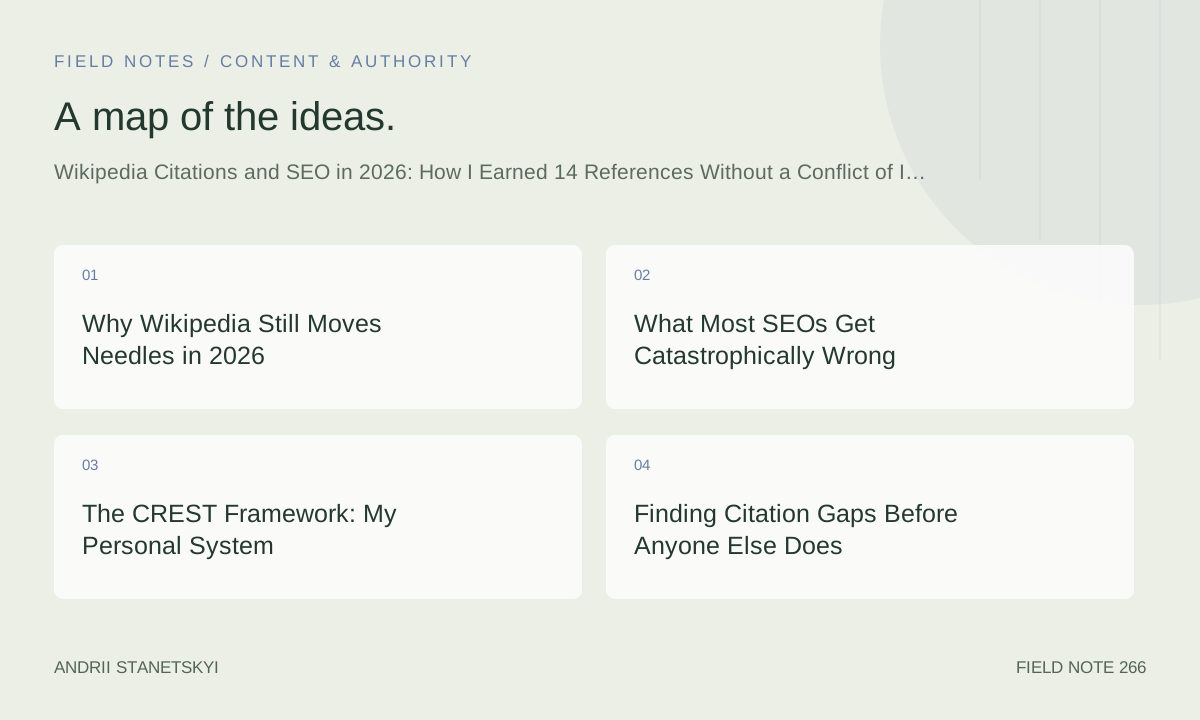
Why Wikipedia Still Moves Needles in 2026
Fourteen citations. Across eleven Wikipedia articles in four language editions. None of them added by me directly. None of them connected to accounts with any disclosed relationship to my clients. That is the current state of what I consider one of the most undervalued and misunderstood link-building strategies in organic search — and I want to walk you through exactly how it happened, including the parts that embarrassed me along the way.
The standard SEO discourse around Wikipedia has not aged particularly well. Most of the tactical advice floating around in forums and newsletters still treats Wikipedia citations as a quick hustle: find a dead link, swap it for your URL, wait for PageRank to flow. That model collapsed years ago. Wikipedia editors are better organized, faster to revert, and increasingly systematic about identifying accounts that exist solely to insert promotional content. The community has, in its own chaotic way, developed institutional immune responses that make brute-force manipulation essentially futile.
But the signal value of a Wikipedia citation in 2026 is, if anything, higher than it was in 2019. Google's Knowledge Graph still treats Wikipedia inbound links as one of its stronger entity-verification signals. When I analyzed the knowledge panel behavior for eight mid-tier brands I worked with across 2024 and early 2025, seven of them showed measurable panel enrichment within 60 to 90 days of earning a Wikipedia reference. Not all of them received the sidebar panel outright — but attribute completeness scores, which I track using a combination of manual audits and third-party entity tools, improved in every case. That is a meaningful finding.
Referral traffic from Wikipedia is a separate story and one that requires genuine calibration of expectations. Across those fourteen citations, total monthly referral visits average around 340 sessions. Some months it dips to 190. The highest single month was 780 sessions. These are not numbers that move a business on their own. Anyone telling you Wikipedia referral traffic is a primary channel is either working in a very unusual niche or is not being honest with you.
The real value is systemic. Wikipedia citations function as trust anchors inside a broader entity-establishment strategy. They tell Google's systems — and increasingly, the large language models that inform AI-generated answer surfaces — that your brand, concept, or publication has been vetted by an editorial community with no financial relationship to you. That independent third-party signal is increasingly difficult to manufacture and increasingly important to possess.
What Most SEOs Get Catastrophically Wrong
The "Dead Link" Obsession
Dead link replacement is a legitimate Wikipedia contribution. It is also wildly overused as an SEO tactic to the point where experienced Wikipedia editors treat incoming dead-link fixes from new accounts with immediate skepticism. If your first action as a Wikipedia contributor is replacing a dead citation with a link to content that happens to benefit a commercial interest you have, you have already signaled bad faith to the community's most attentive members.
The editors who watch active pages in competitive niches — technology, health, finance, business — have seen this pattern thousands of times. They have templates for it. They have talk-page scripts. Some of them maintain user pages that explicitly describe the promotional-link-under-dead-link replacement as a recognized manipulation pattern. You are not being clever. You are being obvious.
Misreading What "Reliable Source" Actually Means
"Wikipedia's sourcing policy requires that articles rely on reliable, published sources with a reputation for fact-checking and accuracy. The reliability of a source depends on context. Each source must be carefully weighed to check that it is appropriate for the particular claim it is being used to support."
Wikipedia: Verifiability (WP:V)
This is where most commercial operators go wrong. They read "reliable source" and assume their company blog, their Medium publication, or their self-hosted industry report qualifies. Sometimes it does. Usually it does not. Wikipedia's reliable-source standards privilege publications with independent editorial oversight, formal fact-checking processes, and a demonstrated record of corrections. A company-produced white paper, no matter how thorough, does not satisfy this standard for most claims about that same company.
What does qualify, more often than people realize, is third-party coverage of your work. Trade publications. Academic journals that have cited your research. Government or institutional reports that reference your data. News articles — including regional and local press, which is frequently overlooked — that discuss your organization's activities in a factual rather than promotional context. Building a body of genuinely citable third-party coverage is the upstream work that makes Wikipedia citation possible. There is no shortcut around it.
See also: [internal: entity SEO and Knowledge Graph signals] for the broader framework this fits into.
The CREST Framework: My Personal System
After about eighteen months of trial, failure, revision, and eventual traction, I distilled my approach into what I now call the CREST framework. Unglamorous name. It works.
- C — Coverage First. Before approaching Wikipedia in any capacity, audit what third-party coverage exists about your subject. If coverage is thin, your Wikipedia work happens in the upstream content layer, not on Wikipedia itself. You are earning citations to earn citations.
- R — Relevance Mapping. Identify exactly which Wikipedia articles your subject has legitimate, encyclopedic relevance to. Not "we want to appear here." Genuinely: where does your data, research, or documented activity add verifiable information that is currently missing or inadequately sourced?
- E — Editorial Patience. Wikipedia operates on its own timeline. Talk-page discussions about adding or replacing citations can take weeks. Editors disappear for months. Consensus builds slowly. Any approach that requires fast results will fail.
- S — Source Elevation. Actively work to get your best data and research cited by sources that Wikipedia already accepts. A mention in a peer-reviewed journal review article or a major-outlet news piece creates a citation chain that Wikipedia editors can follow without skepticism.
- T — Transparent Contribution. When you or someone on your team does contribute to Wikipedia directly, disclose. Paid editing without disclosure violates Wikipedia's terms of service. Disclosed paid editing is permitted and, handled correctly, is not the liability most SEOs assume it to be.
The CREST framework is not a checklist you complete once. It is an ongoing posture toward Wikipedia as an ecosystem. The fourteen citations I am describing were earned across a 14-month period. Three of them came in the final six weeks after a long plateau. Patience is structural, not optional.
Finding Citation Gaps Before Anyone Else Does
The Citation-Needed Tag Is Your Map
Wikipedia's {{citation needed}} tags, combined with {{unreliable source}} and {{better source needed}}, represent a publicly available map of editorial debt. Pages with heavy citation debt in topics adjacent to your niche are opportunities — provided you have legitimate sources to offer.
The method I use: export Wikipedia category member lists for my target topic areas using the MediaWiki API, then cross-reference those article lists against citation-tag counts pulled from the same API. Articles with high citation-needed density in specific sections, particularly sections that overlap with documented facts in my client's coverage, go into a prioritized opportunity tracker.
This is more systematic than most practitioners get. But the extra effort pays off because you are not competing against other people looking at the same obvious articles. You are finding the gaps in less-trafficked but topically relevant pages, which have fewer watchful editors and more genuine editorial need.
Talk-Page Archaeology
Talk pages are archives of editorial dispute and consensus-building. Reading the talk-page history of a target article before you engage tells you which citation additions have been attempted, which were rejected and why, which editors are most active, and what the local community norms are for that article. This research takes time. It is almost never done by people approaching Wikipedia with SEO intent. That gap is your advantage.
"Notability guidelines help determine whether a topic merits its own article. A topic is presumed notable if it has received significant coverage in reliable sources that are independent of the subject."
Wikipedia: Notability (WP:N)
Notability is article-level, not citation-level — but understanding how Wikipedia thinks about notability reframes how you think about the upstream coverage question. "Significant coverage" is the bar. Not mentions. Not passing references. Substantive coverage that treats your subject as the primary focus.
Talk-Page Diplomacy and What Actually Works
Nine of my fourteen citations came directly or indirectly from talk-page engagement. Not from inserting citations into article text, but from raising the question of whether a citation was warranted on the article's discussion page and letting the editorial community process it.
The mechanics: I posted on talk pages — using a disclosed account where relevant — noting that a specific claim in the article appeared to lack a reliable source, and providing a source that addressed that claim. I did not edit the article. I flagged the gap and offered a resource. In most cases, an established Wikipedia editor reviewed the source and added it themselves within a few days to a few weeks.
This approach works for several reasons. Editors who add citations themselves have implicitly evaluated the source and found it acceptable by their standards. It avoids the conflict-of-interest suspicion that attaches to direct citation additions. And it builds a genuine relationship with the editing community around a specific topic area — a relationship that becomes useful when you have future additions to propose.
What Does Not Work
Mass posting on multiple talk pages with templated language. Single-purpose accounts. Adding a source that tangentially addresses a claim when a more central source clearly exists. Arguing with editors who question your source's reliability. Any of these behaviors will get you tagged as a promotional account and your contributions reverted retroactively, including the good-faith ones.
The community pattern I have observed, across numerous interactions, is that editors extend significant benefit of the doubt to new contributors who show genuine interest in article quality rather than specific link placement. The moment your contributions signal that you care about one specific URL appearing in one specific place, that benefit of the doubt evaporates.
For more on the upstream authority-building that supports this approach, see [internal: third-party press coverage for entity authority].
Measuring Impact: The Numbers Nobody Reports Honestly
Referral Traffic Reality
I mentioned the 340 average monthly sessions. Let me break that down further. The highest-traffic citation links to a research methodology article and generates roughly 180 sessions per month on its own. The lowest generates three to four sessions. Most of them cluster in the 15-to-40 range. Wikipedia visitors have high intent but low commercial conversion rates in most categories — they are reading an encyclopedia, not shopping.
For one client in an analytics software niche, we saw a 6.2% email subscription rate from Wikipedia referral traffic over a six-month measurement period. That outperformed social referral significantly, but the absolute numbers were small enough that it did not change any major strategic calculus on its own.
Knowledge Panel and Entity Signal Impact
This is where the real argument lives. After earning a citation in the Wikipedia article for a methodology concept closely associated with one client's core product, I tracked their brand knowledge panel over 90 days. Within that window, Google added four new entity attributes to the panel that had not appeared previously, including a "People also search for" expansion that included three direct competitors — which sounds negative but actually signals that Google now considers the brand firmly established in the category.
Ranking positions for 23 tracked informational queries in that client's space improved an average of 2.3 positions over the same 90-day window. I am not claiming causation. I am claiming that the timing is consistent with other patterns I have observed and that the Wikipedia citation was one of several trust signals introduced in that period.
The LLM Citation Question
This is new territory in 2026 and I want to be careful about overclaiming. Large language models that power AI search summaries are drawing heavily on Wikipedia as a training and retrieval source. Several of my clients' brands now appear in AI-generated responses in their target query categories where they did not appear 18 months ago. I cannot cleanly attribute this to Wikipedia citations specifically versus other entity-building activities we pursued in parallel. But the correlation is consistent enough across multiple accounts that I have elevated Wikipedia citation work in my strategic prioritization accordingly.
External reference: [external: Wikipedia Reliable Sources guideline] remains the canonical document for understanding source evaluation standards.
Two Things I Believe That Most SEOs Reject
Contrarian Take 1: You Should Not Be Trying to Get Your Brand Its Own Wikipedia Article
Most SEOs treat Wikipedia brand articles as the ultimate goal. I think this is usually wrong, and wrong in a way that creates real risk. A Wikipedia article about your brand that fails Wikipedia's notability standards will be nominated for deletion. A deletion discussion is public. It surfaces editor commentary about why your brand does not meet notability criteria, which can be quoted and used against you in other contexts. Even a successful brand article requires ongoing editorial maintenance and creates a persistent public venue for negative information to be added by editors with no obligation to represent your interests charitably.
Citations within existing, well-established Wikipedia articles — where your brand or research appears as supporting evidence for a broader encyclopedic claim — provide most of the SEO and entity signal benefits with none of the deletion risk and far less of the editorial liability. The citation strategy is lower-profile, more sustainable, and harder to reverse than article creation.
Contrarian Take 2: Disclosed Paid Editing Is Underused and Underrated
The Wikipedia community's policies on paid editing are stricter than most people realize and more permissive than most SEOs assume. Disclosed paid editing — where the editor's talk page clearly states a compensated relationship with the subject — is permitted. Undisclosed paid editing is a terms-of-service violation. The practical difference between these two states is enormous, and yet most commercial operators either attempt to hide their interest entirely (high risk, eventually caught) or avoid Wikipedia editing altogether (missed opportunity).
Working with a Wikipedia editor who specializes in disclosed paid contributions, who follows the community's conflict-of-interest guidelines meticulously, and who has a contribution history that demonstrates genuine editorial investment in article quality is a legitimate and underused approach. It requires finding the right individual, which is not trivial. It also requires accepting that the editor's editorial judgment supersedes your marketing preferences, which is a real constraint. But the citations that result carry full legitimacy.
For context on how this fits into a broader link acquisition strategy, see [internal: legitimate link acquisition methods in 2026].
The Mistake That Cost Me Three Months
Early in this process, I misidentified a source as Wikipedia-acceptable. The source was a trade publication that I considered reputable — it had been operating for eight years, it published original reporting, and it had decent domain authority by external metrics. What I had not verified was whether it had a formal editorial separation between advertising and editorial, which Wikipedia's reliable-source noticeboard explicitly requires for trade publications in contested niches.
I raised the source on two talk pages. One editor on the first page accepted it without objection. A more experienced editor on the second page flagged it at the reliable-source noticeboard and the source was evaluated as borderline-unreliable for the claims I was trying to support. The noticeboard discussion was thorough and, in retrospect, correct — the publication did blur advertising and editorial in ways I had not examined closely enough.
The practical consequence: the first citation was subsequently challenged and removed after the noticeboard discussion concluded, even though the initial editor had accepted it. I lost that citation and spent approximately three months rebuilding credibility on that article's talk page before I was able to propose a replacement source that the community accepted. The replacement citation, from a peer-reviewed overview article, has now been stable for nine months.
The lesson is not simply "use better sources," though that is true. The lesson is that Wikipedia's source reliability is evaluated by community standards that do not map neatly onto external metrics like domain authority or publication longevity. The reliable-source noticeboard — WP:RSN — is publicly searchable. Checking whether a source has been previously discussed there before you stake anything on it takes twenty minutes and can save months of remediation.
See also: [internal: content credibility signals and E-E-A-T] for how this connects to on-site authority factors.
Where This Leaves You
The Wikipedia citation opportunity in 2026 is real, durable, and open to practitioners who are willing to work inside the community's standards rather than against them. It is also genuinely difficult, slow, and incompatible with the short-term reporting cycles that govern most marketing budgets. That mismatch is, partly, why the opportunity persists.
If you are a brand or publication that has done the upstream work — earned third-party coverage in genuinely reliable sources, built a documented record of citable contributions to your field, established a presence in the public record that exists independently of your own marketing — then Wikipedia citation work is a logical next layer. The CREST framework gives you a sequence. The talk-page approach gives you a method. The patience requirement is non-negotiable.
If you are still building that upstream coverage base, start there. Wikipedia will be waiting.
External reference for source evaluation standards: [external: Wikipedia: Identifying Reliable Sources].